
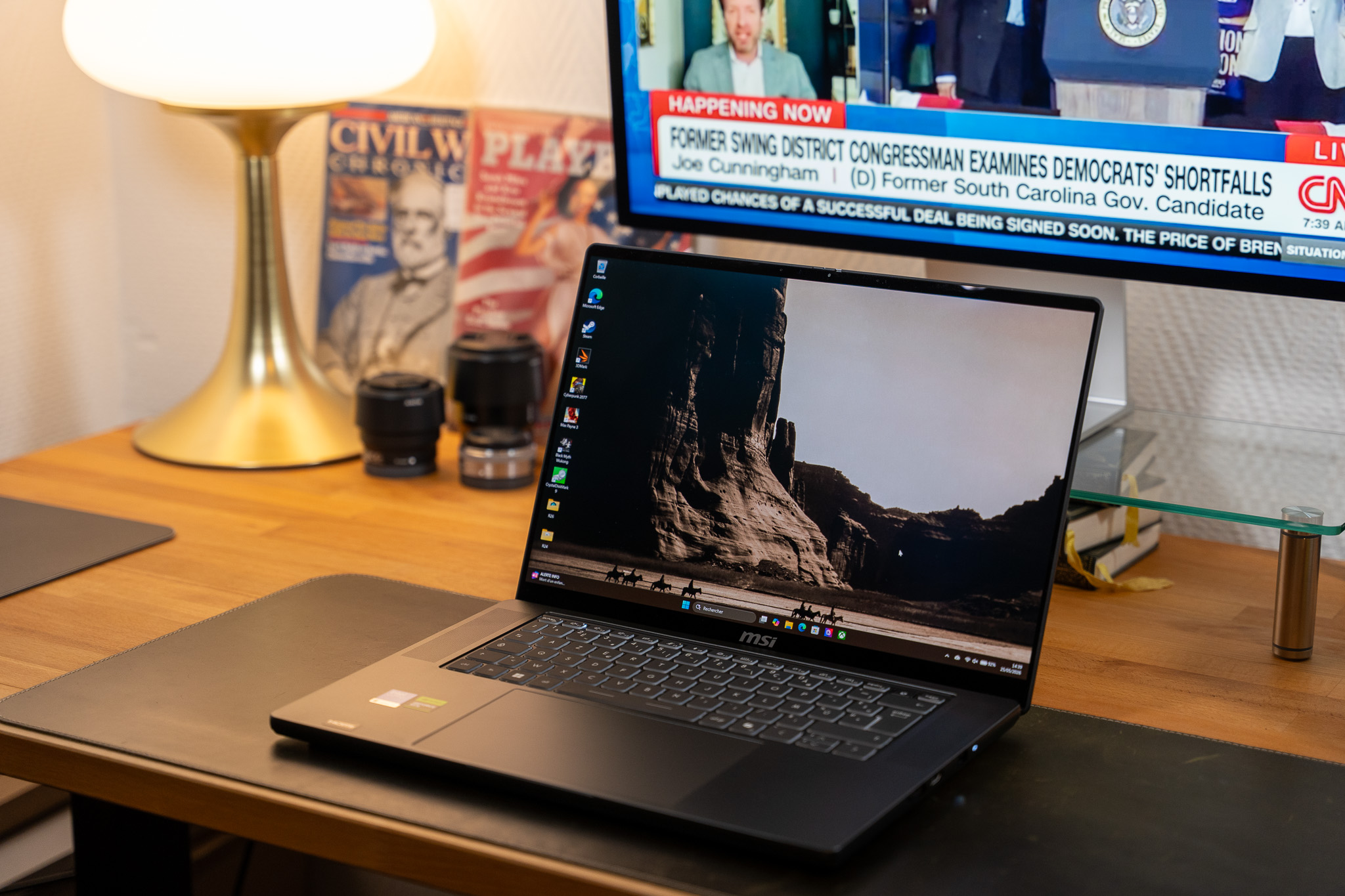
Presented at CES 2026, the new Stealth 16 AI+ marks the arrival of a chassis that is more rounded and less gamer-styled for MSI. Behind this softened design lies a muscular setup, powered by an Intel Core Ultra Panther Lake processor and a GeForce RTX 5000. Could it rival the iconic Blade 16 from Razer? The answer in this test.
7 / 10
- RTX 5080, formidable even when compact
- Reactive OLED screen and well calibrated
- The new rounded design
- Cheaper than its direct competitors
- A 9 Ultra core atone
- Thermal throttling in gaming
- Chassis feels soft, creaks under pressure
- Battery life far from promises (6 hours)
This 16-inch gamer is “slim and light” (understood as being more compact than the Raider models MSI also offers). It competes in a crowded market segment. Right up against it stand several heavyweights like the excellent Razer Blade 16, the well-regarded ASUS ROG Zephyrus G16, or, to a lesser extent, the Acer Predator Helios Neo 16S AI. Fine, even very good models capable of appealing to both gamers and creative users.
What does the MSI Stealth 16 AI+ actually deliver? That’s what we’re about to explore, but first, here is the technical sheet of the model MSI France lent us:
In this configuration, the MSI Stealth 16 AI+ carries a recommended price of 3999 euros. A slightly cheaper version exists in France, this time with an RTX 5070 Ti at the helm.
Design: a chassis with room for improvement, but all-rounded
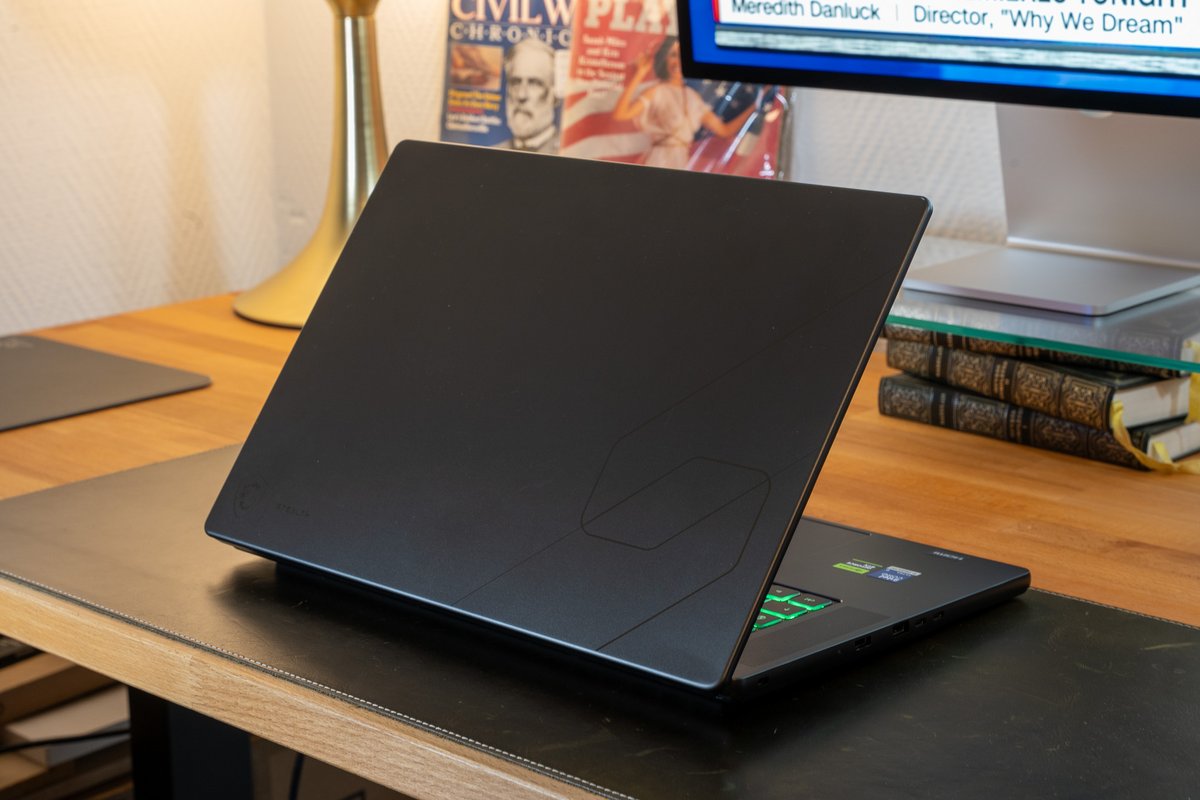
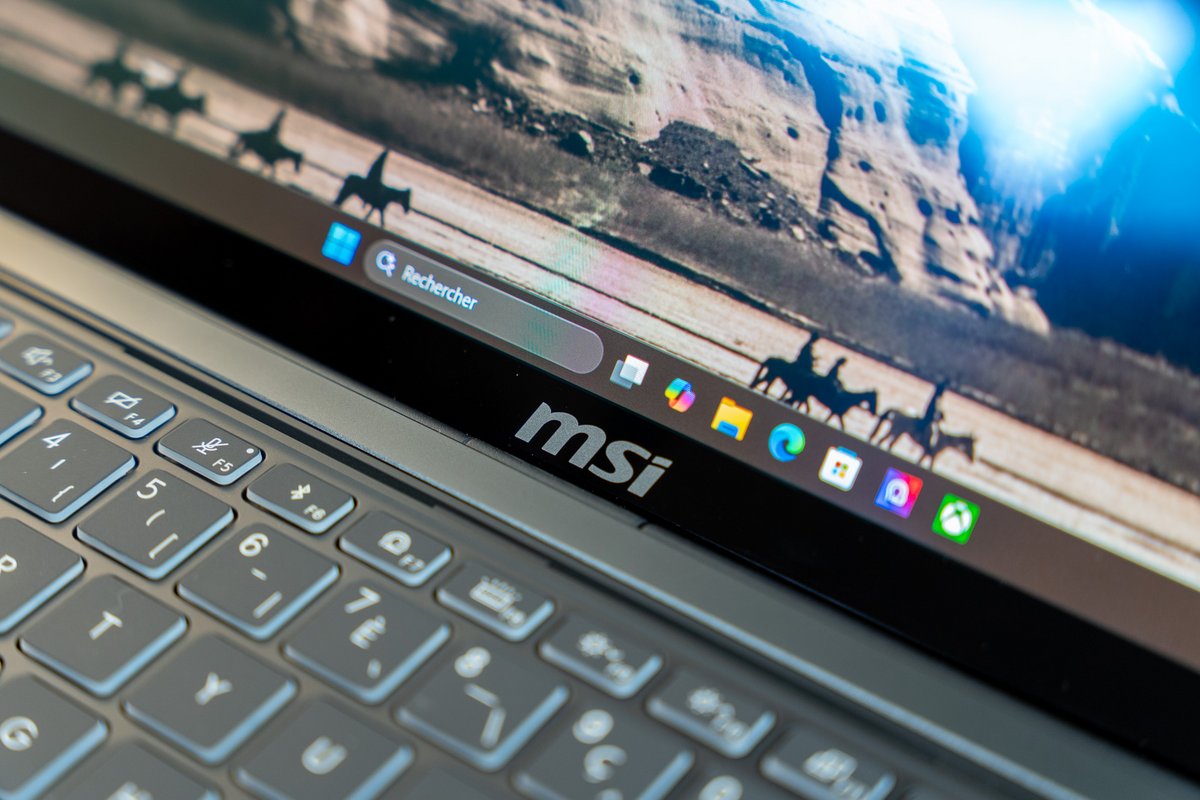
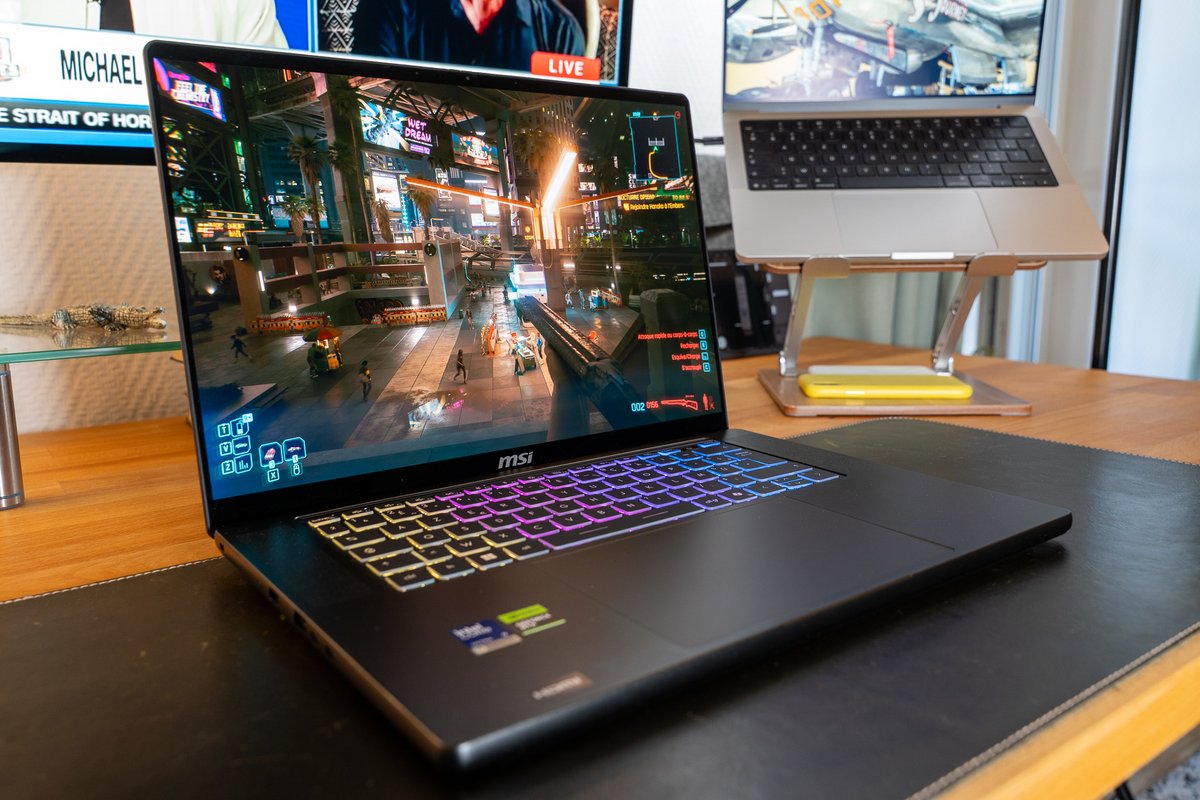
The adjective “compact” fits MSI’s 16-inch Stealth 16 AI+ fairly well. At 354 x 246 x 19.99 mm and 1.99 kg, the device is a touch thicker, but lighter than the latest Blade 16. Its dimensions are also in line with the ROG Zephyrus G16 2026, or the Acer Predator Helios Neo 16S AI discussed earlier. In this regard, MSI matches its rivals, while giving this new model a softer look that is even less “gaming” in style than its competitors.
The device could easily be branded as “MSI Prestige” given how its lines allow it to travel incognito. The chassis, plump and rounded, gives this model a friendly, unthreatening air far from the aggression typical of gaming laptops. The Stealth 16 AI+ is therefore as “stealthy” as its name suggests, and that’s perfectly fine.
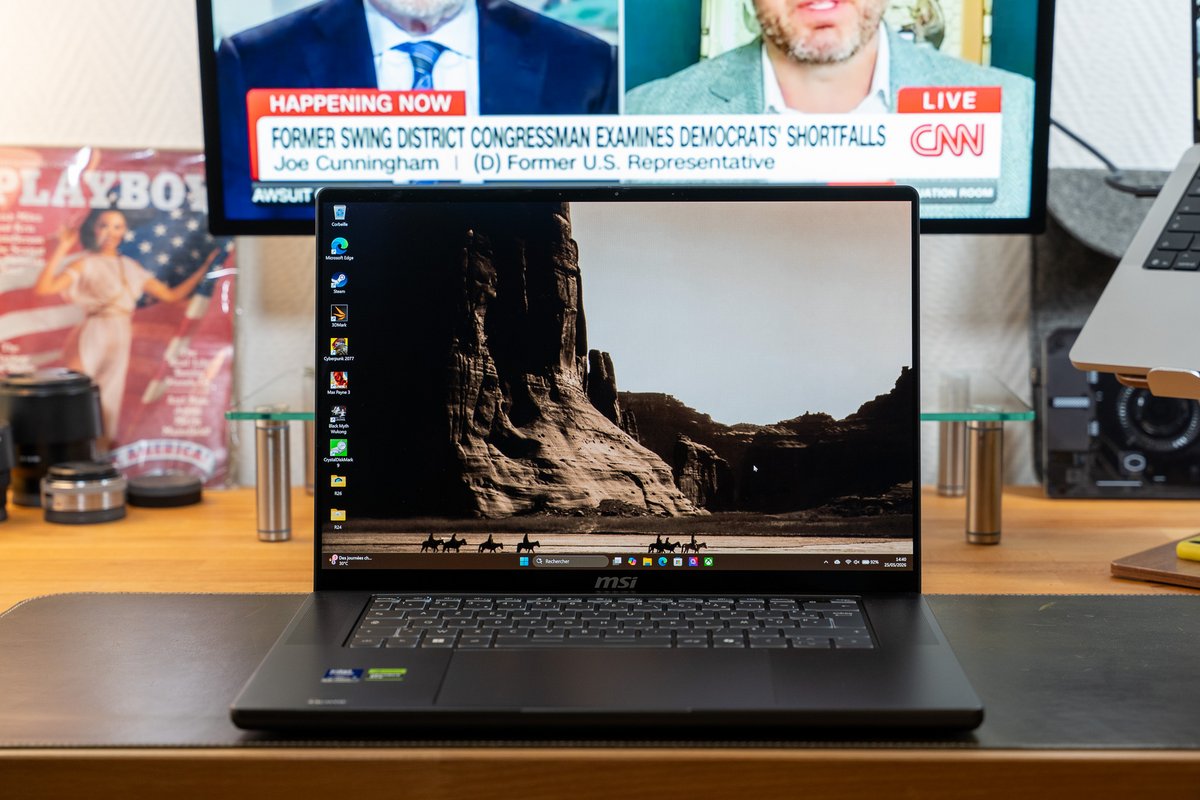
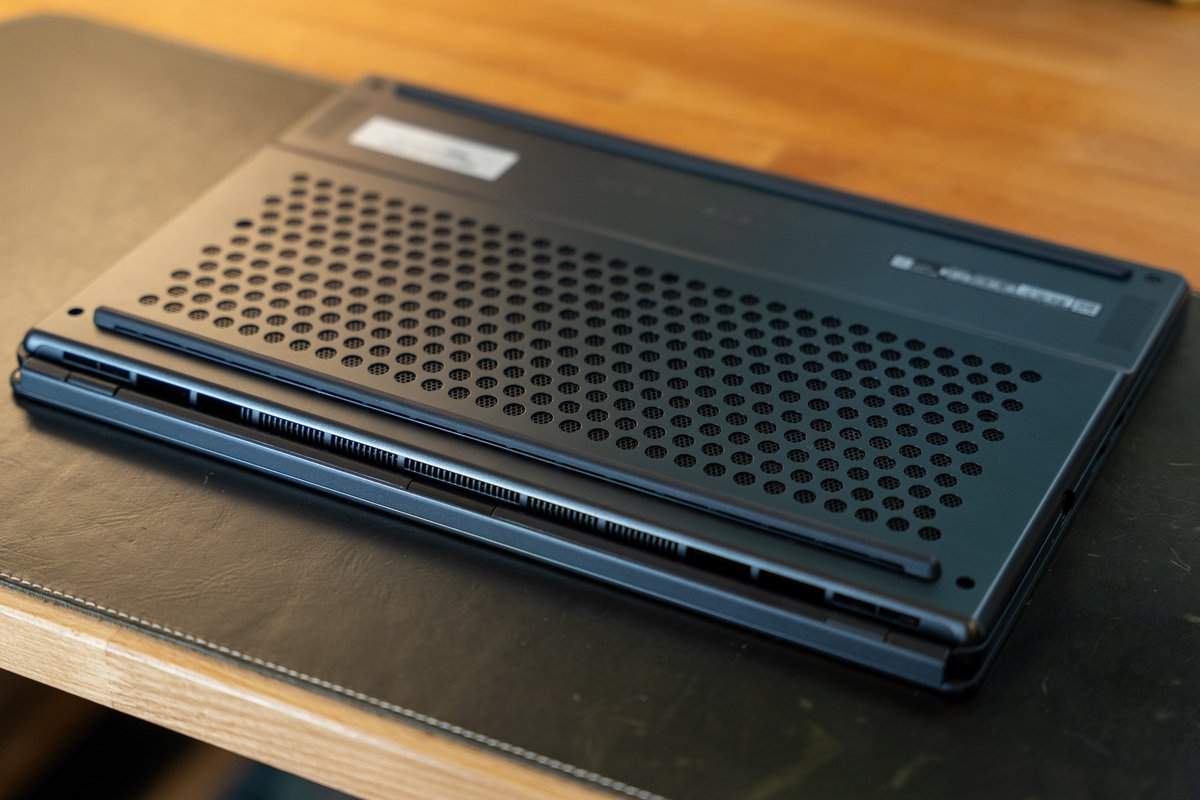
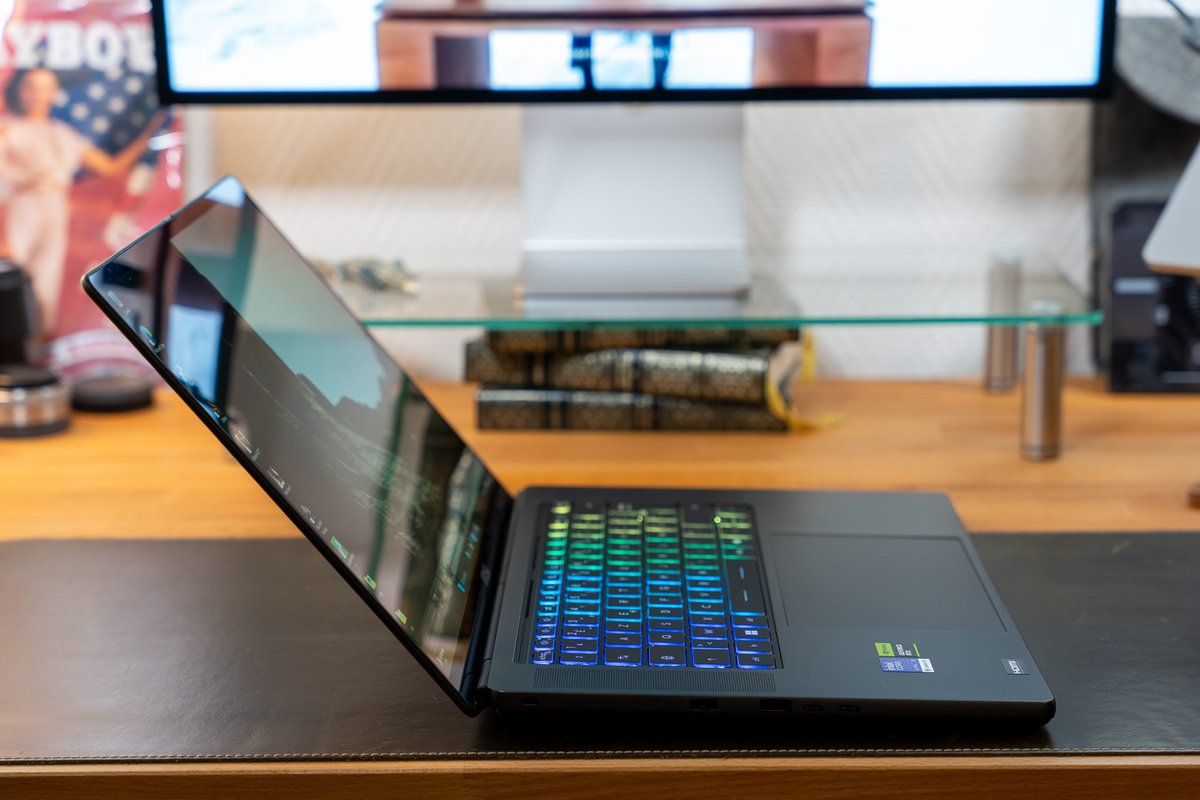
Construction quality, however, is a point of disappointment. ASUS and Razer models don’t have to worry, as our Stealth doesn’t stand on the same level. The device lacks rigidity. Instead of being carved from a single block, like a unibody, its aluminum chassis twists too easily and creaks under the touch. It doesn’t convey the solidity one would hope for. The matte black finish MSI chose is elegant but smudge-prone… and thus perpetually dulled by countless fingerprint marks.
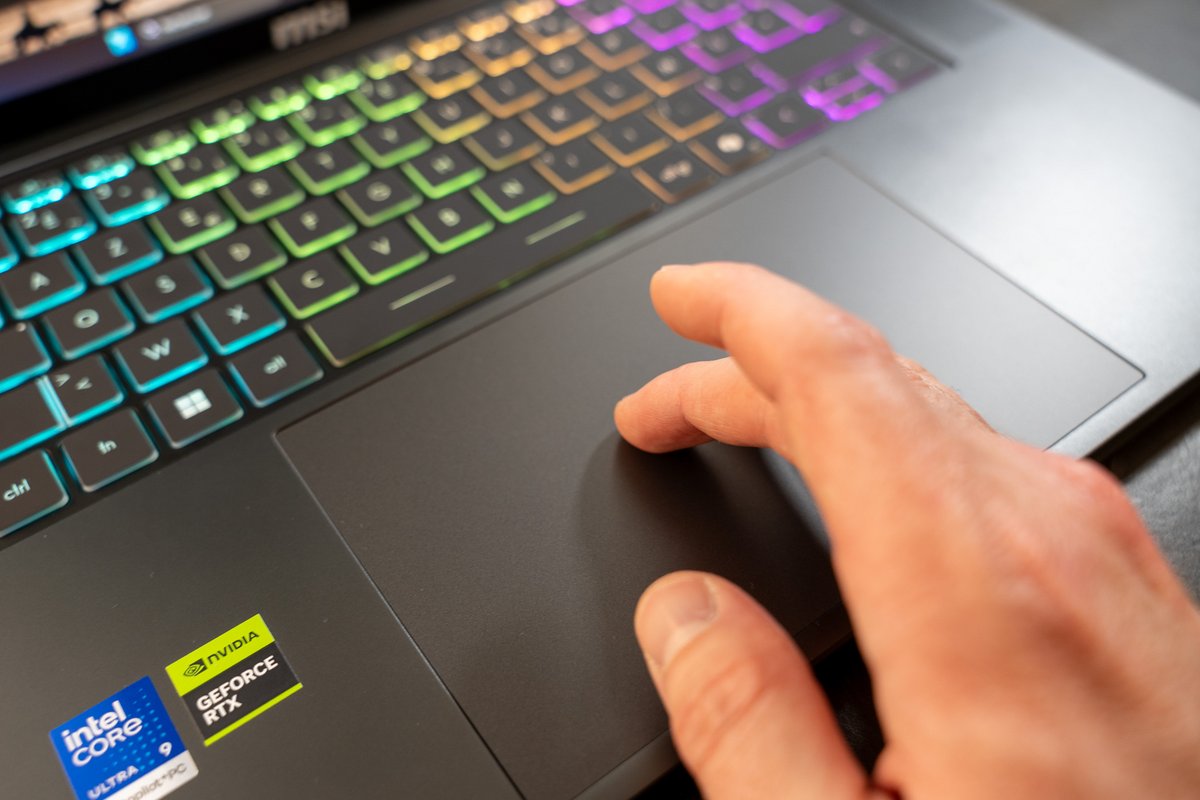
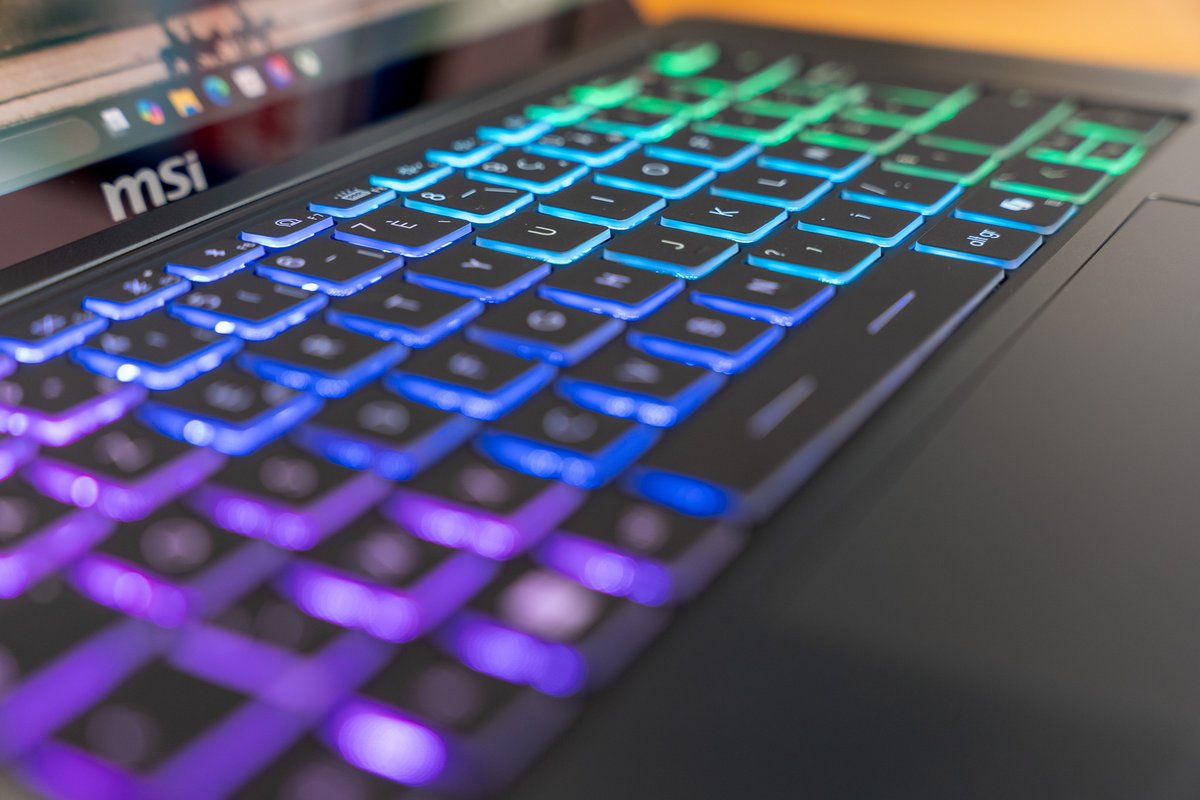
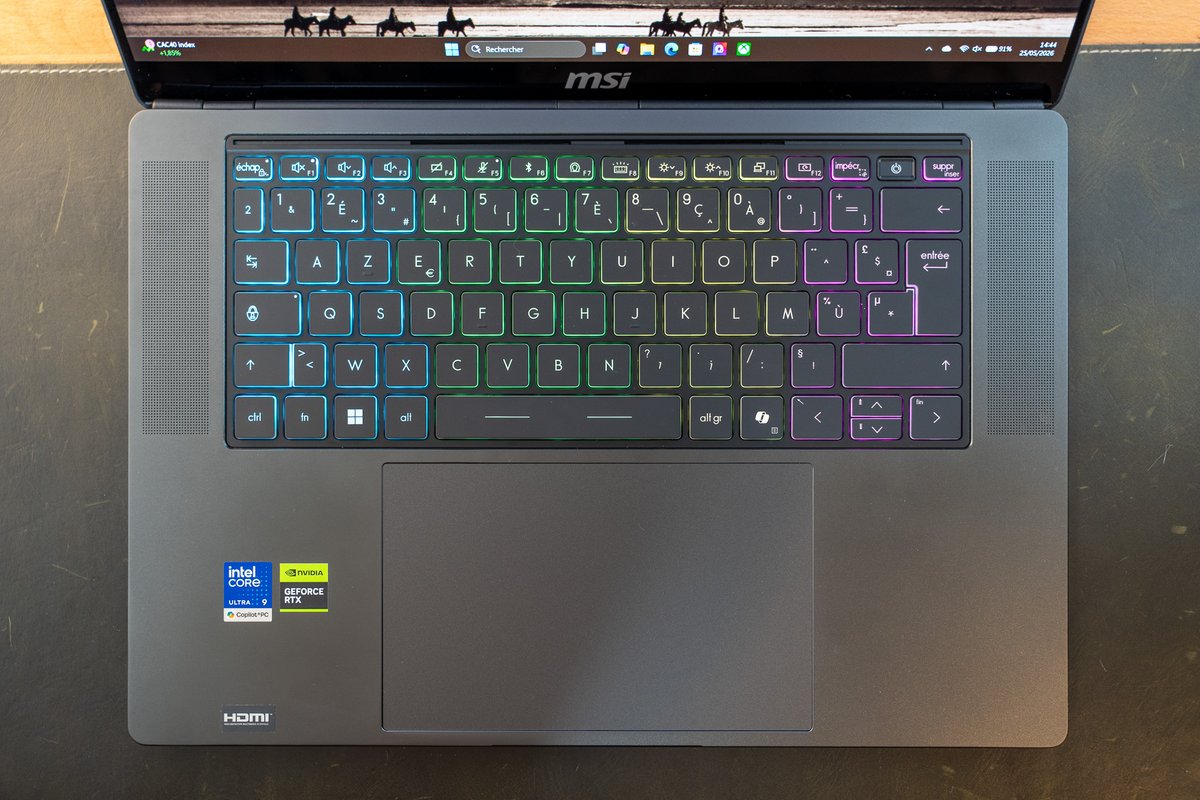
That lack of rigidity also affects the keyboard — with a RGB backlight limited to four zones. In use, it’s quite pleasant for both gaming and office work (despite the lack of a numeric keypad), but the center of the keyboard feels rather soft. A pity. The key travel is generous and the feedback is punchy, which partly compensates for this flaw. The XXL touchpad proves comfortable and precise, though it remains far from the quality of haptic trackpads that, sadly, are still rarely found on gaming machines.
The I/O ports on our Stealth 16 AI+ offer another source of disappointment, albeit more marginal. The layout is awkward: the two sides feature three USB-A 3.2 Gen 2 ports, two USB-C Thunderbolt 4 ports, an Ethernet RJ-45 jack, an HDMI 2.1 output, and a 3.5 mm headphone jack. Nothing missing except perhaps Thunderbolt 5 and an SD card reader (which would be handy for photographers and videographers who also use the machine).
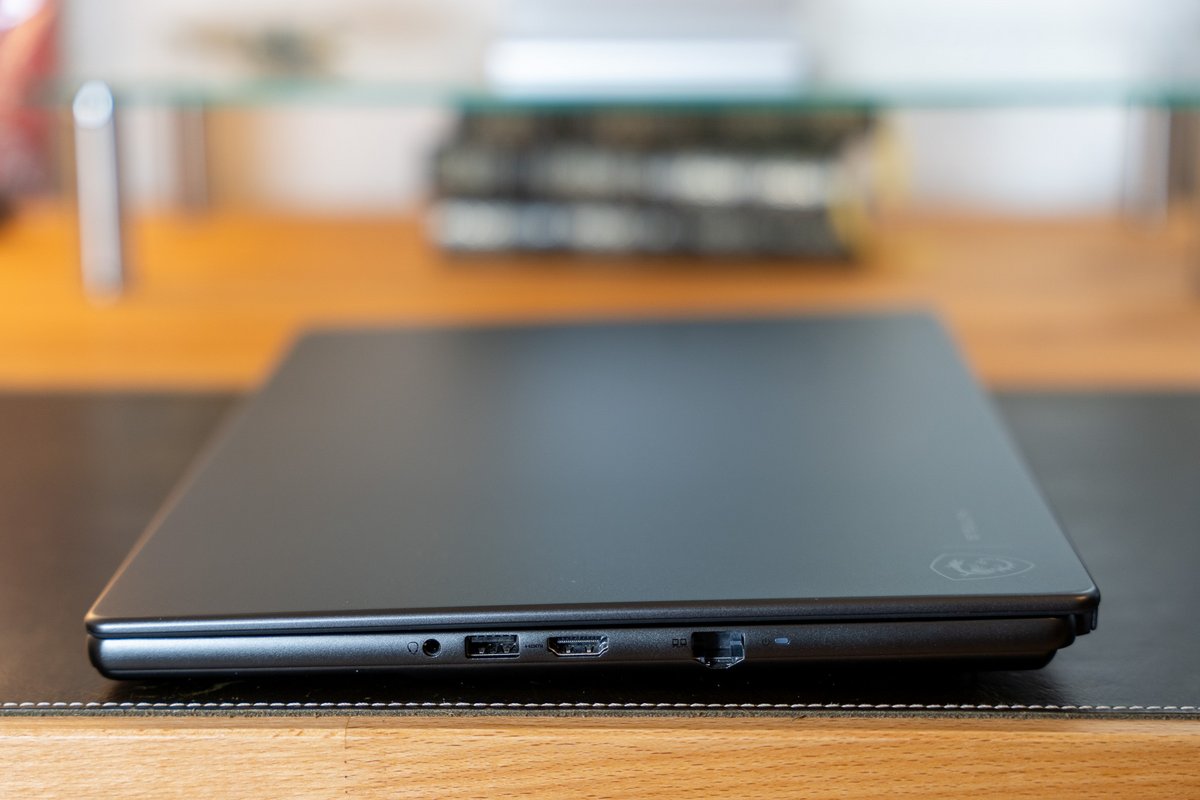
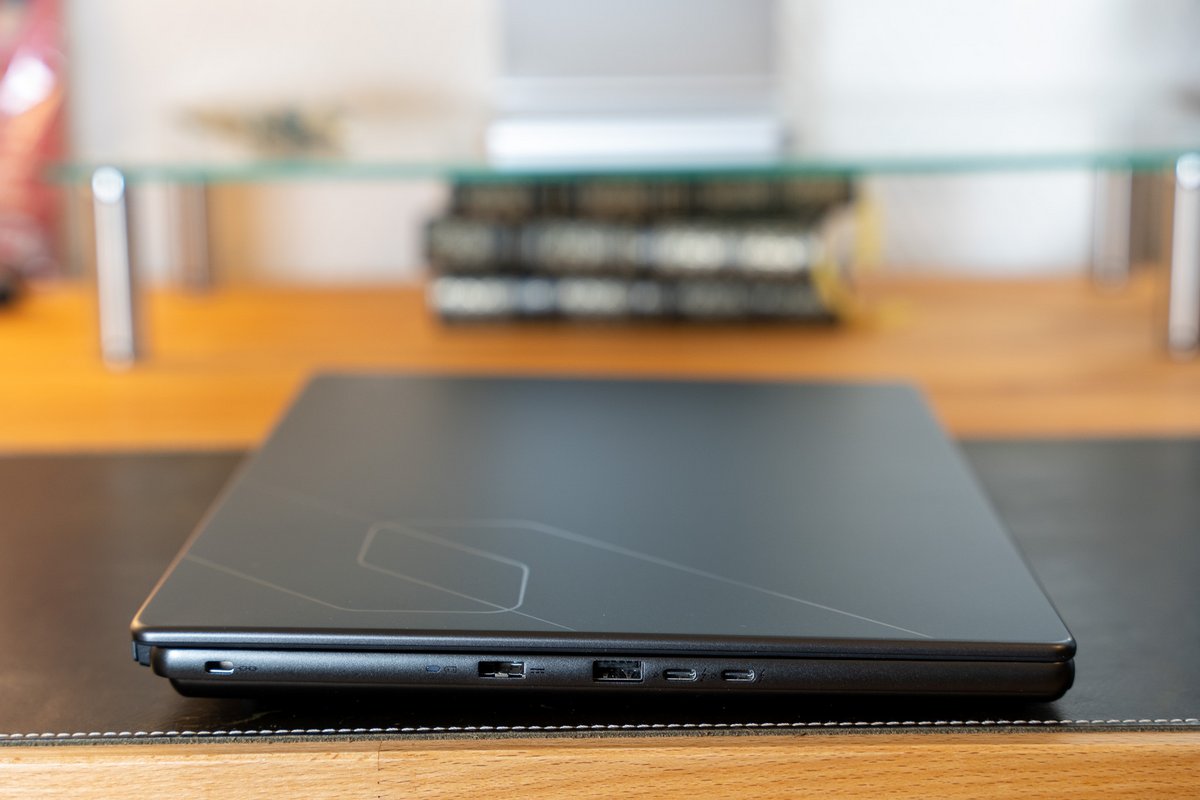
The problem lies more with the odd distribution of these ports. No opening on the sides of the chassis, yet the ports are sometimes too spaced apart or too tight together. Odd, and not very practical, especially since the power cable (centered on the left side) slightly crowds the area.
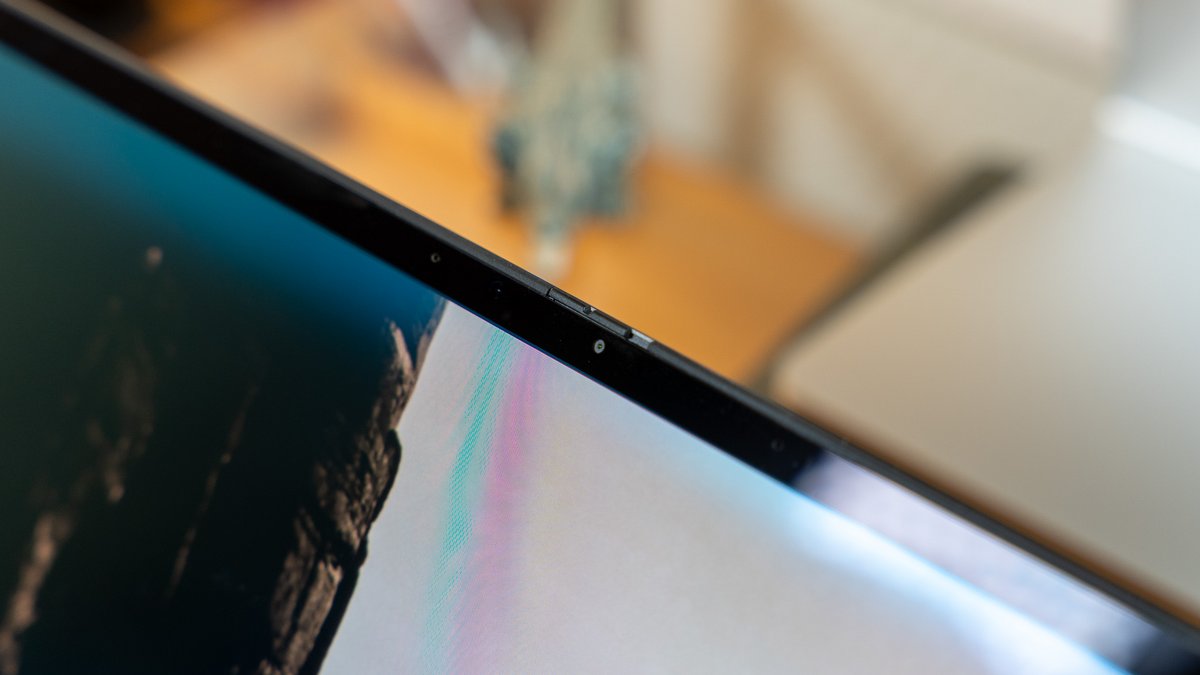

Our take on the webcam and speakers is fairly neutral overall. No catastrophe on the horizon, but also no standout satisfaction. The 1080p sensor perched above the screen yields an image that is noticeably not sharp, but colors are fairly accurate. In short, you won’t look washed out during video calls. This module also benefits from the sensors needed for facial recognition via Windows Hello. It’s also possible to unlock the device biometrically via a fingerprint reader housed in the power button.
Regarding the speakers, MSI relies on two 2 W woofers and two 2 W tweeters tucked under the chassis. The sound is muffled, not particularly memorable, and it mostly highlights voices, but lacks depth and music can feel a bit constricted at higher volumes.
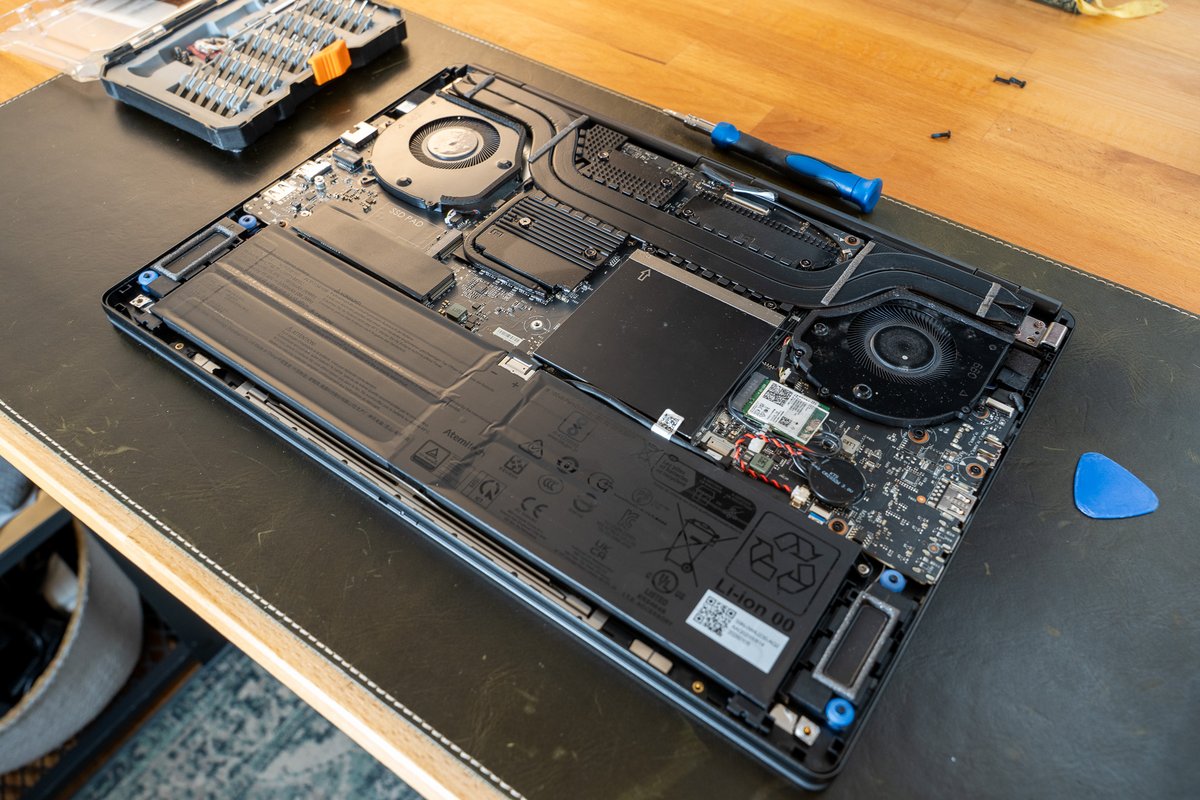
Closing with a note on upgradability for our Stealth 16 AI+. The device is fairly well-behaved in this regard. Its battery is easy to access, there are two M.2 NVMe slots (one of which was occupied on our loaner), a Wi-Fi module, and DDR5 SO-DIMM sticks that can be replaced if needed. We’ve clearly seen worse!
Display: a reactive OLED panel that’s well calibrated
As with many other premium gaming laptops in recent years, MSI opts for an OLED QHD+ panel (2560 x 1600) with a 240 Hz refresh rate for the Stealth 16 AI+. Likely manufactured by Samsung Display, this panel is supposed to cover 100% of the DCI-P3 color space. It also carries the VESA DisplayHDR True Black 600 certification.
In detail, this OLED panel is highly responsive, delivering excellent image quality, vibrant colors, and unbeatable contrast. The usual caveat applies, however: brightness maximum and reflectivity can be limiting factors.
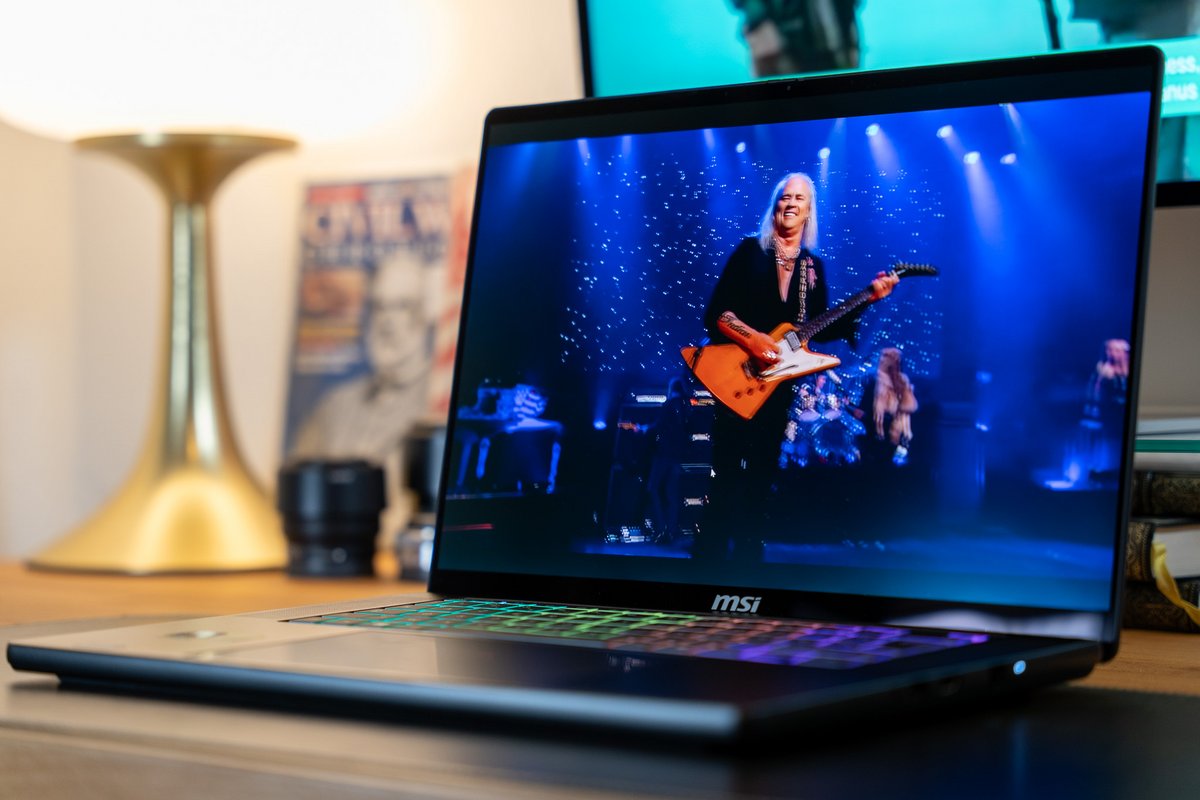
Using our measurement tools and DisplayCal software, we first note a maximum SDR brightness of 389 cd/m2. This is too low to compensate for the numerous reflections that appear on the screen in a very bright room or when near a window on a train, for example.
Being OLED, the contrast is, on the other hand, infinite. The depth of blacks provides excellent image relief, but can, from time to time, produce a halo or blooming effect—especially when a very light element is displayed on a totally black background. Nothing catastrophic, though. Moreover, viewing angles are perfectly wide open: another advantage of this technology.
Color-wise, the display suffers only from a slightly too warm color temperature by default. We measured 6270 kelvin, a little off the ideal 6500 kelvin typically expected for this domain.
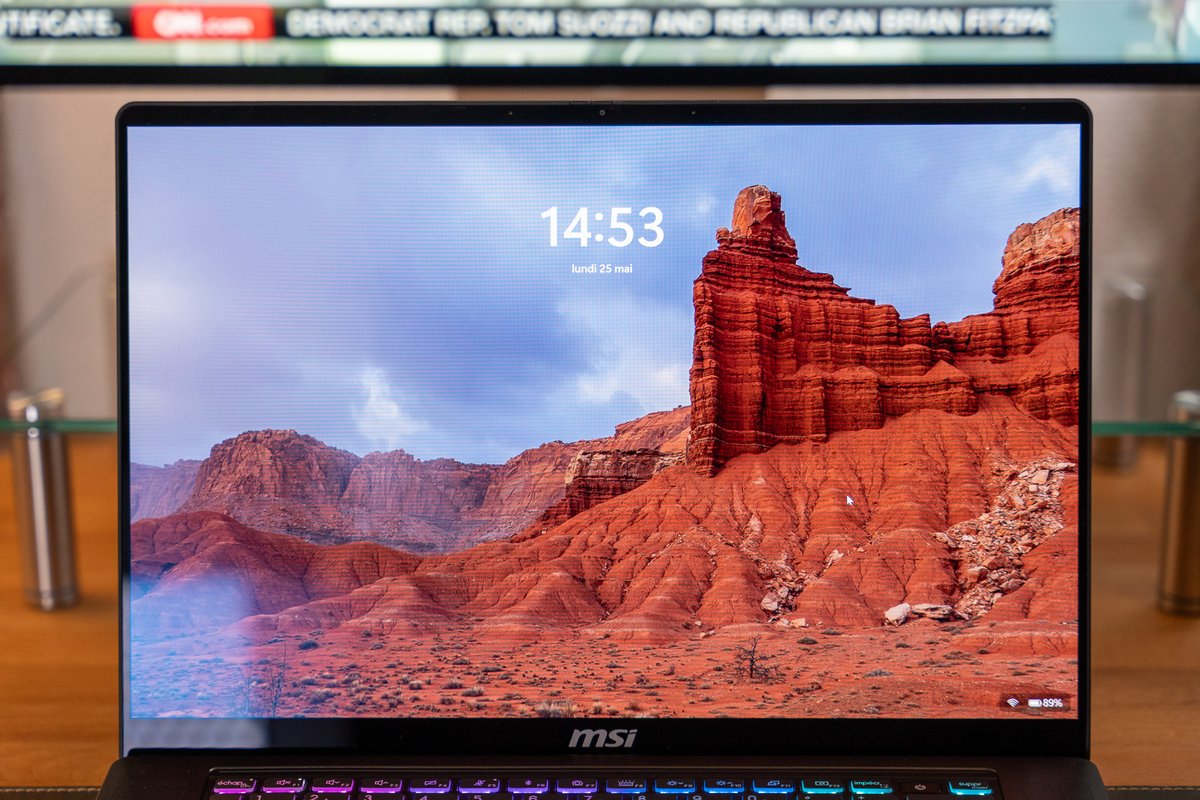
In practice, only the most meticulous will notice, and one can argue that the color differences are actually negligible. Our tools measure a DeltaE of 0.6 on the panel we’re focusing on today. Ideally, this value should be between 0 and 3 to ensure good color fidelity. We’re thus well within acceptable range.
As expected, the primary color spaces are covered at the expected levels: 146% for the sRGB gamut, and 103% for the DCI-P3 spectrum. Nothing to complain about there either. This display will suit both image-loving gamers and creative users needing excellent color accuracy (graphic designers, photographers, videographers…).
Performance: Panther Lake x Blackwell in a refined gamer… What does it do?
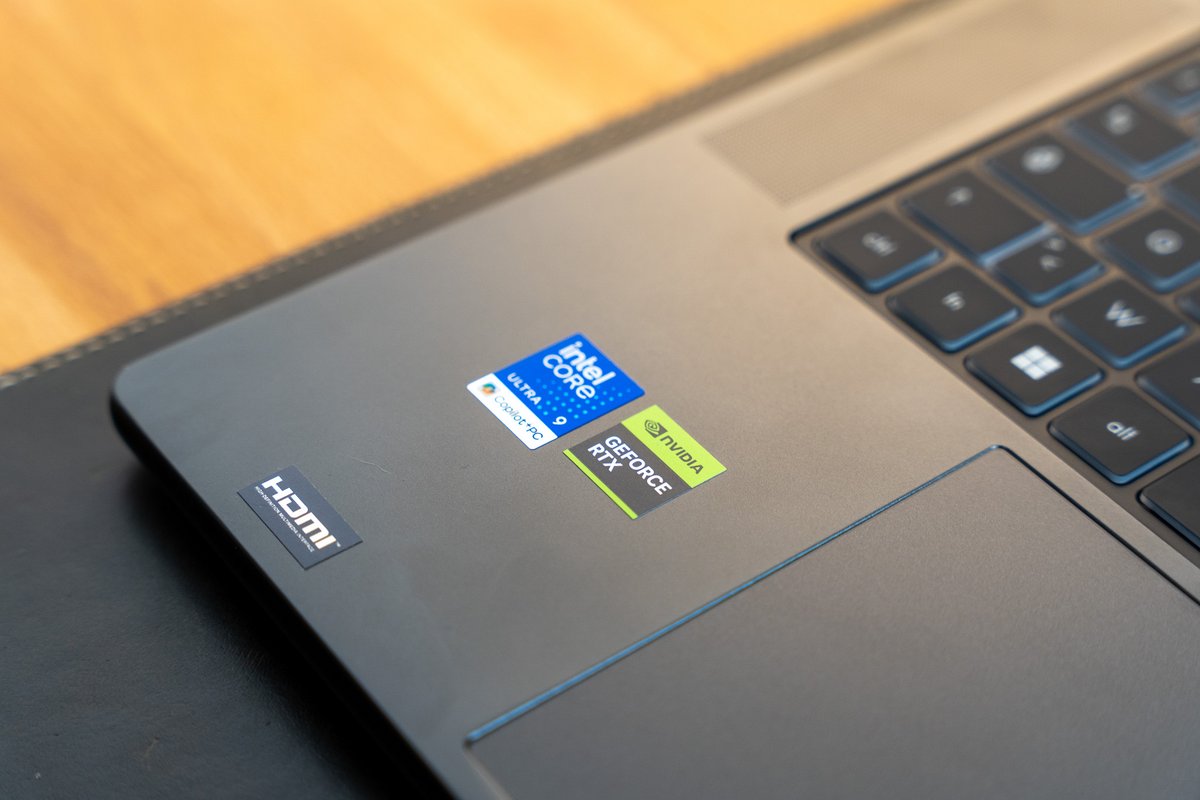
The MSI Stealth 16 AI+ relies on a latest-generation CPU/GPU duo, pairing an Intel Core Ultra 9 386H “Panther Lake” with an RTX 5080 “Blackwell.” Here’s a recap of the loaner model’s technical sheet:
- Intel Core Ultra 9 386H (16 cores — 4 P-cores + 8 E-cores + 4 Low Power E-cores — 16 threads, up to 4.9 GHz, 18 MB cache, 25 W default TDP, 18A fab)
- 32 GB of RAM (DDR5-7200)
- 1 TB NVMe PCIe Gen 4 SSD (two M.2 slots)
- Dedicated NVIDIA GeForce RTX 5080 (16 GB GDDR7 memory, 125 W TGP)
Cette configuration est censée être bridée par un système de refroidissement légèrement under-dimensionné au premier abord, réunissant deux ventilateurs qui aspirent l’air frais sous le châssis et expulsent l’air chaud par l’arrière, ainsi qu’à travers une fente située au-dessus du clavier, et deux gros caloducs. Pas de chambre à vapeur ici, mais une pâte thermique à changement de phase. Ce dispositif peut dissiper jusqu’à 175 W au total, indique MSI, répartis entre le CPU (un peu) et le GPU (beaucoup).
Ce budget TDP global ne permet donc pas à la RTX 5080 de s’exprimer pleinement. Elle est en effet limitée à 125 W au maximum, au lieu des 175 W qu’elle peut atteindre sur des machines légèrement plus volumineuses (comme le MSI Raider 18 HX AI que nous testions l’an dernier, par exemple). Cependant, c’est tout l’enjeu de MSI avec ce nouveau Stealth : faire tenir un maximum de performances dans un 16 pouces d’à peine 2 cm d’épaisseur… ce qui implique forcément quelques compromis.
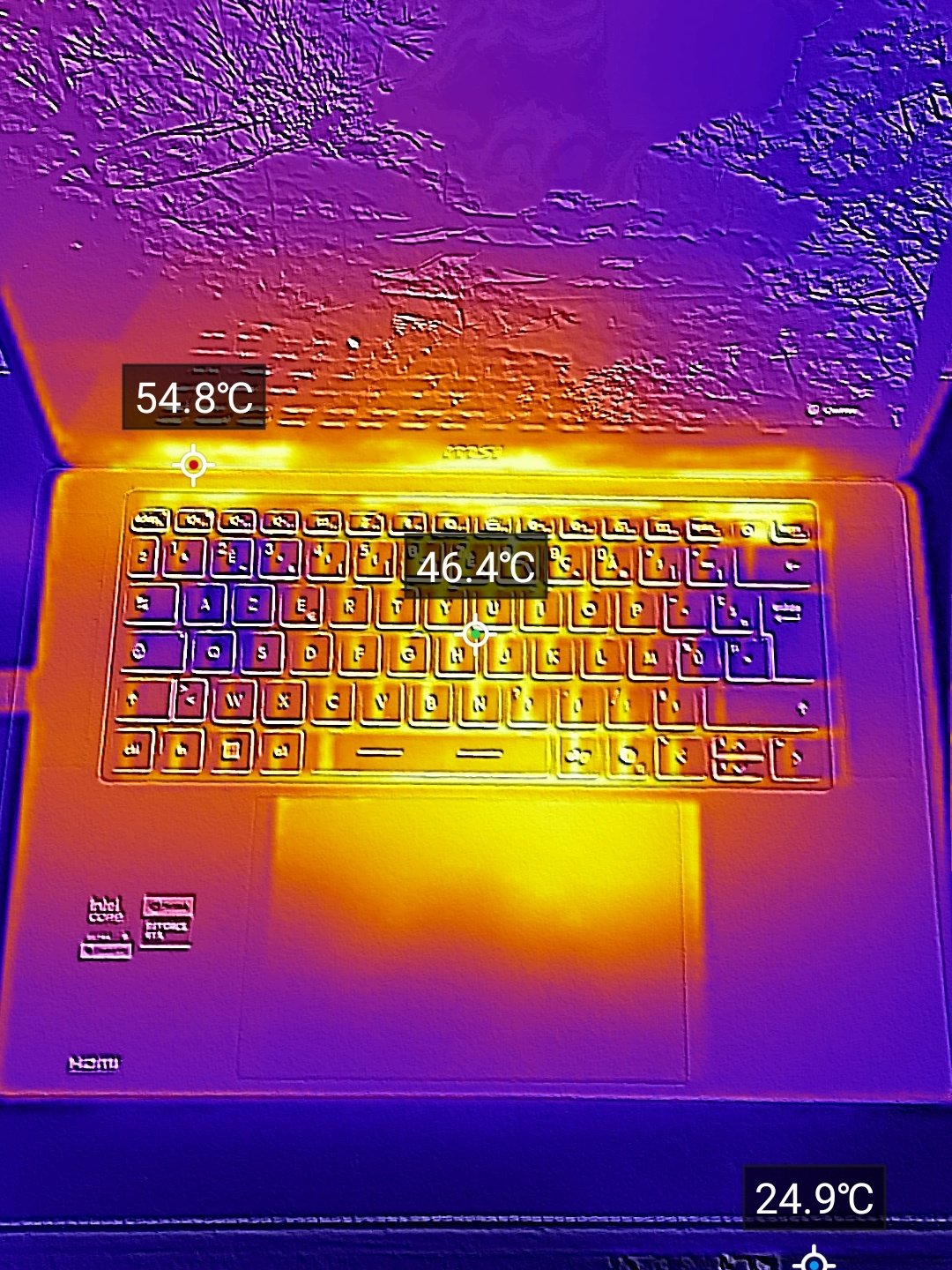
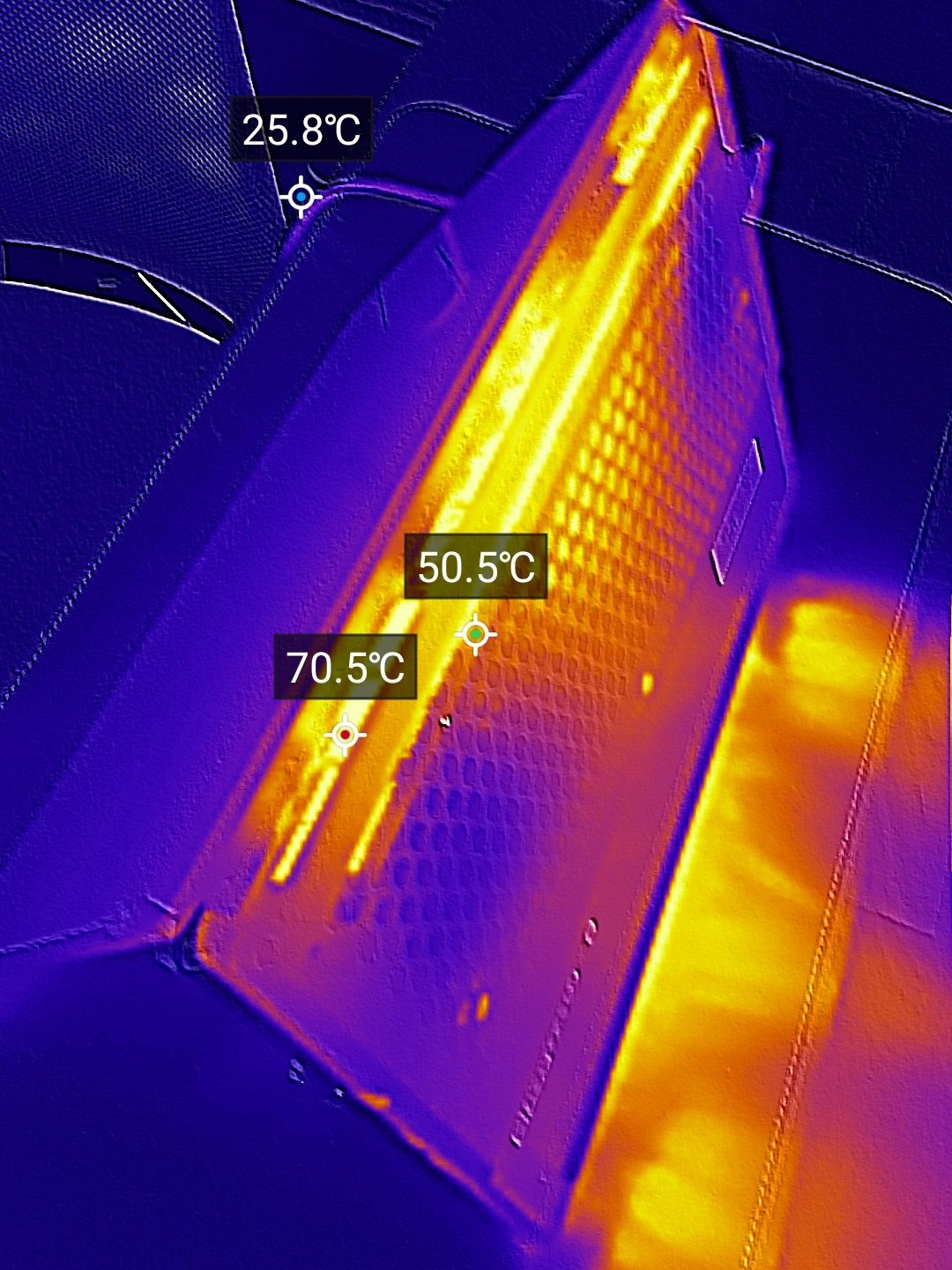
Commençons donc par les performances en matière de refroidissement. Malheureusement, le bilan n’est pas très réjouissant : notre Stealth 16 AI+ montre une montée en chaleur difficile à ignorer lors de charges lourdes et prolongées. En jeu, sur Cyberpunk 2077 puis Black Myth Wukong, après plus d’une heure de stress tests variés, nous relevons jusqu’à 55 degrés au niveau du clavier et du pavé tactile, et un maximum de 70 degrés à l’arrière du châssis. Le bruit des deux ventilateurs, malgré l’activation du mode turbo au préalable, ne dépassait toutefois pas 51 à 52 dB selon notre sonomètre (placé à environ quarante centimètres de l’écran).
Plus que le bruit, c’est la chaleur qui préoccupe. Trop chaude, finalement. En pratique, l’utilisateur aura du mal à ignorer ce problème lors des sessions de jeu. Le Stealth 16 AI+ souffre d’un système de dissipation sous-dimensionné pour cette configuration de test. Cela nous pousse à recommander les versions moins puissantes de l’appareil, comme celle équipée de la RTX 5070 Ti. Car tel qu’il est, notre modèle prêt a du mal à maintenir son niveau de performances sur le long terme.
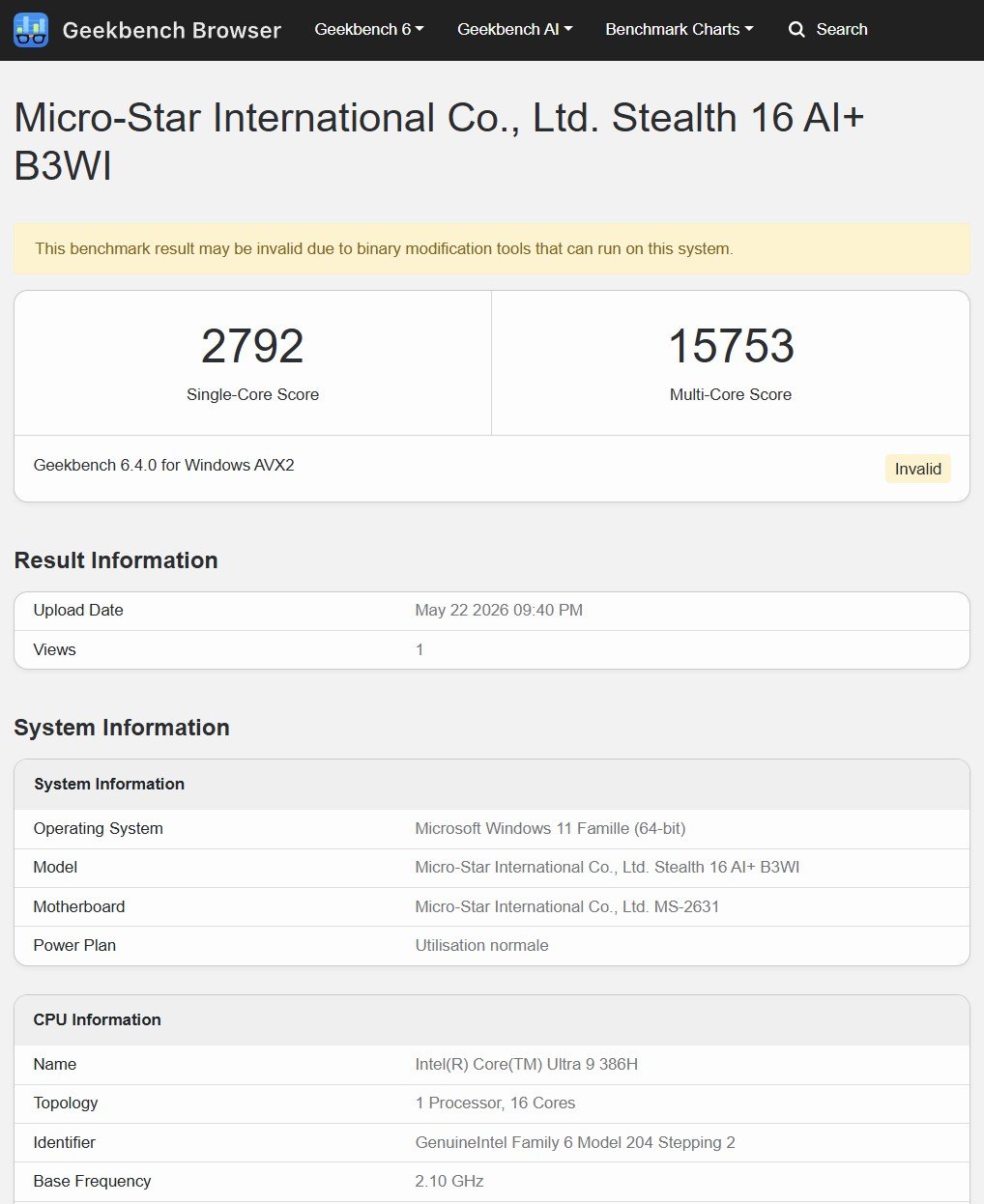
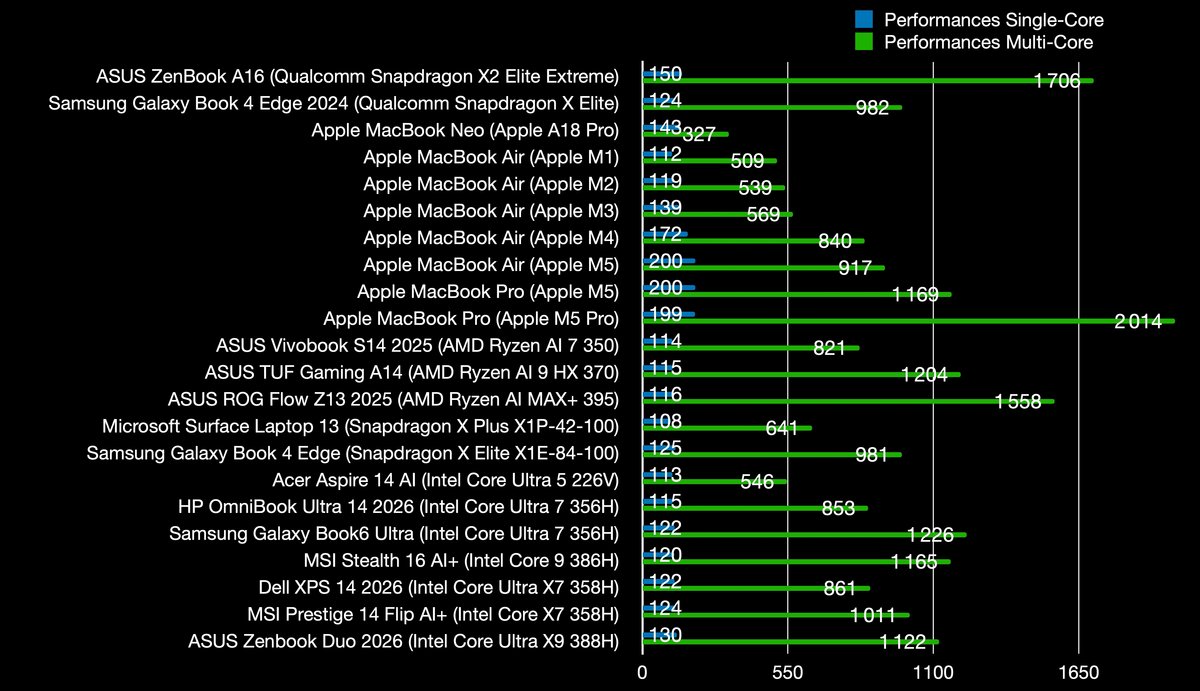
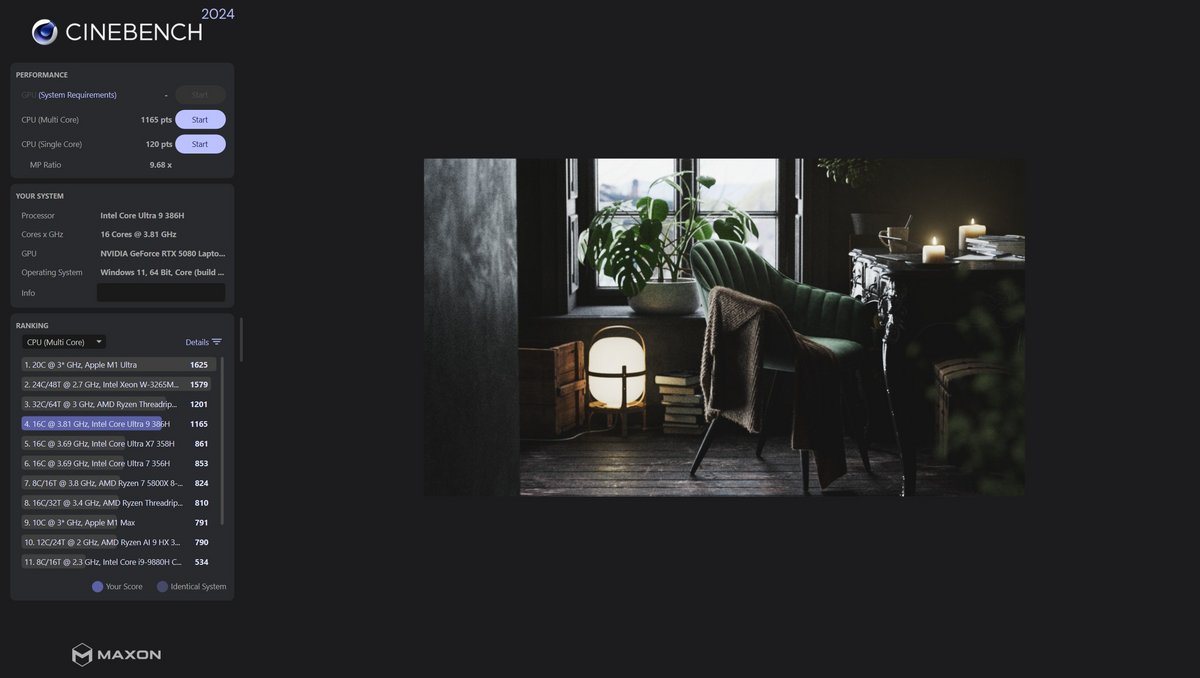
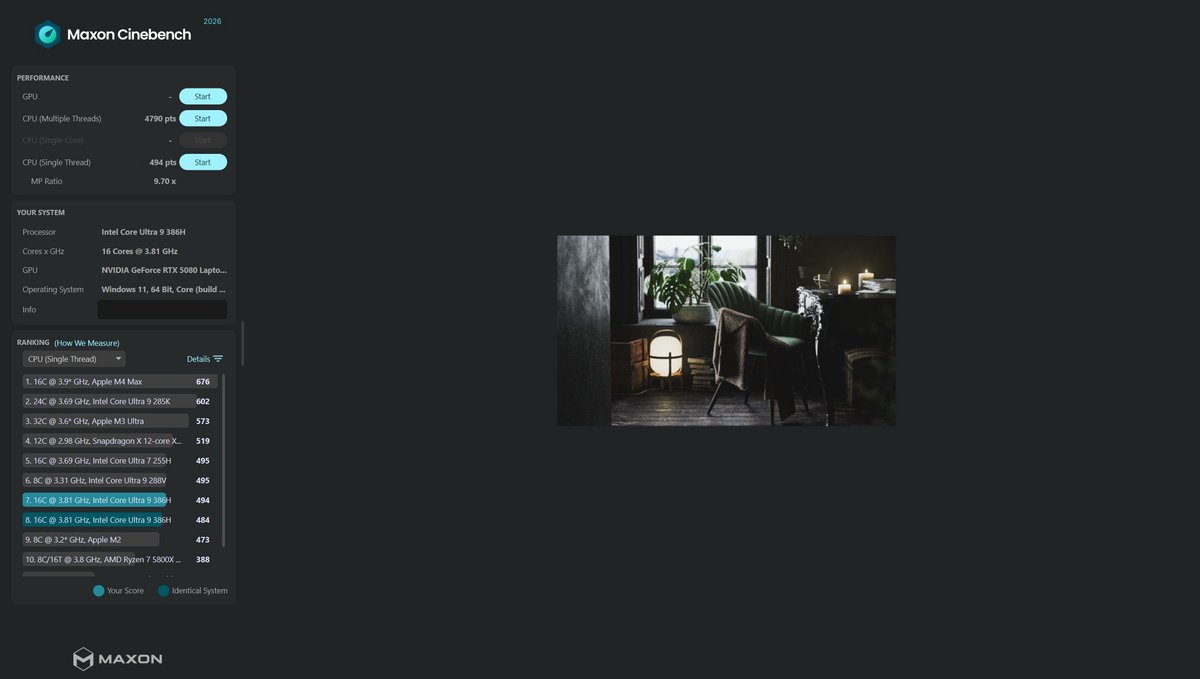
Before addressing graphics performance, let’s first cover processor performance. The Intel Core Ultra 300-series chips are better known for energy efficiency than raw CPU power. With a default 25 W TDP, our Core Ultra 9 386H adheres to this logic, delivering decent but not exceptional performance for the class of device in question. Moreover, it is poorly optimized by the MSI machine.
With 120 points in single-core and 1165 points in multi-core, our Ultra 9 386H underperforms the Core Ultra 7 356H (even though it’s lower in the lineup) on the latest Samsung Galaxy Book 6 Ultra. Heavily throttled, the new Intel chip essentially tows the Stealth back to the level of a simple AMD Ryzen AI 9 HX 370… released in 2024. Not exactly cause for excitement, especially since CPU performance limitations will mechanically hinder the RTX 5080’s performance.
That said, for the targeted QHD+ definition, MSI’s new compact 16-inch does fairly well on the graphics front. In games, the most demanding titles run smoothly, even though this “Blackwell” chip shines more in image-generation efficiency and integrated technologies than in raw power compared to the previous generation (RTX 4000).
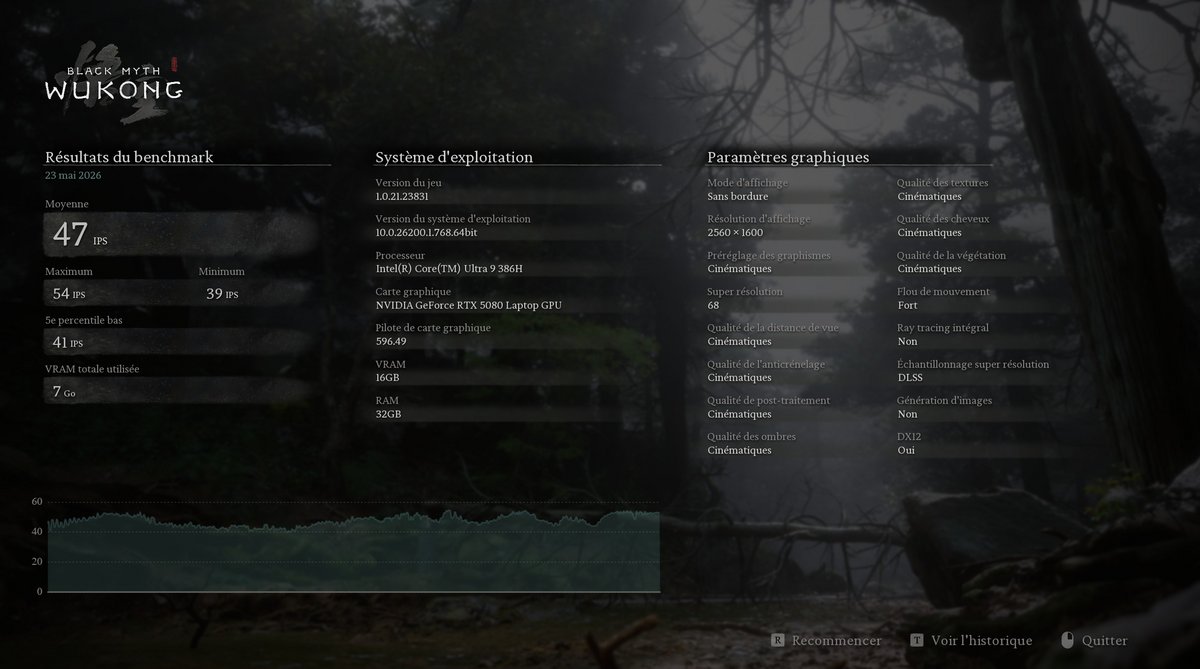
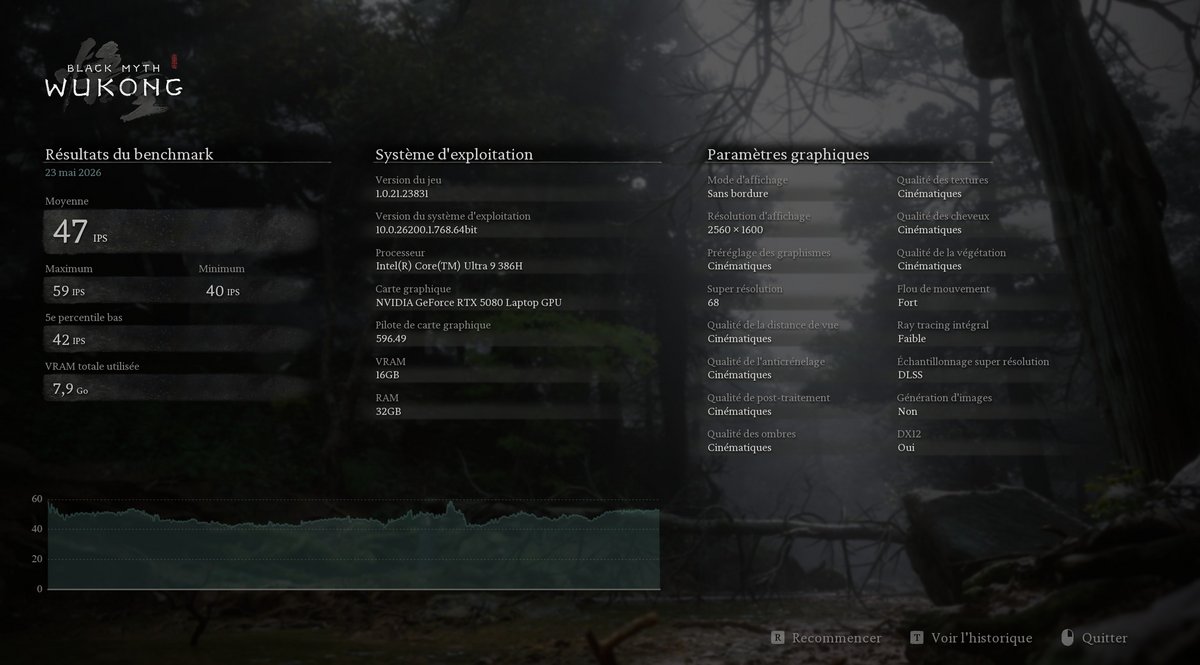
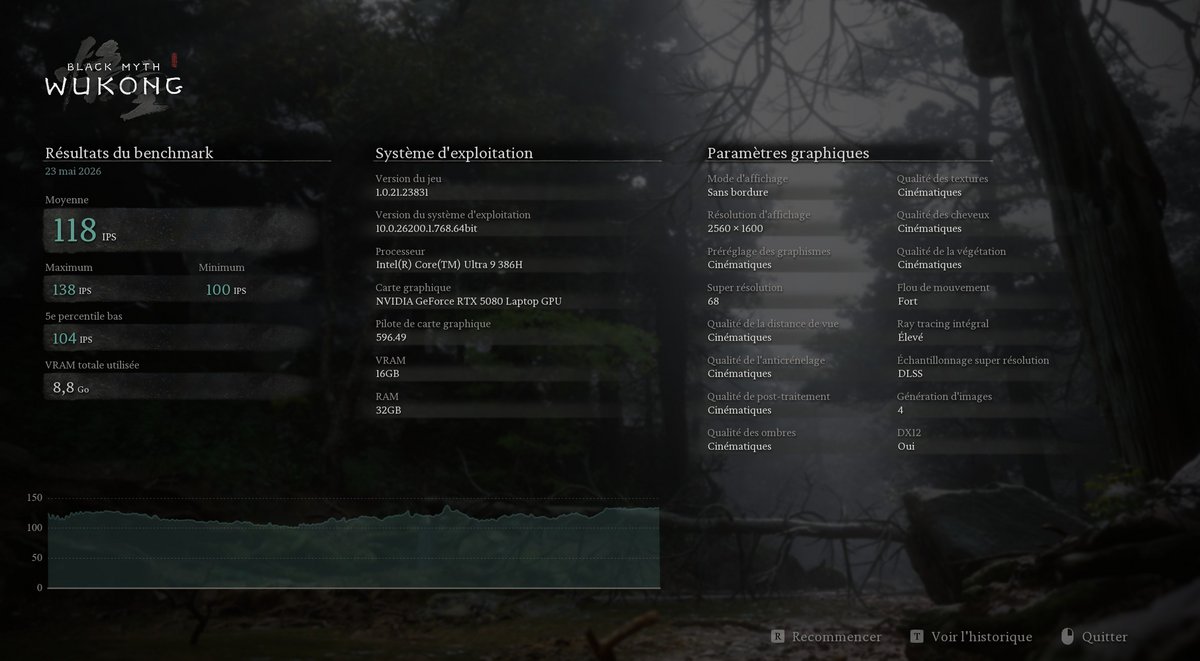
Pour contexte, nous avons mesuré les performances GPU du Stealth 16 AI+ en QHD+ / Ultra, et trois réglages différents sont utilisés tour à tour pour chacun des deux titres testés. Le premier essai utilise le Path Tracing complet et la Multi-Frame Generation ×4. Il est suivi d’un second essai où le Path Tracing est remplacé par le ray tracing « classique »… mais en désactivant la MFG pour pousser le GPU dans ses derniers retranchements. Enfin, un troisième essai est effectué, mais uniquement en rasterisation (ray tracing et MFG désactivés).
Voici les résultats obtenus :
- Sur Cyberpunk 2077, avec Path Tracing activé, couplé à la MFG x4 et tous les réglages en Ultra, nous atteignons une moyenne de 131 FPS. Cette moyenne tombe à 57 FPS lorsqu’on se contente du ray tracing en Ultra et du DLSS « Auto », mais sans génération d’images par IA. Enfin, en rasterisation (pas de ray tracing et pas de génération d’images par IA), mais toujours avec les réglages Ultra, on obtient une moyenne de 98 FPS.
- Sur Black Myth Wukong, nous commençons par une moyenne de 118 FPS avec les réglages « Cinématiques » (les plus élevés disponibles), le ray tracing maximal et la MFG x4. La RTX 5080 de notre Stealth reste toutefois bloquée à 47 FPS lorsque l’on conserve les réglages « Cinématiques » et le DLSS, tout en restant en ray tracing minimal (impossible de faire autrement sur ce jeu), mais en désactivant totalement la Frame Generation. Enfin, en rasterisation, le titre est également animé à 47 FPS en moyenne (réglages « Cinématiques », ray tracing entièrement coupé et frame generation désactivée également).
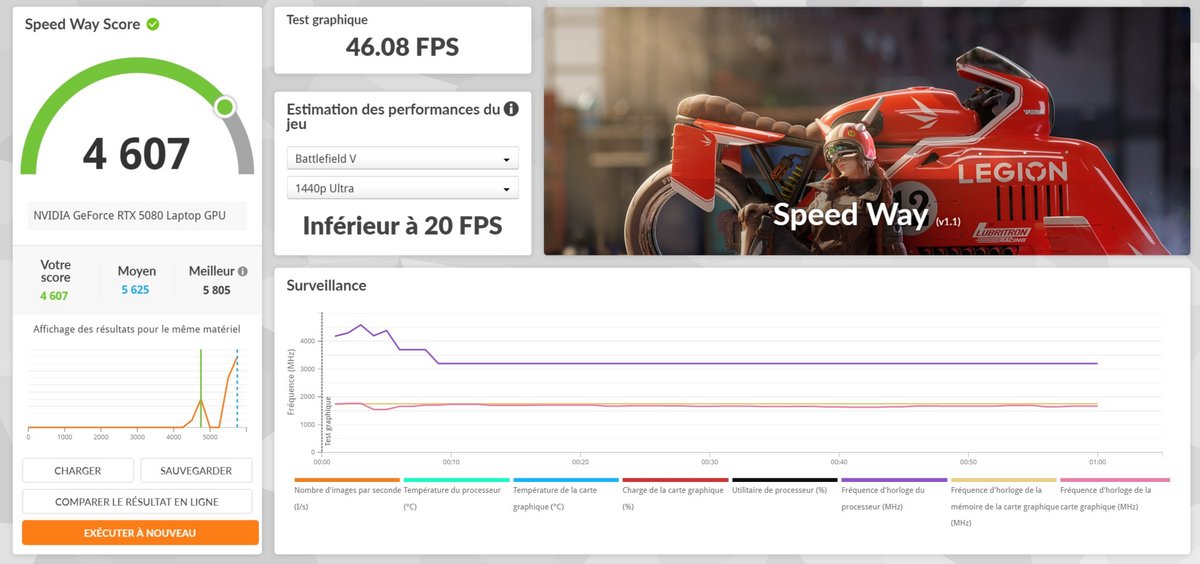
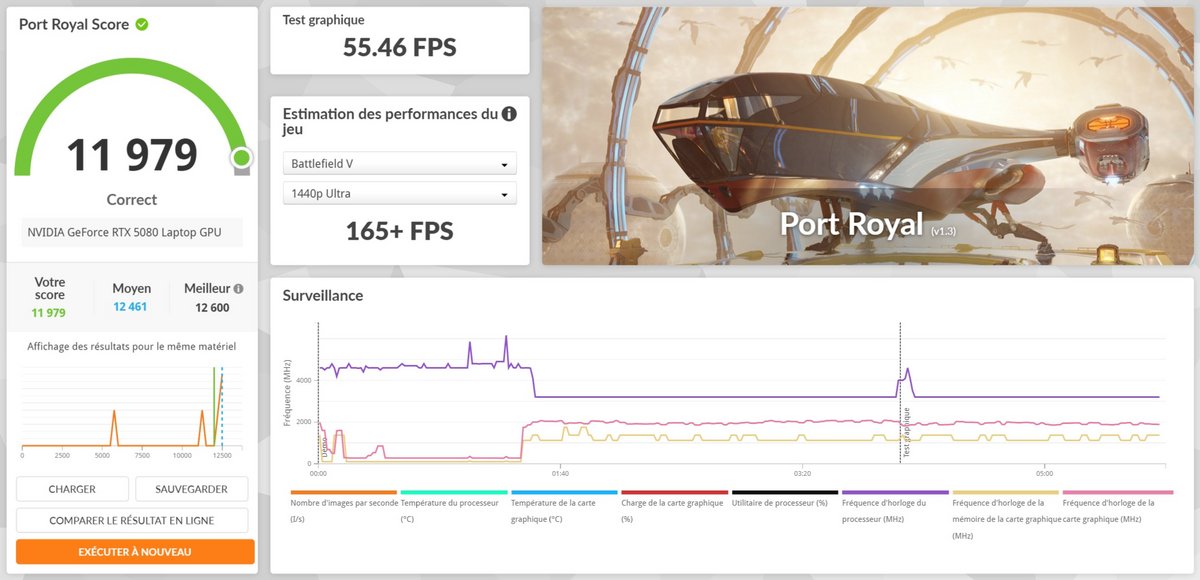
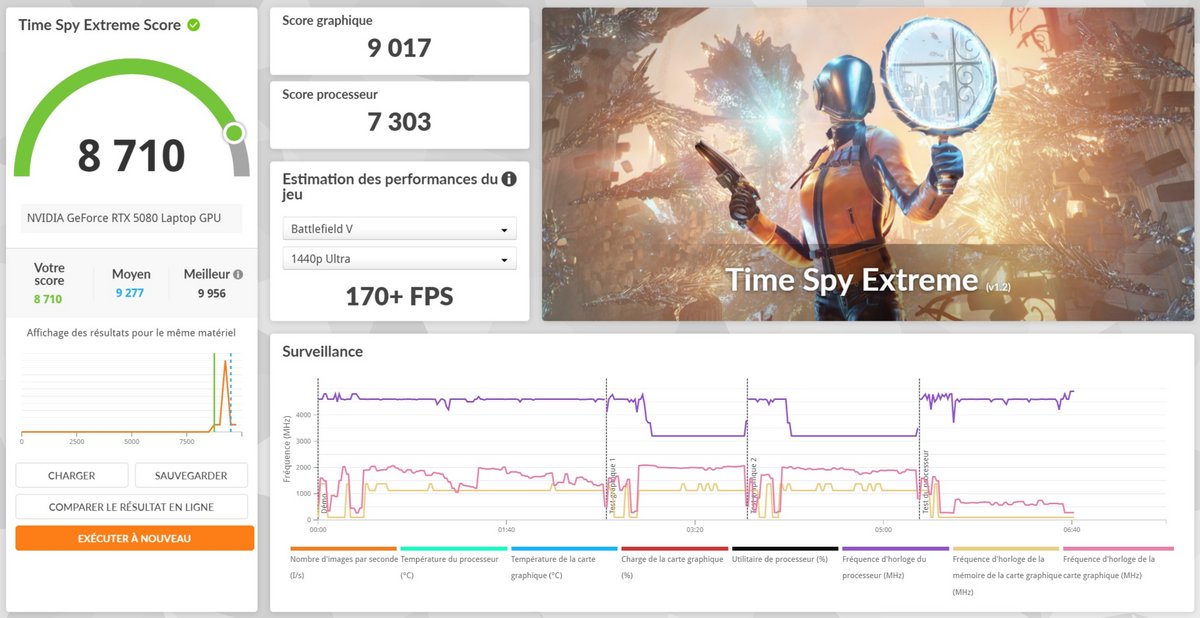
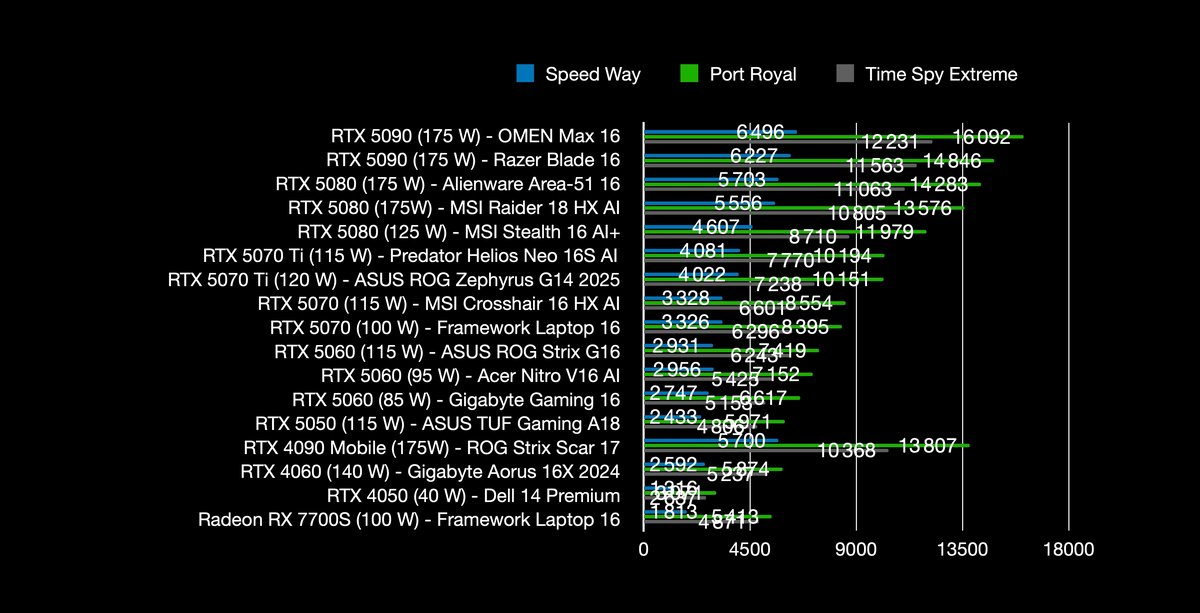
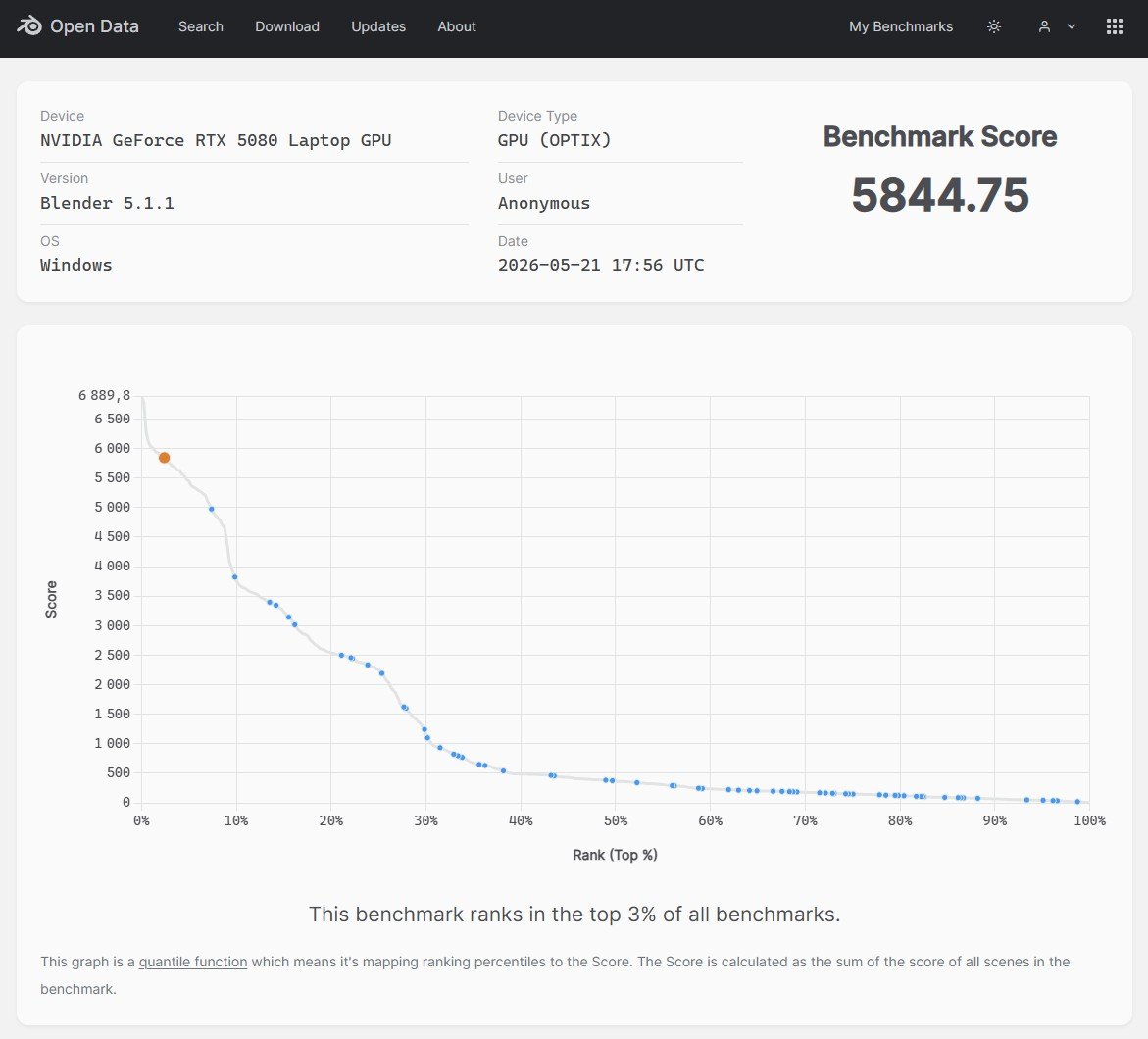
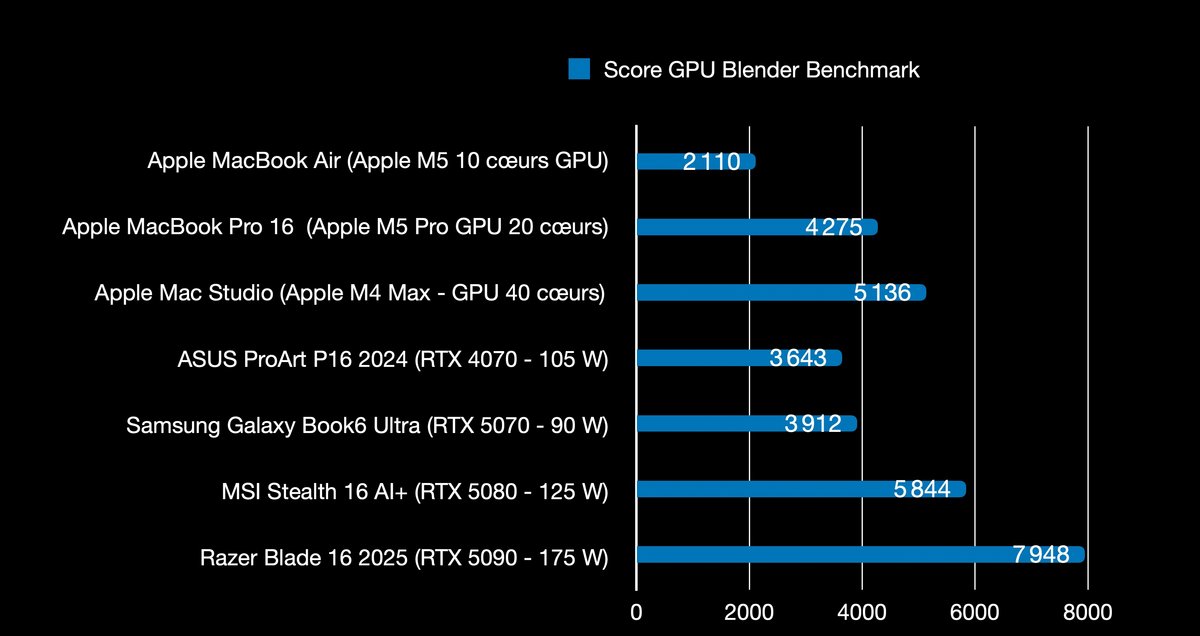
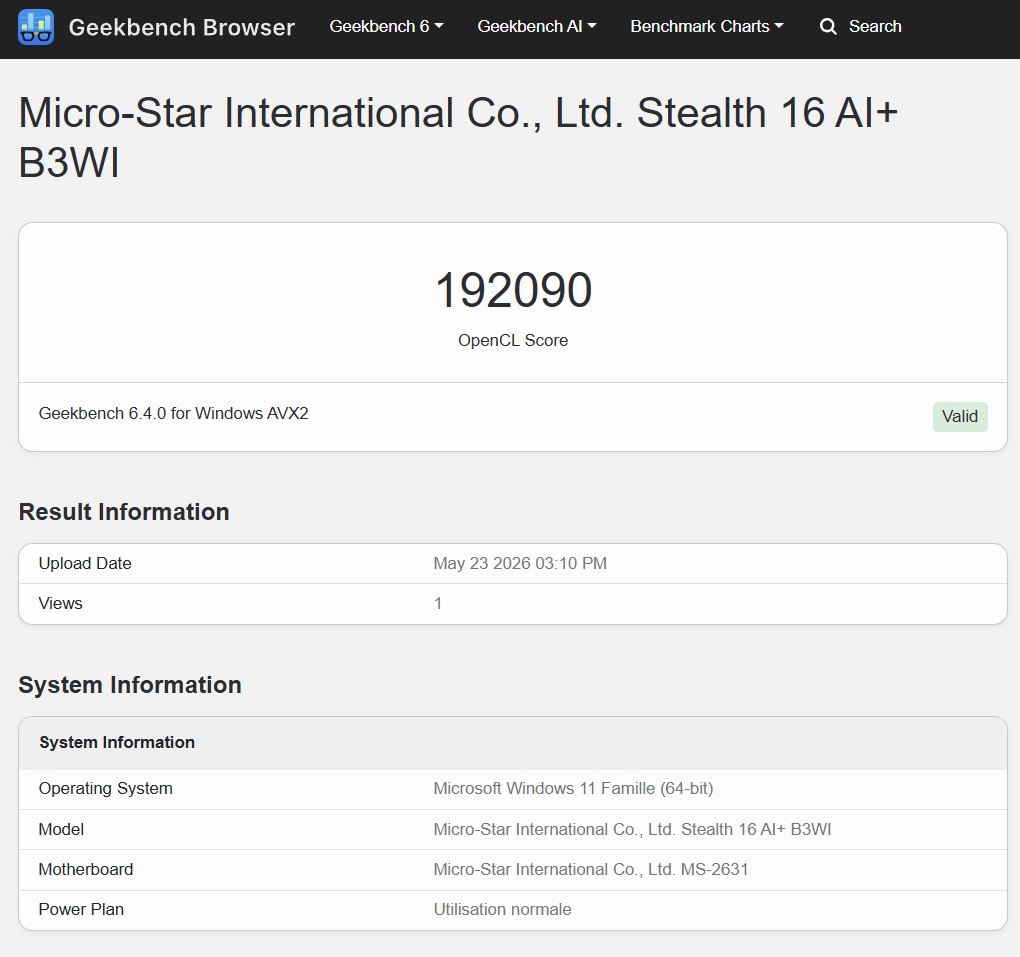
In a 3DMark benchmark, the strong graphics performance of our RTX 5080 is confirmed. Additionally, in Blender, it shows solid results, easily outpacing (not surprisingly) the GPU portion (40 cores) of Apple’s new M5 Pro chip. The two chips, however, do not compare on energy grounds, hence the discrepancy.
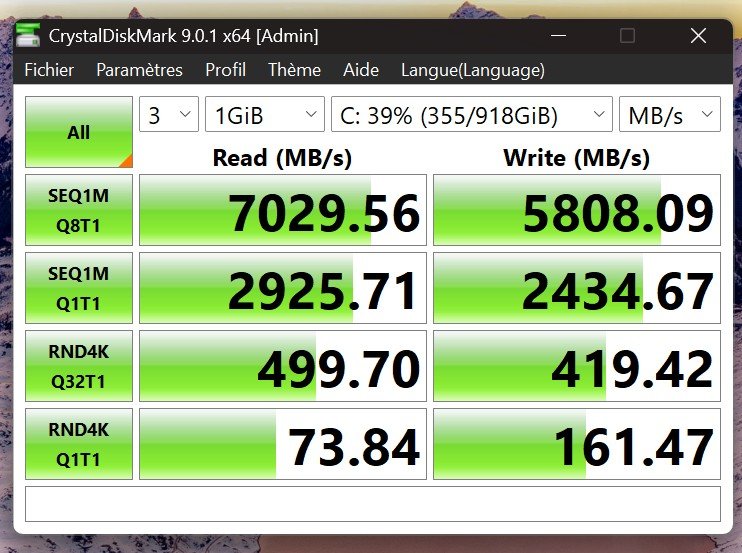
Pour finir sur les performances du SSD, MSI opte pour une barrette M.2 NVMe PCIe Gen 4 rapide. Avec 7029 Mo/s en lecture et 5808 Mo/s en écriture selon CrystalDiskMark, les débits sont bons, suffisants pour la grande majorité des activités visées par ce PC.
Autonomie: toute la journée sur batterie… Vraiment ?
Gaming laptops rarely shine when it comes to long battery life. The arrival of AMD’s “Strix Point” processors a couple of years ago began to change the scene for some models. Today, Intel’s “Panther Lake” processors seem to carry the torch again, enabling certain models with dedicated GPUs to push battery life higher.
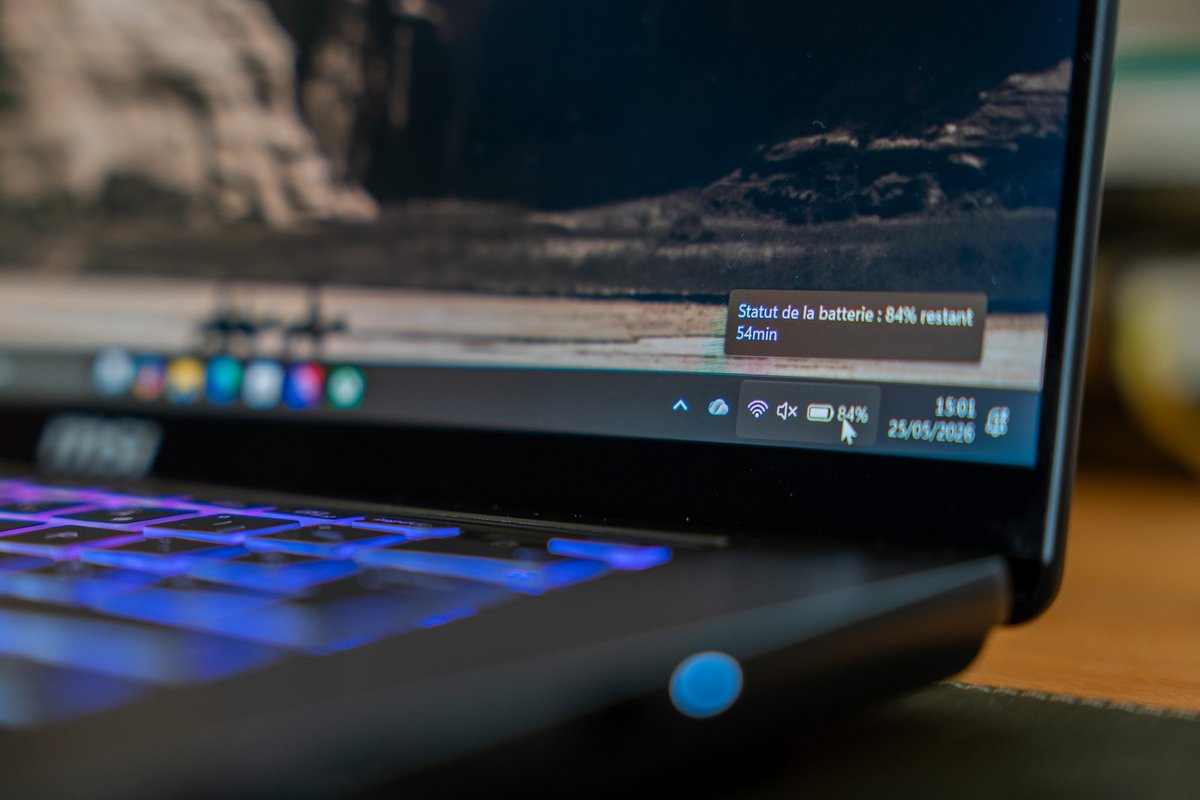
Equipped with a Core Ultra 7 356H (paired with an RTX 5070), the Galaxy Book 6 Ultra can approach 15 hours of battery life. Unfortunately, this is not the case for our Stealth 16 AI+, which, despite a large 90 Wh battery, promises of “all-day autonomy” on MSI’s official product page, remain unfulfilled on our loan unit, which typically shuts down after about 5 hours of normal use (web browsing, productivity, video playback).
En lecture vidéo, selon notre protocole habituel (lecture vidéo YouTube, via Edge, avec casque branché, luminosité écran à fond, rétroéclairage du clavier coupé et paramètres les plus favorables à l’économie d’énergie — avec GPU dédié désactivé), nous atteignons environ 6 heures et demie d’autonomie avant extinction des feux.
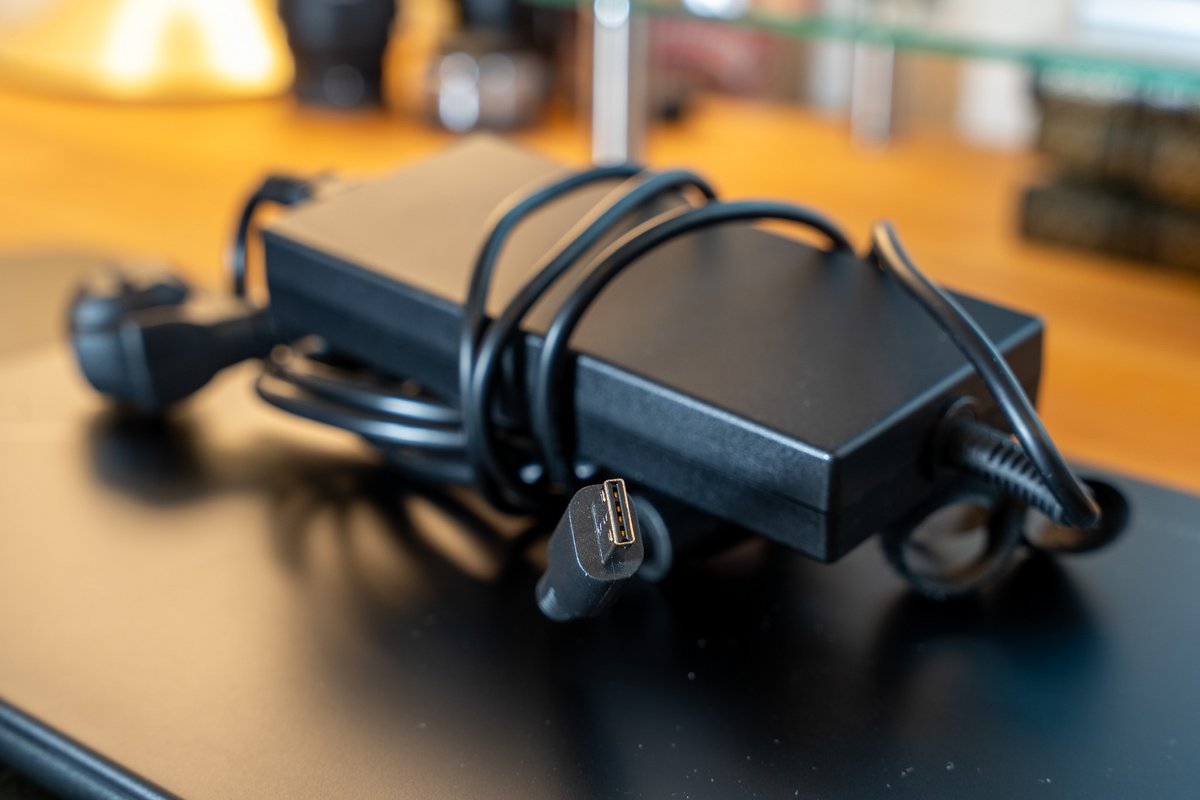
La recharge se fait avec le gros adaptateur 240 W fourni (environ deux heures pour un plein), ou en utilisant l’alimentation via l’un des ports USB-C, mais alors sans débloquer le plein niveau de performances de l’appareil.
MSI Stealth 16 AI+ : l’avis de Clubic
Finding the right balance wasn’t easy. With the Stealth 16 AI+, MSI is still exploring. It’s too heat-sensitive, the device occasionally vents hot and cold.
With it, the Taiwanese brand begins a stylistic shift worth noting, delivering a more mature, understated, and elegant device than prior Stealth generations, but also one that’s more pleasant to handle. Against flawless rivals from Razer, ASUS, or even Samsung, this 2026 model suffers from inferior build quality and a cooling system that’s too modest to effectively manage a RTX 5080 in a compact chassis.
Two weak points that, in our view, cap this year’s potential. Still, at 4000 euros, the device offers a competitive price point. With equivalent configuration, it’s currently about 400 euros cheaper than a Blade 16 2026 and nearly 1500 euros cheaper (yes) than the latest ROG Zephyrus G16. That’s enough to make you think and to lean toward indulgence.
- La RTX 5080, même à l’étroit, reste redoutable
- L’écran OLED réactif et bien calibré
- Le nouveau design tout en rondeur
- Moins cher que ses concurrents directs
- Un cœur Ultra 9 à punir
- La chauffe en jeu est marquée
- Le châssis tout mou, qui craque sous le doigt
- L’autonomie loin des promesses (6 heures)
7
8
7
6
Fnac
Darty
Fnac
Competition: what alternatives to the Stealth 16 AI+?
- An RTX 5090 in a hyper-thin chassis
- Refined, corrected design
- The Blade 16 finally has an excellent keyboard

Daniel Brooks
I cover everyday products with a practical eye, from kitchen tools and home essentials to smart gadgets and consumer trends. My goal is to help readers understand what is genuinely useful, what is worth the price, and what deserves a second look before buying.