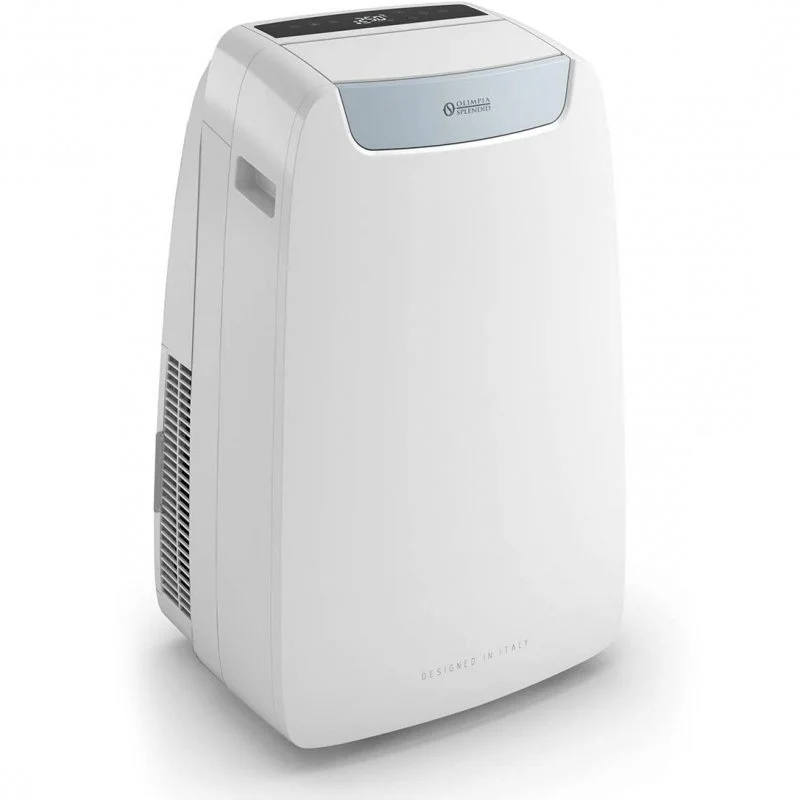
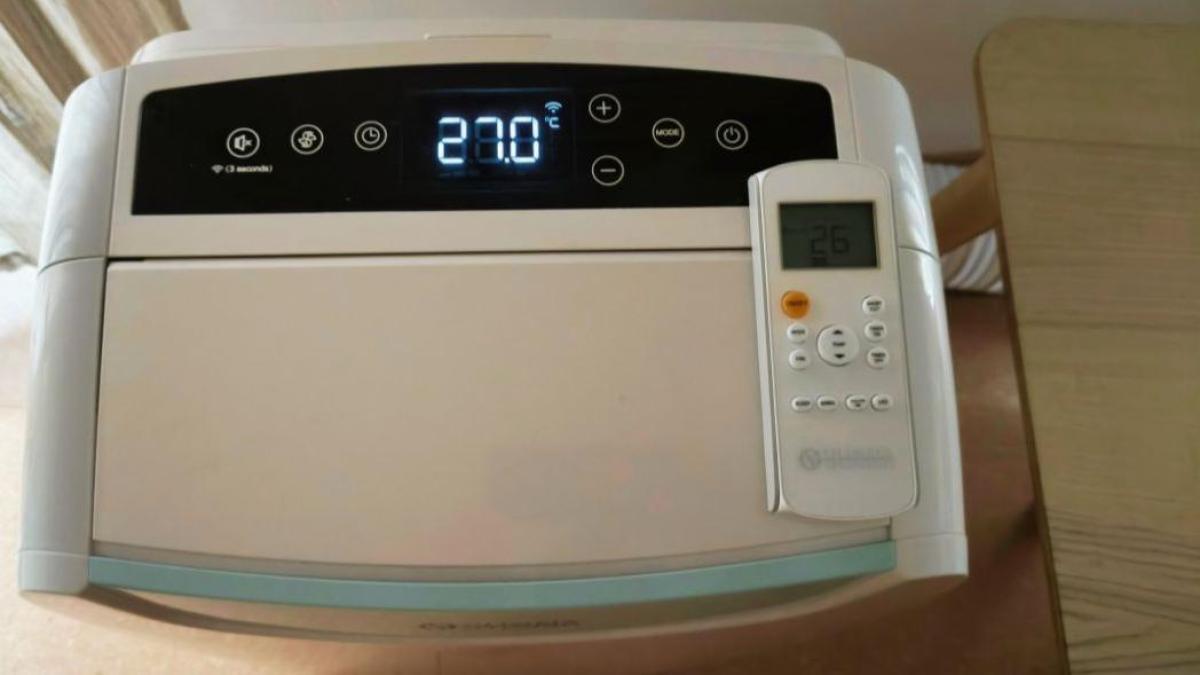
There are products you test calmly and others that win you over (or disappoint you) in the heat of the moment. This Dolceclima Air Pro 13 A+ NW arrived home right during a heatwave week in Catalonia, the kind of days when the floor starts to warm up in the early afternoon and it’s hard to drop the temperature at night even with windows open, blinds down, and fans going.
And that’s where a portable air conditioner stops being a “summer” purchase and becomes a little home-survival tool. Not because it’s perfect, nor because it replaces a fixed split, but because it lets you cool a specific room without construction, without permanent installation, and with the option to move it if you need.
In this review I focus on what matters after trying it: how much it cools, how loud it is, whether the WiFi actually contributes, what living with the exhaust hose implies, and when it makes sense to pay around €450 for the product.
The exact model I tested is the DOLCECLIMA Air Pro 13 [A+ NW], a monoblock portable air conditioner from Olimpia Splendid with a nominal cooling capacity of 2.93 kW, advertised 13,000 BTU/h, A+ energy class, R290 refrigerant, built-in WiFi, OS Comfort app, 3 l/h dehumidification, and an exhaust hose of 150 mm in diameter and 1.5 m in length.
The Dolceclima Air Pro 13 A+ NW is worth it if you’re looking for a powerful portable air conditioner with WiFi and enough capacity to cool a specific room on very hot days. I’d especially recommend it for apartments where you can’t install a fixed split. I wouldn’t choose it if you need absolute silence for sleeping.
See price of the Dolceclima Air Pro 13 A+ NW
Veredict short
✔️ What’s best
- Cools more effectively than many small portable units thanks to its 2.93 kW and 13,000 BTU/h advertised.
- Energy class A+ and EER 3.1 place it well within its category.
- The built-in WiFi makes sense: being able to switch it on before you get home changes the experience.
- The 3 l/h dehumidification helps when the problem isn’t just heat but also muggy air.
- Design, LCD panel, remote control, and wheels make it more comfortable to use than other basic “penguin” units.
❌ What’s not
- It isn’t quiet: it lists 50-52 dB(A) of sound pressure and 62 dB(A) of acoustic power.
- Weighs around 32 kg, so “portable” doesn’t mean lightweight.
- The exhaust tube dictates where you can place it.
- Needs a well-sealed window to perform well.
- Above €500, it’s worth comparing carefully with other options.
In short, if you want portability with power, WiFi, and a real solution for a specific room, it’s a very complete option. If you’re after split-level silence or plan to move it around the house daily, it isn’t the ideal product.
Who it’s for and who it isn’t
Who it’s for
I find it especially interesting for renters, for spaces where fixed installation isn’t possible, or for cooling a specific area of the home during peak heat. In an apartment, it makes sense for a mid-sized living room, a large bedroom, or a home office that heats up in the afternoon.
I’d also recommend it to someone who wants a bit more than a basic portable unit. Here you don’t pay only for cooling: you pay for more power, A+ class, WiFi, app, remote control, dehumidification, and a somewhat nicer design. If you’ll use it many summer afternoons, those extras count.
WiFi is, in my view, more than a cosmetic add-on. Being able to switch it on a few minutes before arriving home was one of the most useful features. You switch it on from your phone, walk in, and the living room is already more comfortable. It doesn’t cool the entire home by magic, but it can make the room where it’s installed considerably more pleasant.
Who it isn’t for
I wouldn’t recommend it to someone seeking a silent experience like a fixed split. In a monoblock portable, the compressor is inside the room. That means noise is part of the deal. You can mitigate it with softer modes, but you can’t make it disappear.
Nor do I see it as the best device for moving around between rooms. It has wheels and side handles, but we’re talking about about 32 kg and a hose that must be placed in a window. It works much better if you leave it installed for weeks in the room where you need it most.
Yes for apartments without construction and serious heat; no for those who prioritize absolute silence or daily mobility.
Editorial note: 8.3/10
I give it an 8.3 out of 10. The score is high for power, features, and ease of use, but drops due to three clear format limits: noise, weight, and reliance on the exhaust hose.
- Performance: very good for a domestic portable unit, with 2.93 kW and 13,000 BTU/h advertised.
- Comfort: good if you leave it fixed in a room, less convincing if you want to move it daily.
- Noise: acceptable for living room or work, more delicate for sleep if you’re sensitive.
- Connectivity: WiFi adds real value because it lets you switch it on before arriving home.
- Price: worth it if you’ll use it a lot in summer and need the power.
In short, it’s a powerful and well-equipped portable air conditioner, but you shouldn’t buy it thinking it will be as silent, efficient, or unobtrusive as a fixed split.
Check availability before the next heat wave
If the Dolceclima Air Pro 13 A+ NW isn’t available or has become too expensive, it’s worth checking PcComponentes’ cooling offers. In peak season, stock for portable air conditioners moves quickly and sometimes interesting alternatives appear in fans, evaporative coolers, dehumidifiers, or portable models from other brands.
View ventilation and climate offers at PcComponentes
Everyday use
Installation, start-up and first 24 hours
The experience is defined first by the window. This Dolceclima needs to expel hot air outside through a flexible hose of 150 mm diameter and 1.5 m length. If you have a sliding window, it’s usually easier. If you have a tilt-and-turn window, you’ll likely need to spend more time sealing the outlet well.
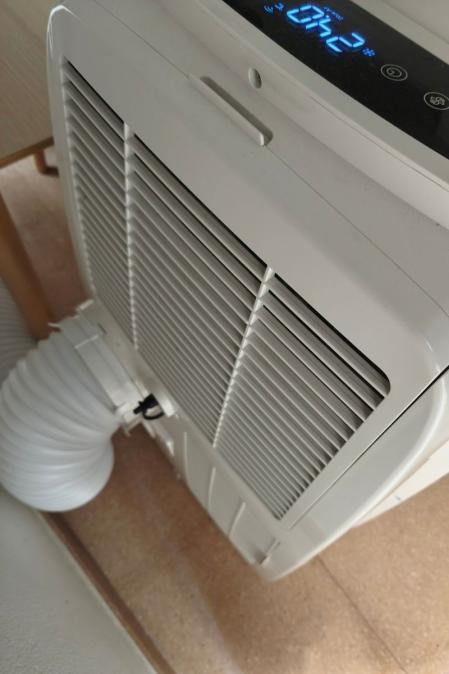
Here I encountered one of the product’s most improvable points: the instructions aren’t very clear. The guide relies heavily on small drawings, but some steps aren’t understood at first glance. And precisely the installation of the exhaust tube with the window adapter and its sealing is where more explanatory, visual, larger, or more detailed guidance would be welcome.
My recommendation is not to treat this step as secondary. The device may have enough power, but if hot air sneaks back in through a gap, part of the job is lost. This is where this portable AC really tests your experience: not in the power button, but in how the hose and window adapter are positioned.
At first start-up it becomes clear you’re not dealing with an evaporative cooler or a fan with an air-conditioning aesthetic. There is real compressor, real cold air, and real noise. The LCD panel and the remote help, but I would set up the OS Comfort WiFi as soon as possible, because it makes the most sense in this model.
Important note: the hose is not optional. If you don’t expel the hot air outside, the unit won’t be able to cool the room well. The outcome depends as much on the machine as on how well you resolve the window.
Setting up isn’t difficult, but you do need to do it with a bit of care.
Main use: cooling a specific room
The most sensible use is clear: choose a room, close doors, lower blinds if direct sun enters, and let it work. That’s how you get the most out of the Dolceclima Air Pro 13 A+ NW. If you place it in a space that’s too open, with hallways, kitchen, or entryways connected, you’re asking more of a portable unit than it should reasonably handle.
During the recent heatwave, I mostly used it to regain temperature control in the main living area. It doesn’t work miracles instantly, but it does noticeably change the sensation when you enter a previously stifling room. The air comes out cool, the flow is noticeable, and the automatic oscillation of the flap helps distribute the air more evenly without always pointing in one spot.
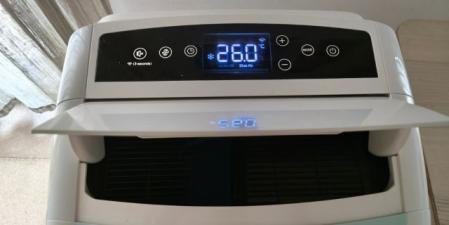
The Auto/Blue Air feature seems practical to avoid constantly fiddling with speeds. Eco mode makes sense once the room is more stable. Turbo would be reserved for the initial heat spike because it adds a sense of power but also makes the noise more noticeable.
It works best as the main air source in a room rather than as a portable device moved room by room.
WiFi: the feature I ended up using the most
Among all features, what convinced me most was the ability to turn it on remotely. It may seem like a minor detail until you try it on a hot day. You switch it on about 30 minutes before arriving home and, when you open the door, the room is already much more pleasant.
That change matters because it avoids the worst moment of a portable AC: arriving home to a hot house, turning it on, and waiting for it to take effect. With WiFi, you shorten that waiting time. For me, it’s the clearest argument to choose this model over simpler portable units.
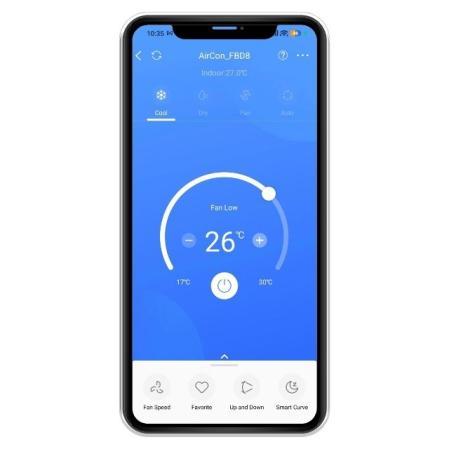
It’s also convenient if you’re on the couch, in bed, or working and don’t want to get up to change mode or temperature. But I insist: the differentiator is the remote control away from home.
That said, there’s a limitation to keep in mind: I didn’t manage to integrate it with voice assistants like Alexa or Google Home. There might be a workaround via external automations, but from normal OS Comfort app usage I didn’t find a way to control it by voice. In my case, the phone became the primary remote.
Important note: WiFi doesn’t compensate for a poor exhaust-tube installation or a too-large room. It’s a convenience feature, not a magical performance boost.
The WiFi is one of the clearest reasons to pick this model if you’ll use it daily in summer, though I wouldn’t buy it expecting complete smart-home integration with Alexa or Google Home.
Intense use: when the heat truly bites
When the heat is really on, you see the real limits of any portable unit. The Dolceclima Air Pro 13 A+ NW has muscle, but it still depends on insulation, room size, apartment layout, and how well the hot-air outlet is positioned.
Its 13,000 BTU/h advertised and 2.93 kW nominal capacity give it room to breathe compared to smaller portables. In a medium-sized room or a contained living area, you notice it’s not running at full capacity. But if you try to cool a larger open zone, with doors connected or a lot of sun, the effort increases and the result takes longer to arrive.
My sense is that it’s best used thoughtfully: close doors, prevent direct sun exposure, place it near a well-sealed window, and don’t wait until the room is at the limit to turn it on. If you switch it on earlier, it works better and doesn’t always have to run at maximum power.
Important clarification: I wouldn’t consider it a direct substitute for a fixed split for the whole home. It’s a powerful portable solution for a specific room, not a full climate-control system.
It has power, but shines best in a controlled room.
Design, size and ergonomics
The design stands out among many affordable portable units. It has a clean presence, an LCD panel, a remote, wheels, side handles, and an upper outlet with a motorized vent. It isn’t a small object, but visually it looks more refined than other more basic-looking “penguin” units.
The wheels help a lot for moving it around the same room or shifting it a few meters. The handles are also handy. But don’t be fooled: with about 32 kg, it isn’t a device you’ll carry up and down stairs or move between rooms several times a day.
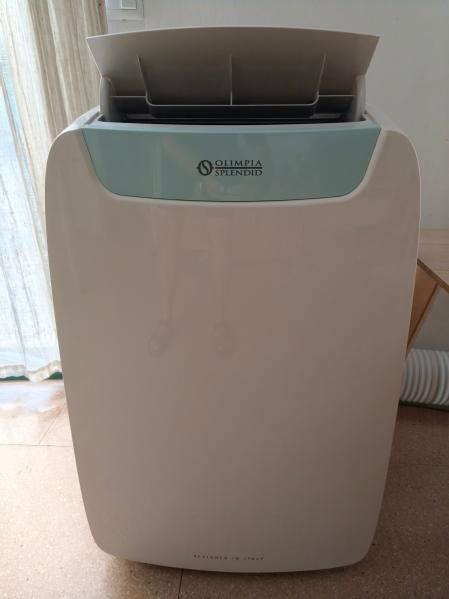
The hose is the element that most conditions aesthetics and placement. It’s 1.5 m long, so you can’t put it just anywhere. It must live relatively near a window. Also, the hose gets hot because it’s expelling hot air, which is normal but important if you’re tight on space.
Important note: “portable” means it doesn’t require fixed installation, not that it’s light. If you have little space or want to store it daily, its dimensions and weight may end up bothering you.
Well designed for its category, but you need to be clear where it will stay.
Performance and key features
The main function is cooling, and the official figures are solid for a portable air conditioner: 2.93 kW nominal capacity, 13,000 BTU/h advertised, energy class A+ and EER 3.1. In real-world use: it has more margin than a small portable unit to lower room temperature when the heat is on.
The dehumidification of 3 l/h also makes sense. In summer, often what gets overwhelming isn’t only the thermometer but the humidity. When the environment is humid, removing moisture helps the room feel more breathable.
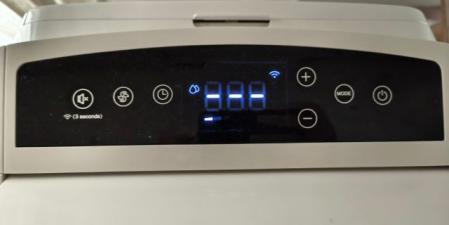
The main modes are pretty clear: Turbo for a strong kick when the room is very hot. Eco to keep a more reasonable temperature once you’ve cooled things down. Silent/Sleep to smooth operation when you don’t need maximum power. Auto/Blue Air to let the unit regulate flow without constant tweaking.
The Pure system combines an electrostatic anti-dust filter and an activated carbon filter for odors. I see it as an interesting extra, but I wouldn’t consider it a substitute for a dedicated air purifier. Its main job remains climate control.
Its features aren’t decorative: WiFi, Turbo, Eco, Auto, dehumidification, and filtration add value if you truly plan to use it during the summer.
Consumption, noise and heat
In terms of consumption, the A+ energy class and EER 3.1 are good news within the portable category. The EER indicates the ratio between the cooling delivered and the energy consumed: the higher, the better. Still, a powerful portable AC does not consume like a fan. If you use it for many hours during a heat wave, it will show on the bill.
The smarter way to use it isn’t always cranking it to max, but anticipating. Lower the blinds, close doors, and switch it on before you arrive or before the room is boiling; it will work better. In my case, turning it on about half an hour earlier from the app helped a lot to avoid pushing it to the limit all the time.
As for noise, honesty is key. The spec lists 50-52 dB(A) of sound pressure and 62 dB(A) of acoustic power. In a quiet living room you’ll notice it. In a living room with some background noise or street noise, it blends more as background sound. For sleeping, it will depend a lot on your sensitivity.
And then there’s the less technical but very real part: when it’s brutally hot outside, the sound of the air conditioner bothers you much less. It’s not that it disappears; your brain simply negotiates quickly and decides that staying cool is worth the noise.
Important clarification: Silent does not mean absolute silence. In a portable unit, the compressor is inside the room. If any hum wakes you, perhaps it fits better to cool the bedroom before going to sleep and turn it down or off at night. For all-night operation with minimal noise, a split remains a better option.
Also consider the heat of the hose. It’s expelling hot air, so it must be properly connected and sealed as well as possible. If there are leaks at the window, some heat returns and the unit works worse.
It consumes and sounds like what it is: a powerful portable air conditioner. The key is to anticipate and not always use it against a room that’s already overheated.
Check current price at PcComponentes
If this model isn’t available, you can check PcComponentes’ climate offers: during peak heat, portable air conditioners, fans, evaporative coolers, and other portable models from various brands often appear as compelling options.
View climate deals at PcComponentes
FAQ about the Dolceclima Air Pro 13 A+ NW
Does the Dolceclima Air Pro 13 A+ NW cool a living room?
Yes, it can cool a medium-sized living room if it’s well insulated, with doors closed and the hose correctly installed. I wouldn’t use it for large open spaces. Its 2.93 kW and 13,000 BTU/h advertised help, but the result depends a lot on sun, window, and real volume.
Is the Dolceclima Air Pro 13 A+ NW quiet?
It isn’t as quiet as a split. It lists 50-52 dB(A) of sound pressure and 62 dB(A) of acoustic power. In a living room it can be tolerable as background noise; for sleeping, it depends on your sensitivity. The Silent mode softens operation but doesn’t eliminate the compressor.
Does it require installation?
No construction or technician is required, but you do need to position the exhaust tube toward a window. This is key. If the outlet is poorly sealed, exterior heat will enter and performance will drop. In tilt-and-turn windows you may need an additional fitting.
How much does this portable air conditioner consume?
It has A+ energy class and EER 3.1, solid figures within the portable category. Yet, a 2.93 kW unit does not consume like a fan. Consumption depends on usage hours, outside temperature, insulation, and selected mode.
Is the WiFi app worth it?
Yes, especially if you want to switch it on before arriving. In my use, turning it on about 30 minutes earlier made a difference on the hottest days. It doesn’t boost the power, but it lets you reach a cooler room sooner.
Is it suitable for sleeping?
It works if you tolerate white noise and don’t need absolute silence. If you’re sensitive to sound, I’d use it to cool the bedroom before bed and then reduce intensity or switch it off. For all-night operation with minimum noise, a split remains a better option.
What maintenance does it need?
Basic maintenance involves cleaning filters, checking the air outlet, keeping the tube properly placed, and managing condensation according to use. It isn’t difficult, but it’s worth not neglecting: a dirty filter or a poor air exit can worsen performance.
Quick summary