
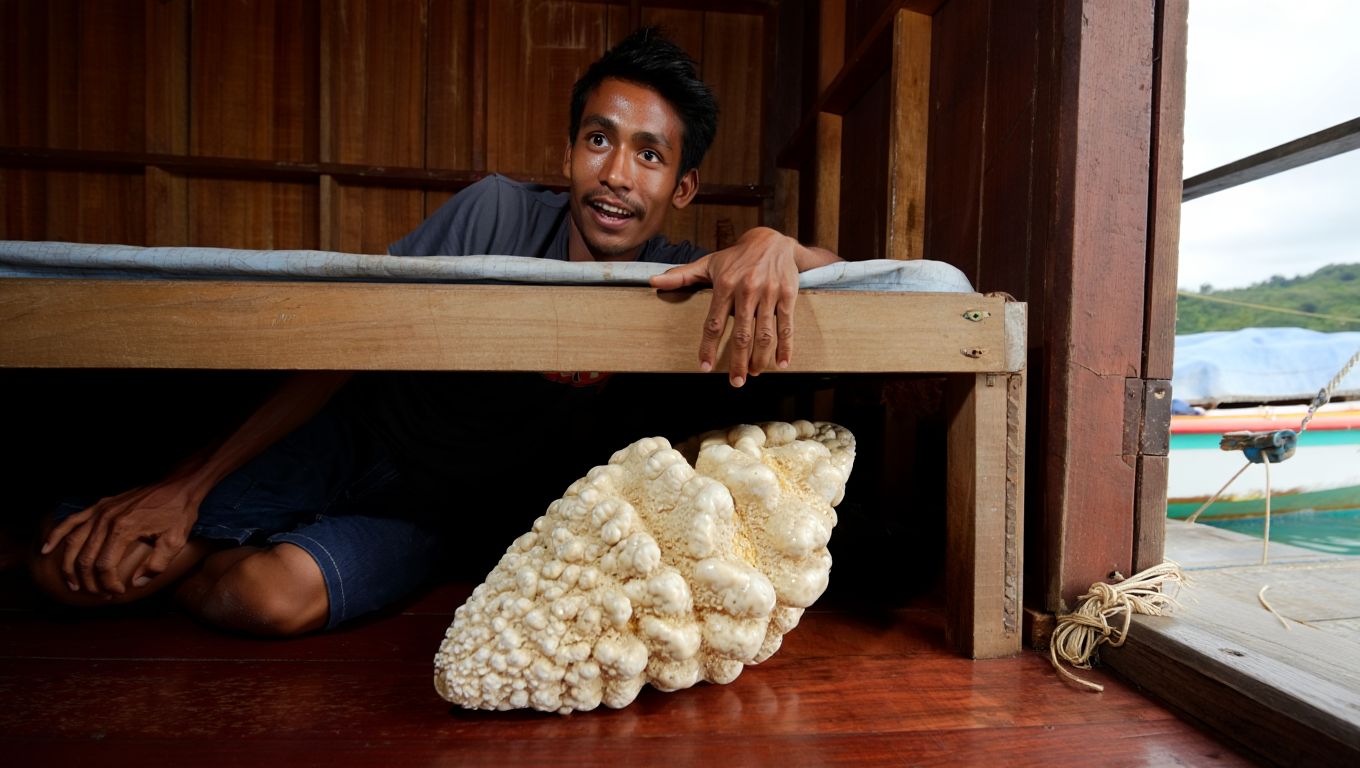
For nearly ten years, the object reportedly remained hidden beneath a bed in a fisherman’s home in Palawan. He did not know that he might be keeping one of the largest pearls ever found. To him, the huge, irregular mass brought up from the sea was a good-luck charm, not a treasure that would later be linked to a staggering $100 million estimate.
The story travelled around the world in 2016, but that headline figure needs an important warning. It was not a price paid at auction, nor was it a certified valuation. The sum was presented as a potential estimate while officials were still seeking independent gemologists to establish exactly what the object was and what it might realistically be worth.
An accidental discovery off Palawan
According to the account reported by The Guardian, an unnamed Filipino fisherman found the enormous object off Palawan. His anchor had become caught on a giant clam. When he tried to free it, he discovered the formation inside and took it home.
The fisherman did not immediately attempt to sell his discovery. Instead, he reportedly kept it beneath his bed as a good-luck charm for about a decade. Only when he was preparing to move house did he hand it to a relative connected with the tourism office in Puerto Princesa.
That was when local officials began to understand its extraordinary scale. The object was said to weigh roughly 34 kilograms and measure about 61 centimetres long by 30 centimetres wide. It was nothing like the small, round pearls normally set into jewellery.
Where the $100 million estimate came from
Officials in Puerto Princesa compared the find with the famous Pearl of Lao Tzu, another enormous formation from a giant clam with strong links to the Philippines. Because the Palawan object was considerably heavier, claims emerged that it could be worth as much as $100 million.
That comparison alone cannot establish a market price. A professional valuation would need to consider composition, authenticity, documented provenance, condition and whether collectors would actually compete for such an unusual object. A theoretical or publicity value is not necessarily the amount a buyer would be willing to pay.
Early reports made clear that officials still wanted specialist gemologists to examine the find. It is therefore accurate to say the object could have been worth $100 million according to the widely reported estimate. It would be misleading to claim that it was sold for that amount or officially certified at that value.
This was not an ordinary jewellery pearl
The familiar pearls used in necklaces and earrings are prized for their nacre, lustre, smoothness and regular shape. The formation found in Palawan was reportedly produced by a giant clam. It was massive and deeply irregular, looking more like a natural sculpture than a pearl that could ever be mounted in jewellery.
News reports and local officials commonly called it a pearl, but specialists distinguish between nacreous pearls and non-nacreous concretions produced by certain molluscs. That scientific distinction can have a major effect on commercial value, even when an object is exceptionally large.
Its dimensions nevertheless gave it clear scientific, cultural and tourism importance. Even without confirmation of the $100 million claim, finding a 34-kilogram formation inside a giant clam would be an exceptionally rare event. Its significance did not depend entirely on whether somebody was prepared to buy it.
Why the fisherman may not have suspected its value
The idea that such an object could sit under a bed for ten years sounds almost impossible. Yet the circumstances help explain it. The fisherman lived in a maritime region where giant clams were part of the local environment. The object did not resemble a polished jewellery pearl, while its extreme weight made it difficult to carry to a specialist.
He also seems to have given it sentimental and protective value. When something is treated as a souvenir or good-luck charm, its owner may have little reason to search for an auction price. It was the practical decision to move home, rather than a deliberate hunt for wealth, that reportedly brought the object to public attention.
The story is a reminder that value is not always visually obvious. A smooth, tiny pearl immediately suggests jewellery. A large, rough formation may instead look like an unusual piece of shell, especially to the person who recovered it from the sea without expecting a financial reward.
A local discovery that became a global phenomenon
Puerto Princesa officials presented the find as a potential attraction for Palawan. Reports said it was placed on local display while authorities sought to confirm its authenticity and determine whether it could rank among the largest pearls or clam concretions known in the world.
The story contains every element of an irresistible discovery: an anonymous fisherman, an accidental find, ten years beneath a bed and a theoretical sum equivalent to billions of Philippine pesos. But the essential qualification should never disappear from the headline: $100 million was a widely repeated potential estimate, not a verified sale price.
The most remarkable part may not be the money at all. An object kept simply as a lucky charm remained almost unknown for a decade before the outside world realised that it might have exceptional scientific, cultural and financial importance.