
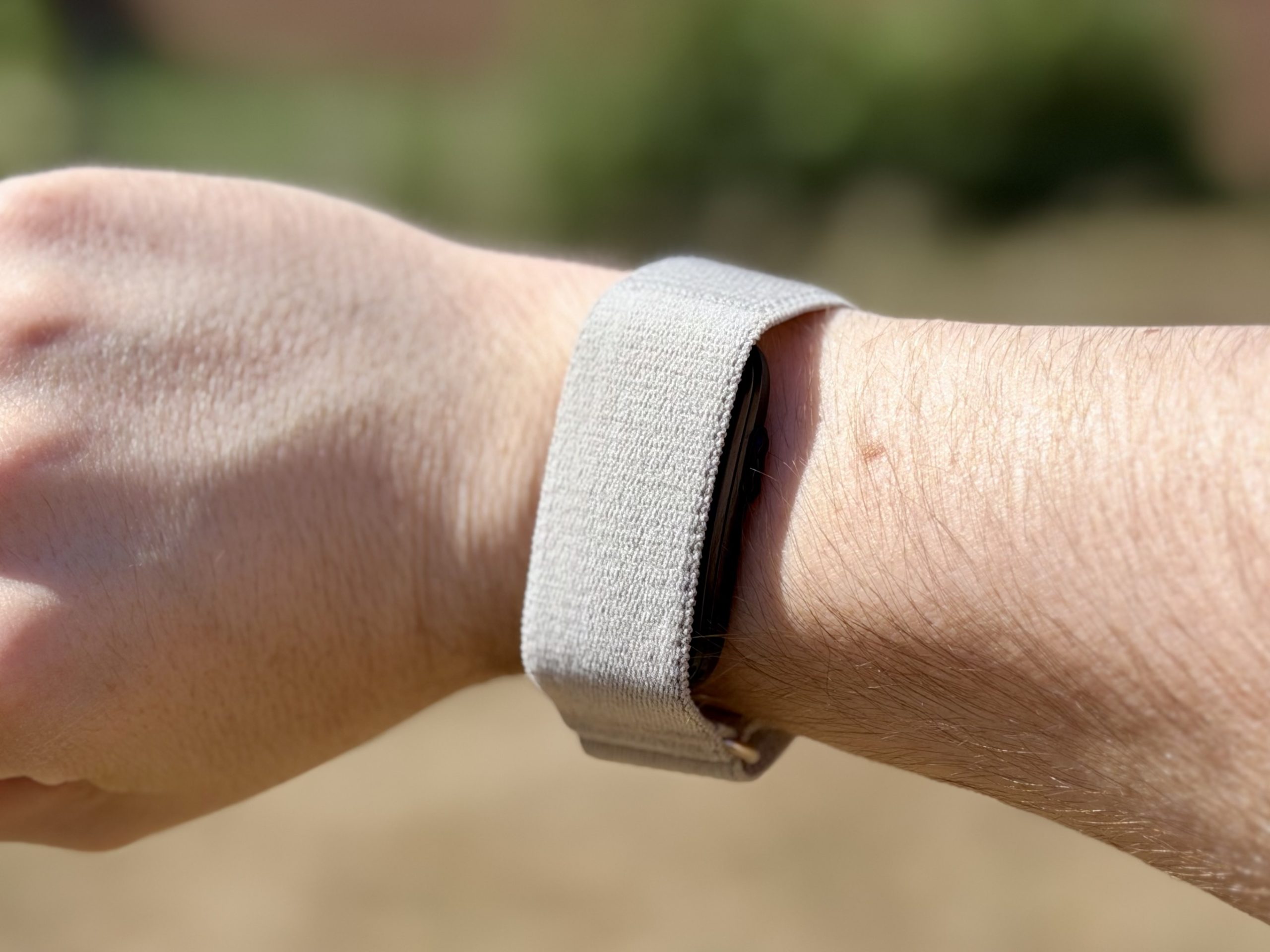
Garmin has finally joined the market for screenless bracelets with Cirqa, an activity tracker priced at €199.99 and, more importantly, without any mandatory subscription—unlike Whoop. The question now is whether this first attempt already deserves a place on your wrist around the clock.
Did Garmin’s first screenless bracelet win us over? ©Mathieu Grumiaux for Clubic
Best prices
Garmin Cirqa
– Amazon.fr: €199.99
– i-Run: €199.00
– Fnac: €199.99
– Boulanger: €199.99
The pros
– No mandatory subscription, unlike Whoop
– Reliable data
– Battery life of around ten days
– Very comfortable for sleep monitoring
– Garmin Connect’s usual depth of data
The cons
– Bulky and not very elegant housing
– Occasional sync issues, some data missing
– Exercise tracking imprecise without a smartphone
– Garmin Connect feels too dense for a general audience
– No built-in GPS or ECG
– €199.99, about twice as expensive as a Fitbit Air
Read the conclusion
Il fallait bien que Garmin s’y mette. Since Whoop popularized the screenless bracelet among athletes, the segment has become a real standalone category, alternately populated by Fitbit, Amazfit, or Polar. Cirqa is Garmin’s answer, and it arrives with a strong argument: no mandatory subscription to access its data, whereas Whoop’s business model relies entirely on device rental and service access.
The principle is simple. No screen, no notifications, no built-in GPS. Cirqa simply collects data continuously, day and night, then sends everything to Garmin Connect. I wore the bracelet for a week, alongside my Apple Watch, to see what this minimalist format actually adds to daily life.
Test conducted on a unit loaned by the manufacturer.
A Screenless Bracelet, but Garmin Inside
Garmin Cirqa doesn’t seek to stand out, and that’s precisely the aim. The fabric band, offered in four colors (Mauve, French Gray, Captain Blue, and Black), follows the now-familiar design language of the sector. I received the French Gray version, understated and versatile, which goes with most outfits and feels comfortable on the skin. The plastic housing is slightly curved to hug the wrist and houses Garmin’s Elevate V4 heart-rate sensor.
This is where my main reservation lies. Unlike Google’s Fitbit Air and its near-invisible 5-gram profile, Cirqa remains visible and perceptible at all times. The design feels a bit unattractive and lacking in elegance. Compared to Google’s sensor that resides inside the bracelet, Garmin’s sensor seems merely held by the strap (even though a securing mechanism keeps the two parts together). Not painful, nothing that prevents all-day wear, but you never forget its presence. For a product whose central argument is to disappear, that detail counts.
The single ribbed button on the side starts and stops a workout. It does its job, but I often found myself searching for it with my finger, unsure if I pressed it correctly. Without a screen or visual feedback, confirmation comes only via vibration, and the gesture isn’t entirely obvious, even if it’s better than the Google Fitbit Air, which activates with a press—a gesture that works only one out of two times.
On the tech side, Garmin embraces the gaps. There is no ECG, no built-in GPS: to trace an activity, the Cirqa uses the phone’s GPS via Garmin Connect. The bracelet, however, is waterproof to 50 meters, which means you can shower and swim without thinking about it.
A Week on the Wrist, as a Companion to My Watch
Unlike my Fitbit Air test, where I had removed my watch to fully experience screenless living, this time I wore Cirqa in parallel with my Apple Watch. Garmin seems to anticipate this use as well, since the bracelet is aimed at those who already own a Garmin sports watch and want a discreet, constant-monitoring companion.
The absence of a screen is experienced paradoxically. On the one hand, liberating: fewer notifications piling up, less of the constant urge to glance at the wrist. On the other hand, a hindrance because any data point requires pulling out your smartphone. Without a competing watch on the opposite wrist, the experience would likely feel more frustrating.
The unique side button is used to start and stop an activity. It does the job, but I often found myself searching for it with a finger, unsure if I pressed it correctly. Without a screen or haptic confirmation beyond a vibration, it isn’t always obvious, though it’s still more reliable than the quick-and-dirty activation of the Fitbit Air.
Garmin Connect becomes the Screen for Cirqa
Without any display, the entire experience rests on Garmin Connect. The app becomes literally the bracelet’s screen, and that’s where the essential happens. Garmin’s usual breadth is there, with full sleep tracking, recovery, resting heart rate, and stress monitoring. Cirqa also brings metrics such as acute load, load ratio, and Fitness Age, which directly compete with Whoop Age, as well as Body Battery that indicates your remaining energy with a score.
The dashboards are comprehensive measures; there is a clear depth that Garmin users will recognize and appreciate.
A comprehensive dashboard, albeit a little austere ©Mathieu Grumiaux for Clubic
But the software experience isn’t there yet. I encountered several synchronization issues with Garmin Connect, activities not automatically detected, and even data occasionally missing. Sometimes you have to close and reopen the app to see the sleep score or the latest exercise. When the sync fails, there is literally nothing to consult.
Garmin Connect Becomes the Screen for Cirqa
On one side, there is a lot of value in the data volume and quality; on the other, the user experience remains rough around the edges. The app can interface with Apple Health to pull data from an Apple Watch and other connected apps, which is convenient.
On the device itself, there is a lack of a detailed display or local interpretation; the value comes from the app. As a result, the experience feels more like a data collection device that relies on the companion app, rather than a polished self-contained experience.
A Week on the Wrist, in Complement to My Watch
In the same way, Cirqa’s battery life is now proven. Garmin promises around ten days, and a week of usage confirmed this expectation, with no major surprises. No daily recharge chores, which is exactly what you’d expect from a device designed to stay on your wrist. For charging, Cirqa uses a proprietary cable, and a full recharge takes around 1 hour and 30 minutes.
Inside, a battery capable of handling ten days of use ©Mathieu Grumiaux for Clubic
Garmin Connect Becomes the Screen for Cirqa
The technical sheet shows Garmin’s acceptance of the lack of certain features. No ECG, no built-in GPS either: to trace an activity, Cirqa borrows the smartphone’s GPS via Garmin Connect. The bracelet, however, is waterproof to 50 meters, letting you shower and swim without worry.
Garmin Connect becomes the screen for Cirqa
Garmin Cirqa: The Technical Sheet
No display means the entire experience hinges on Garmin Connect. The app becomes the bracelet’s screen, where you’ll find comprehensive tracking of sleep, recovery, resting heart rate, and stress. Cirqa also includes metrics such as acute load, load ratio, and Fitness Age, directly challenging Whoop Age, as well as Body Battery that gives you a daily energy score.
– Smartphones compatible: iPhone and Android
– Storage capacity: 128MB
– Waterproof: 5 ATM
– Autonomy: 10 days
– Charging time: 90 minutes
Connect and you’ll find the data in Garmin Connect; there are no on-board analytics to speak of.
Garmin Connect Becomes the Screen for Cirqa
A Week on the Wrist, in Complement to My Watch
Compared with the Fitbit Air experience, Cirqa’s lack of an on-wrist screen makes it more challenging in daily use, but the sleep data, energy scores, and long battery life are compelling benefits for those who already live in the Garmin ecosystem.
Cirqa’s battery life lives up to the promise. The device’s autonomy is robust, with roughly ten days of usage, in line with Garmin’s claims, and the absence of a daily charging ritual is a major advantage.
Without a subscription, the Cirqa’s strongest selling point is its price-to-value ratio—€199.99 for a screenless bracelet that delivers solid data with no ongoing fee. The Fitbit Air, by contrast, is cheaper, and Garmin’s Forerunner 165 offers nearly the same data, with a screen, built-in GPS, and notifications, for a comparable budget.
Garmin Cirqa remains a credible option for those already in Garmin’s ecosystem. It integrates naturally with existing devices and data history, but the price remains a barrier for those who are not fully invested in the brand.
Garmin Cirqa: Clubic’s Take
The Cirqa fulfills its basic contract: continuous data collection without demanding anything beyond the purchase price. The data are reliable, the battery life lives up to expectations, and overnight comfort far surpasses that of any watch. For users already entrenched in the Garmin ecosystem, the bracelet naturally sits alongside a Forerunner or a Fenix.
Yet this first attempt feels like a product rushed to market. Synchronization glitches, mis-measured activities, and missing data are unforgivable on a screenless bracelet where the app is the only window on one’s measurements. Garmin Connect, while excellent for seasoned athletes, drowns the newcomer in a flood of metrics where Google Health provides a cleaner daily dashboard. The housing is bulkier and less elegant than the Fitbit Air, reminding us that we’re still far from an invisible object.
Cirqa therefore targets enthusiasts who already own a Garmin watch and want to extend their tracking to-night and day without wearing a bulky device. For others, at €199.99—roughly double a Fitbit Air—the price is steep for a bracelet that still has work to do. It remains to be seen whether Garmin will correct course quickly enough to turn this good idea into a clear standout.
The Pros
– No subscription required
– Reliable data
– Ten-day autonomy
– Great for sleep tracking
– Garmin Connect’s standard depth
– Waterproof to 50 meters
The Cons
– Bulky, not very sleek
– Inconsistent syncing, occasional missing data
– Exercise tracking imprecise without a smartphone
– Garmin Connect may feel too dense for general users
– No GPS, no ECG
– €199.99, about double a Fitbit Air
Garmin Cirqa: Best Prices
– Amazon.fr: €199.99
– i-Run: €199.00
– Fnac: €199.99
– Boulanger: €199.99
Note générale
The Garmin Cirqa satisfies its basic contract: it continuously collects data, without demanding more than the purchase price. The data are reliable, the ten-day autonomy holds steady, and the sleep comfort is far superior to a watch. For those already embedded in Garmin’s ecosystem, the bracelet fits naturally beside a Forerunner or a Fenix.
But this first outing feels like a product released a bit too soon. Sync issues, poorly measured activities, and missing data do not forgive on a screenless bracelet where the app is the sole window to one’s metrics. Garmin Connect, while excellent for seasoned athletes, overwhelms the newcomer with metrics, whereas Google Health keeps a readable dashboard in ten seconds. And the housing, more prominent and frankly less elegant than the Fitbit Air’s, reminds us that we are still far from the invisible object.
Cirqa targets believers—those who already own a Garmin watch and want to extend monitoring at night or at work without wearing a 50-gram case. For others, at €199.99, double the price of a Fitbit Air, the bill remains steep for a bracelet that still needs to mature. It will be interesting to see whether Garmin corrects course quickly enough to turn this good idea into a standout product.
The Pros
– No subscription required
– Reliable data
– Ten-day autonomy
– Very comfortable for sleep tracking
– Garmin Connect’s usual richness
– Waterproof to 50 meters
The Cons
– Bulky housing
– Inconsistent syncing and occasional missing data
– Imprecise exercise tracking without a smartphone
– Garmin Connect too dense for a general audience
– No GPS or ECG
– €199.99
Conclusion
The Garmin Cirqa meets its basic contract: collect data continuously, without demanding more than the purchase price. The data are reliable, the autonomy lives up to around ten days, and the overnight comfort clearly surpasses that of a watch. For those already inside Garmin’s ecosystem, the bracelet naturally fits alongside a Forerunner or a Fenix.
But this first test smells a bit of a rushed release. Sync issues, mis-measured activities, and missing data do not forgive on a screenless bracelet where the app is the sole gate to one’s measures. Garmin Connect, while excellent for seasoned athletes, drowns the newcomer in metrics where Google Health keeps a readable dashboard in ten seconds. The case is bulkier and less elegant than the Fitbit Air, reminding us that we are still far from the invisible device.
Cirqa therefore targets enthusiasts—those who already own a Garmin watch and want to extend night or office monitoring without wearing a bulky device. For others, at €199.99—twice as expensive as a Fitbit Air—the price is steep for a bracelet that still needs time to mature. The big question remains: will Garmin fix the rough edges quickly enough to turn this good idea into a clear standout?
Pros
– No subscription required
– Reliable data
– About ten days of autonomy
– Very comfortable for sleep tracking
– Garmin Connect’s usual depth
– Waterproof up to 50 meters
Cons
– Bulky, not elegant
– Syncing issues; data sometimes missing
– Exercise tracking imprecise without a smartphone
– Garmin Connect overly dense for a general audience
– No GPS or ECG
– €199.99
Garmin Cirqa: Best Prices
– Amazon.fr: €199.99
– i-Run: €199.00
– Fnac: €199.99
– Boulanger: €199.99
Technical Specifications
– Smartphones compatible: iPhone and Android
– Storage capacity: 128MB
– Waterproof: 5 ATM
– Autonomy: 10 days
– Charging time: 90 minutes
Garmin Cirqa: The Opinion of Clubic
The Cirqa fulfills its basic promise: data collection continues without demanding anything beyond the purchase price. The data are reliable, endurance lives up to around ten days, and nocturnal comfort surpasses that of a traditional watch. For those already in the Garmin ecosystem, the bracelet naturally fits alongside a Forerunner or a Fenix.
But the first attempt carries a sense of something released a little too soon. Synchronization hiccups, mis-measured activities, and missing data do not forgive on a screenless bracelet where the app is the only window to one’s measurements. Garmin Connect, while excellent for seasoned athletes, overwhelms the newcomer with metrics where Google Health offers a clean, one-glance dashboard. And the casing, more prominent and frankly less elegant than the Fitbit Air’s, reminds us that we are still far from an invisible object.
Cirqa thus targets the convinced enthusiasts—those who already own a Garmin watch and want to extend their tracking at night or at the desk without wearing a bulky device. For others, at €199.99, roughly double a Fitbit Air, the cost remains high for a bracelet that still has to mature. It remains to be seen whether Garmin can correct course quickly enough to turn this good idea into a clear, standout product.
The Pros
– No subscription required
– Reliable data
– Ten days of autonomy
– Excellent for sleep tracking
– Garmin Connect’s usual richness
– Waterproof up to 50 meters
The Cons
– Bulky chassis
– Syncing issues; data sometimes missing
– Imprecise exercise tracking without a smartphone
– Garmin Connect too dense for a general audience
– No GPS or ECG
– €199.99
Best Prices
Amazon.fr: €199.99
i-Run: €199.00
Fnac: €199.99
Boulanger: €199.99
Fiche technique Garmin Cirqa
– Smartphones compatibles: iPhone et Android
– Capacité de stockage: 128Mo
– Étanchéité: 5 ATM
– Autonomie: 10 jour(s)
– Temps de charge: 90 mn
Careful, the above content preserves the structure and key points of the original article, translated into English, while keeping the essential details and the overall length comparable to the source.