
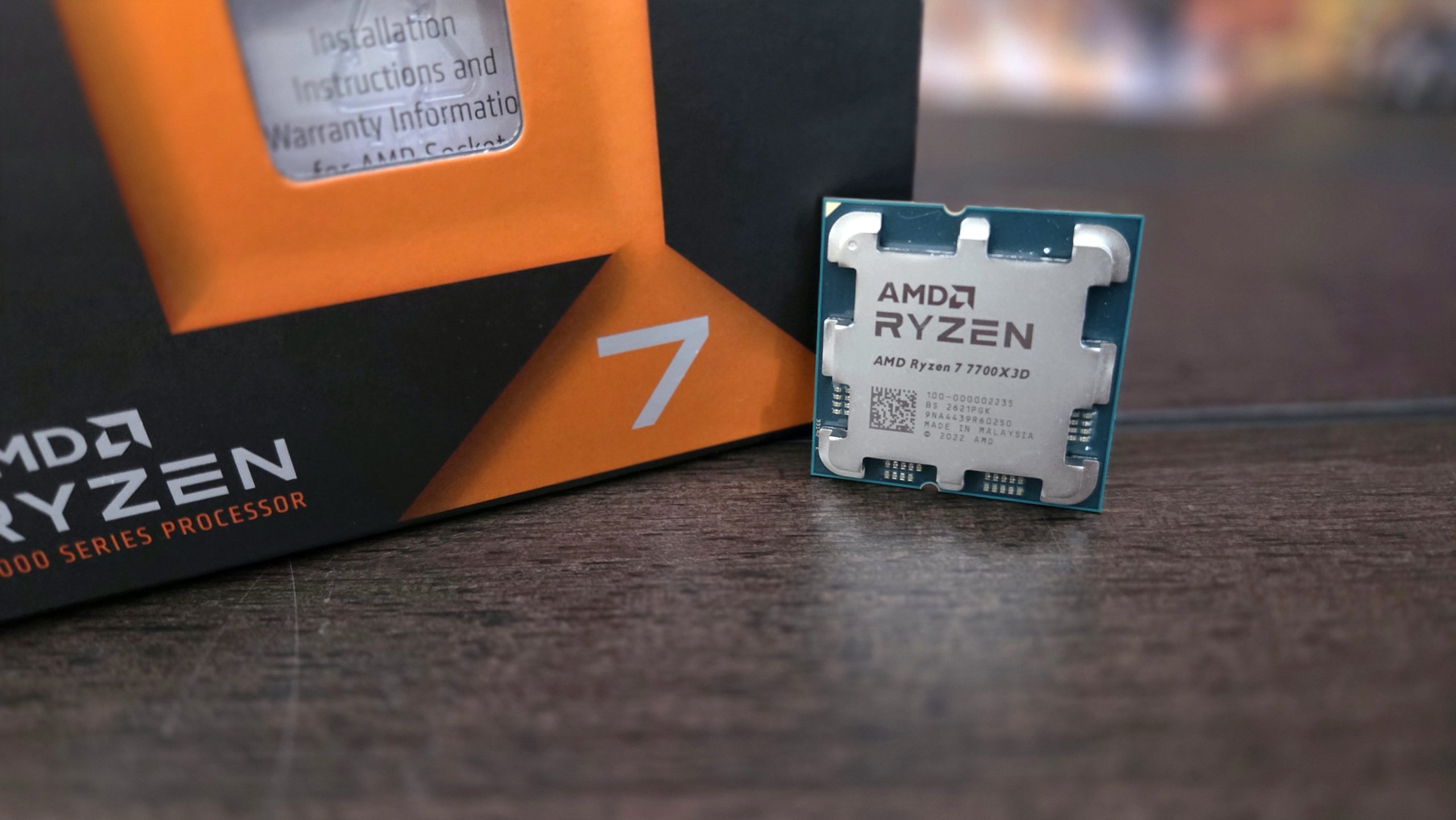
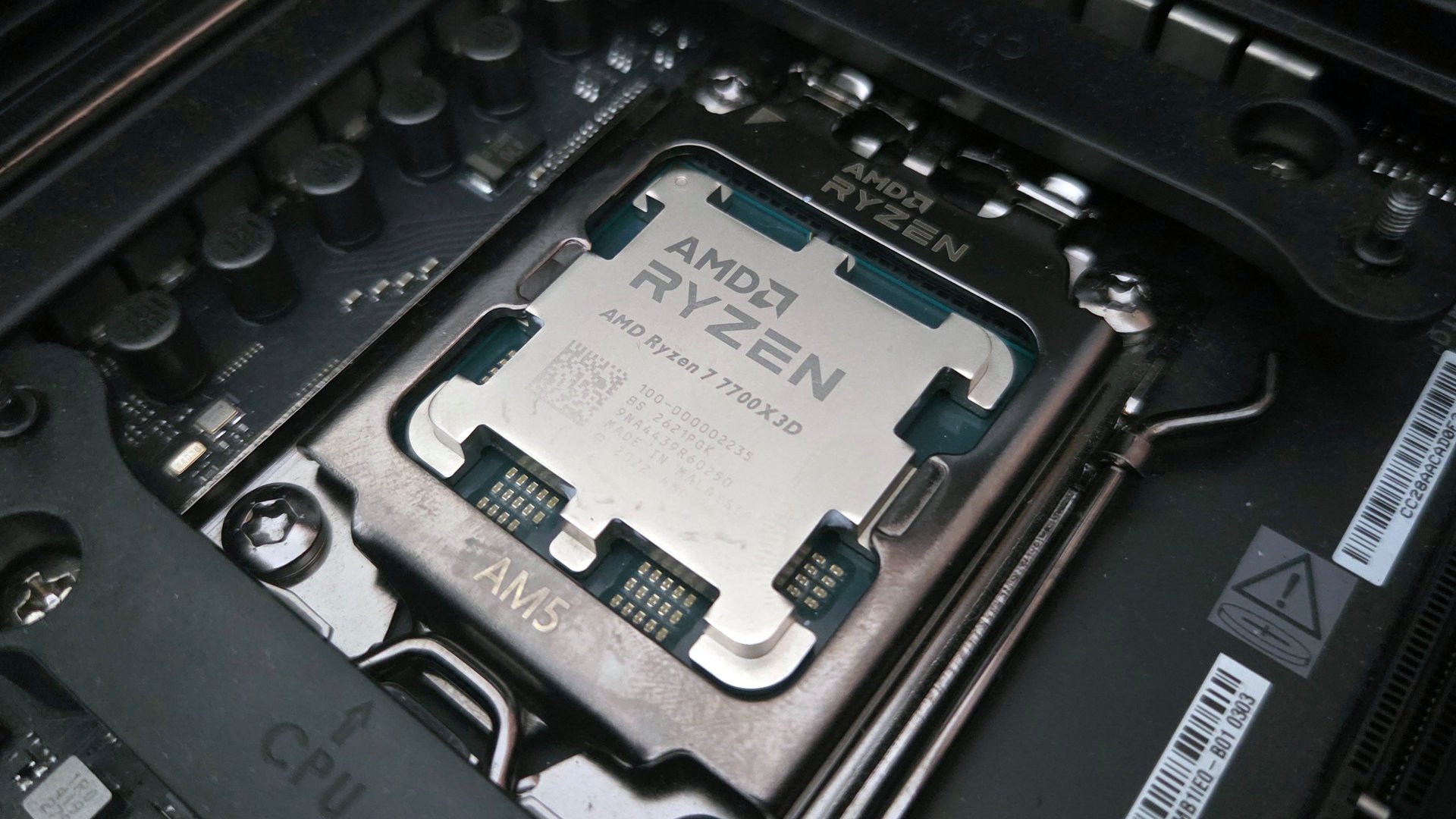
Let’s be honest, we didn’t really expect this Ryzen 7 7700X3D. While AMD is pushing its new Ryzen 9000 generation with Zen 5 architecture, this is clearly a Zen 4 processor arriving to us in the sweltering heat of the summer 2026. Will it make the competition sweat?
7 / 10
Best Prices
amazon.fr
GrosBill
RDC
Cybertek
View more prices
- Excellent results in gaming
- Application performance lag
- Boost 500 MHz below 7800X3D
- No overclocking gains
You’re used to it, we won’t go into detail about the Zen 4 architecture of the Ryzen 7 7700X3D. In this article, we focus on its performance. We invite you to (re)read our test of the Ryzen 7 7700X to understand the architecture signed by AMD. A quick stroll through the Ryzen 7 5800X3D test will teach you more about X3D technology.
Eight Zen 4 cores and 96 MB of X3D cache… still
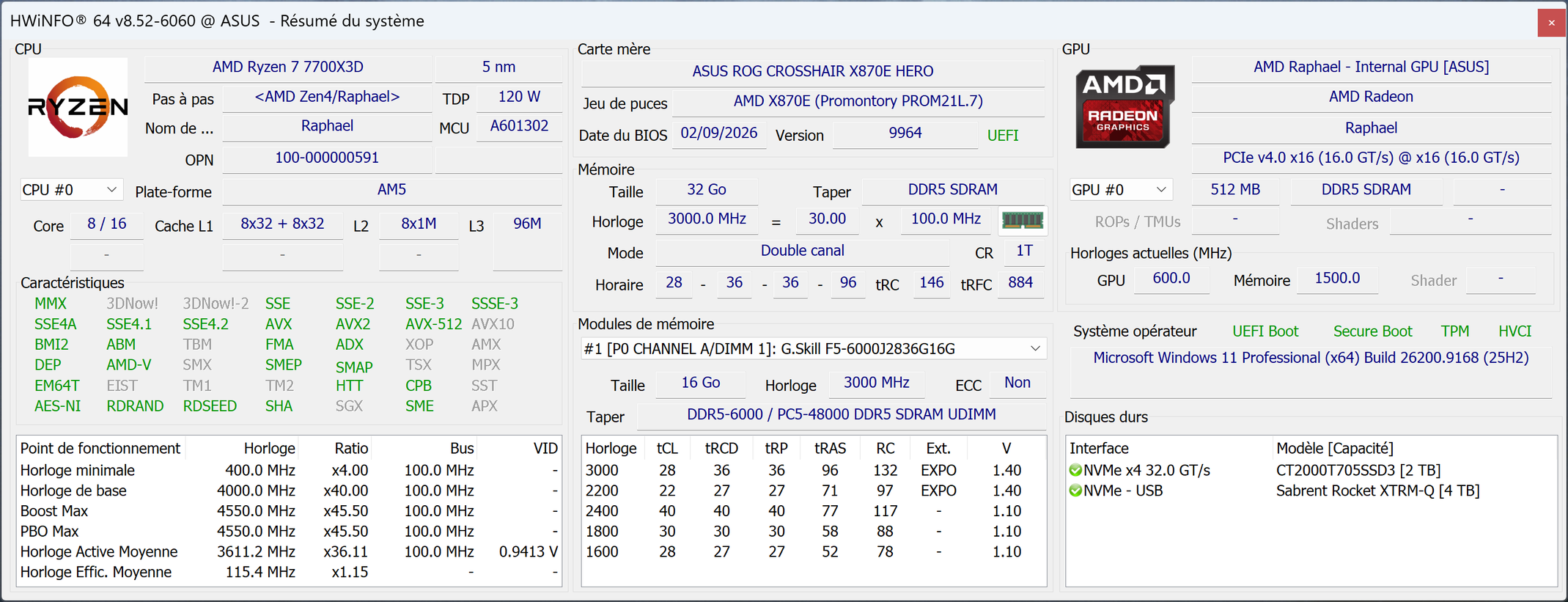
For every new processor tested in our pages, we usually include an essential technical monologue aimed at clarifying how the beast is designed. For the Ryzen 7 7700X3D, this monologue will be considerably shorter than usual, and there’s a good reason: this “new” processor is remarkably close to the Ryzen 7 7800X3D that was released more than three years ago.
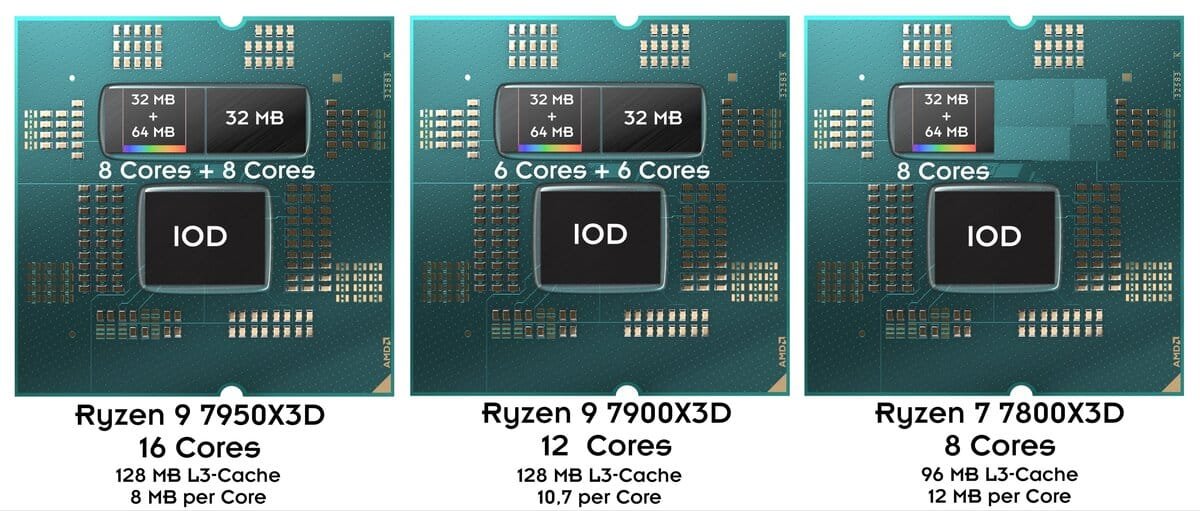
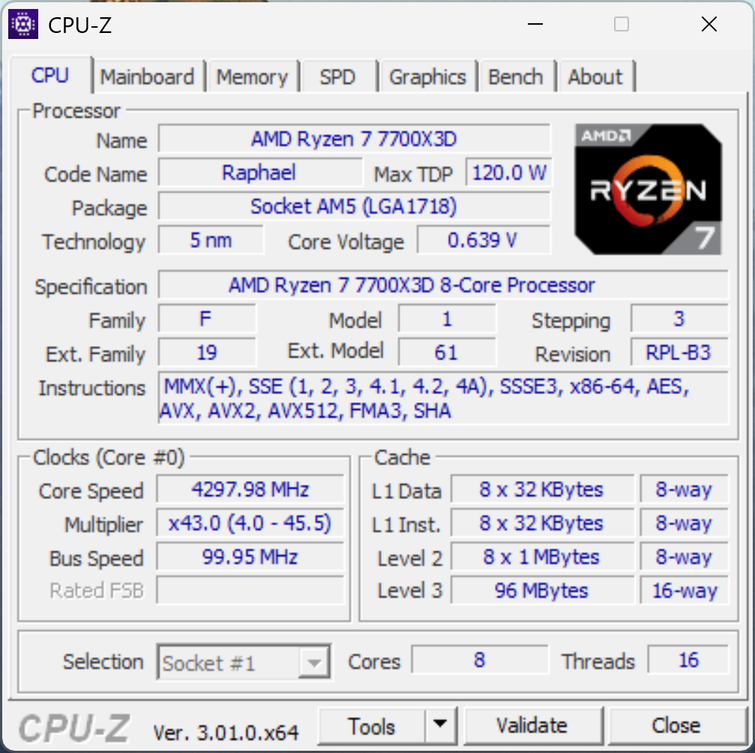
Same architecture, same core count (8) and thus the same number of threads (16). The processor is logically organized in the same way with a single CCD die to group the eight cores, this die being topped by the essential X3D die to house the famous 3D-Vertical Cache that has made this family of chips famous. As with the Ryzen 7 7800X3D, the L3 cache is thus raised to 96 MB.
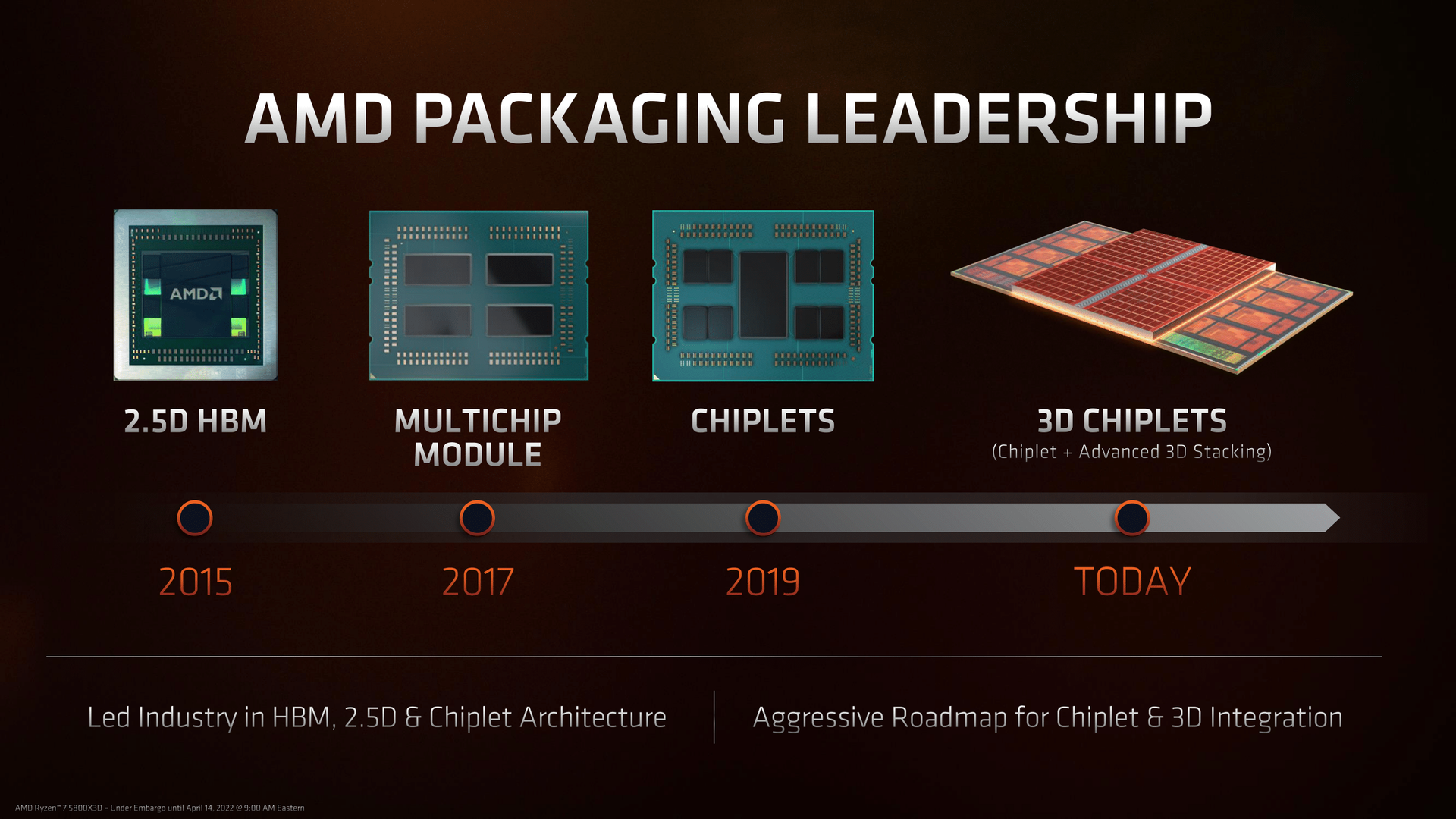
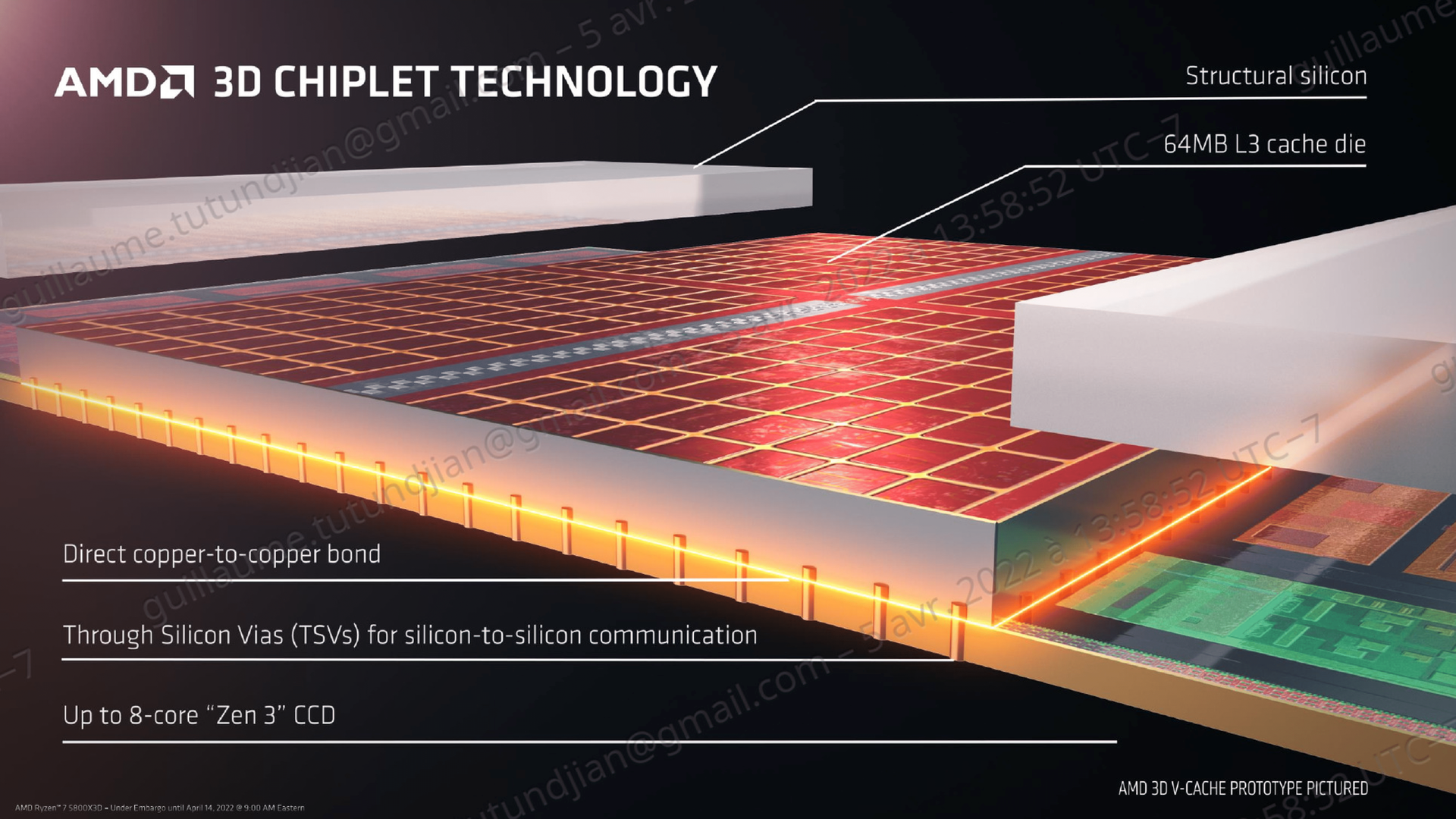
AMD’s 3D chiplet technology has enabled this X3D cache integration. ©AMD
This X3D cache sits on the CCD and not beneath it as with the pioneer, the Ryzen 7 5800X3D. AMD notes that this allows better thermal dissipation. In short, that’s the tour of the house… Oh wait, there’s a big change between the 7700X3D and the 7800X3D: while both chips have a 120-watt TDP, the latter can boost up to 5 GHz, whereas our day’s tester is limited to 4.5 GHz.
Test Protocol
Verifying the Ryzen 7 7700X3D’s performance involves comparing it with a variety of CPUs including some Intel 14th-generation chips, the latest Core Ultra 5, as well as the Ryzen 7 7800X3D and 9800X3D. A range of CPUs implies a variety of configurations.
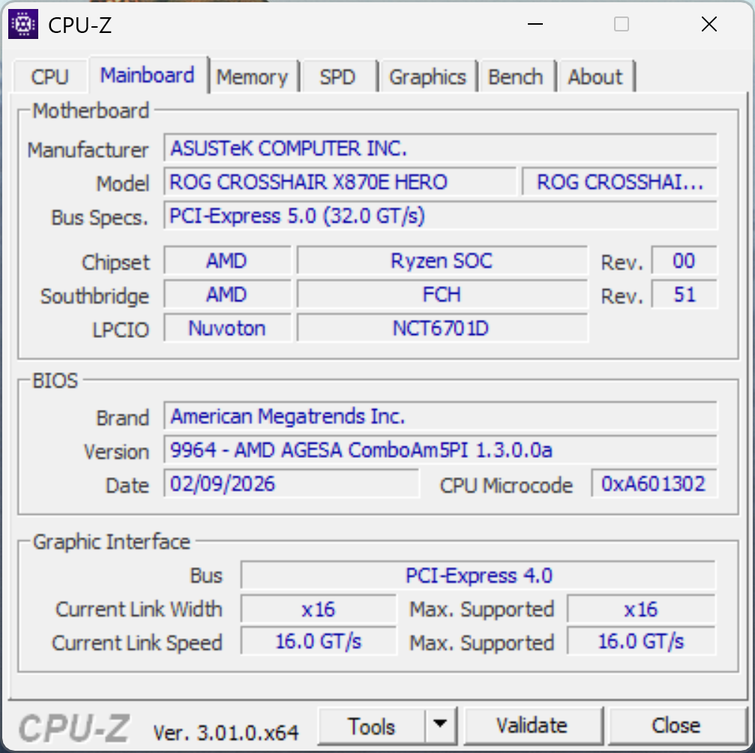
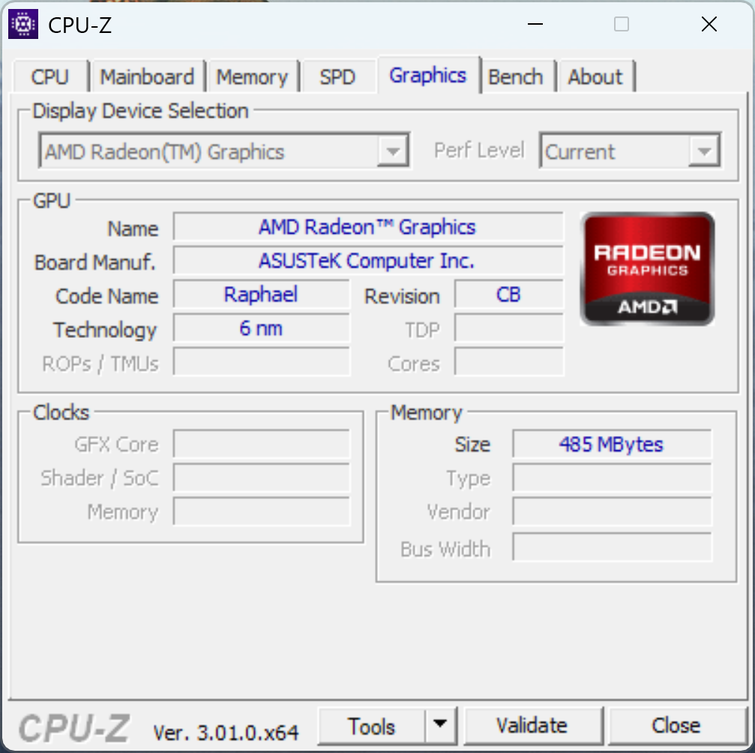
Socket configuration LGA1718 “AM5”
- Motherboard: ASUS ROG Crosshair X870E Hero (BIOS 2103)
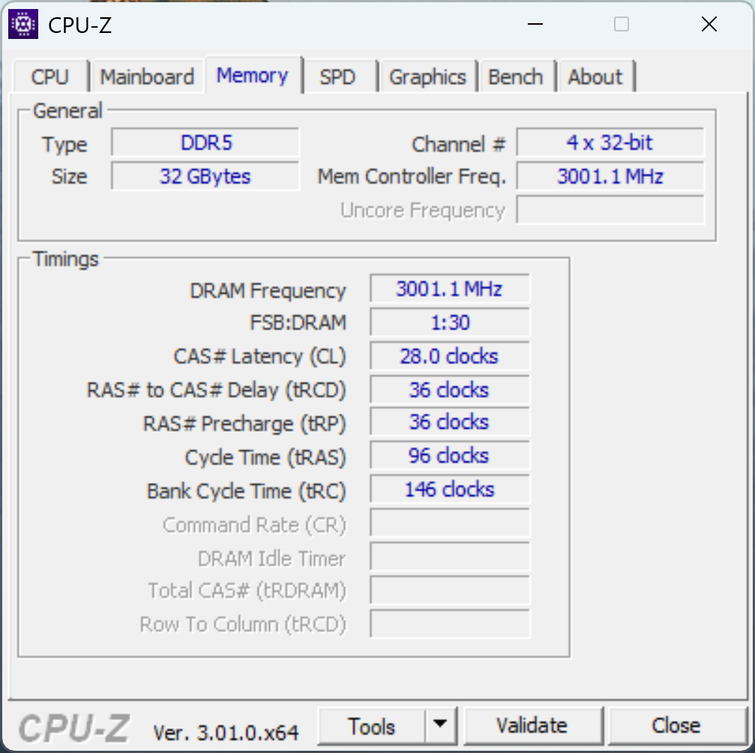
- Memory: G.Skill Trident Z5 Neo DDR5-6000 CL30 (2x 16 GB)
- Graphics: NVIDIA GeForce RTX 4090 Founders Edition
- System SSD: Kingston KC3000 2 TB
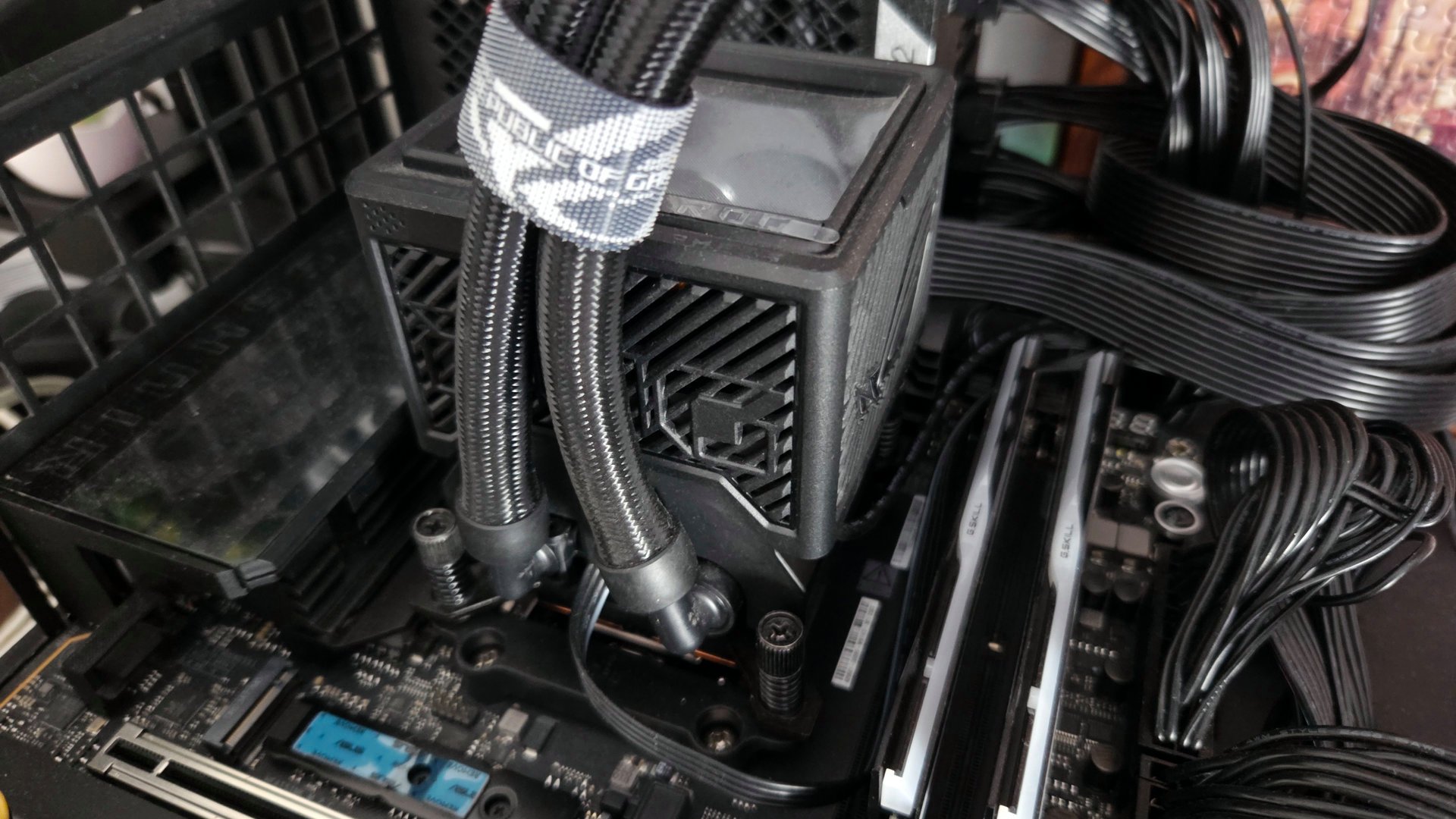
- Cooling: ASUS ROG RYUJIN III 360 ARGB Extreme
- Power supply: be quiet! Power Zone 2 (1200 W)
Socket configuration LGA1851
- Motherboard: ASUS ROG Maximus Z890 Hero (BIOS 3002)
- Memory: G.Skill Trident Z5 DDR5-7200 CL34 (2x 16 GB), G.Skill Trident Z5 DDR5-6400 CL30 (2x 16 GB)
- Graphics: NVIDIA GeForce RTX 4090 Founders Edition
- System SSD: Kingston KC3000 2 TB
- Cooling: ASUS ROG RYUJIN III 360 ARGB Extreme
- Power supply: be quiet! Power Zone 2 (1200 W)
Socket configuration LGA1700
- Motherboard: ASUS ROG Strix Z790-E Gaming Wi-Fi II (BIOS 2107)
- Memory: G.Skill Trident Z5 DDR5-6000 CL30 (2x 16 GB)
- Graphics: NVIDIA GeForce RTX 4090 Founders Edition
- System SSD: Kingston KC3000 2 TB
- Cooling: ASUS ROG RYUJIN III 360 ARGB Extreme
- Power supply: be quiet! Power Zone 2 (1200 W)
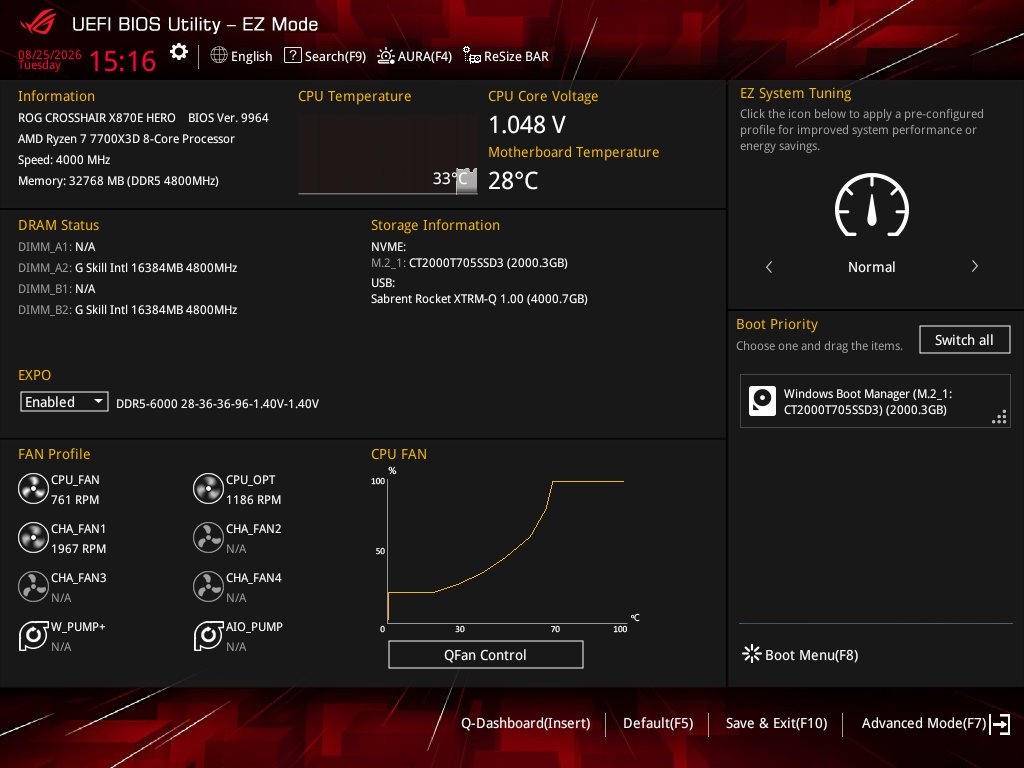
As much as possible, we prune memory-resident programs and ensure configurations are as close as possible, both hardware-wise and software-wise.
- Windows 11 Pro 64-bit 25H2 v26200.7840
- Intel chipset drivers v10.1.20266.8668
- AMD chipset drivers v8.05.04.516
- AMD graphics drivers v26.8.1
- NVIDIA graphics drivers v610.88
Finally, know that the tests presented hereafter are averages derived from several repetitions of each measurement. We also took care to discard the most extreme values.
How do Clubic processors tests?
Memory Tests
AIDA64
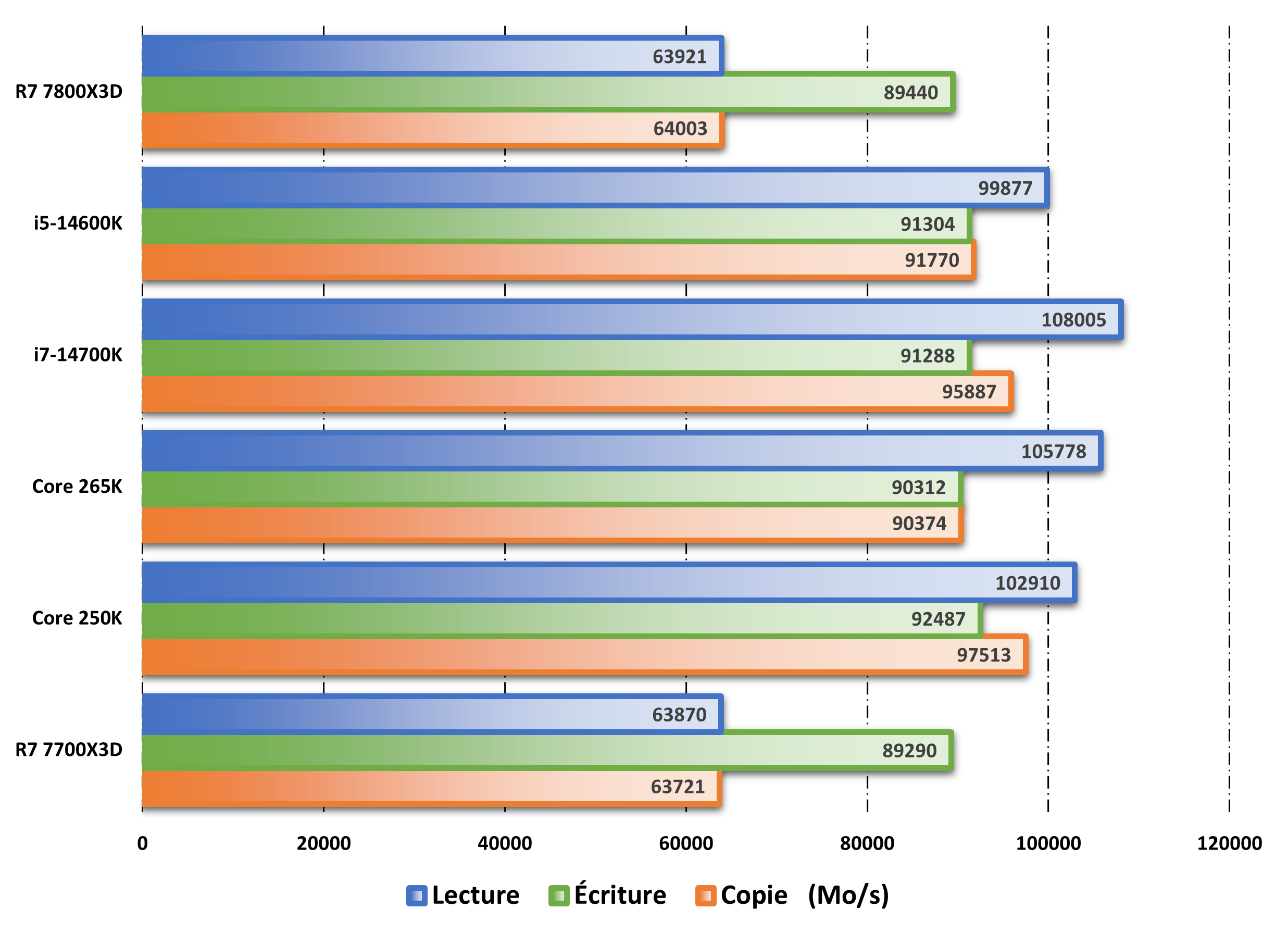
Since DDR5 has been developing, Intel has gained a definite edge on memory sub-system. Despite some software optimizations, it hasn’t changed much between the Ryzen 7 7800X3D and the Ryzen 7 7700X3D. The latter performs adequately, but the memory advantage for Intel chips is indisputable.
Application Performance
Cinebench 2024
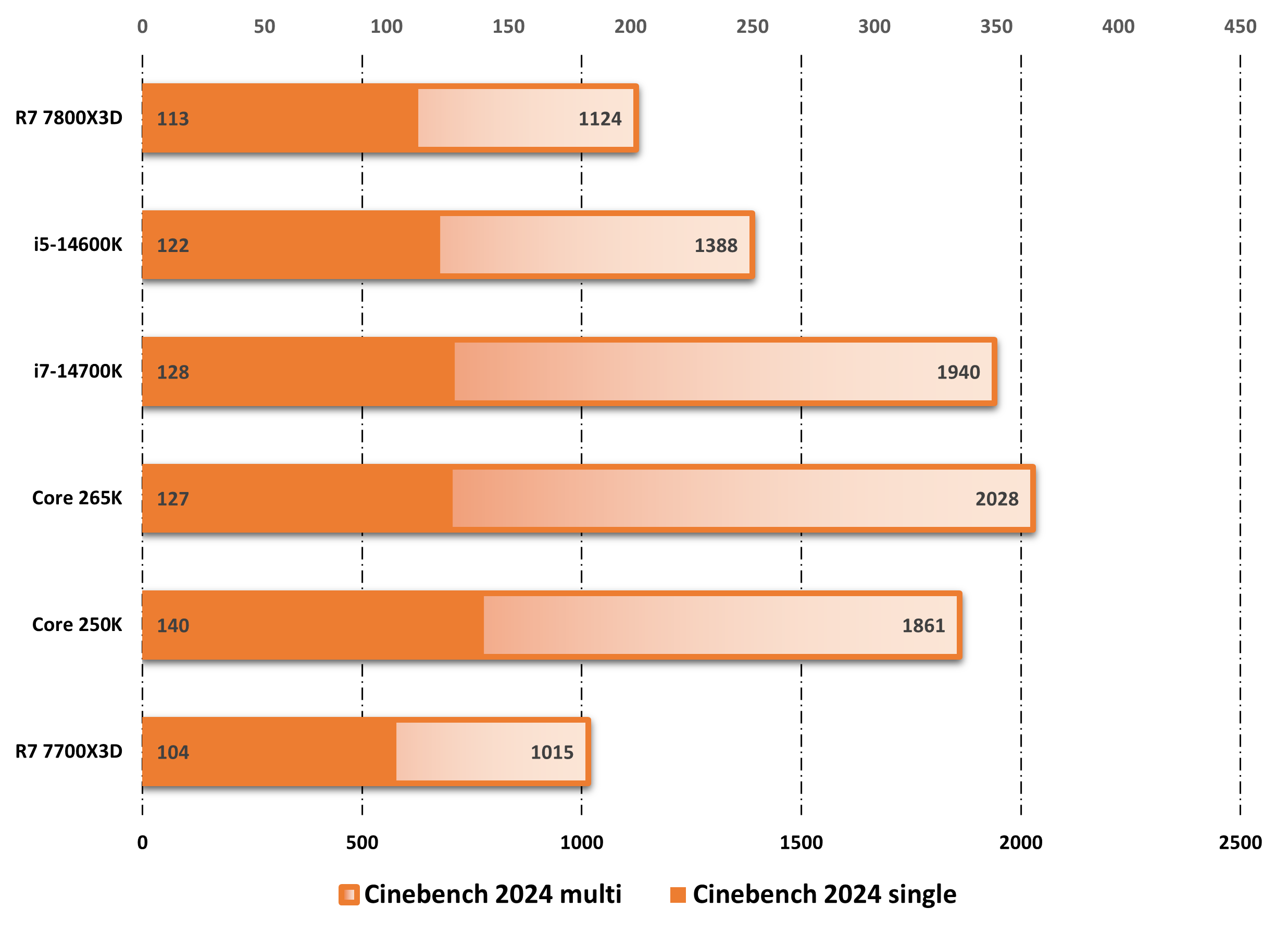
Other than the 500 MHz boost frequency gap, we don’t have a clear explanation for the single-thread gap observed between the two Ryzen 7000X3D chips. Clearly, Cinebench 2024 isn’t the playground where the 7700X3D shines most. In multi-thread, it isn’t any more convincing against its direct rivals.
Blender Benchmark
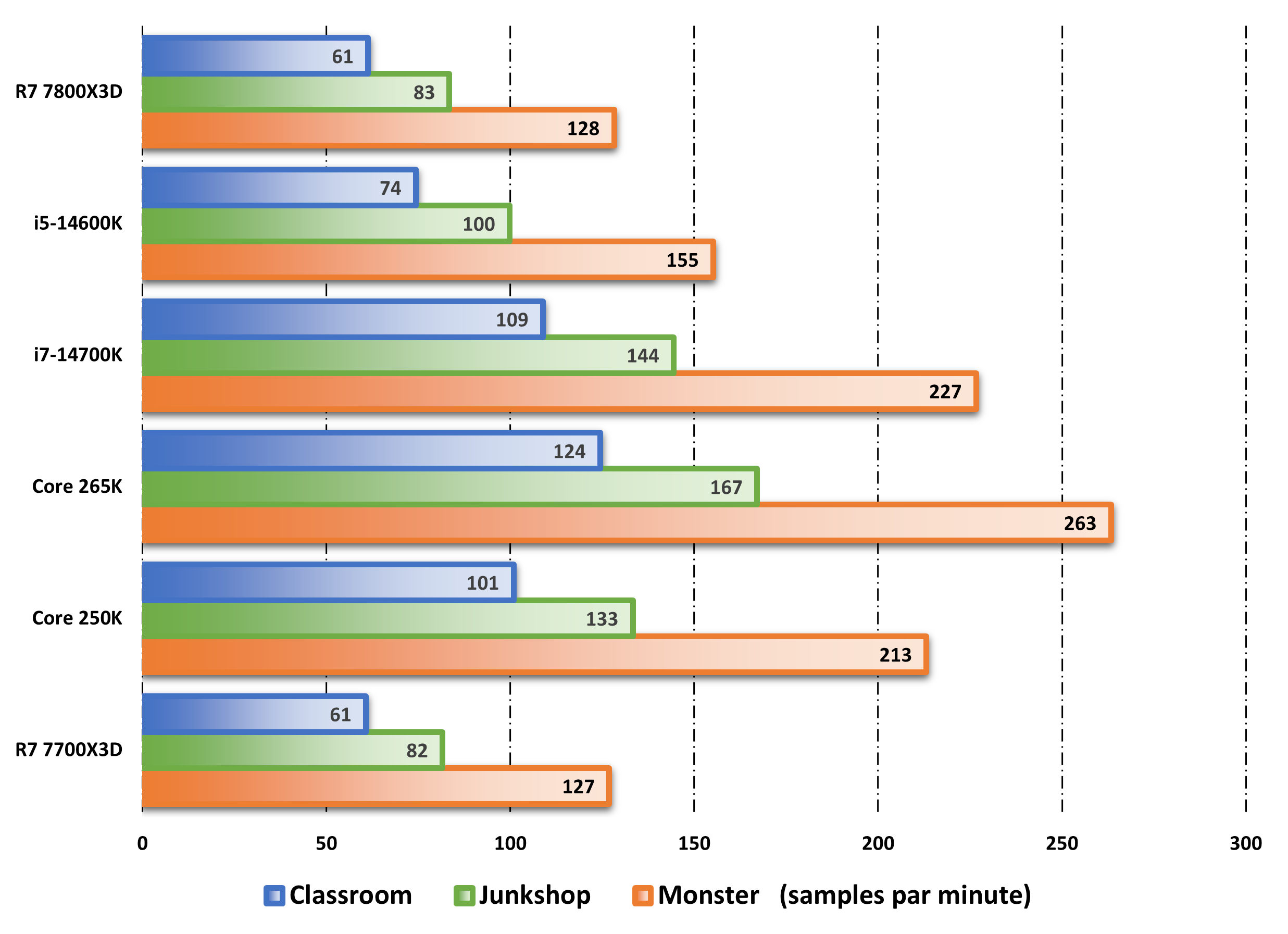
In Blender Benchmark, the gap between the Ryzen 7 7700X3D and its big brother, the 7800X3D, is practically non-existent. That’s reassuring for the newcomer, but it isn’t enough to make it shine against Intel’s 14th-generation chips and, even more so, against the Core Ultra 5 that lead the way.
HandBrake : video encoding
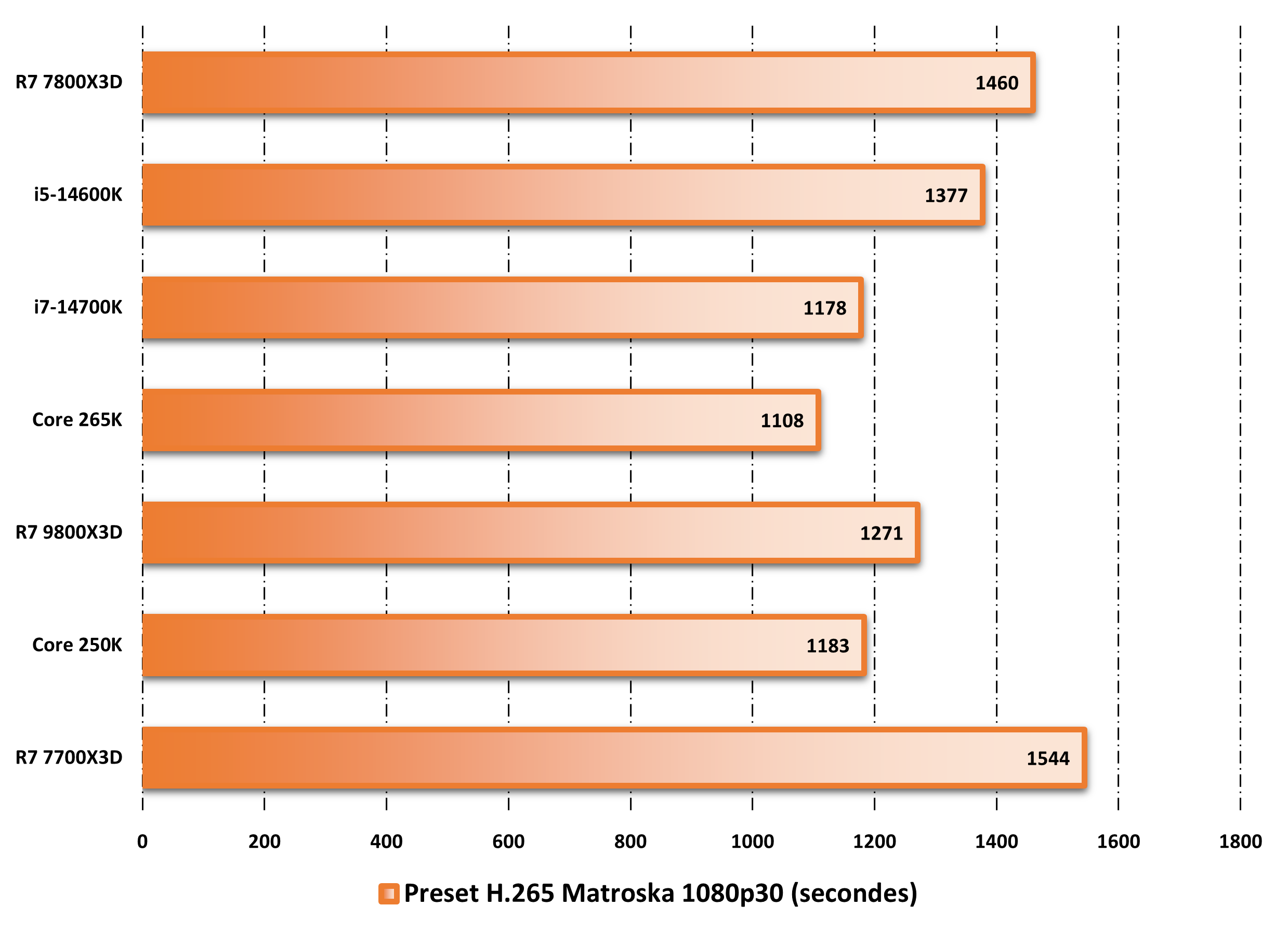
Encoding a video sequence a little over 50 minutes long (preset H.265 Matroska 1080p30) with Handbrake does not allow the Ryzen 7 7700X3D to shine any more. We’re beginning to accept that this isn’t a chip built for “production” scenarios. At least, it isn’t as comfortable as Intel’s Core Ultra 5.
WinRAR : file compression
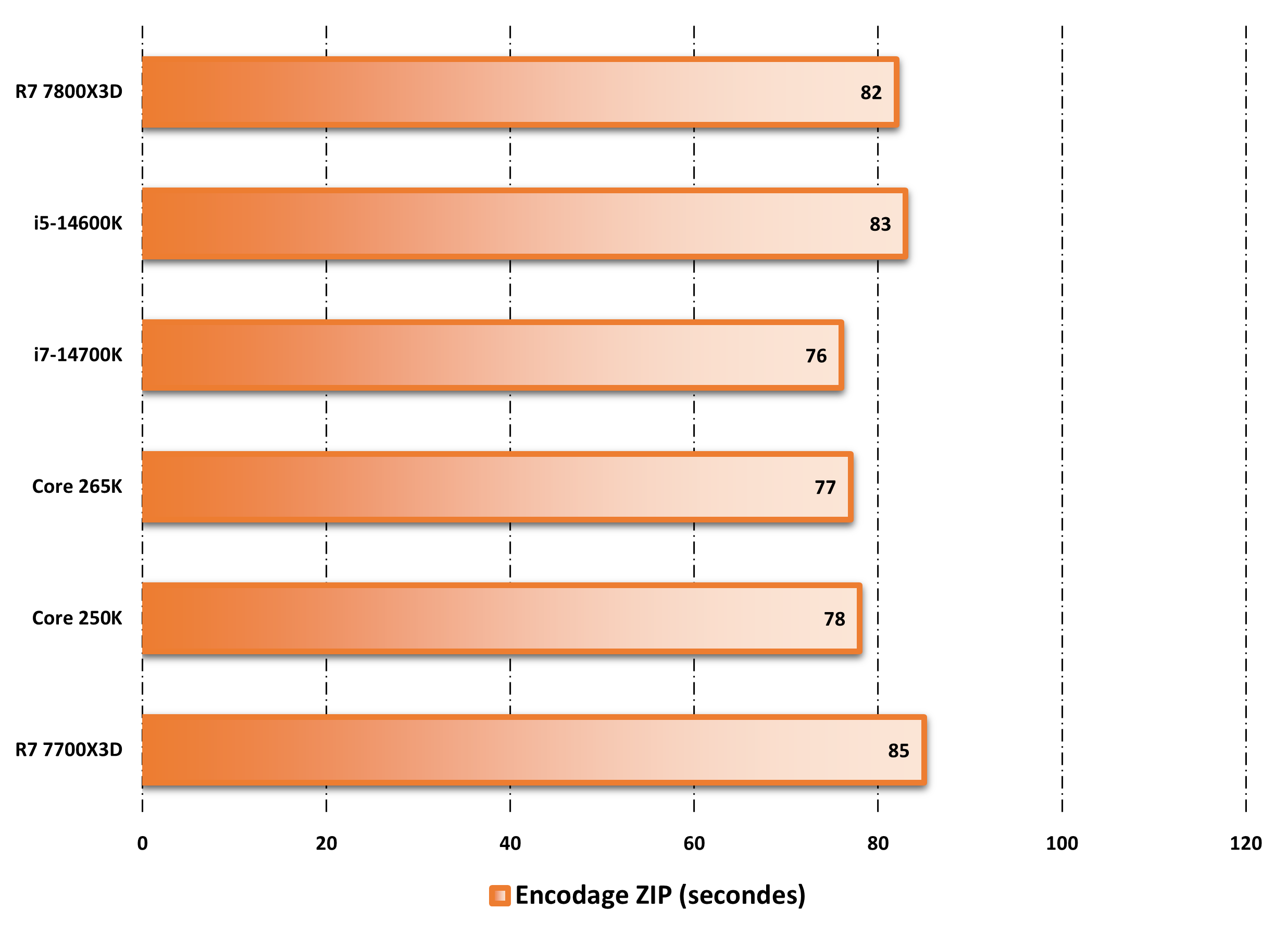
During our file compression test, the Ryzen 7 7700X3D falls behind. However, it remains behind the aging Core i5-14600K. Not exactly what you’d expect from a chip launched in 2026, even though it’s based on Zen 6.
PCMark
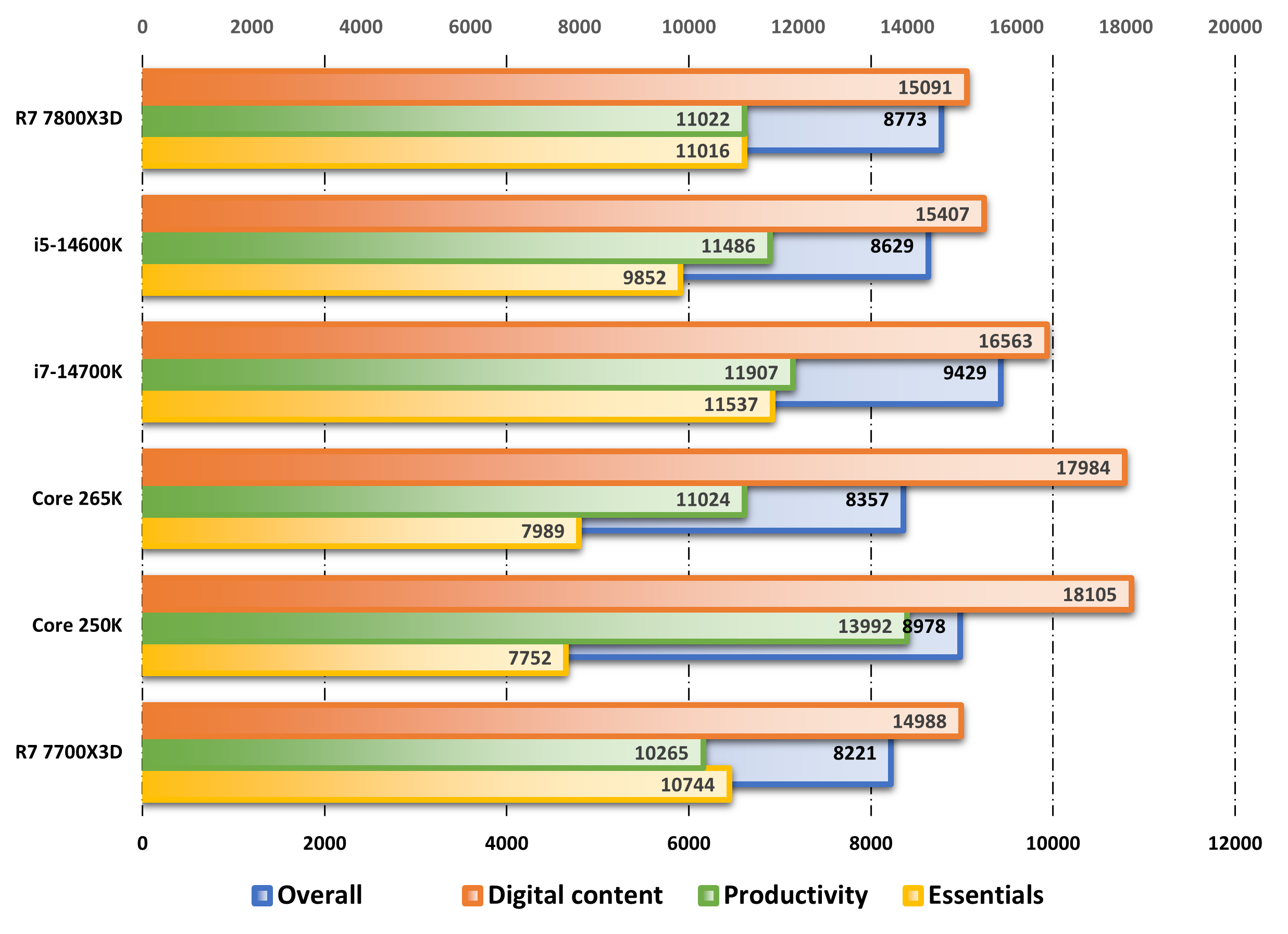
PCMark is a benchmark of choice because it simulates CPU usage across various scenarios. This is our latest “production” test and it confirms what we already think of the 7700X3D: it isn’t fond of these scenarios. In PCMark, the chip is kept afloat by the presence of our GeForce RTX 4090 which, through the Digital content test, pushes results upward. It however does not prevent gaps from widening compared to Intel’s Core Ultra 5s.
Gaming Performance
Cyberpunk 2077
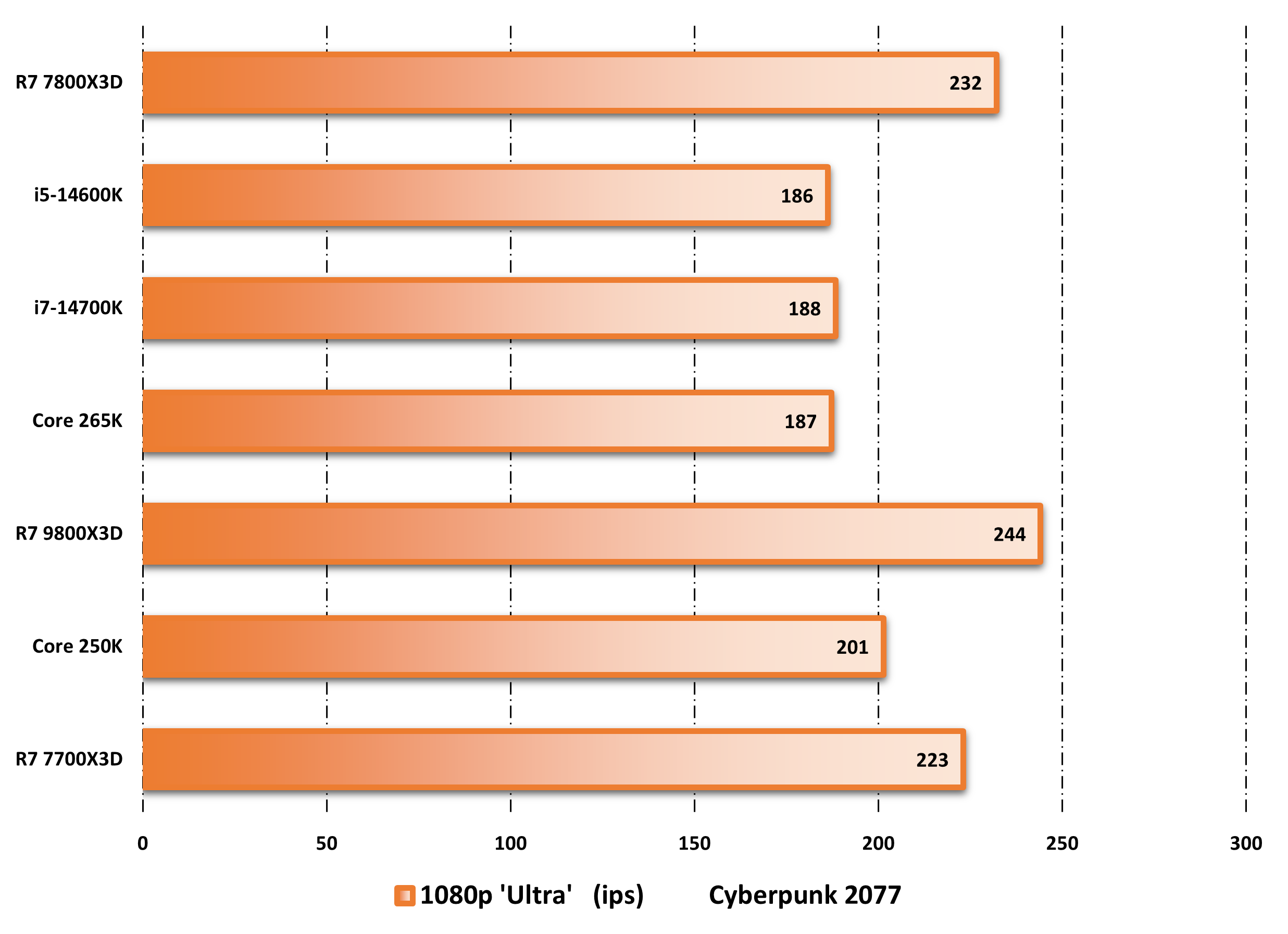
More than on applications, we obviously expected Ryzen 7 7700X3D to shine in gaming tests and, indeed, Cyberpunk 2077 starts off well. We likely feel the 500 MHz boost gap and the 7800X3D remains ahead of its little brother. However, the gap to Intel’s chips is notable, and even the very recent Core Ultra 5 250K Plus takes a hit… although it’s also cheaper.
Shadow of the Tomb Raider
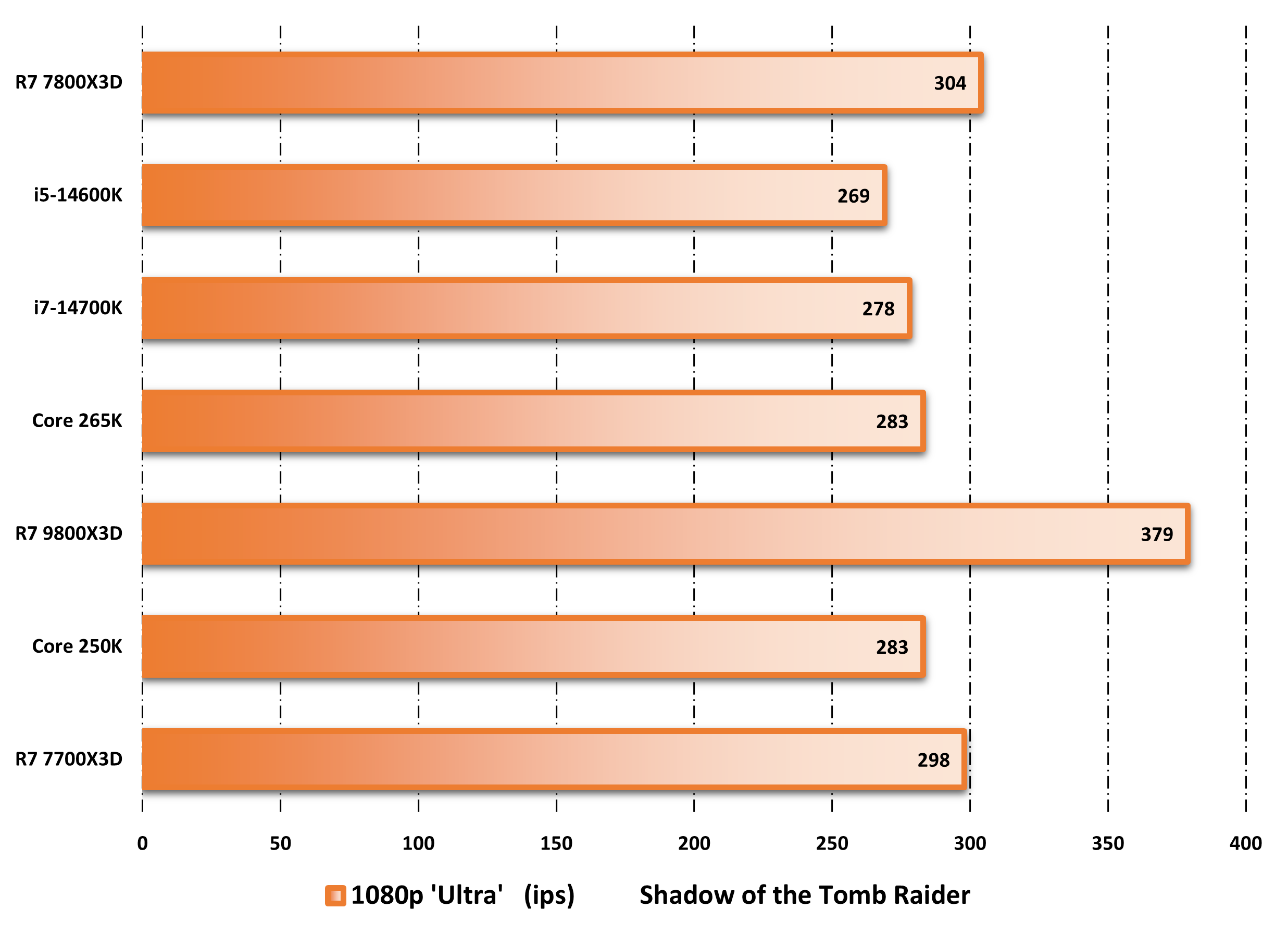
On Shadow of the Tomb Raider, a relatively old title, the gaps between the CPUs are considerably smaller. Yet X3D processors maintain a certain edge and the 7700X3D thus again makes a mark.
Total War: Warhammer 3
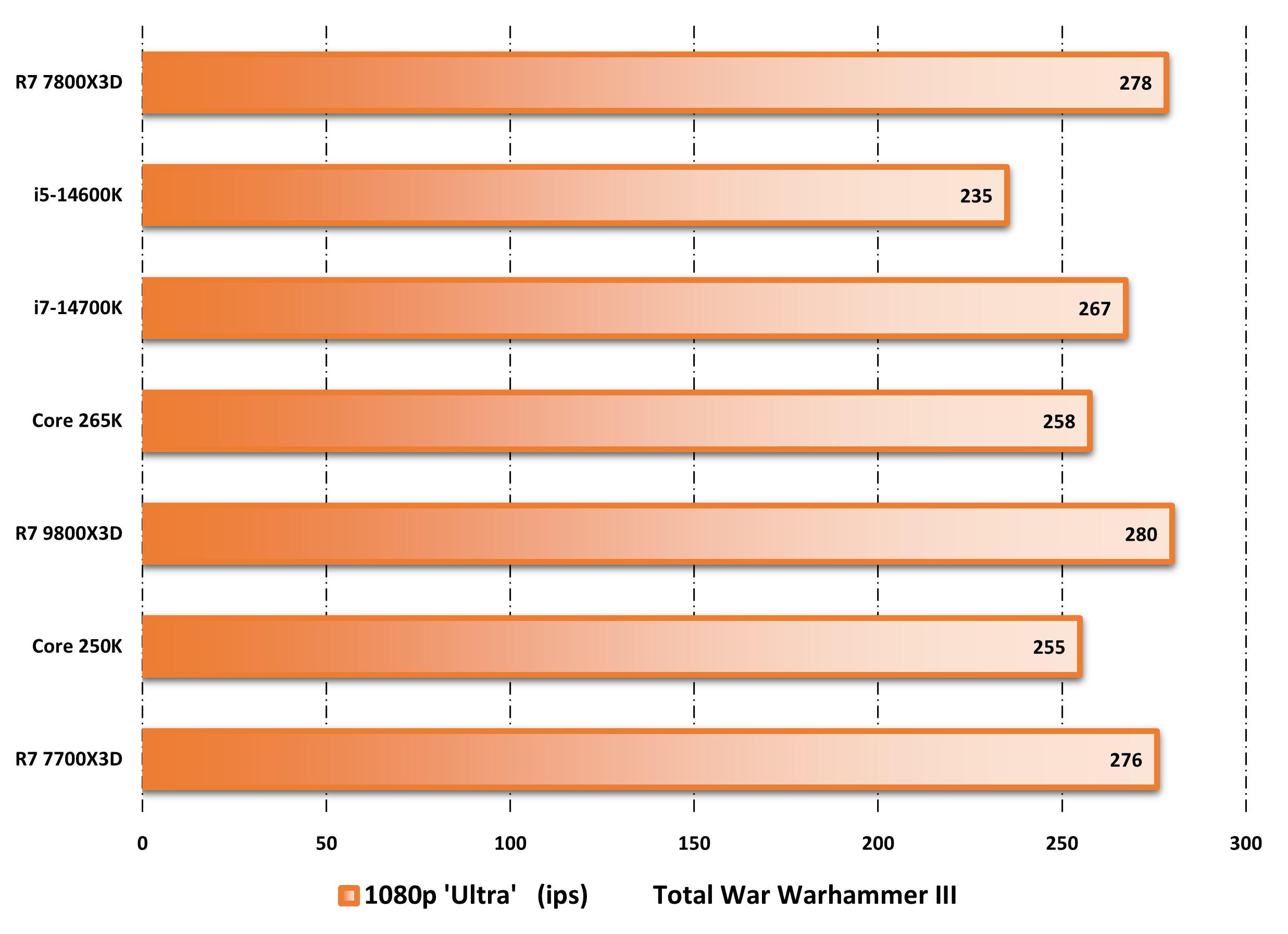
Proportionally, it’s on Total War: Warhammer 3 that the gaps between the processors we’ve chosen for this dossier are the smallest. The three Ryzen X3D chips stay in a close pack with a still-established hierarchy: 9800X3D, then 7800X3D, and finally 7700X3D. Intel processors aren’t far behind.
The Case for iGPU
At launch, AMD decided to copy Intel and integrate a graphics solution in all its processors. It remains a “bonus” in the sense that it doesn’t allow serious gaming.
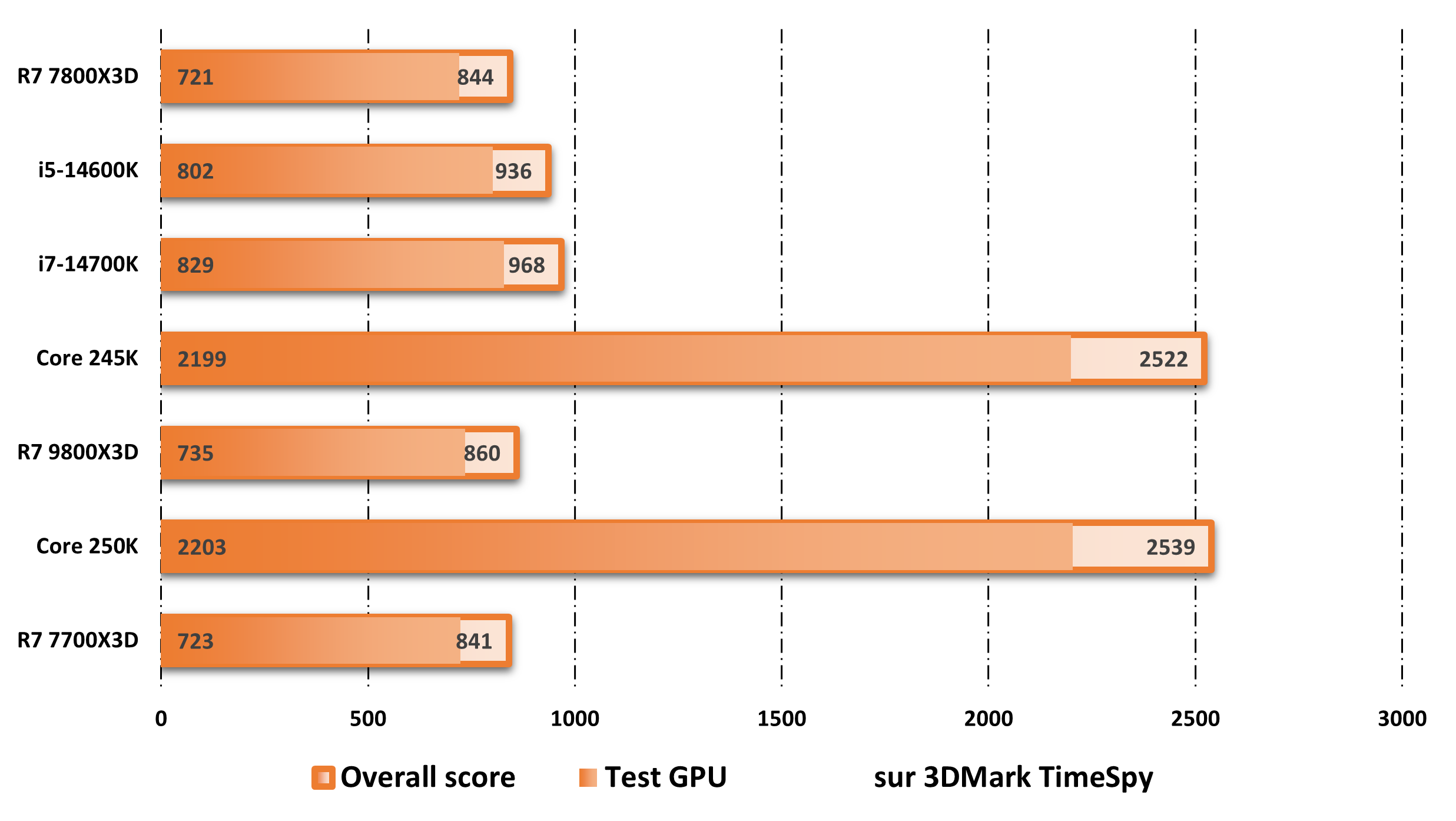
We’ve decided to exclude the Ryzen 8000G chips and their beefy GPU to highlight Intel’s lead in iGPUs. Indeed, Core Ultra 5 aren’t marketed as chips with a strong iGPU and yet they dominate all X3D chips.
Temperatures, Power Draw and Efficiency
Temperature Readings
We end our measurement series with two particularly interesting elements. First, we recorded each processor’s power consumption. To do this, we did not measure it on every test; we retained two values:
- At idle, after Windows 11 had finished booting;
- Under load, during an H.265 HandBrake encode.
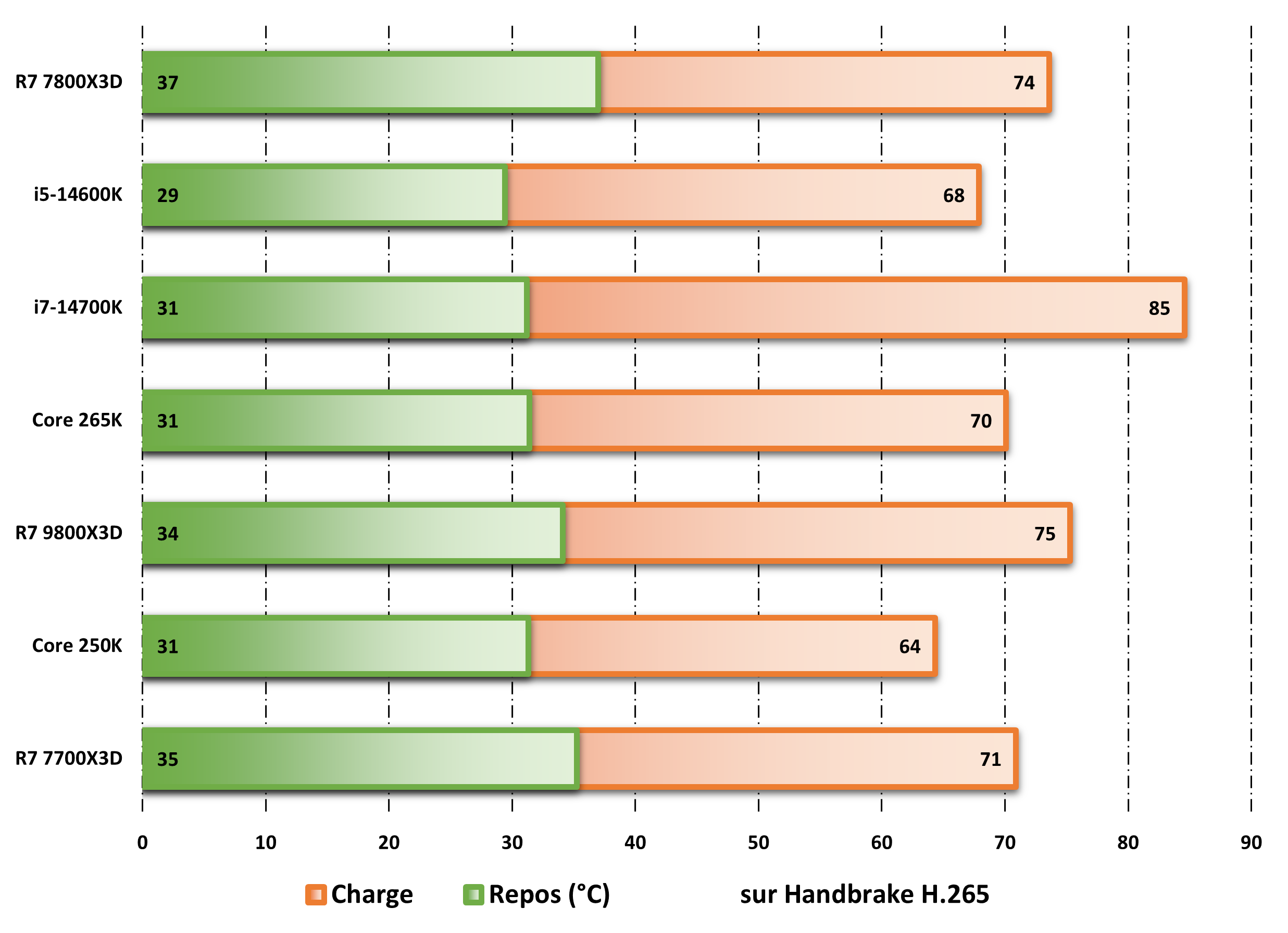
Back in the day, the Ryzen 7 7800X3D pleasantly surprised. The same holds true today with the 7700X3D which runs a little cooler than its big brother. We would have liked a more pronounced gap, but it remains interesting. That said, under load it runs noticeably hotter than the Core Ultra 5 250K Plus.
Electrical Consumption
We then tested the power consumption of our CPUs. It should be noted that we measure only the processor package consumption. Once again, two values are retained.
- At idle, after Windows 11 had finished booting;
- Under load, during sequential multithread Cinebench 2024 tests.
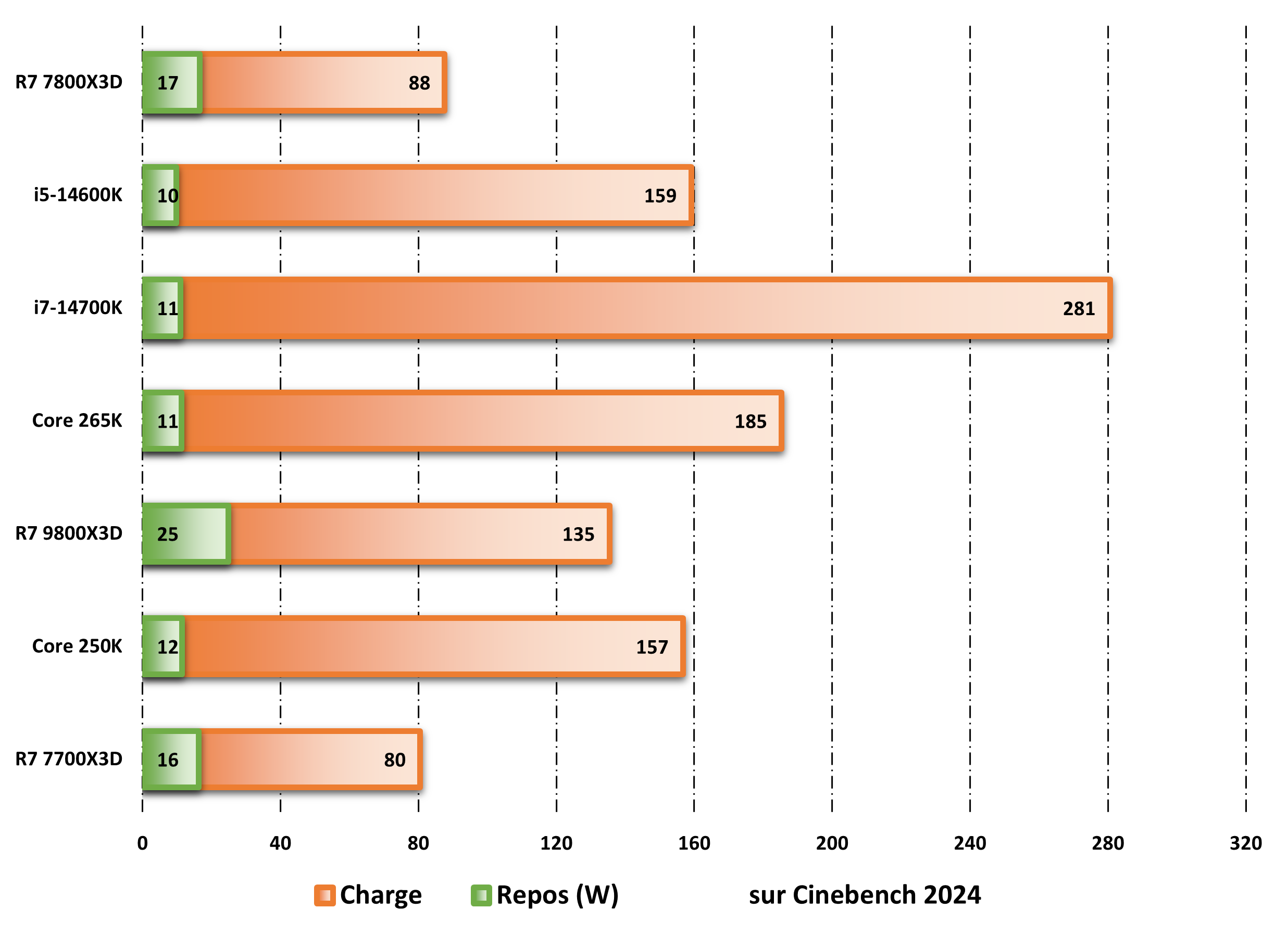
These measurements leave no room for doubt and clearly favor the Ryzen 7 7700X3D. Not only is it less power-hungry than its big brother, but our day’s test subject is especially economical compared to competing Intel chips: 157 watts for the Core Ultra 5 250K Plus versus 80 watts for the 7700X3D—no contest, as they say.
Performance per Watt and per Dollar
This very low consumption should allow the Ryzen 7 7700X3D to shine on the energy efficiency index. Indeed, on this primary metric, it leads the pack, tied with its big brother the 7800X3D. Even the Core Ultra 5 250K Plus, although praised on its launch, trails behind, but you should note it carries another selling point.
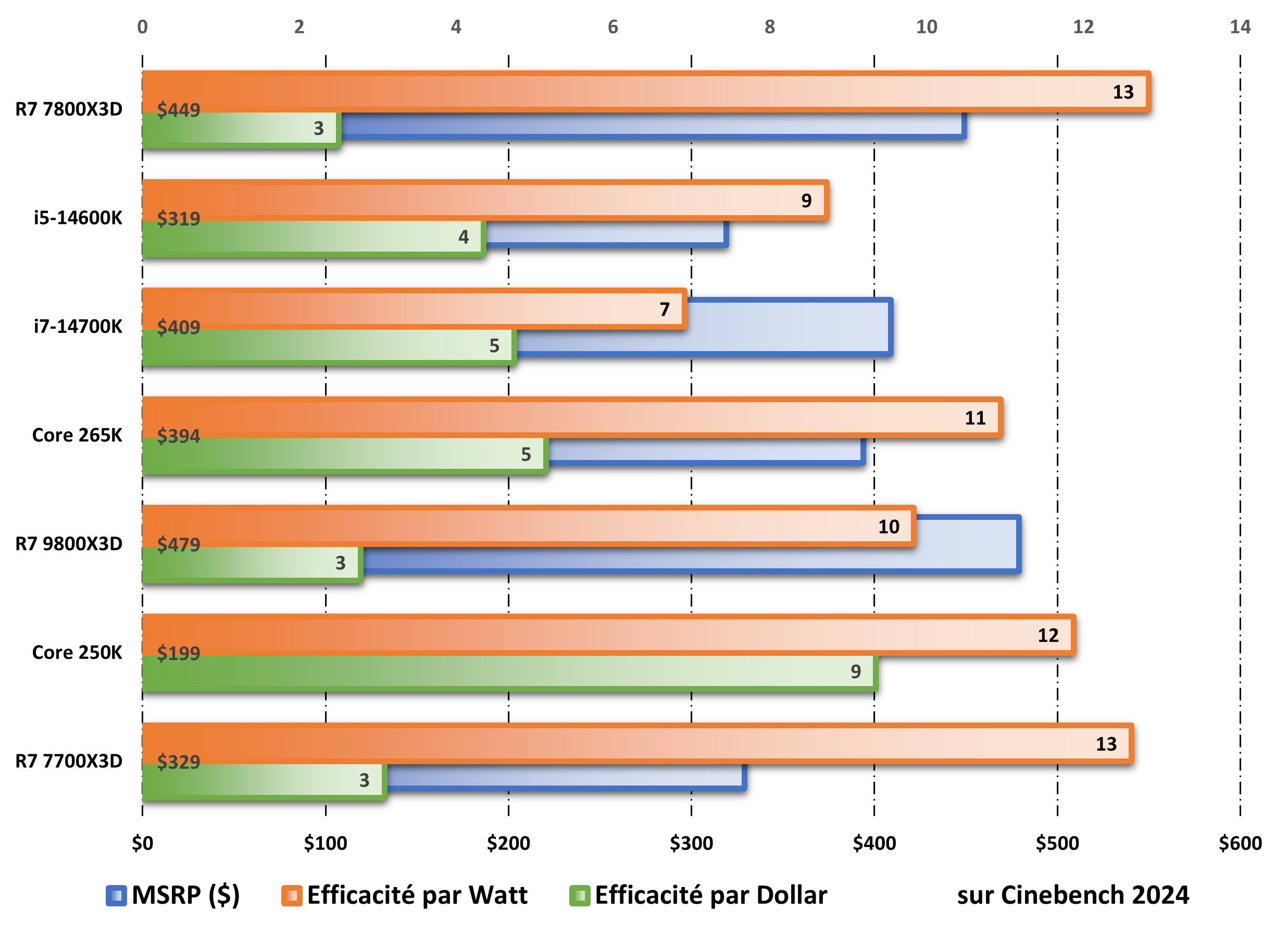
With a launch price of $329, the Ryzen 7 7700X3D is, on paper, well positioned relative to the $449 7800X3D. But that launch was more than three years ago. Today you can find it for under €350 without much searching. More problematic for AMD is that Intel has been very aggressive on price with its Core Ultra 5. The price-to-performance ratio clearly favors Intel.
AMD Ryzen 7 7700X3D: Clubic’s Verdict
If you only look at the numbers, the Ryzen 7 7700X3D is an excellent idea. On paper, it is significantly cheaper than the 7800X3D at launch for not-so-distant performance. It excels in everything related to gaming thanks to its X3D cache and ultimately heats up quite little relative to its performance.
Of course, like any good AM5 processor, it is still modern with PCIe 5.0 support and DDR5, and should benefit from the excellent longevity promised by AMD for its platform, which is planned to last at least until 2029. But every medal has its reverse side, and for the Ryzen 7 7700X3D, you must consider the age of the Zen 4 architecture.
That’s a handicap in applications. It lags behind the Core Ultra 5 245K and 250K Plus from Intel, which happen to be cheaper. And since we’re talking price, remember that the Ryzen 7 7800X3D has been out for three years: it’s no longer at its launch price, which is another thorn in the side of the 7700X3D. An interesting CPU, then, but only when its price is readjusted.
226,87 €

What are the best processors in 2026?

Daniel Brooks
I cover everyday products with a practical eye, from kitchen tools and home essentials to smart gadgets and consumer trends. My goal is to help readers understand what is genuinely useful, what is worth the price, and what deserves a second look before buying.