
Few services document their privacy commitments as precisely as this one. Open‑source applications, fifth consecutive no‑log audit, Secure Core, Stealth: Proton VPN brings together several solid arguments to position itself among the best VPNs of 2026.
What is Proton VPN?
At Proton VPN, privacy is not based solely on a no‑log policy. The Swiss VPN provider publishes the source code of its apps, subjects its infrastructure to independent audits, and develops several tools for the most sensitive contexts, from Secure Core to Stealth. Its network now features over 20,600 servers across 148 countries, with a paid plan that covers up to ten devices simultaneously.
View Proton VPN offers
Proton VPN technical data sheet
Summary
| Servers | 20681 |
| Countries covered | 148 |
| Simultaneous connections | 10 simultaneous connections |
| Free trial | 30-day free trial |
| Advantages | Advantage: enhanced privacy |
Features
| Servers | 20681 |
| Countries covered | 148 |
| Simultaneous connections | 10 simultaneous connections |
| Free trial | 30-day free trial |
| Data logs | No data logs |
| Advantages | Advantage: enhanced privacy |
| Headquarters | Switzerland |
| Emergency block | Yes |
| Split Tunneling | Yes |
| Protocols | OpenVPN, WireGuard, Stealth |
| Platforms | Windows, macOS, Linux, Android, iOS, Google Chrome, Android TV |
| Client support | Yes |
| Price (€/mois) | 3.49 |
| Commitment | 24 months |
| Payment | Credit card, PayPal, Bank transfer, Crypto, Cash |
Specifications
| Operating system | Web |
| License | Proprietary software |
| Editor | Proton AG |
| Language | French |
| Category | VPN |
| European alternative | Yes |
Its free VPN plan remains one of its key strengths: no data cap, no time limit, no ads and no artificial speed throttling, in exchange for only one connected device and a reduced server selection.
In August, Proton officially introduced Proton Protocols, a new client-side architecture designed to improve stability and resistance to blocks. Linux 4.18 already benefits from a beta version and finally includes Stealth.
Proton has also updated its transparency report. Published on July 14, 2026, it covers the first half of the year. Proton states it received 47 legally binding orders approved by Swiss authorities, without providing information that could identify the users concerned due to the absence of retained logs.

- storage20681 servers
- language148 countries covered
- lan10 simultaneous connections
- mood30‑day free trial
- thumb_upAdvantage: enhanced privacy
- High-level security and privacy
- A convincing free plan
- Thoughtful Stealth and Secure Core for restricted environments
- Very good performance in Europe
- Polished desktop and mobile apps
- Prices higher than several mainstream competitors
- Support mainly in English, with variable response times
- Performance less convincing on some faraway destinations
Proton VPN infrastructure
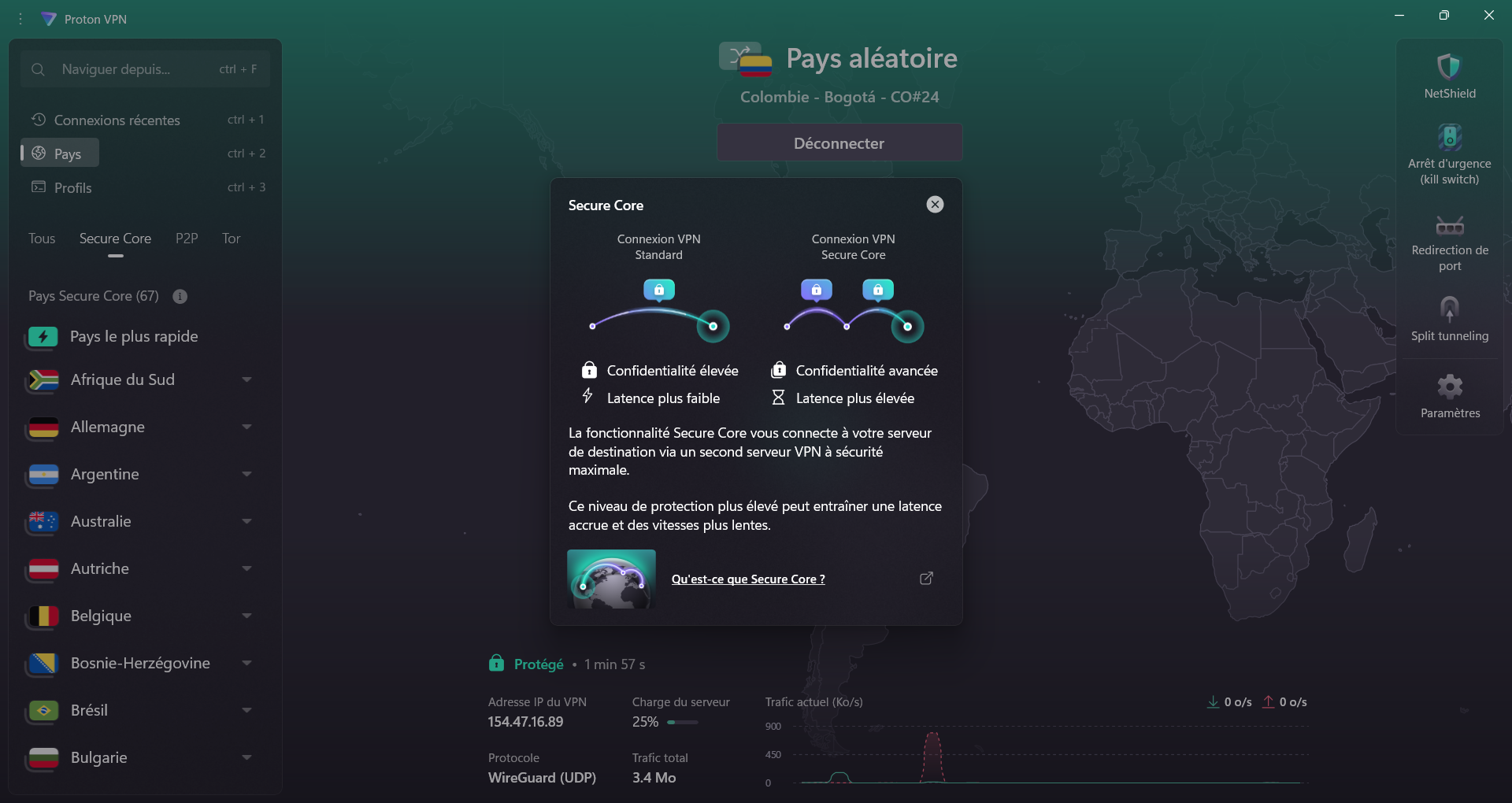
Proton VPN relies on distributed infrastructures across secure sites and operates two types of networks. On one hand, a standard VPN network covering the bulk of uses. On the other hand, Secure Core servers, which route traffic through specially protected equipment identified by IP addresses owned and managed by Proton’s local Internet Registry (LIR) before redirecting it to a standard VPN instance. These servers are hosted in Iceland, Sweden and Switzerland, in locations designed to limit unauthorized access, including a former military site, an underground data center, and a reinforced shelter.
Altogether, the service claims over 20,600 servers across 148 countries, with the bulk included in the Proton VPN Plus offering and a portion accessible for free. The Secure Core servers alone provide access to 68 countries, after a mandatory first pass through one of the three aforementioned sites.
Is Proton VPN free?
Two plans coexist at Proton VPN, including a fully free one, sufficiently compelling to be included in our comparison of the best free VPNs. The free access has the advantage of not being time‑limited or data‑restricted and contains no advertising or artificial speed throttling, but it is limited to one device and offers a reduced server selection.
In detail, this free plan lets you connect to servers in ten countries, including the Netherlands, Japan, Romania, Poland, Norway, Switzerland, Singapore, Mexico, Canada and the United States. Proton automatically selects the first server used. Subsequent changes remain possible, but will route you to a random location and impose a delay between selections. These servers do not grant access to paid‑only features such as Secure Core, NetShield, Tor over VPN, streaming‑optimized servers, or P2P support.
What are Proton VPN prices?
In addition to its free tier, Proton VPN offers several paid plans, including Proton VPN Plus, which is the most relevant for regular use since it unlocks all advanced features: up to ten connections, streaming‑optimized servers and P2P downloads, NetShield ad and malware blocker, access to Secure Core or Tor, and speeds up to 10 Gb/s.
As with most players in the sector, Proton applies tiered pricing based on the duration of the commitment. Currently, Proton VPN Plus is billed as follows:
- €9.99 per month for a one‑month subscription;
- €3.99 per month for a one‑year subscription (charged as €47.88 upfront);
- €2.99 per month for a two‑year subscription (charged as €71.76 upfront).
The provider also offers a 30‑day money‑back guarantee, allowing a full refund within that period.
Proton also markets several bundles under the Proton Unlimited offering. They bundle all premium services in the ecosystem (Proton Mail, Proton Drive, Proton Calendar and Proton VPN). The personal plan starts at €7.99 per month with a two‑year commitment, the family plan (six users) starts at €23.99 per month for one year, while business customers have a dedicated subscription at €12.99 per month with annual commitment, with additional options on quote.
Download and install Proton VPN
Proton VPN today covers a wide range of platforms. The service provides dedicated apps for Windows, macOS, GNU/Linux, Android, iOS and ChromeOS, as well as native clients for Android TV and Apple TV. Browser extensions are also available for Chromium and Firefox. Consoles such as PlayStation, Xbox, Nintendo Switch, Nvidia Shield and several TV boxes can be protected via a suitable network configuration or a compatible router.
In addition, the provider offers configurations for several routers, including pfSense, Vilfo, AsusWRT, Tomato and DD‑WRT, to protect all devices on a home network.
To start using the service, simply create a free or paid account on the provider’s site, download the Proton VPN client app to your device, then log in with your credentials.
Interface and features
Organization of the VPN client and web console
The Proton VPN desktop interface was redesigned in spring 2025 to modernize navigation and simplify access to the essential features. More streamlined and better organized, it highlights the main controls while still providing quick access to advanced settings. Connection can be made from the server map or from the country list shown in the sidebar. A Quick Connect button automatically selects the most efficient location.
Once a session is established, the app displays useful information such as the assigned IP address, the protocol used, the transfer speed, and the server load.
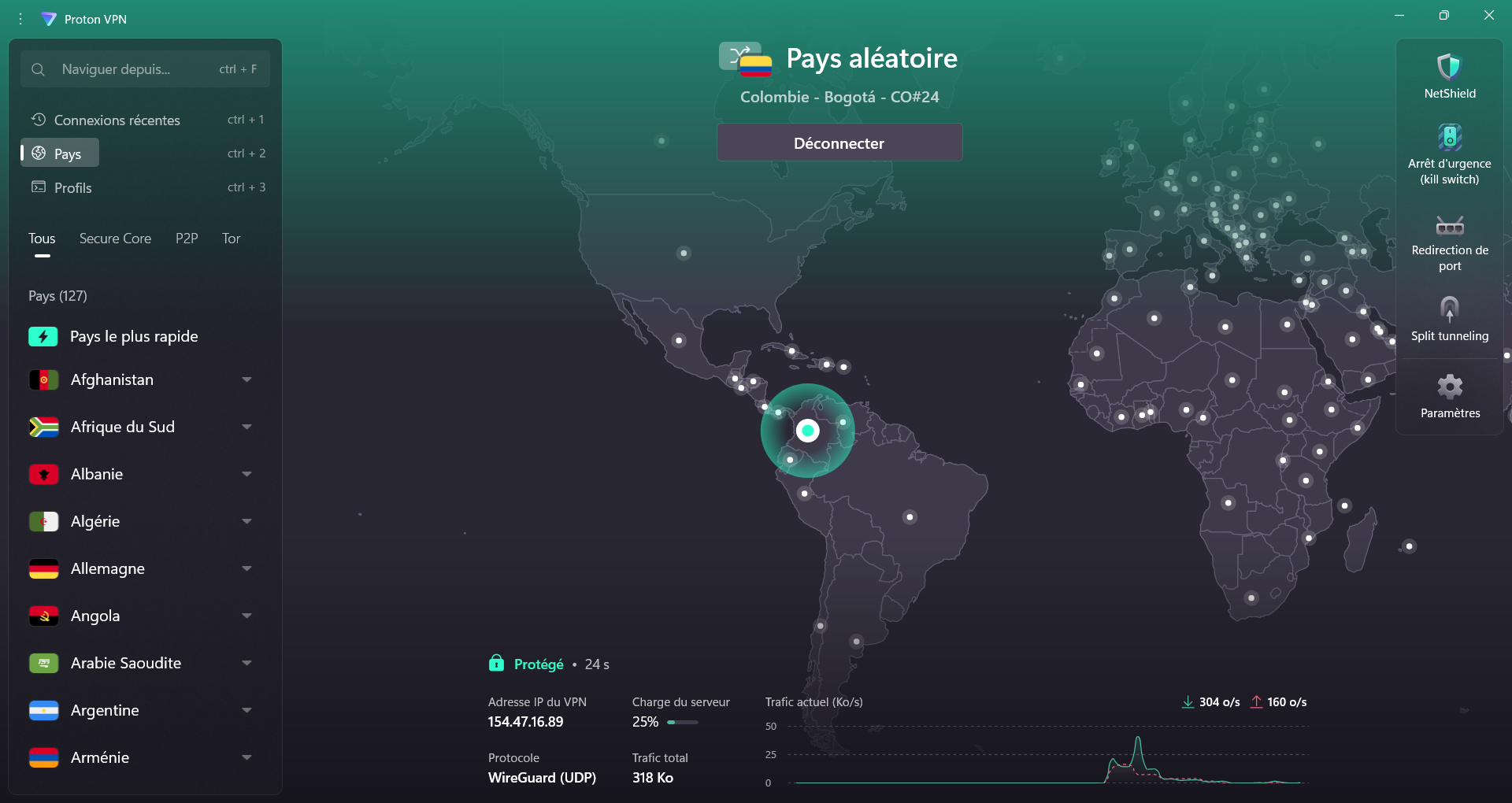
Quick access to the advanced features varies slightly across systems, but always provides the most useful adjustments, such as NetShield, the kill switch, or, where supported, port forwarding. On Windows and macOS, Secure Core servers appear as their own server category.
The Settings menu centralizes profile management, connection options and advanced features. This is where Quick Connect is configured, where the protocol is changed, where fallback routing is activated, or where VPN Accelerator is adjusted.
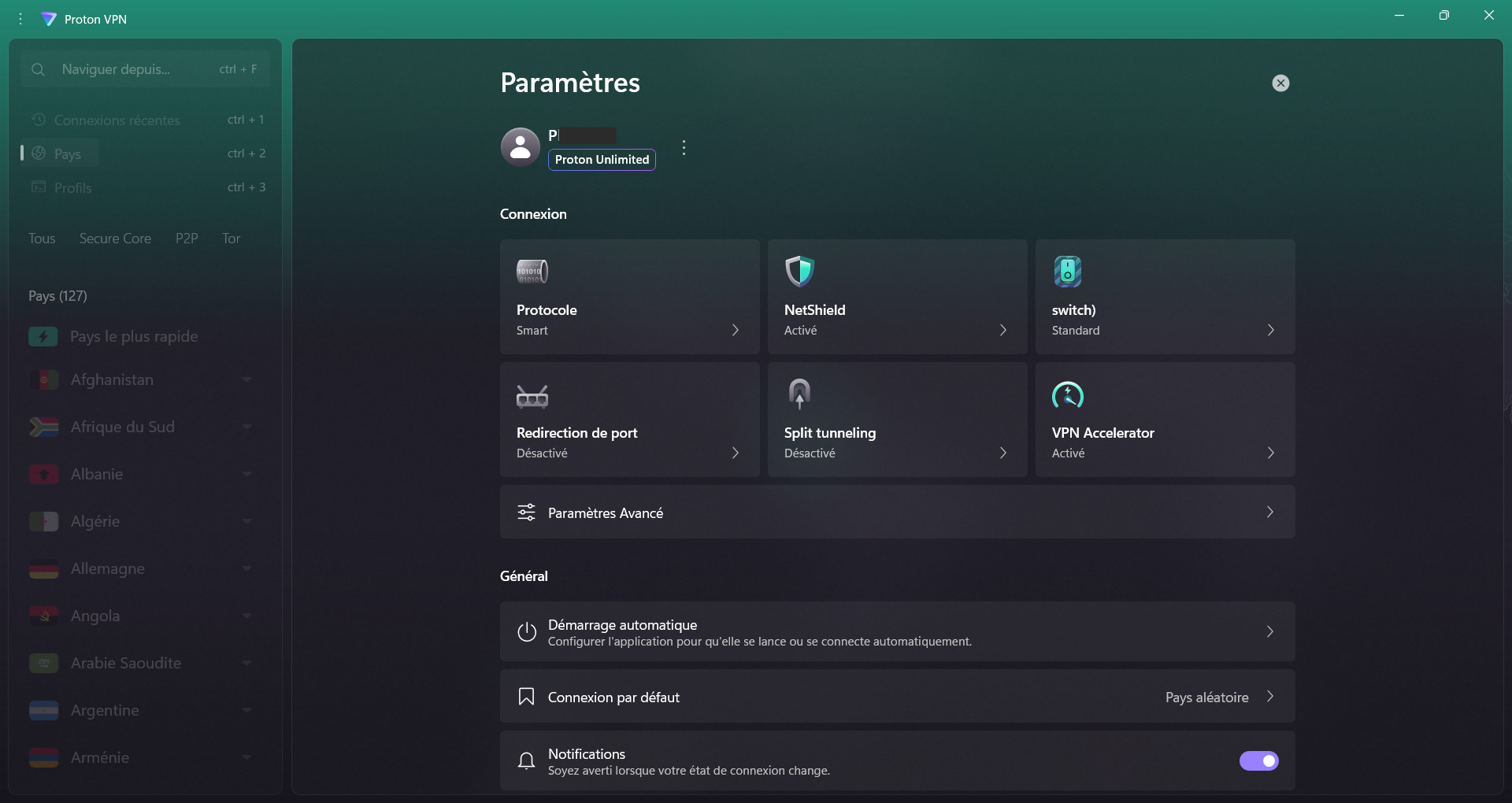
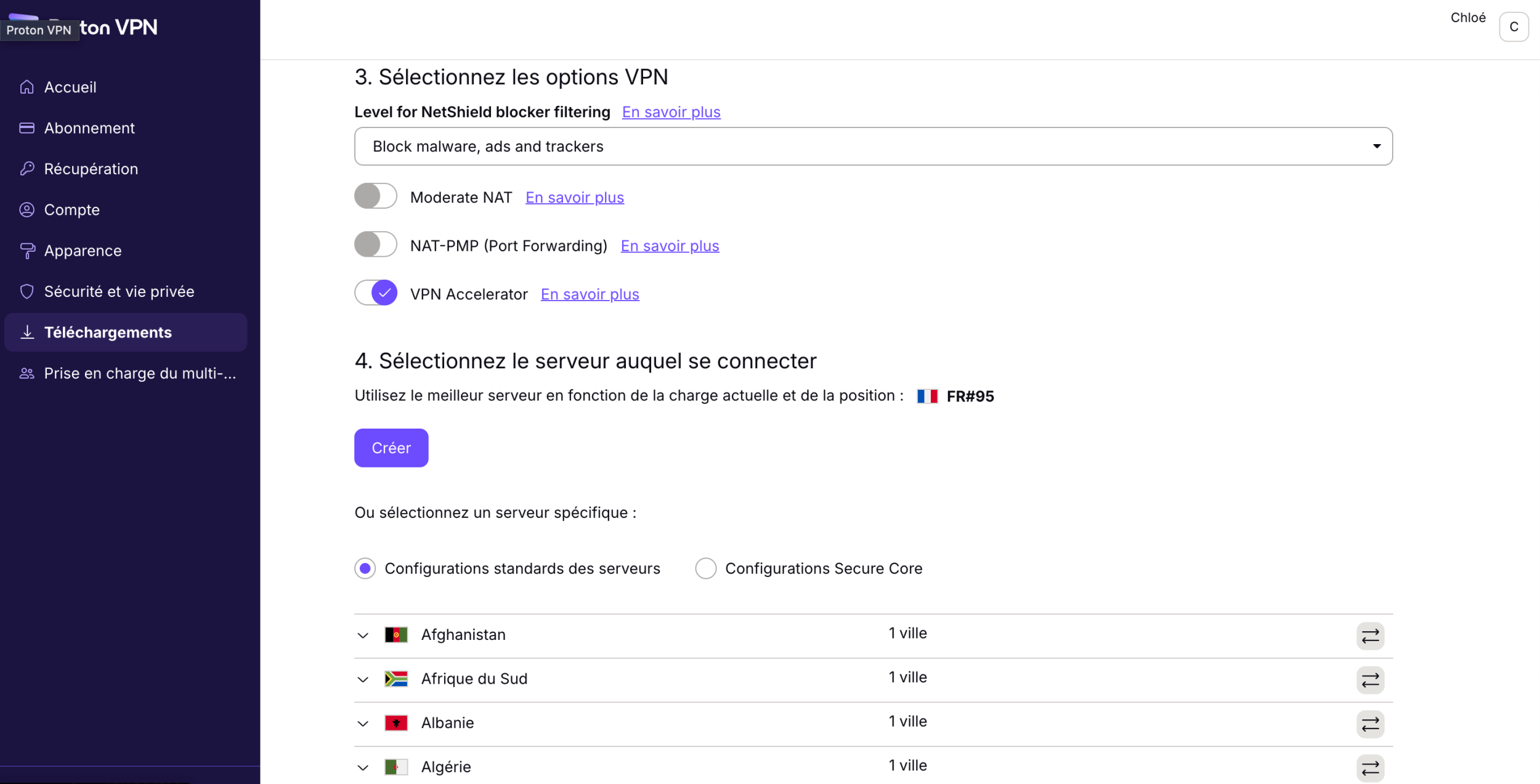
Finally, the web interface groups options related to the subscription, account information, two‑factor authentication and recovery options. It also allows you to download the apps as well as OpenVPN and WireGuard configuration files for manual or router use.
Location choices
A click on a country reveals the list of available servers, whether they belong to the standard network or to Secure Core. The app then shows the associated cities, real‑time load and potential optimizations. Proton no longer displays the entire fleet by default and now offers leaner, more readable lists with better load balancing. Servers that don’t appear in this view remain accessible via search, connection profiles or configuration files, allowing you to stay in control without turning the selection into an endless catalogue.
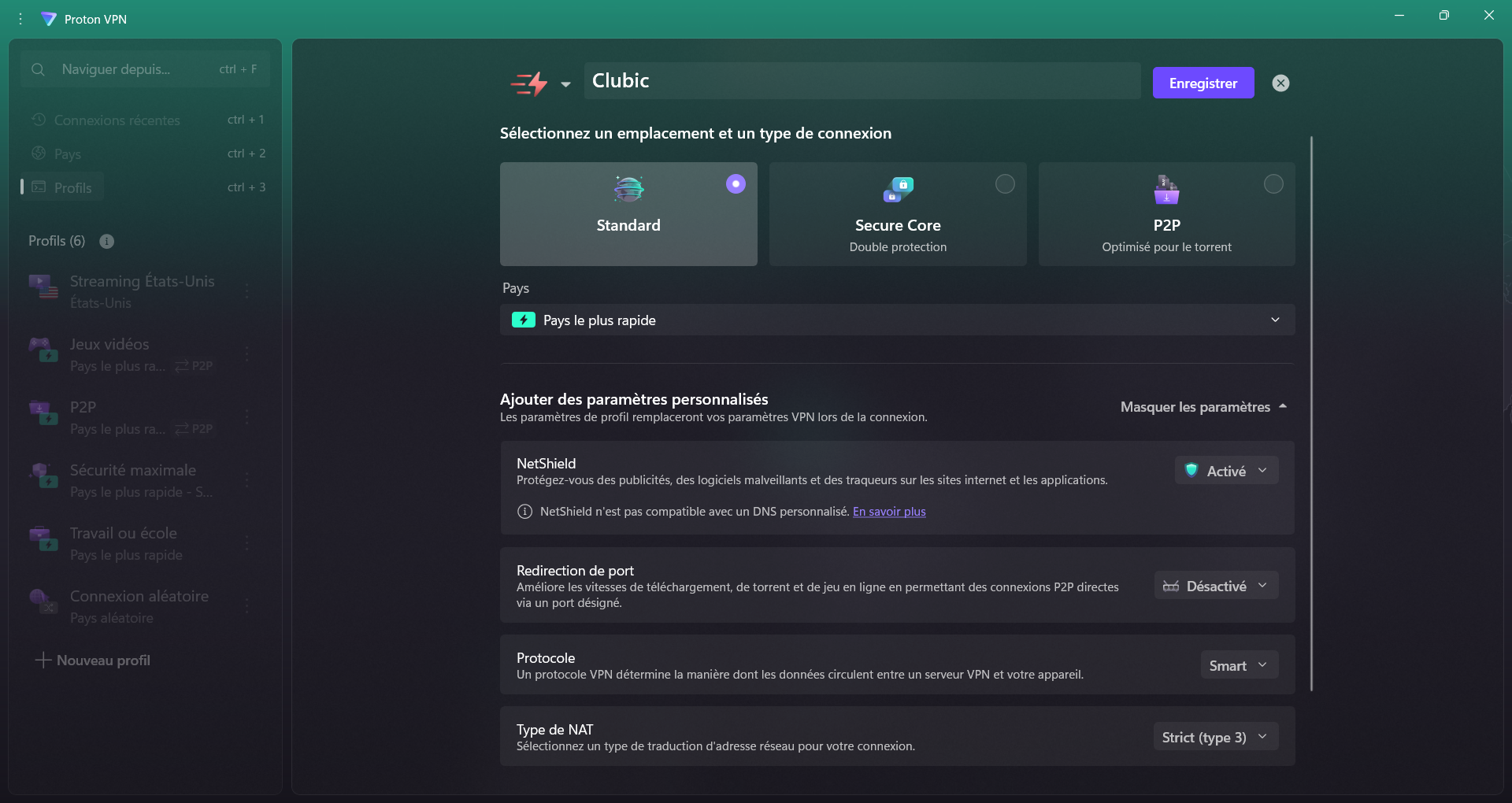
To take further control of connections, the Profiles menu offers several customization options. It lets you connect automatically to the fastest server, vary location each session, or create customized profiles tailored to your needs. In this case, you can choose the type of server, the VPN protocol, the exit country and, if needed, a specific server to fine‑tune the setup. On Windows and Android, these profiles also benefit from Connect and Go, a feature that automatically opens an application or a site as soon as the connection is established. Useful for launching a streaming service, a work tool, or a more discreet browser on the fly.
Protocols and encryption
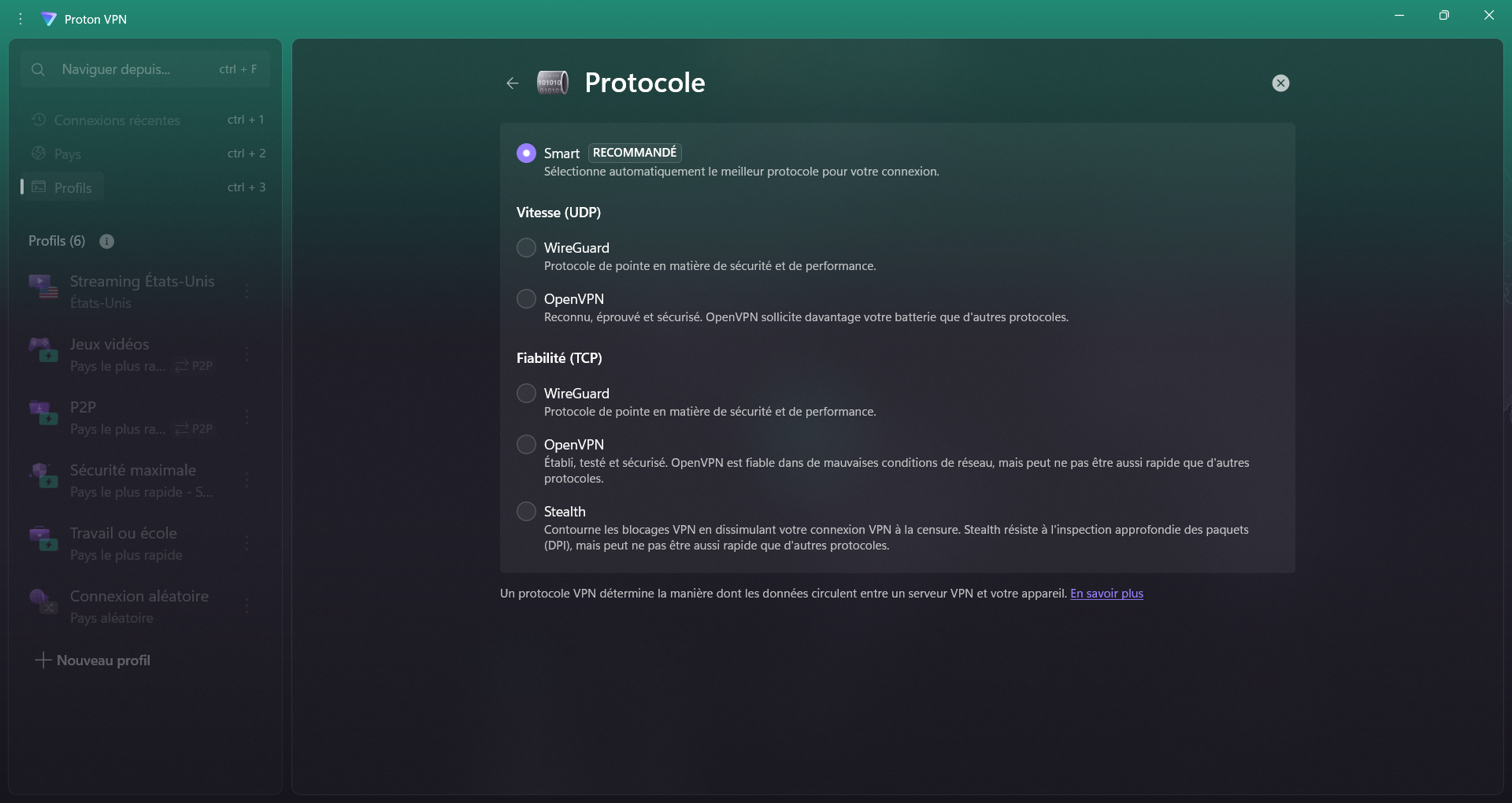
Regarding protocols, Proton VPN relies on proven standards to ensure stability and security. OpenVPN uses AES‑256 encryption, RSA‑4096 key exchange and HMAC‑SHA‑384 authentication, while WireGuard rests on ChaCha20‑Poly1305, a modern and particularly efficient algorithm, especially on mobile devices. IKEv2 remains available in some cases, but Proton announced at the end of March 2026 that it would begin phasing it out on macOS in favor of simplification and improved app performance.
The service also implements Perfect Forward Secrecy. In plain terms, every session uses temporary keys that expire quickly, making it impossible to recover data from a past session in case of a leak.
Proton has also developed its own obfuscated protocol, Stealth, designed to circumvent VPN traffic detection in restricted environments. The provider presents it as a layer of obfuscation intended to disguise the VPN connection to more easily bypass certain blocks and forms of censorship, including on the free tier. Its effectiveness depends on local measures and the countermeasures Proton deploys in return. Its reliability can evolve, even if the provider adjusts its mechanism when Stealth is restricted or blocked.
Technical support
Paid subscriptions now grant access to live chat available 24/7. Users of the free plan can still go through the in‑app ticket system or the form on the website.
Support remains primarily in English, though French inquiries can be handled. In our ticket exchanges, response times varied depending on the nature of the request, while the chat now offers a much faster response for paying subscribers.
Speed test
For the writing of this review, our speed tests were conducted on a MacBook Air (M1, 2020), with a fiber wired connection (download speed advertised as 1 Gb/s; upload speed advertised as 700 Mb/s).
To obtain results as neutral as possible, we ran measurements on nPerf three times a day (9:00, 13:00, 18:00) for three days, with and without VPN, using WireGuard. For the VPN measurements, we tested the servers automatically assigned by Proton VPN in France, the United States, the United Kingdom and Japan.
These measurements also feed into our open data file, which gathers the results from the major VPN tests conducted by our editorial team. They are also included in our speedometer of the fastest VPNs to compare service performance under identical conditions and across multiple destinations.
*Recall that PING measures (in milliseconds) the time for data packets to travel to and from the Internet. The lower, the better. For the download and upload speeds, the higher, the faster the connection.
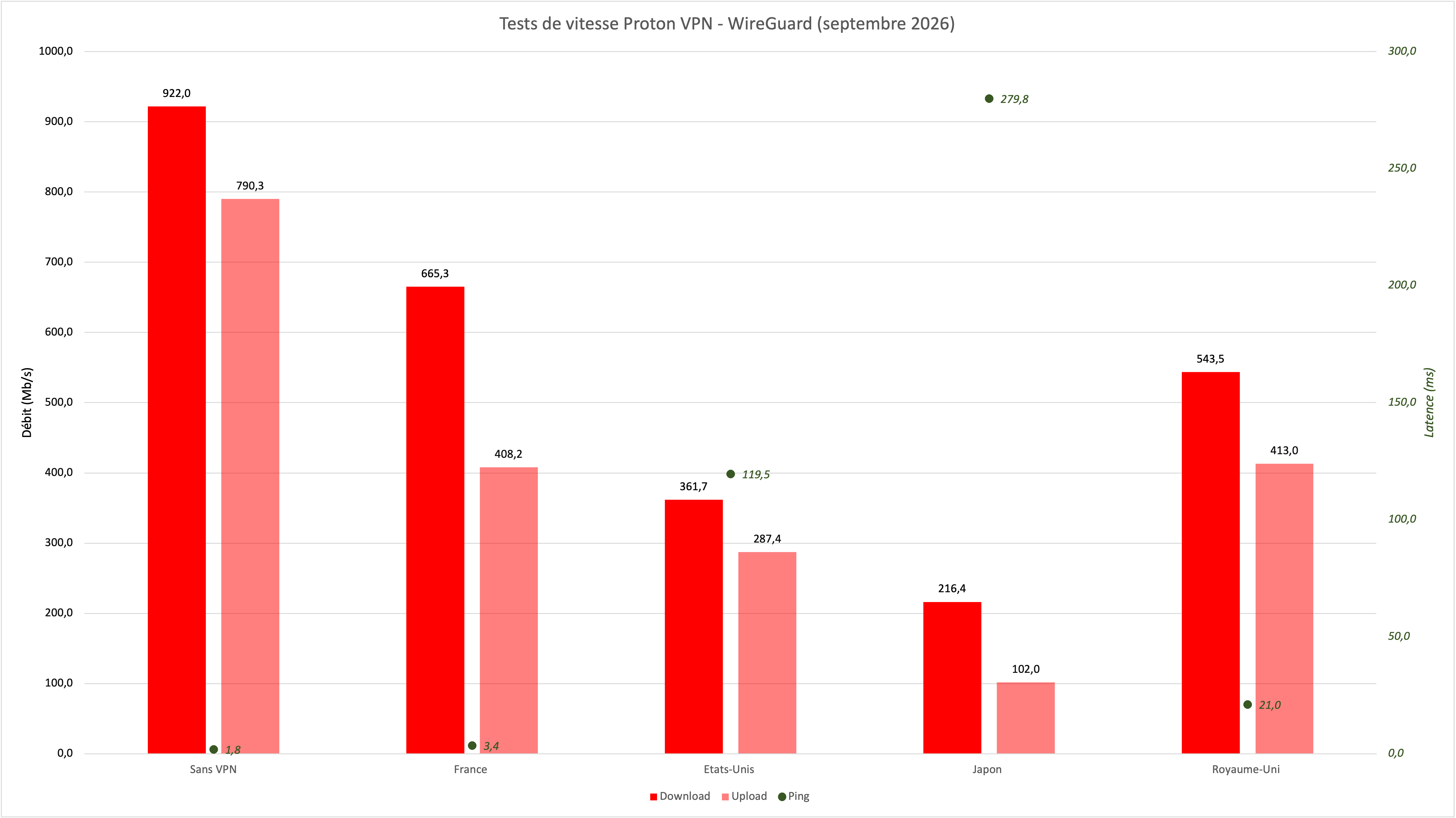
In September 2026, Proton VPN performs particularly well on nearby connections. In France, it maintains an average of 665.3 Mb/s in download on a reference line of 922 Mb/s, i.e., just over 72% of the baseline speed. Upload reaches 408.2 Mb/s against 790.3 Mb/s without VPN. The loss is therefore more pronounced in this direction, but speeds remain very comfortable. Ping only increases from 1.8 to 3.4 ms. On fast fiber, Proton VPN thus preserves a solid portion of available bandwidth, with fairly uniform French measurements across the three testing days.
The United Kingdom confirms this good performance with 543.5 Mb/s download, 413 Mb/s upload and only 21 ms latency. The results are more nuanced toward the United States, with an average of 361.7 Mb/s download and 287.4 Mb/s upload, for 119.5 ms ping. These figures remain usable, but are dragged down by a noticeable drop during an 18:00 measurement on the second day, down to 34.6 Mb/s in download and 19.7 Mb/s in upload. Outside that episode, Proton VPN typically ranges between 340 and 530 Mb/s on the US link, signaling a potential higher performance than the overall average suggests.
Japan shows a comparable profile, with more irregularity than chronic weakness. Proton VPN reaches an average of 216.4 Mb/s download and 102 Mb/s upload, while the ping climbs to 279.8 ms. Again, a particularly low reading — 17.4 Mb/s down and 6.7 Mb/s up — heavily weighs on the final result, even if many passes exceed 200, even 300 Mb/s. So Proton VPN delivers an excellent European performance and maintains strong long‑distance capability, but our American and Japanese measurements reveal occasional weaknesses that could cause performance to vary significantly from moment to moment.
Security test
DNS, WebRTC and IPv6 leaks
To verify the absence of DNS, WebRTC and IPv6 leaks, we performed several test series on different days using specialized platforms such as dnsleaktest.com, browserleaks.com and IPv6leak.com. No issues were detected, confirming the service’s reliability.
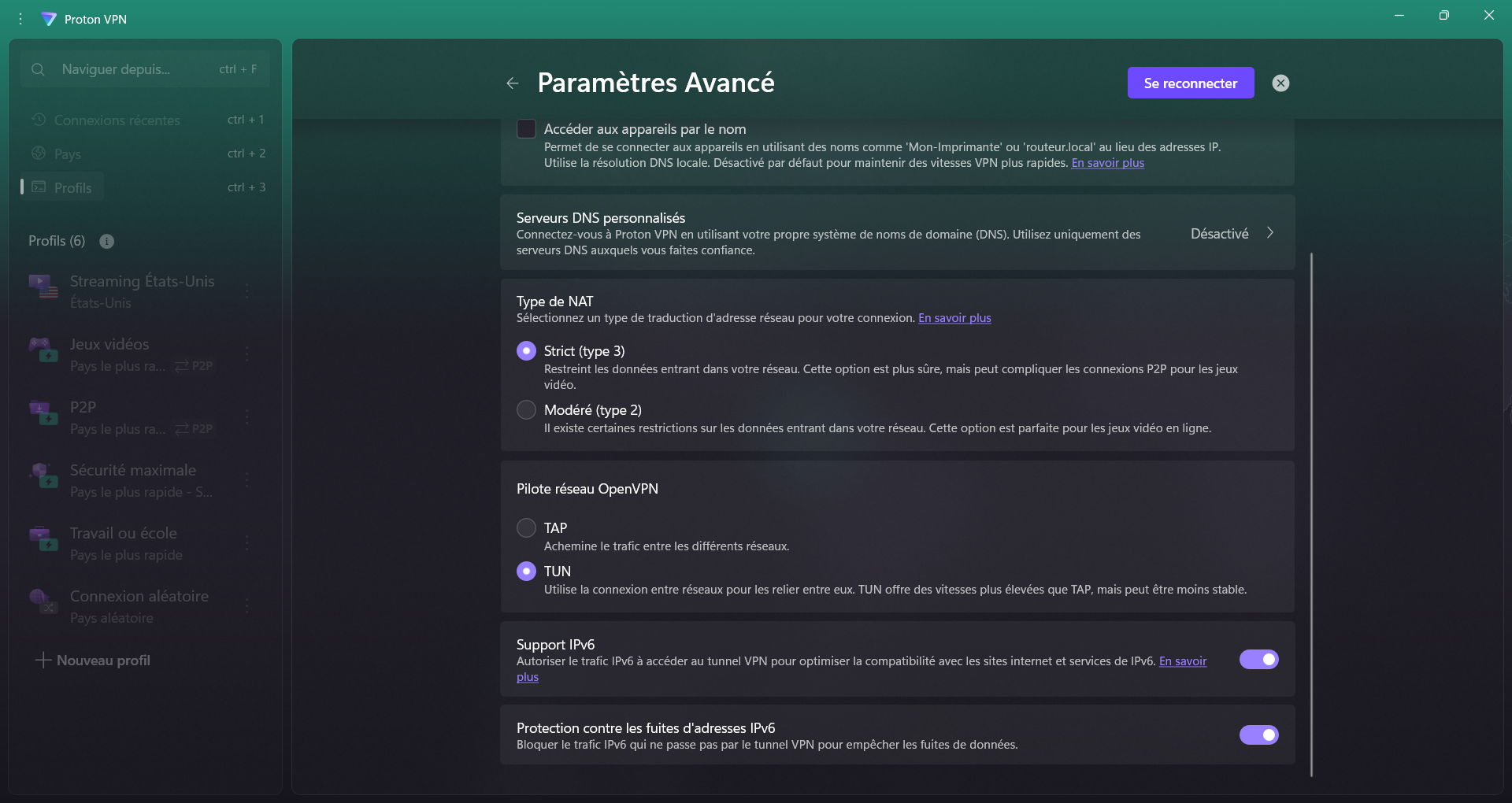
Additionally, Proton VPN offers dedicated options to limit these risks in its advanced settings. The service also handles IPv6 natively on Android, Linux and Windows, whereas most VPNs still block this traffic. This approach prevents an IPv6 request from escaping the encrypted tunnel in case of conflict or network misconfiguration, a rare but real scenario on some environments.
Headquarters, privacy policy and audit
Proton VPN has built its reputation on privacy protection, and its Switzerland base is no accident. The provider applies a no‑log policy that covers both paid subscriptions and the free plan and specifically excludes recording of browsing history, DNS requests and data that could connect activity to a user over time.
That balance could evolve. Since 2025, the Swiss Federal Council has been working on revising several telecoms surveillance texts, a reform Proton has been monitoring closely and whose implications the management has already criticized. The idea of Proton leaving Switzerland has even been publicly mentioned by Andy Yen if the local framework were to undermine user protections.
These privacy requirements are also reflected in how Proton secures its infrastructure. Secure Core servers are hosted on highly secure sites, sometimes former military bases, with biometric access control, restricted physical access and full-disk encryption. Proton specifies that it installs and operates this infrastructure itself to minimize unauthorized access or physical compromise.
In the same spirit, all Proton VPN applications are published as open source, allowing anyone to inspect the code. The company also conducts independent audits regularly through third‑party firms. The most recent, published in 2026 by Securitum, constitutes Proton’s fifth consecutive annual audit of its no‑log policy. The experts found no navigation logs, no DNS requests, no traffic contents, and no persistent metadata tying a user to their activity.
The first‑half 2026 transparency report provides another layer of verification. Proton states it received 47 legally binding orders approved in Switzerland, without providing data that would identify individuals based on their VPN usage.
Proton VPN for streaming (Netflix, Disney+, HBO)
Proton VPN offers servers optimized for streaming services, with speeds up to 10 Gb/s. In our tests, playback on Netflix, Disney+ and Prime Video was smooth and stable, even when connecting to servers in Australia, the United Kingdom or the United States.

Proton VPN for torrenting
To compare P2P performance, we measured the download times of a 6‑GB ISO (Ubuntu 24.04) using qBittorrent, with and without VPN. We let the VPN select the best location and protocol. This method was repeated over three consecutive days, each morning.
To obtain a coherent comparative chart, we reported the download times as percentages to reflect the evolution rate of the VPN’s impact on the original connection. In this setup, the lower the values, the better the service.

Again, Proton VPN performs surprisingly well in a field where it was not expected to shine. Even without its P2P‑optimized servers, the provider delivers excellent download speeds. While the ISO retrieval time increases by a mere 25%, it still leads all competitors, some of which have been in the business for more than a decade.
Proton VPN on iPhone or Android
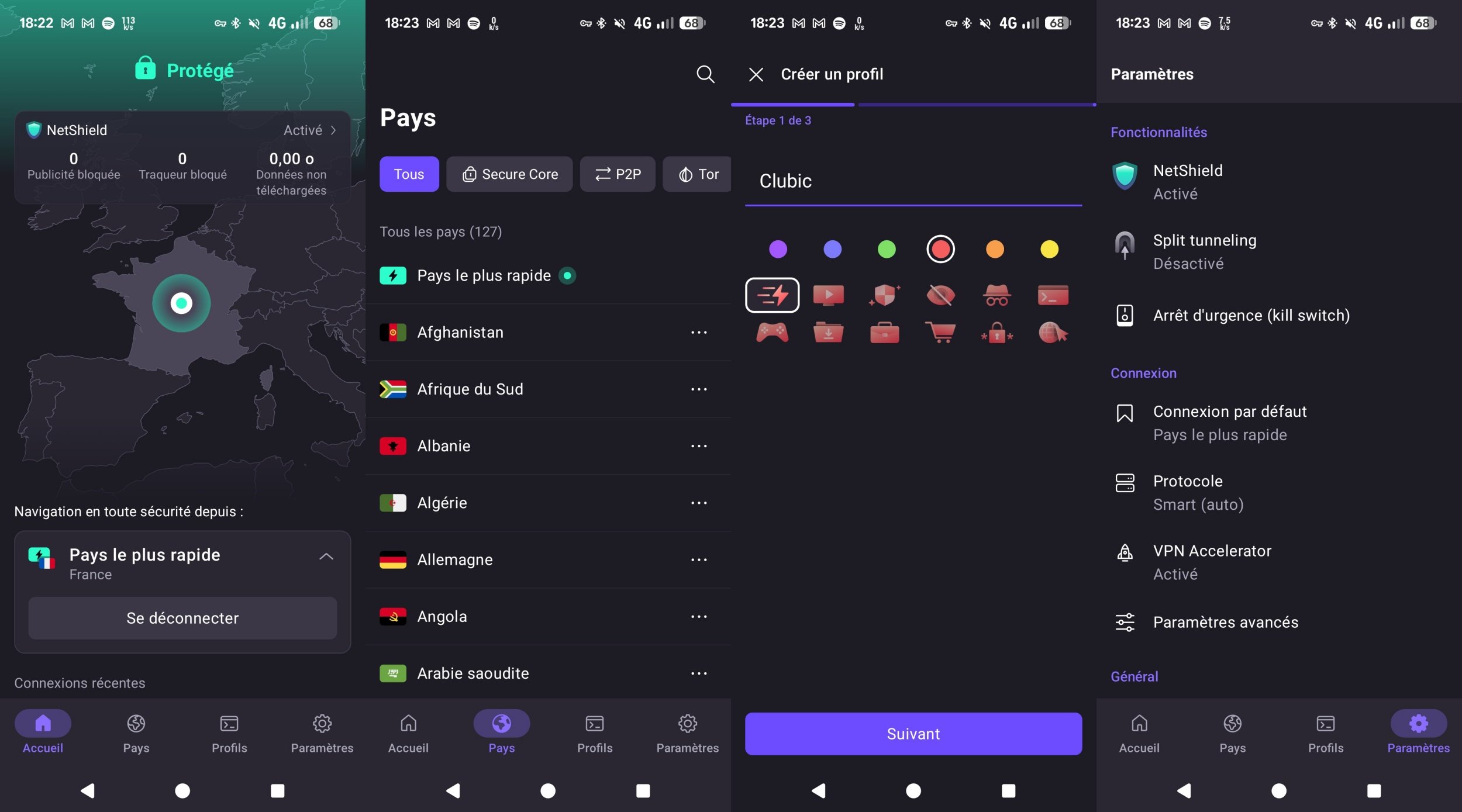
Available on Android and iOS, the Proton VPN mobile app carries over most of the desktop experience. The interface remains clear and well organized, with direct access to servers via a map or a country list. The app also shows useful details such as server load, location and the assigned IP address.
You will find the main service features there, including Secure Core, the kill switch and profile management. Overall, it is stable and coherent, with quick daily usability.
Other Proton VPN features
Proton VPN bundles several features designed to offer more control and flexibility in daily use. Split tunneling lets you choose which apps or IP addresses use the VPN. The feature is available on Windows, Android, Linux and macOS, but remains experimental on Mac, with limitations for Safari and other WebKit‑based apps. It proves useful for maintaining access to certain local services while encrypting the rest of the traffic.
P2P users also benefit from port forwarding, which allows certain inbound connections normally blocked by the servers’ firewall and boosts speeds when combined with servers optimized for file sharing. In addition, NetShield, to block ads, trackers and malicious domains, as well as VPN Accelerator, Proton’s in‑house technology designed to optimize speed and stability on challenging links.
Proton VPN also offers tools designed for highly censored environments. It is possible to use the app without creating an account in certain situations via temporary access managed by Proton, available as secure links on Android or via a guest mode on iOS. On Android, it is also possible to mask the app’s icon behind a harmless utility to avoid drawing attention. The service also includes an Alternative Routing feature, designed to help the app stay accessible when direct access to Proton’s infrastructure is disrupted or blocked.
In terms of navigation, Chrome, Firefox and Edge extensions allow you to secure a session without opening the full client. Since March 2025, Proton VPN has also been integrated into Vivaldi, with direct activation from the browser.

What is the best VPN in 2026? The VPNs best ranked by our tests
- The best free VPNs
- The best VPNs for streaming (Netflix, YouTube, sports events)
- Best VPNs for all devices (Smart TV, Apple TV, Android, iOS, PC, Mac, router)
- Best VPNs for your Chrome/Firefox browser
- Best VPNs for travel
- Best VPNs for adult content
- Best VPNs for IPTV
Our complete tests of the Top 5 VPNs in 2026:
- CyberGhost
- Proton VPN
- ExpressVPN
- NordVPN
- Surfshark VPN
Frequently asked questions about Proton VPN
Is there a free version of Proton VPN?
Based in Geneva, Switzerland, the provider benefits from some of the strictest privacy protections on the planet. It is not subject to European or American data‑retention laws, and it cannot be forced by authorities to provide personal information about its users. Proton VPN has made privacy its primary battleground and does not log connection histories, DNS queries or data that could link activity to a user over time.
How to cancel or unsubscribe from Proton VPN?
To cancel your Proton VPN subscription, open the app, tap the menu icon with three horizontal lines, then choose “Account” and “Manage account” in the upper right corner of the window to open the online dashboard. Open the “Credits” tab in the left menu and select the “Downgrade account” button at the bottom of the page. This action cancels the current paid subscription, and the remaining balance is returned as account credits to reactivate the service later if needed.
How to configure Proton VPN on Chromebook?
How to configure Proton VPN on Android TV?
How to configure Proton VPN on iOS and Android?
Available on Google Play and the App Store, Proton VPN’s mobile apps provide access to the service’s main functions. To continue receiving updates on iPhone and iPad, you now need iOS or iPadOS 17 or later, as Proton halted updates for iOS 16 in January 2026.
Once installed, simply sign in to connect to the VPN and authorize the creation of the VPN configuration during the first launch. The app then lets you choose a server, use Secure Core, Stealth or the kill switch depending on the platform and the subscription plan.
How to configure Proton VPN on Android TV ?
How to configure Proton VPN on iOS and Android?
Available on Google Play and the App Store, the mobile apps give access to the main features of the service. To continue receiving updates on iPhone and iPad, you now need iOS or iPadOS 17 or later, as Proton has stopped updates for iOS 16 since January 2026.
Once installed, simply enter your credentials to connect to the VPN and allow the creation of the VPN configuration on first launch. The app then lets you choose a server, use Secure Core, Stealth or the kill switch depending on the platform and the subscribed plan.