
Using the latest Claude or OpenAI models while prioritizing privacy is DuckDuckGo’s bet with its Duck.ai Plus and Duck.ai Pro subscriptions. These grant access to Claude Opus 4.8 and GPT-5.6 Sol for €9.99 and €19.99 per month respectively. But what do you actually get?
After Proton Lumo and Infomaniak Euria, we turn this time to Duck.ai Pro, the private AI from the DuckDuckGo search engine.
What is Duck.ai Plus and Pro?
A paid privacy bundle
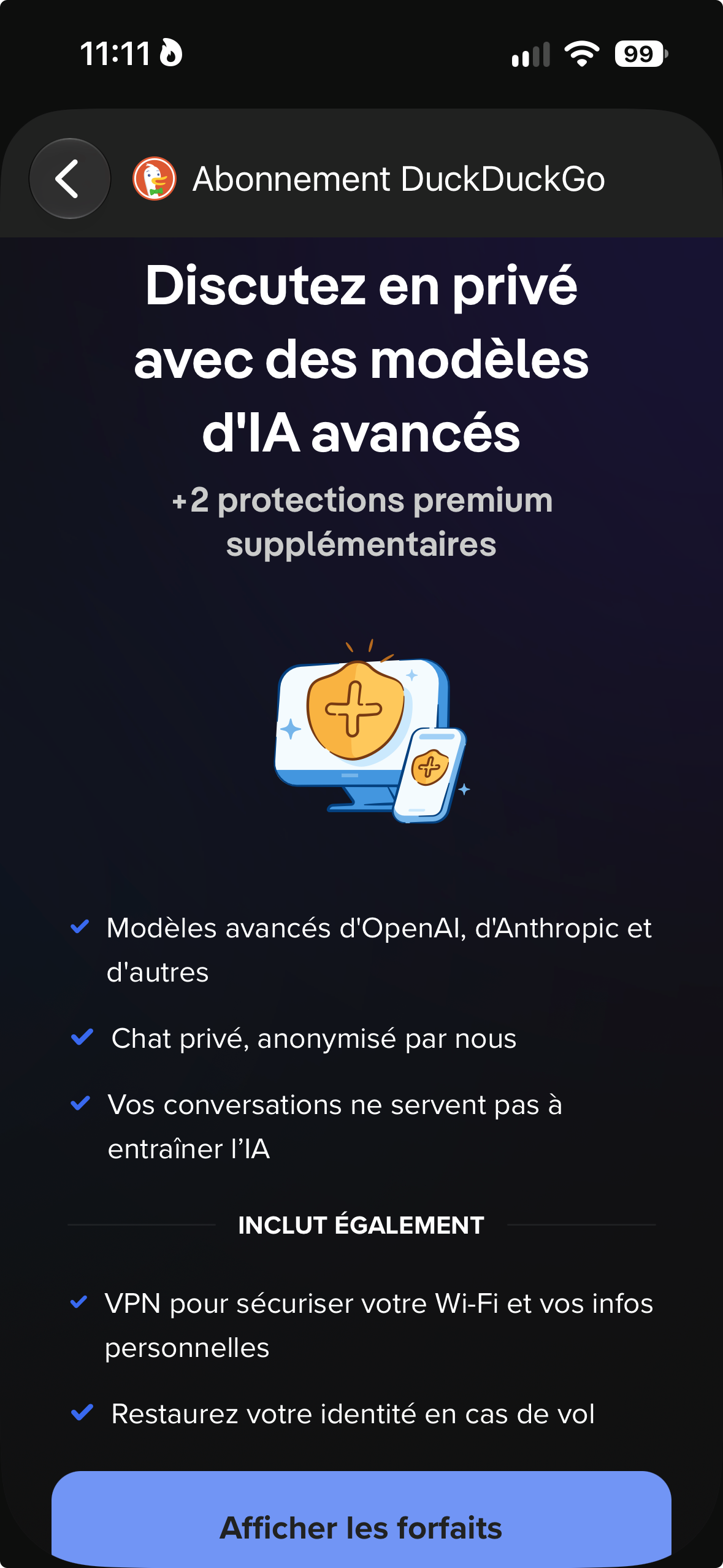
Duck.ai has had a free version since March 2025, with no account or sign-up required. The tool allows anonymous dialogue with several third-party models. DuckDuckGo acts as an intermediary between the user and model providers (Anthropic, OpenAI, Mistral…). Access to more advanced models was subsequently integrated into DuckDuckGo’s existing subscription, which until then focused on VPN, the deletion of personal data, and identity restoration.
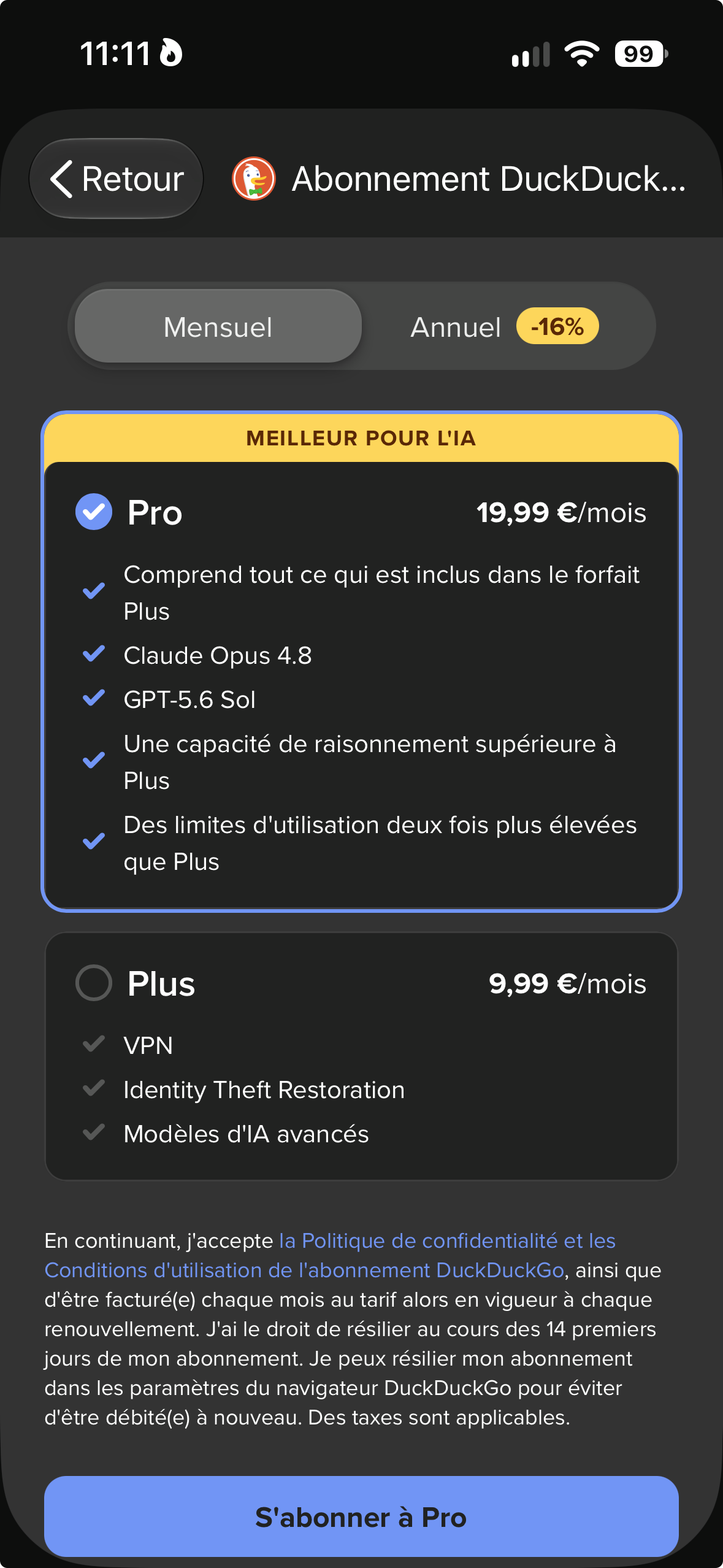
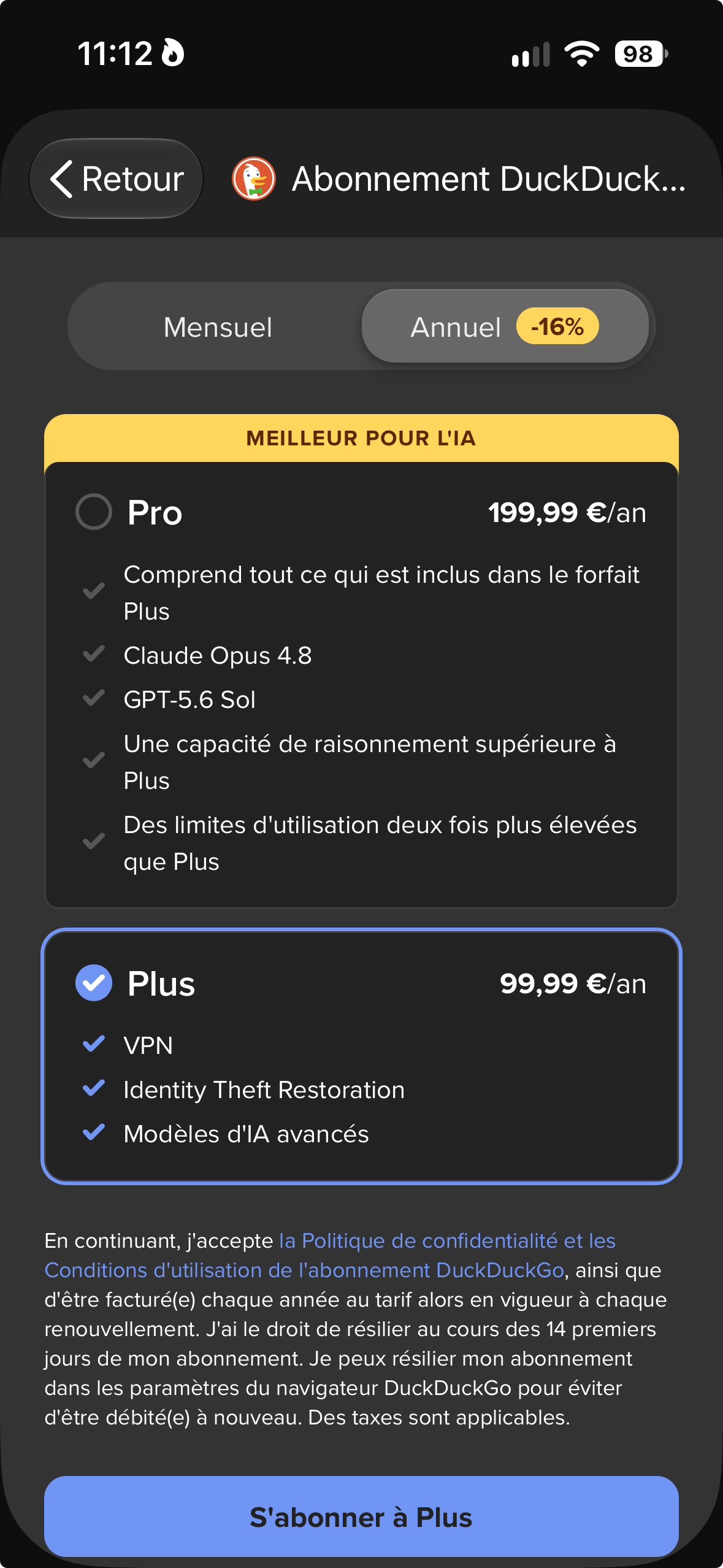
DuckDuckGo split this subscription into two tiers. Plus, at €9.99 per month, covers all four protections already offered. Pro, at €19.99 per month, adds access to more powerful models, a higher level of reasoning, and usage limits doubled compared with Plus. As is often the case, the price includes a discount (16%) for annual commitment.
Note that neither Plus nor Pro are AI subscriptions in the strict sense. They are global privacy plans, in which access to advanced models is added to a no-logs VPN and identity-protection tools. Therefore, it is difficult to make a direct comparison with a ChatGPT Plus or a Claude Pro.
Claude Opus 4.8 and GPT-5.6 Sol: the same engines as the competition
Unlike Lumo or Euria, Duck.ai does not host any model in-house. The service acts as an anonymization layer in front of proprietary models owned by other companies.
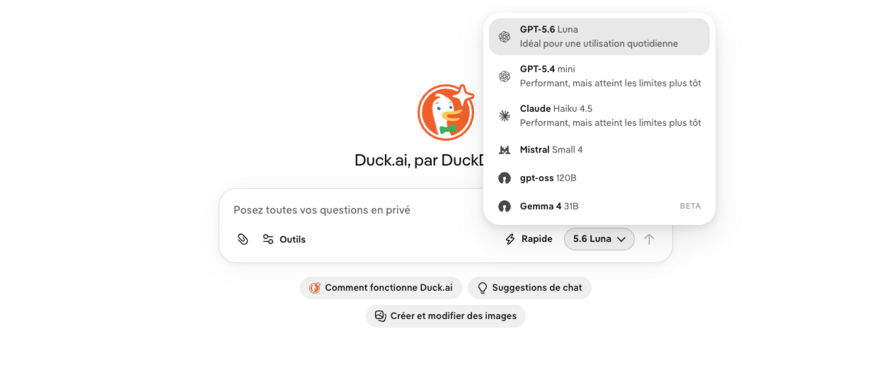
The free tier provides access to Claude 4.5 Haiku from Anthropic, Mistral Small 4, GPT-5.4 nano and GPT-5.4 mini from OpenAI, as well as gpt-oss-120b and Gemma 4 31B, the latter two models hosted by Tinfoil, an independent provider specializing in confidential computing rather than directly by OpenAI and Google.
The Plus tier adds GPT-5.4 and Claude Sonnet 4.6. The official DuckDuckGo documentation mentions for Pro only the addition of Claude Opus 4.8, available since May 28, 2026, with enhanced reasoning and doubled limits. However, the iOS app’s subscription screen reveals a second model exclusive to Pro, GPT-5.6 Sol.
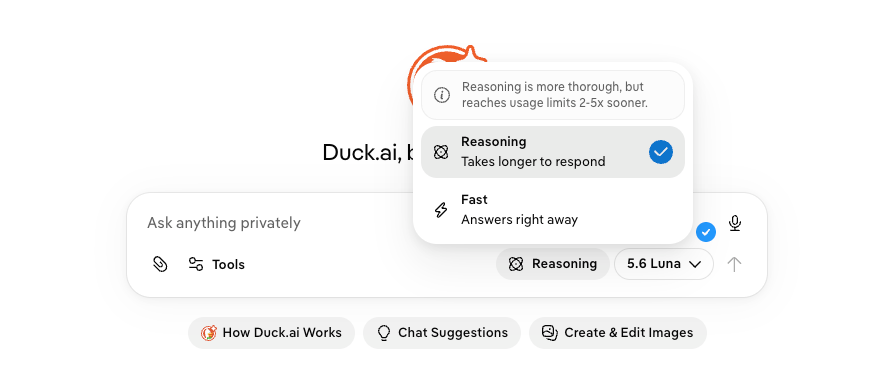
For comparison, Perplexity reserves its most advanced models, refreshed regularly with new OpenAI and Anthropic releases, to its Max plan at about $200 per month. Duck.ai Pro provides access to a comparable level for about a tenth of the price. Perplexity, however, is more responsive and has just switched from GPT-5.6 Sol and Claude Opus 5 to GPT-6 Sol and Claude Opus 5.5.
Well, clearly, we obtain a fairly dramatic visual, a bit too dark for our taste, but it certainly illustrates the article’s content. The generation took about ten seconds and is comparable to what we get with Gemini. Note that image creation is also available in the free version, of course with a token limit.
Photo editing
Next, we move on to editing an existing image. For this operation, Duck.ai relies on the same GPT Images 2.0 model from OpenAI.
As with our Lumo test, the idea is to upload a photo and ask the chatbot to remove the background and replace it with a neutral backdrop. We test with the same Shutterstock image. The foreground object is a car whose white doesn’t entirely separate from the background and slightly blends into the sky. The chatbot handles this without any issues.
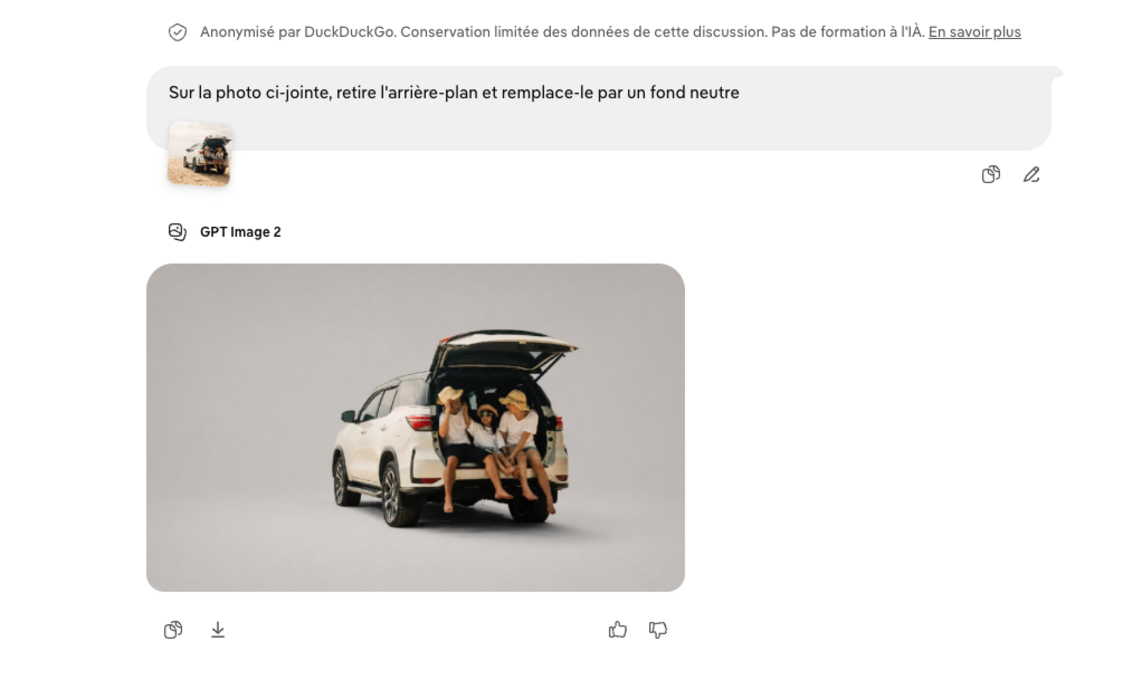
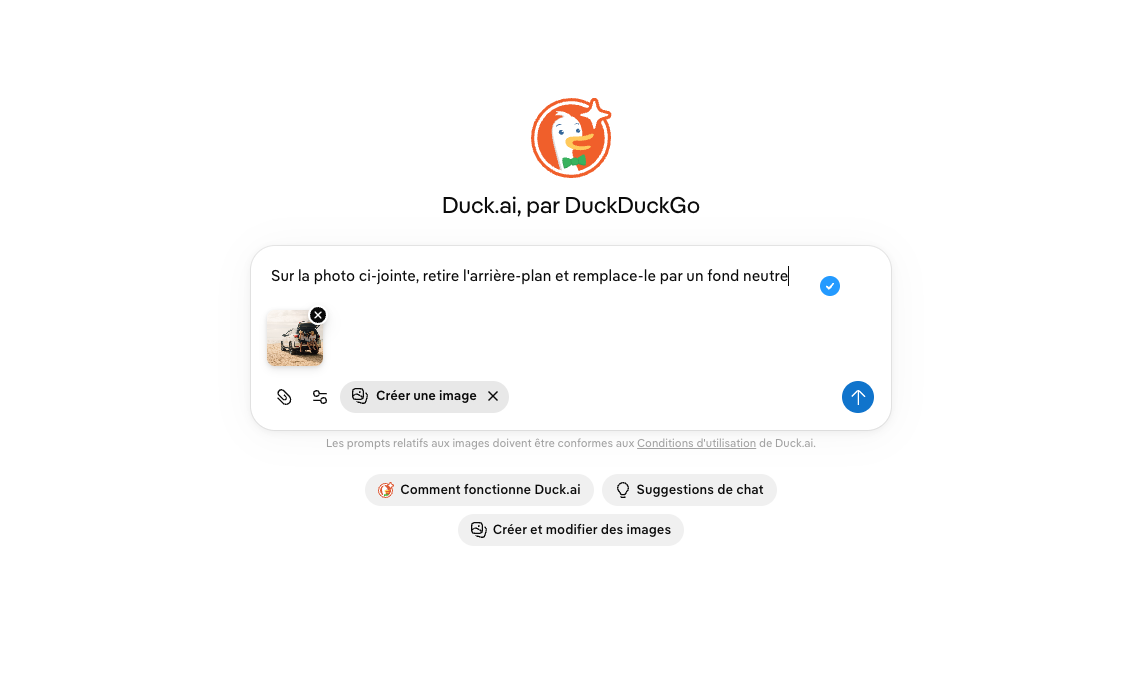
Following up on the thread, we ask it to add a new backdrop. This time the result is somewhat more realistic than with Lumo, which, for reference, relies on FireRed-Image-Edit-1.1, developed by the FireRed team at Xiaohongshu.

Pricing: what privacy really costs
The pricing matrix
So how does Duck.ai actually position itself against competitors, and what are you really paying for these subscriptions? Here is a comparison table, which could become obsolete quickly as LLMs evolve in the coming months.
| Service | Monthly price | Premium model accessible | What is actually sold |
| Duck.ai Plus | €9.99 | Claude Sonnet 4.6, GPT-5.4 | VPN + data deletion + AI |
| Duck.ai Pro | €19.99 | Claude Opus 4.8 (+ GPT-5.6 Sol depending on the app) | Same, doubled limits |
| Perplexity Pro | around $20 | GPT-5.6 Terra, Claude Sonnet 5 | AI-sourced search + model choice |
| Perplexity Max | around $200 | GPT-6 Sol, Claude Opus 5.5 | Same + Model Council + Perplexity Computer |
| Lumo Plus | €12.99 (€9.99 with a one-year commitment) | Qwen 3.5 and GLM 5.2, Apertus 1.5 hosted by Proton | Autonomous chatbot |
| Euria (my kSuite+) | €19 | Qwen 3.5 and Apertus 1.5, hosted by Infomaniak | Email, storage and AI bundled in kSuite |
| ChatGPT Plus, Claude Pro, Google AI Pro | €20 to €23 | In-house model | Autonomous AI subscription |
| Mistral Vibe Pro (ex-LeChat) | €17.99 | Mistral model | Autonomous AI subscription |
Duck.ai Pro remains the cheapest option to access a model on par with Claude Opus 4.8, far from the $200 per month that Perplexity charges for a comparable Max-level access. Then, Duck.ai and Euria stand out from the others by what they attach to the chatbot: a VPN and identity-protection tools for DuckDuckGo, an email box and kDrive storage for Infomaniak. Lumo Plus and Le Chat Pro, by contrast, remain autonomous AI subscriptions sold on their own even though Proton and Mistral also offer other products separately.
What the Duck.ai subscription does not include
Even at the Pro tier, Duck.ai remains a chat interface, nothing more. It does not offer anything akin to Claude’s Projects or Lumo’s spaces, even at Pro. Exchange history is limited to a recently accessed conversation list stored locally on the device, with the option to pin up to five at the top and to clear everything with a Fire Button. There is therefore no space to gather multiple documents around a single topic, no persistent memory from one conversation to another, no knowledge base fed by files, and no customizable assistants like Custom Lumos.
There is no public API documented. It is therefore impossible to integrate Claude Opus 4.8 or GPT-5.6 Sol into a script, a Zapier or Make workflow, or a third-party app via Duck.ai: you would need to subscribe directly with Anthropic or OpenAI.
No development environment is offered either, unlike Claude Code or ChatGPT’s Advanced Data Analysis. Duck.ai can explain or generate code, but it never executes it and does not allow interactive debugging.
Finally, there is no plugin, no extension marketplace, no executable agent action. Duck.ai remains an anonymized entry point to models, not a working environment.
Who is Duck.ai Plus/Pro for?
Duck.ai Plus and Pro are mainly aimed at those who want to use the latest high-performing models while improving the privacy of their interactions, without seeking a sovereign tool.
Access to Claude Opus 4.8 or GPT-5.6 Sol remains a strong selling point, but for a use that ends up being somewhat constrained. If we were not expecting APIs or development tools, the absence of projects, a secure persistent memory, or a knowledge base is somewhat disappointing and could irritate users in daily life.
Without that tracking, one would rather go for occasional use. In that case, it is hard to justify an annual subscription. However, as a secure supplementary solution, Duck.ai can be interesting. For everyday use, with full encryption of exchanges (media included), a sovereign AI, and project management, it’s better to turn to Proton Lumo, even though it does not have the market’s most powerful LLMs.

Duck.ai is a web service to chat with several third-party AI models. DuckDuckGo acts as an intermediary to remove identifiers before sending requests to the model providers.
- Account-free access to DuckDuckGo
- Anonimized chats by DuckDuckGo
- Multiple cutting-edge models to choose from
- No project management
- Non-sovereign AI
- No media encryption

Daniel Brooks
I cover everyday products with a practical eye, from kitchen tools and home essentials to smart gadgets and consumer trends. My goal is to help readers understand what is genuinely useful, what is worth the price, and what deserves a second look before buying.