
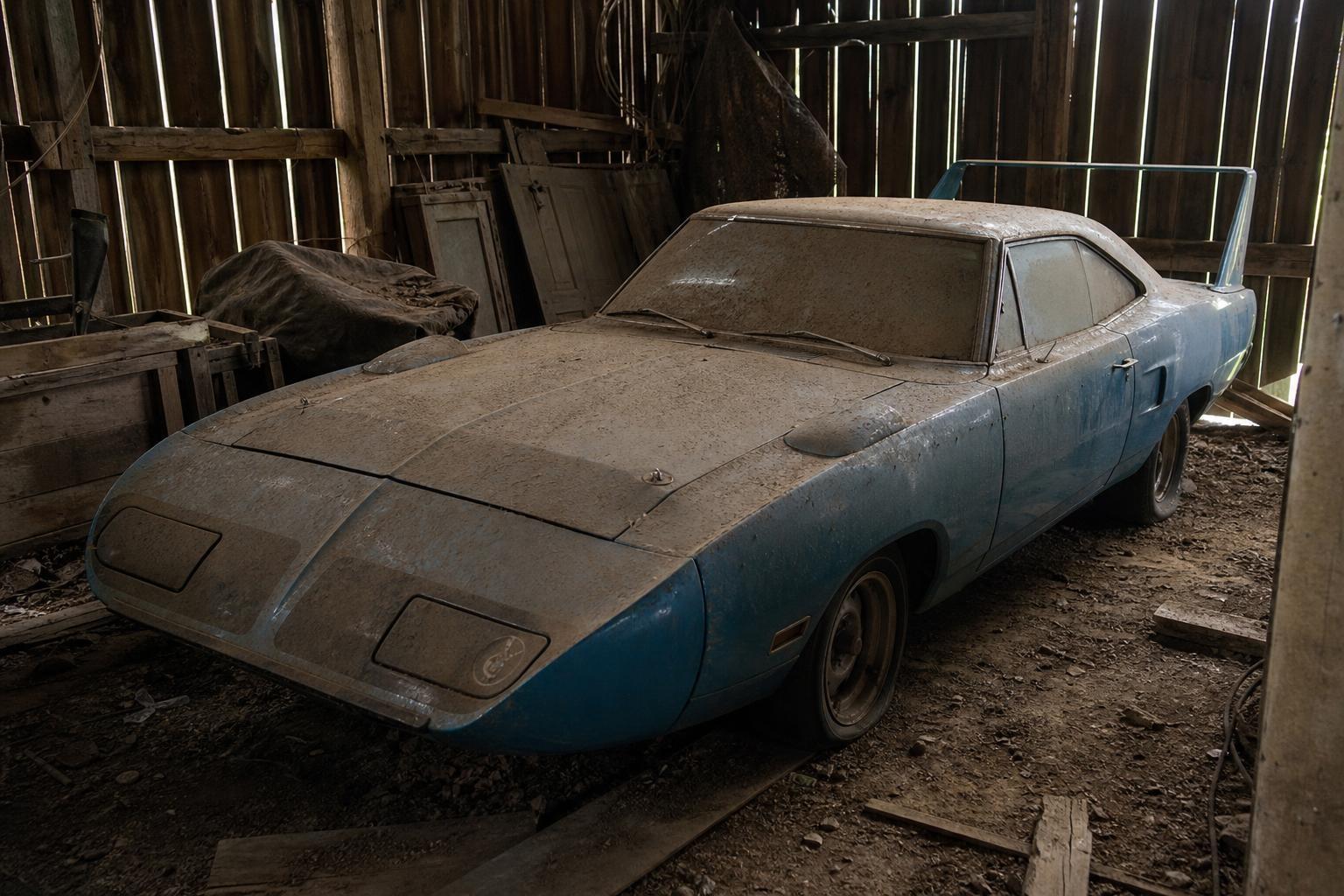
The padlock squealed, the hinges groaned, and a chill of dust-filled air rushed past as if the barn itself exhaled. After three decades, a son finally turned the key his late father had kept on the same nail, high on a beam no one ever noticed. “He told me it was just tools and junk,” the son murmured, brushing off a strand of cobweb. Then the lights flicked on, and a long, silent shape materialized beneath a collapsed tarp.
The Lock That Stopped Time
Under layers of hay and a film of Ohio dust, something bright still glowed. He pulled the cover free and stepped back with a gasp. There it sat, nose pointed like a dart, rear wing soaring like a billboard for speed: a 1970 Plymouth Superbird. The odometer blinked a number almost impossible in the present—just under nine thousand miles.
“Dad never drove it in the rain,” he said, almost laughing. “He barely drove it at all.”
A Time Capsule on Four Wheels
Everything looked untouched and strangely alive. The original decals, the Road Runner badging, even the cheeky “Beep Beep” horn button waited where it always had. Under the skin, bright orange paint hugged immaculate panels, while the cabin wore that distinct vinyl smell—half dealership, half timeline folded in on itself.
On the shelf beside it sat a shoebox of receipts, a dog-eared brochure, and a single Polaroid of Dad at a gas pump, grin wide enough to be its own spoiler. “He bought it in ’71,” the son said, skimming the paperwork with trembling hands. “Parked it in ’93. Said he’d get to it someday.”
Why This Winged Warrior Matters
The Superbird wasn’t just a muscle car; it was a missile disguised for the street. Born out of NASCAR’s aero wars, its towering wing and wind-slicing nose were designed to do one thing: go very, very fast. Only around two thousand were built for homologation, and many were driven, modified, or lost to the ordinary grind of time.
Finding one with so few miles, and in such complete condition, is like discovering an unopened time capsule in your own attic. “I’d seen them at auctions,” he said, “but never thought there was one sleeping ten feet from our tractor.”
The Little Details That Tell the Big Story
Every survivor whispers clues. This one sang.
- Factory-correct graphics and a deep, even finish beneath the dust
- A straight, unwarped nosecone and properly aligned headlights
- Period wheels with aged but intact rubber
- A clean, unmolested interior—no extra switches, no modern stereo
- Matching-number drivetrain tags nestled where only patient eyes look
You could feel the care his father took—how he’d lift the hood, polish the air cleaner, then shut everything carefully away. Not hoarding, not bragging, just preserving a private joy.
Waking It Gently
The barn didn’t just hide a car; it kept its promises. Bringing it back would require patience. Fuel lines, gaskets, and hoses dislike long sleep. The right approach is steady and soft: fluids flushed, belts checked, tires cautiously inflated, and the engine coaxed with fresh oil and a turned-by-hand crank.
“Dad would’ve said, ‘No rush—treat it like a watch,’” the son smiled. And that’s exactly the plan: no fireworks, just careful breathing life back into what once ruled ovals and country roads alike.
Memory, Metal, and Meaning
Some finds are about money. This one felt about memory. As the son stood by the fender, you could see the weighing—keep it as a family heirloom, or share it with the world in a museum or at a careful, respectful auction. The market for these aero icons is fierce, with originality and mileage commanding rarefied attention. But numbers can’t capture a father’s habit of pulling a cover straight, of labeling a key, of choosing to save something brilliant for another day.
“He used to joke that the wing held the whole sky up,” he said. “Now it kind of does.”
The Road Ahead
Soon the Superbird will roll into light, its horn chirping that cartoon call, its big V8 thudding a measured heartbeat after a very long rest. Fresh fuel, new rubber, and a set of plates could turn a closed barn into an open-ended journey. Maybe it stays in the family, maybe it headlines a national show, maybe it stretches its legs on a cool morning, the nose slicing air as if nothing has changed since 1970.
What began with a stubborn lock has become a living story—of speed paused, of care unbroken, and of a son stepping into his father’s footprints. Under the dust, the car was never really asleep. It was simply waiting for the right pair of hands to say, “Okay, let’s go home.”