
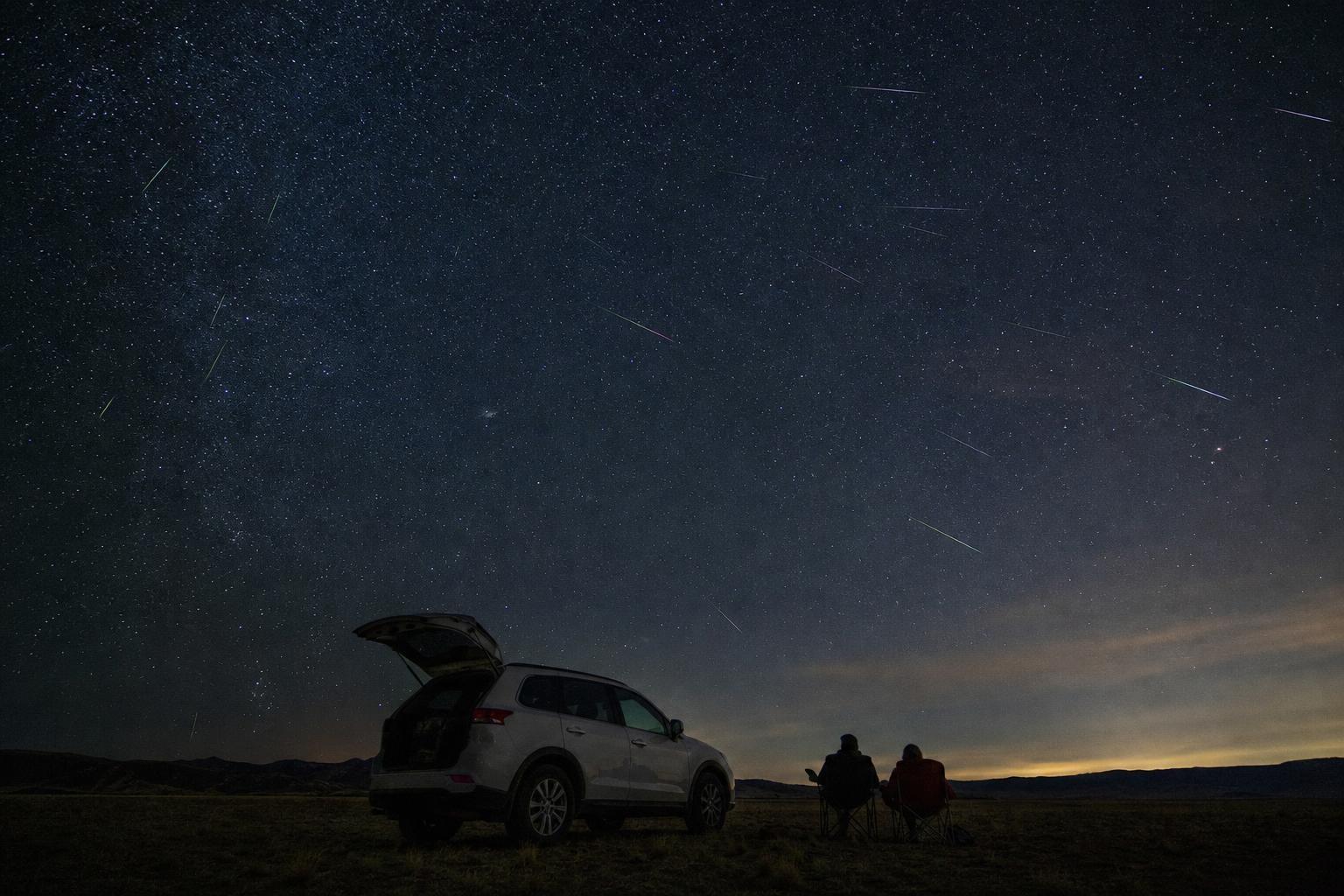
On a cold December night, the sky above the Americas turns into a natural fireworks show. For several hours, patient watchers can catch dozens of shooting stars arcing in silence, some flaring into bright fireballs. The pace can climb to about 120 meteors per hour under pristine darkness—an idealized rate that skywatchers call the ZHR—with real-world counts usually lower but still thrilling. As one seasoned observer likes to say, “Give your eyes time, and the sky will perform.”
Why these meteors aren’t from a comet
Unlike most major showers, this one springs from an asteroid, not an icy comet. The parent body is 3200 Phaethon, a roughly 5‑kilometer object discovered in 1983. Astronomers sometimes call it a “rock comet,” because when Phaethon swings very close to the Sun, intense heating likely cracks and sheds dust from its surface. Over centuries, those grains have spread along Phaethon’s orbit. Each December, Earth plows into that stream, and the particles hit our atmosphere at about 35 km/s, creating fast, streaking meteors.
“Think of it as Earth driving through a lane of pebbly dust,” one educator explains. “Each grain burns up high overhead, and your eyes catch the flash.”
When and where to look
The shower ramps up late on the night of December 13 and continues into the early hours of December 14. The radiant—the point from which meteors appear to fan out—sits in the constellation Gemini, near the bright stars Castor and Pollux. You don’t need to stare at Gemini; meteors will streak across much of the sky.
- Best time: from about 10 p.m. local time to dawn, with a typical peak around 2 a.m. when the radiant is highest.
Across North and South America, the show favors those under dark, clear skies. City lights reduce the count, but brighter meteors still punch through. If the Moon is bright, expect fewer faint streaks; if it’s thin or set, the sky gets richer.
How to watch like a pro
You don’t need a telescope—just your eyes. Telescopes and binoculars narrow your view, making you miss the wide-sky action. Find the darkest spot you can, with a broad view of the heavens. Face generally away from the radiant for longer, dramatic trails, but scan the whole dome.
Bring a reclining chair, warm layers, and hot drinks. Allow 20–30 minutes for full dark adaptation. Silence phones and avoid white light; use a dim red light to preserve your night vision. “The longer you stay, the more the sky seems to wake,” as many observers like to say.
What you’ll likely see
Expect a steady sprinkle punctuated by quick flurries. Many meteors are medium-bright, with occasional fireballs that draw gasps. Colors can range from white to yellow and green, depending on speed and composition. Some leave faint, lingering trains—wispy glows that fade over a few seconds.
Because this shower’s particles are denser and slower than the Perseids, their streaks can look clean and sharp, sometimes with a “spark” as they end. On a truly dark night, counts in the dozens per hour feel plentiful.
Understanding the numbers
That eye‑catching “120 per hour” is the theoretical ZHR: what an experienced observer might see under perfectly dark skies, with the radiant at the zenith. Most people will record fewer—perhaps 20 to 60 per hour—depending on light pollution, clouds, moonlight, and simple luck. Don’t rush the experience. Settle in for at least an hour so peaks and lulls can average out.
Photography tips for meteors
A sturdy tripod, a wide‑angle lens, and continuous shooting help. Try 10–20 second exposures at ISO 1600–6400, with the lens as fast as possible (f/2.8 or wider). Use manual focus on a bright star, then tape the ring. Point anywhere with a large swath of sky, slightly away from the radiant for longer trails. An intervalometer keeps the shutter clicking while you enjoy the show. Expect many frames with only stars—meteors are random, but perseverance wins.
Safety, comfort, and etiquette
Dress for still, cold air; even mild nights feel chilly when you’re seated. Keep gear tidy so you don’t trip. If you must use a car, dim interior lights to protect your (and others’) night vision. In shared spaces, keep voices low—the hush is part of the magic.
Why this night matters
Meteor showers connect us to the Solar System’s history. Each streak is a grain older than recorded time, igniting a few dozen miles above our heads. That these meteors come from an asteroid reshapes the usual story of comets shedding ice; it shows there’s more than one path to a dusty, annual display. As one skywatcher puts it, “For a few hours, the universe feels close—and incredibly alive.”
If clouds intrude, the shower remains active for a couple of nights around the peak—try the night before or after. Either way, step outside, look up, and let patience meet wonder. The sky, given time, will absolutely deliver.