
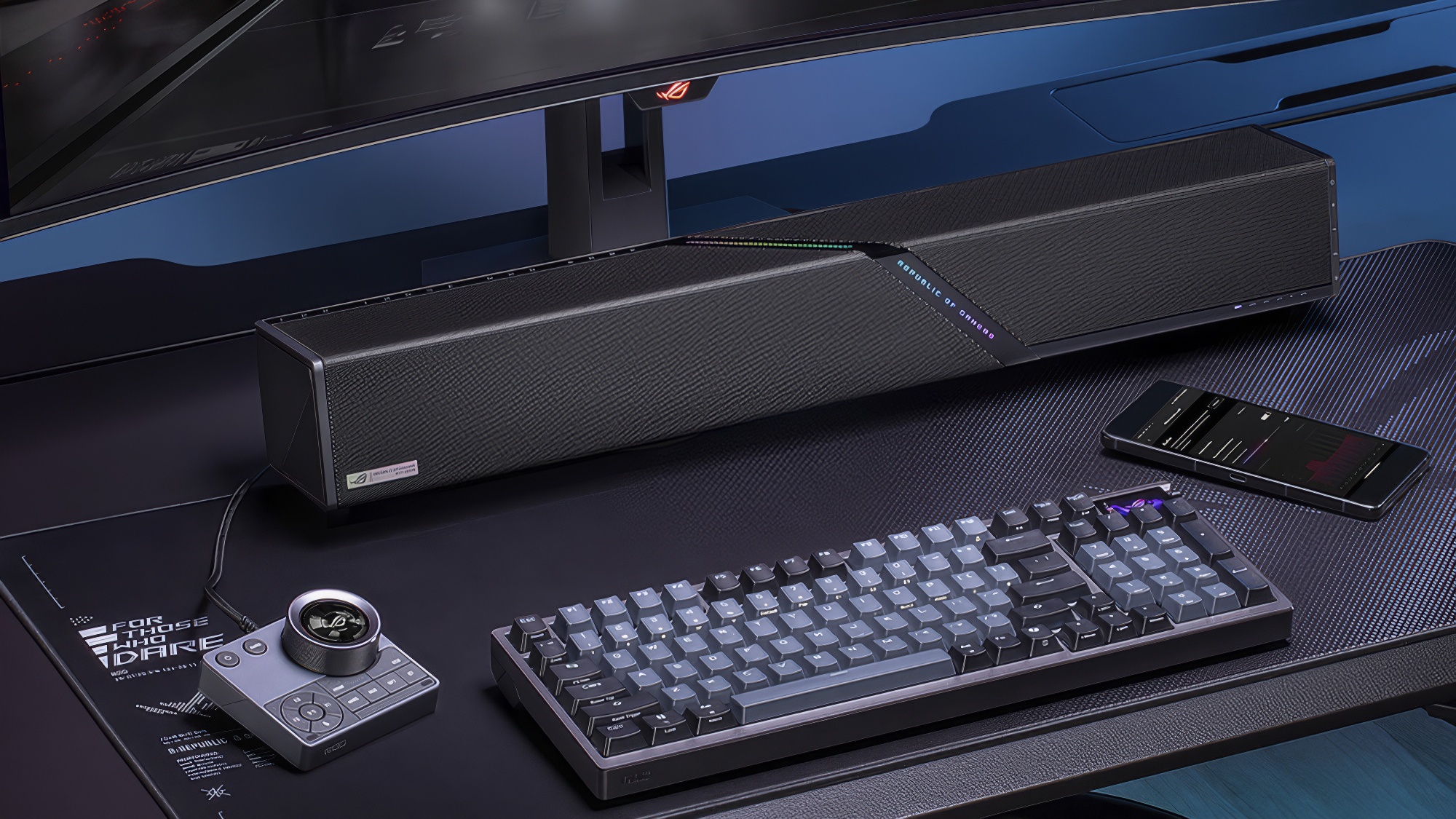
With the ROG Gjallar, ASUS isn’t just putting a soundbar under a monitor. Dolby Atmos, a wireless subwoofer, HDMI 2.1, a Control Hub, and numerous adjustments: all of this aims to become the true audio hub of a gaming setup. A compelling and particularly compact proposition, but priced at nearly 600 euros.
On a desk, choosing between a pair of speakers, a 2.1 kit, or a headset generally hinges as much on available space as on the performance sought. ASUS here attempts another approach with the ROG Gjallar, a 2.1 soundbar primarily meant to accompany a PC and, optionally, several consoles.
On paper, the proposition is unusually complete. The bar combines multiple front-facing drivers with two upward-facing channels, while a 6.5-inch wireless subwoofer handles the bass frequencies. Dolby Atmos, HDMI 2.1 with eARC, USB-C, Bluetooth 5.3, optical and aux input complete the package. ASUS also adds a remote Control Hub equipped with a display and microphones. All these elements allow the Gjallar to clearly stand out from a simple pair of desktop speakers. Is this enough to justify a price approaching 600 euros?
8 / 10
Best prices
amazon.fr
Materiel.net
RDC
- Extremely compact format
- Efficient and easy-to-integrate wireless subwoofer
- Rich connectivity
- Control Hub is well implemented and Gear Link complements it
- Very convincing for immersive solo gaming
- Finishes on this price range could be improved
- Stereo field narrower than with good separate speakers
- Very deep bass can bury voices
- Atmos more enveloping than truly three-dimensional
- Microphone not ideal for competitive or team play
- Very high price
Compact, well thought out… but not flawless at this price
The first pleasant surprise comes from the size. With a little over 60 cm in width, the Gjallar is considerably more compact than its ambitions might suggest. It easily fits beneath a monitor and does not overly encroach on the desk space. ASUS has also managed to keep the height low enough so it doesn’t obscure the bottom of the screen in a standard setup.
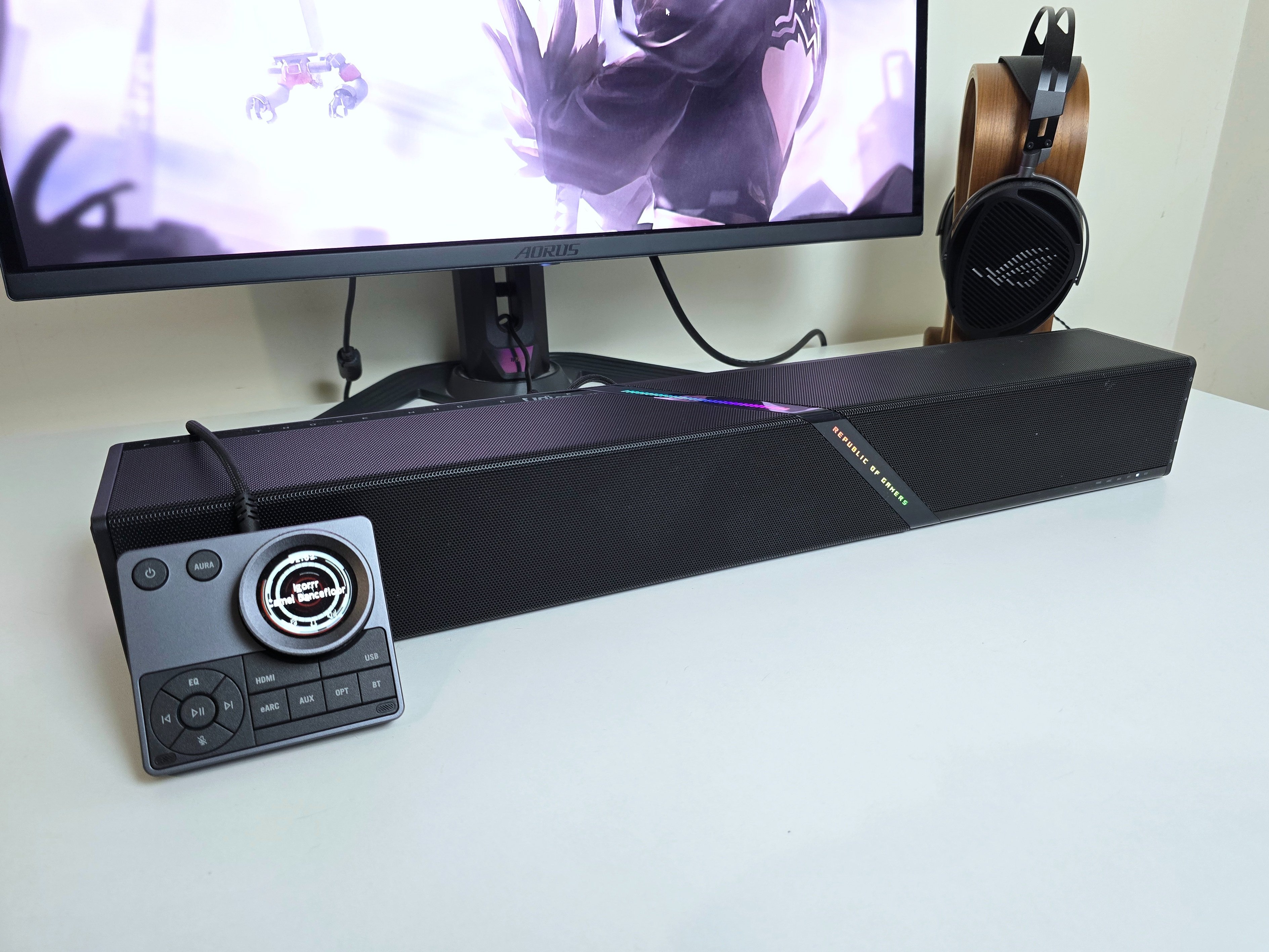
The bass subwoofer is similarly compact, with only 12.5 cm in width, easily sliding under a desk or against a piece of furniture. Its wireless connection also limits cabling constraints. During our test, the connection proved perfectly stable. One minor note: after turning on the soundbar, the sub may take three or four additional seconds to power up.
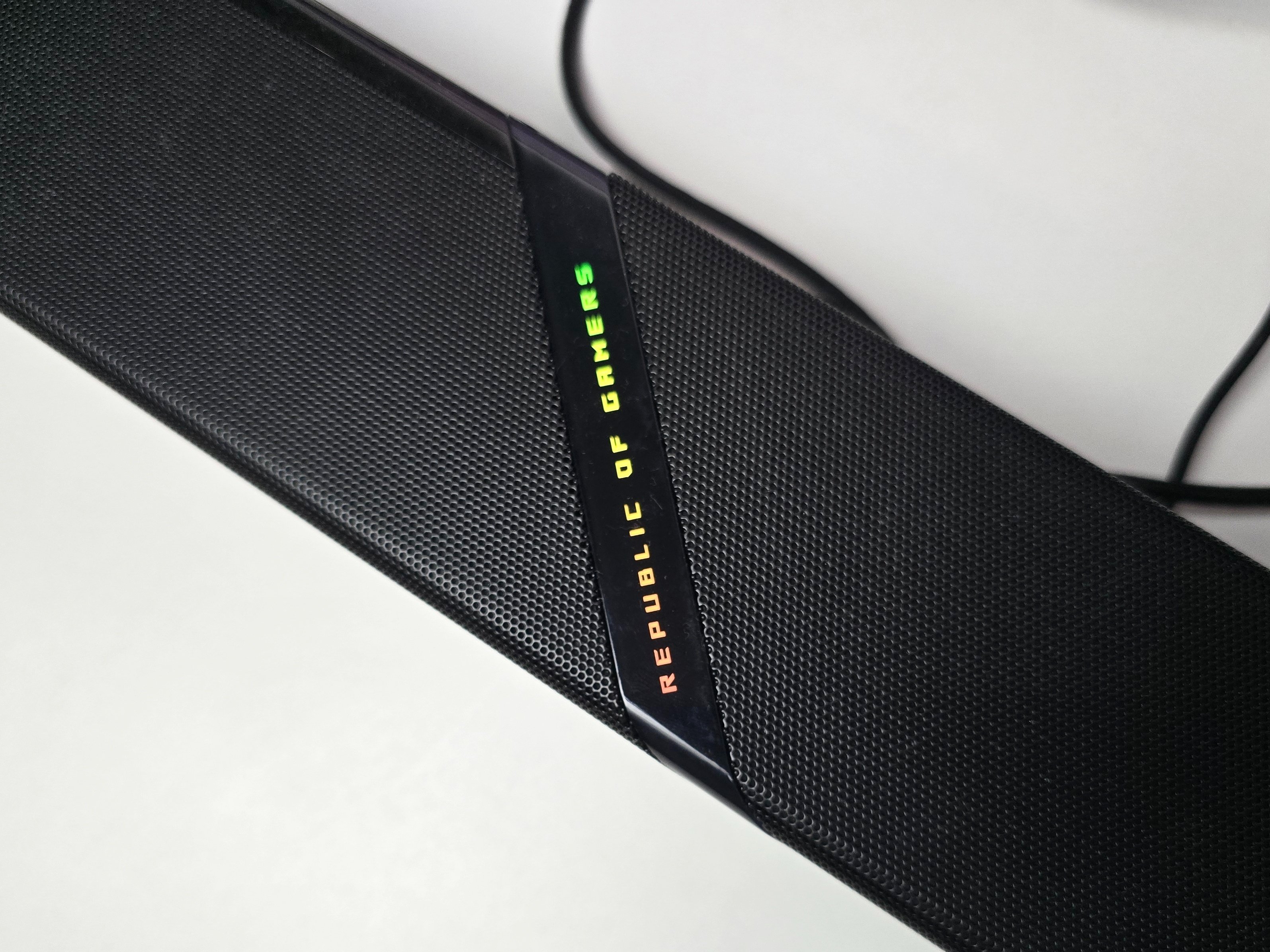
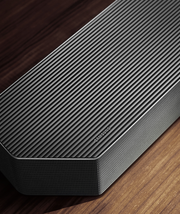
The design remains recognizable as a ROG product, notably thanks to the RGB strip crossing the front grille, but ASUS thankfully keeps it from going overboard. The Gjallar can thus fit into environments beyond the gaming niche, including a small living room. The lighting adds a small aesthetic touch; it obviously does not change the experience once you are focused on a game.
However, the finishes leave us somewhat cautious given the asking price. The metal grille inspires confidence and leaves a fairly good impression, but some plastics, especially at the ends and at the back of the bar, look somewhat ordinary. Not a deal-breaker, and the build quality remains solid, but one could have expected a more uniform level of finish on a product priced around 600 euros.
The Control Hub makes a real difference
The small box that comes with Gjallar might seem like an added accessory just to fill a spec sheet. In practice, though, it stands out as one of the product’s strongest points.
Placed within arm’s reach on a desk, the Control Hub feels almost like a mini mixing console. Its screen is legible, the various buttons fall to hand, and above all, its large central knob is particularly pleasant to use. A simple press can mute the sound, and turning the knob adjusts the volume quickly.
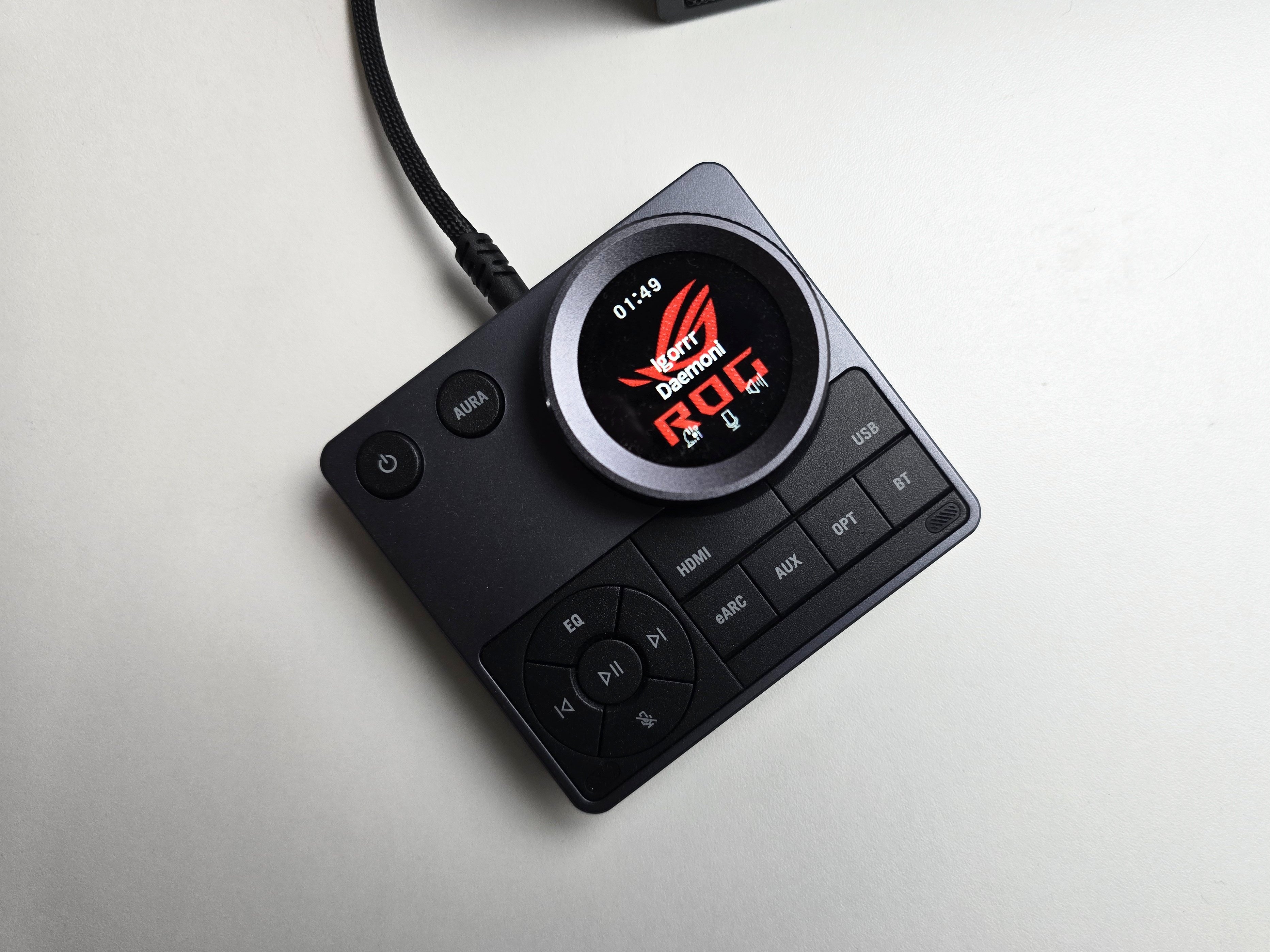
The controls grant access to the daily essentials: source switching, audio profiles, playback, and RGB lighting management. The Control Hub clearly contributes to a more premium feel. Its relevance is much more evident on a desk than in a living room setup. Right next to the keyboard and mouse, it becomes almost an extension of the bar. Several meters away from the TV, its relevance is necessarily more limited.
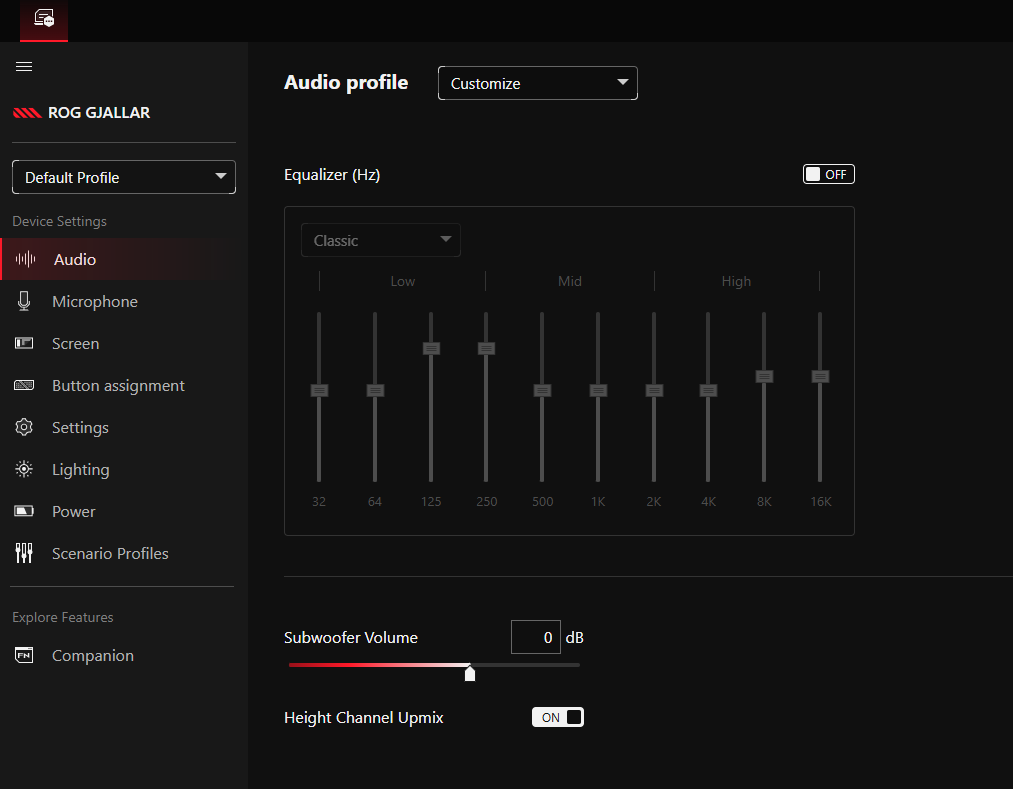
ASUS completes the package with Gear Link, accessible on PC but also via a mobile app. The tool doesn’t replace the Control Hub: it rather fills gaps that would have been difficult to integrate into such a compact hardware interface.
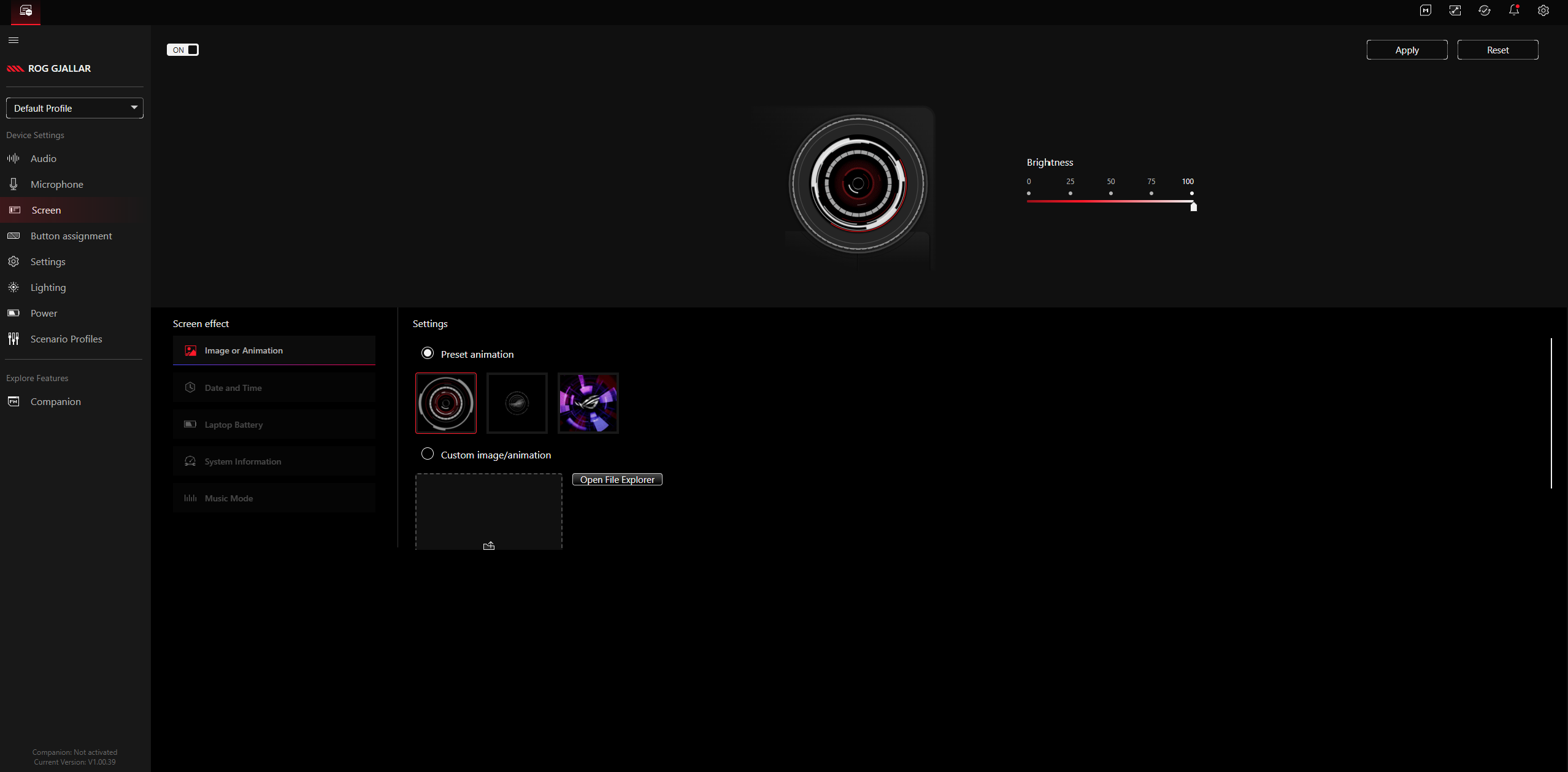
Within Gear Link you’ll find a full equalizer, profile management, detailed RGB settings, screen brightness and animations, wake-up delay, and microphone-related options. It’s also possible to reassign certain Aura button functions.
Gear Link isn’t indispensable on a daily basis, but it provides enough options to justify exploring it during the initial setup.
One remaining regret: the subwoofer level would have ideally been adjustable directly from the Control Hub. It’s exactly the kind of control you might want to tweak quickly depending on whether you’re listening to music, gaming, or watching a film.
A connectivity tailored to becoming the center of your desk
This is where the Gjallar clearly differentiates itself from a traditional speaker system.
USB-C, HDMI 2.1 with eARC, optical, auxiliary input, and Bluetooth 5.3 allow connecting several sources without constantly juggling cables. ASUS also explicitly plans for use with PCs, consoles, and mobile devices.
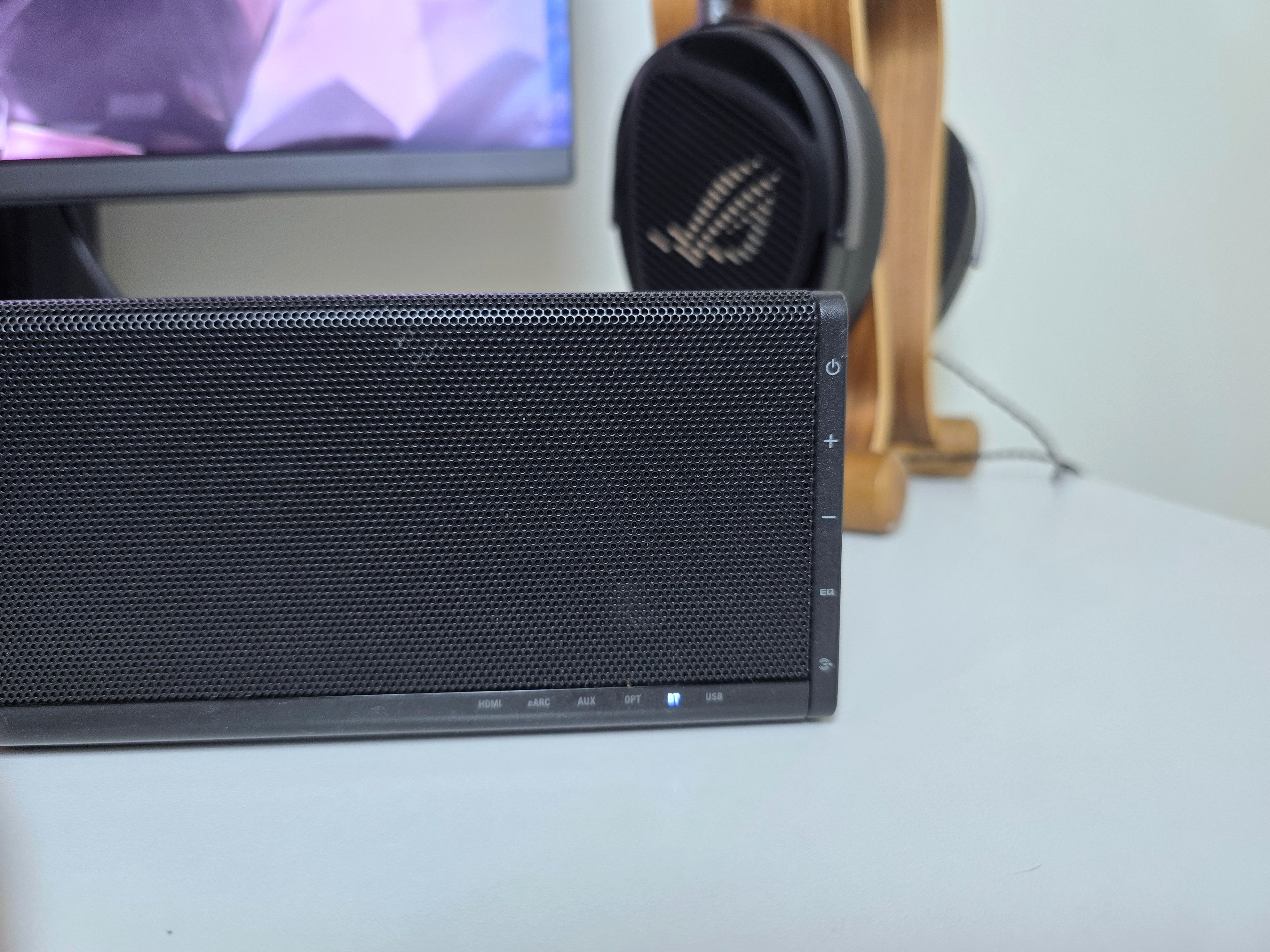
In our case, Gjallar was mainly used with a PC connected via HDMI, but also with a smartphone via Bluetooth and various laptops connected to the monitor. Switching from one source to another happens without particular difficulty, and we did not experience recognition or connection issues.
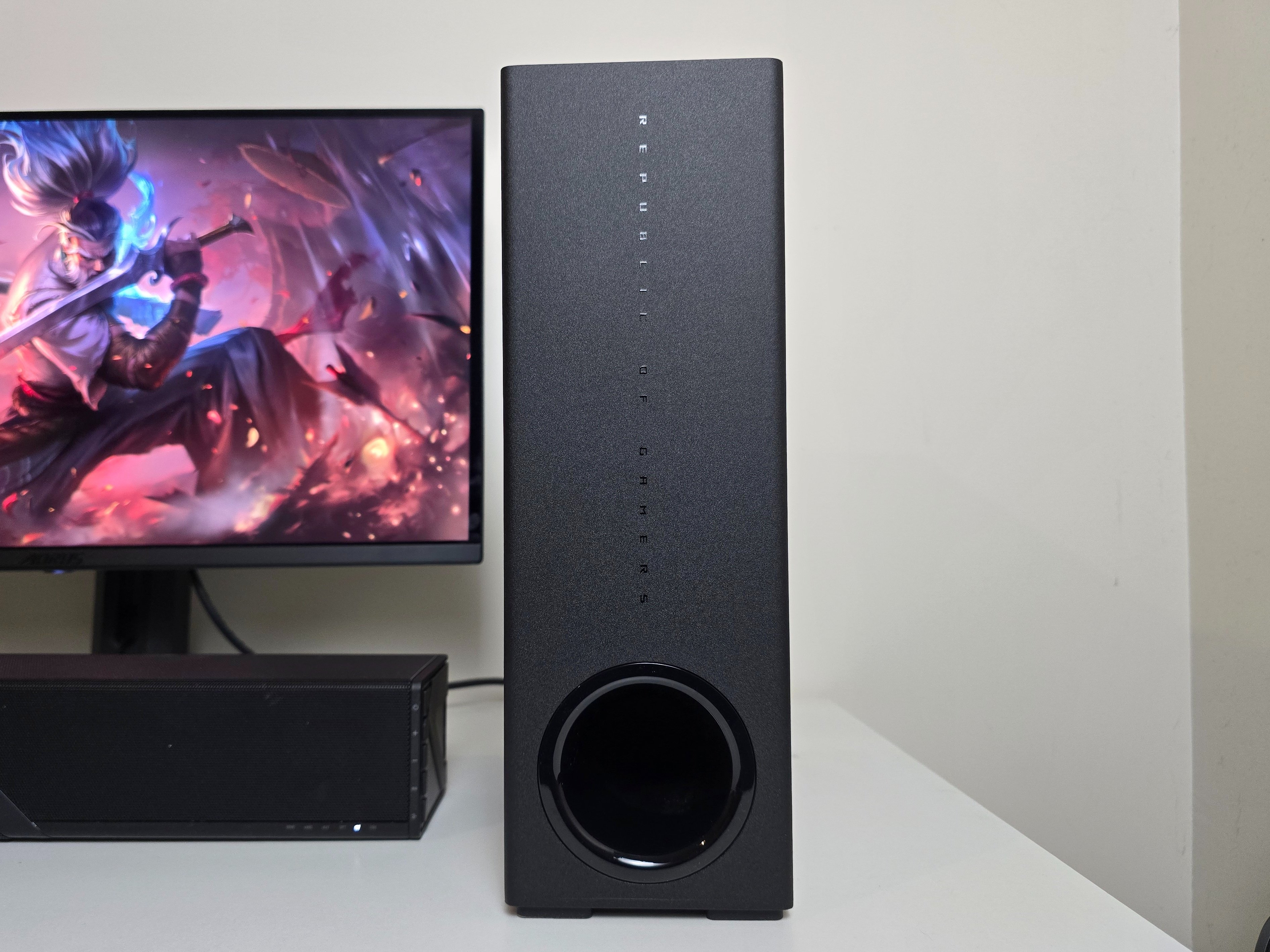
Compared to the VULKKANO A5 ARC MKII, which we recently tested, Gjallar offers more impact in the low end. The A5 ARC MKII, however, preserves an advantage in the stereo width, a logical outcome of two speakers placed left and right of the monitor. Our previous test noted the A5 ARC MKII’s generous but space-limited character in the bass department.
That’s precisely why it would be risky to claim Gjallar is simply better or worse than a typical 2.1 kit. It simply doesn’t operate under the same constraints.
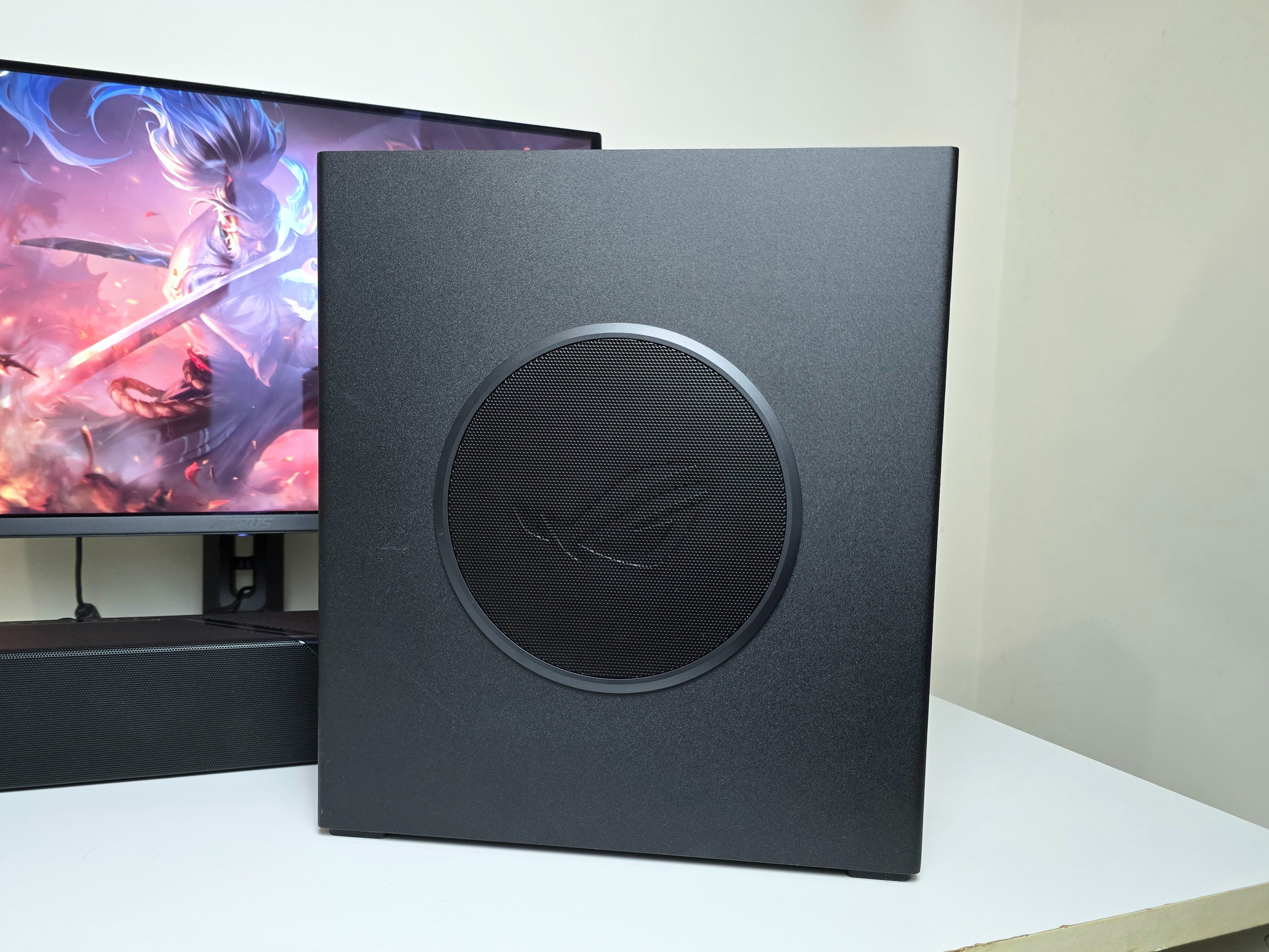
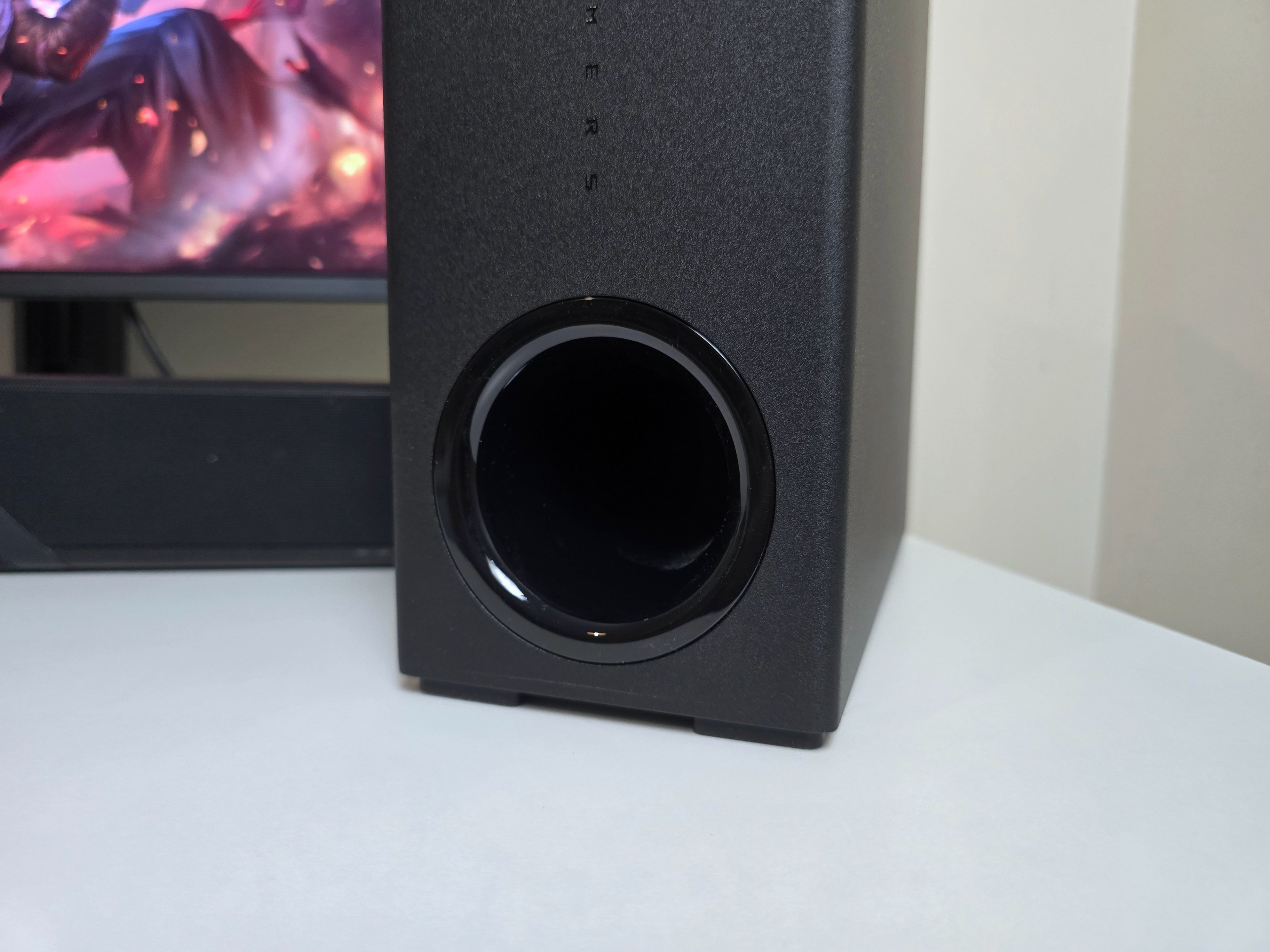
The soundstage extends beyond the physical dimensions of the bar, enough to avoid an overly cramped output, but it remains fairly centered. Properly spaced speakers still have a clear advantage here.
The signal remains very clean. We didn’t detect any hiss or noticeable background noise at close range, which is particularly welcome for a product designed to sit just a few tens of centimeters from the user.
The bar also retains good control at higher volumes. Its headroom is more than enough for typical desk use. At this distance, stay reasonable. This power becomes interesting when you want to spread music around a room or use Gjallar from a greater distance.
Gaming: immersive play is clearly its forte
It’s ultimately in the game controller’s hands that Gjallar’s signature makes the most sense. In titles like Black Myth: Wukong or Death Stranding, the subwoofer adds a more physical dimension to environments, impacts, and sound effects. The output is generous, ample, and dynamic enough to enhance immersion in a way that a headset struggles to replicate in the same fashion.
That doesn’t necessarily mean it’s better than a headset: it’s simply a different experience. While a headset isolates more and allows precise placement of different sound elements, Gjallar more readily conveys the impression that the game truly fills the room.
The Gaming profile is well-tuned for this use. The bass remains generous, but this emphasis is less bothersome in a spectacular title than in musical listening. Dolby Atmos also contributes to this sensation, though it’s important to temper the promises associated with the two upward-facing channels.
If you’re more into headphones, check out our review of the ROG Kithara, arguably one of the most accomplished gaming headsets of the year.

Test Asus ROG Kithara : when Hi-Fi hides behind a gaming headset
Yes, the soundstage broadens and the rendering feels more enveloping. No, Gjallar does not create a true sonic bubble around the listener. We never really felt like effects came from directly above or behind the listening position. The enhancement exists, but it should be viewed more as an extension of the soundstage rather than a substitute for a true multichannel system.
The limitation becomes more evident in competitive FPS games. To enjoy a truly immersive single-player experience, the bar makes perfect sense. For precisely pinpointing the origin of a shot or a moving opponent, a good headset remains preferable.
The same comment applies to cooperative gaming. The built-in microphones on the Control Hub can be helpful, and Gear Link offers various treatments to improve capture, including reducing background noise and echo. But the experience isn’t convincing enough to fully replace a headset-mic during long sessions with voice chat.
For music, the limits become more audible
Gjallar is easier to fault when switching from gaming to music listening with care.
The Music mode offers a generally pleasant balance, and the built-in profiles are relevant enough to use without immediately diving into manual equalization. But the bass output remains broadly generous in the lower end.
On our reference tracks, the bass sometimes takes a bit too much space and the vocals don’t always stand out as clearly as we would have liked. They sometimes feel slightly recessed in the mix.
This behavior isn’t necessarily problematic for ambient listening, but becomes more noticeable when you know the recordings used and you’re judging the separation of different ranges.
That’s where Gjallar’s price positioning becomes trickier. At nearly 600 euros, you can find stereo or more ambitious 2.1 setups in the pure acoustics domain, particularly in terms of soundstage width, balance, or finesse. Yet none of these criteria alone sums up the appeal of the ASUS product.
Clubic’s verdict on the Asus ROG Gjallar
ASUS hasn’t necessarily designed the best audio system you can buy for 600 euros. Yet, the manufacturer delivers a notably coherent solution for a gaming desk: compact, easy to install, with a compact subwoofer, generous bass, and enough power to go well beyond near-field listening.
The connectivity is excellent, the source switching works as expected, and the Control Hub is a real success. Gear Link intelligently complements the whole with enough adjustments to tailor Gjallar to different uses without making the software indispensable.
Still, a few trade-offs remain. The stereo field is narrower than with good separate speakers, the musical reproduction sometimes lacks balance with voices slightly recessed and bass a touch too prominent, and Dolby Atmos offers more sense of scale than a genuine height sensation. Most of all, near 600 euros remains hard to justify. At this price, competition isn’t limited to gaming products but also to audio systems capable of higher-fidelity restitution.
- Exceptionally compact format
- Efficient wireless subwoofer and easy to integrate
- Rich connectivity
- Control Hub is successful and Gear Link complements it
- Very convincing for immersive solo play
- Finishes could be improved for this price range
- Stage stereo is less wide than with good separate speakers
- Bass is a bit too prominent / Vocals sometimes recessed
- Dolby Atmos adds airiness but not a real height effect
- Microphone not ideal for competitive or team play
- Very high price
The best price quotes appear below:
Compact, well thought out… but not flawless at this price
The first good surprise comes from the size. At just over 60 cm wide, Gjallar is much more compact than its ambitions would suggest. It fits easily under a monitor and doesn’t intrude too much on desk space. ASUS also managed to keep the height low enough not to occlude the bottom of the screen in a typical setup.
The bass unit is similarly slender. At only 12.5 cm wide, it easily tucks under a desk or beside a cabinet. Its wireless link further reduces cabling constraints. During our test, the connection proved perfectly stable. Only minor note: after turning on the bar, the subwoofer sometimes takes a few additional seconds to power up.
The design remains recognizable as a ROG product, notably thanks to the RGB strip across the front grille, but ASUS thankfully avoids excessive. Gjallar can thus find its place in environments beyond the gaming setup, including a small living room. The lighting adds a small aesthetic touch; it does not change the experience once you’re focused on a game.
However, the finishes leave us a bit more cautious given the asking price. The metal grille inspires confidence and makes a good impression, but some plastics, especially at the ends and the rear of the bar, look more ordinary. Nothing crippling, and the build is solid, but one could have expected a more uniform finish level on a product priced near 600 euros.
The Control Hub makes a real difference
The small box that comes with Gjallar might seem like a mere accessory to meet the specs. In practice, it’s one of the most successful elements of the product.
Placed within reach on a desk, the Control Hub feels almost like a mini mixing interface. Its screen is legible, the buttons are easy to reach, and most of all, the large central knob is a joy to use. A simple press can mute the sound.
The commands provide access to the daily essentials: source changes, audio profiles, playback, and RGB lighting management. The Control Hub clearly elevates the experience. Its usefulness is obvious on a desk and near the keyboard and mouse, becoming almost an extension of the bar. A few meters away from the TV, its relevance is necessarily more limited.
ASUS completes the suite with Gear Link, accessible on PC but also via a mobile app. The tool does not replace the Control Hub; it rather fills in what would have been hard to integrate into a compact hardware interface.
On retrouve notamment un égaliseur complet, la gestion des profils, les réglages détaillés du RGB, la luminosité et les animations de l’écran du Control Hub, le délai avant mise en veille ou encore différents paramètres relatifs au microphone. Il est également possible de réaffecter certaines fonctions du bouton Aura.
Gear Link n’est donc pas indispensable au quotidien, mais il apporte suffisamment de possibilités pour mériter que l’on s’y attarde lors de la première configuration.
One remaining regret is that the subwoofer level could have been adjustable directly from the Control Hub. It’s exactly the kind of control you might want to tweak quickly depending on whether you’re listening to music, playing, or watching a film.
A connectivity-focused design to become the center of your desk
This is probably where the ROG Gjallar clearly differentiates itself from a conventional speaker setup.
USB-C, HDMI 2.1 with eARC, optical, auxiliary input, and Bluetooth 5.3 allow multiple sources to be connected without constantly juggling cables. ASUS explicitly envisions use with PCs, consoles, and mobile devices.
In our test, Gjallar was used mainly with a PC connected via HDMI, but also with a smartphone via Bluetooth and several laptops connected to the monitor. Switching between sources happens without particular issues, and we did not encounter recognition or connection problems.
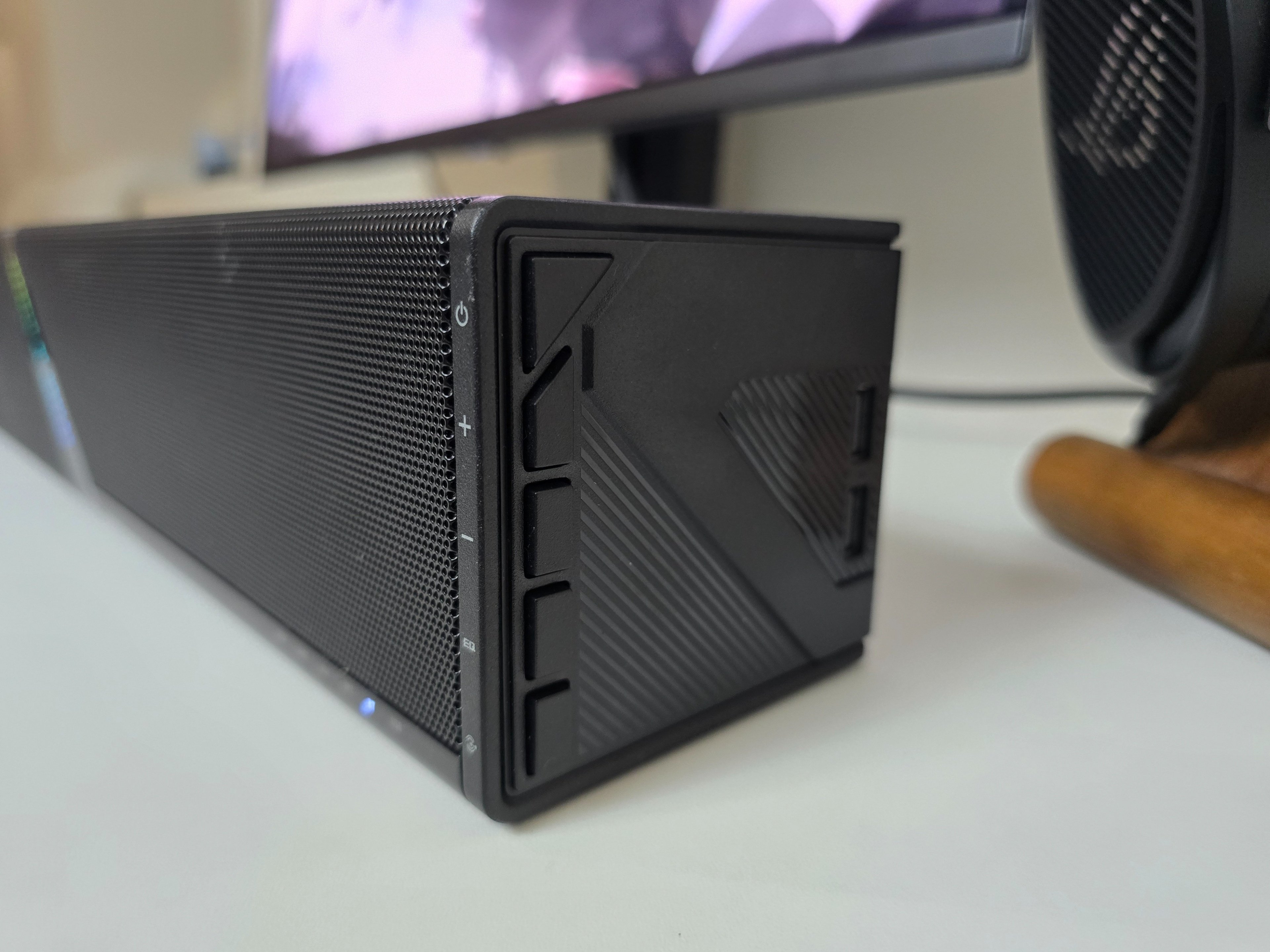
Not everyone will take advantage of this richness. A gamer using only a PC will probably never need half of the available inputs. However, for someone who wants to connect a computer, a console, and a smartphone to the same audio system, this proposition makes a lot of sense.
This is also what differentiates Gjallar from a good stereo or traditional 2.1 kit: ASUS isn’t just trying to produce sound, but to simplify the entire installation surrounding it.
A generous sound and a subwoofer that makes a difference
Listening to Gjallar, its signature tends toward generosity. This isn’t a neutral or analytical system; it’s clear that ASUS isn’t aiming for neutrality.
The subwoofer largely contributes to the character as a whole. It goes low enough to give weight to impacts and atmospherics without becoming overwhelmingly intrusive. Its presence is especially a real differentiator versus small desktop speakers that must cope with the physical limitations of their drivers.
Compared to the VULKKANO A5 ARC MKII, Gjallar delivers more impact in the bass. The A5 ARC MKII, however, preserves the advantage in stereo width, a natural outcome of two speakers separated on either side of the monitor. Our previous test already noted the A5 ARC MKII’s generous but space-limited bass character.
This is precisely why it would be risky to claim Gjallar is better or worse than a standard 2.1 kit. It simply doesn’t operate under the same constraints.

The sound stage slightly exceeds the bar’s physical dimensions, enough to avoid a entirely cramped restitution, but it remains quite centered. Properly spaced speakers still hold a clear advantage here.
The signal purity is, however, excellent. We did not notice any hiss or background noise at short distance, which is particularly appreciated for a product meant to sit just a few tens of centimeters from the user.
The bar also maintains good control when the volume is raised. Its headroom is more than enough for typical office use. At this distance, modesty is advisable. This power becomes interesting when broadcasting music in a room or using Gjallar from greater distance.
Gaming: immersive play is Gjallar’s natural habitat
It ultimately makes the most sense when you’re hands-on with a controller. In games like Black Myth: Wukong or Death Stranding, the subwoofer adds a more physical dimension to environments, impacts, and audio effects. The output is generous, expansive, and dynamic enough to intensify immersion in a way that a headset struggles to match in the same way.
It doesn’t necessarily beat a headset; it’s more about offering a different experience. While a headset isolates more and allows precise placement of different sounds, Gjallar more readily conveys the feeling that the game truly fills the room.
The Gaming profile is well tuned for this use. The bass remains generous, but this emphasis bothers us less in a spectacular title than in music listening. Dolby Atmos also contributes to this sense, but temper expectations about the height effect brought by the two upward-facing channels.
Are you more in the mood for a headset? Check our review of the ROG Kithara, perhaps one of the most accomplished gaming headsets of the year.
Test Asus ROG Kithara : quand la Hi-Fi se cache derrière un casque gamer
Yes, the scene gains width and the sound becomes more enveloping. No, Gjallar does not create a true sonic bubble around the listener. We never felt that effects originated precisely from the ceiling or behind the listening position. The enhancement exists, but it should be seen more as an extension of the soundstage rather than a substitute for a true multi-channel system.
The limit is even more evident in competitive FPS games. To enjoy an immersive single-player game, the bar makes perfect sense. To determine precisely where a shot is coming from or where an opponent is moving, a good headset remains preferable.
The same applies to cooperative play. The microphones built into the Control Hub can help, and Gear Link offers different treatments designed to improve capture, notably reducing background noise and echo. But the experience isn’t convincing enough to replace a headset-mic for long sessions with voice chat.
For music, the limits are more noticeable
Gjallar is more prone to showing its weaknesses when you switch from gaming to music listening. The Music mode offers a generally pleasant balance, and the built-in profiles are relevant enough to use without immediately diving into manual EQ. But the bass response remains generous down low.
On our reference tracks, the bass can take up a bit too much space and vocals don’t always stand out as clearly as we would like. They sometimes appear slightly recessed in the mix.
This isn’t necessarily problematic for ambient listening, but becomes more noticeable when you know the recordings used and you’re evaluating the separation of different registers.
That’s where Gjallar’s price positioning becomes more delicate. At around 600 euros, you can find stereo or larger 2.1 systems that push further in terms of acoustics, particularly in soundstage width, balance, or finesse. Yet none of those criteria alone captures the overall appeal of ASUS’s product.
Clubic’s verdict on the Asus ROG Gjallar
ASUS hasn’t necessarily crafted the best audio system to buy at 600 euros. Nevertheless, the manufacturer delivers a particularly coherent office solution: compact, easy to install, with a small subwoofer, generous bass, and enough power to comfortably exceed near-field listening.
The connectivity is excellent, source switching works as expected, and the Control Hub is a genuine success. Gear Link effectively complements the whole with enough settings to adapt Gjallar to different uses without making the software essential.
Still, some compromises remain. The stereo field is narrower than with good separate speakers, musical restitution sometimes lacks balance with voices slightly recessed and bass a bit too prominent, and the Atmos promises more breadth than a true sense of height. Above all, near 600 euros is hard to justify. At this price, competition comes not only from gaming products but also from audio systems capable of higher-fidelity restitution.
Gjallar becomes a lot more interesting when compactness, versatility, and installation simplicity are highly valued. If its price drops significantly during Black Friday or other promotions, the compromise could become quite appealing.
Pros
- Exceptionally compact
- Wireless subwoofer that’s easy to integrate
- Gorgeous and clean sound, even at higher volumes
- Excellent connectivity
- Control Hub and Gear Link complete it
- Very convincing for immersive solo experiences
Compact, well thought out… but not flawless at this price
The first pleasant surprise comes from the format. At a little over 60 cm in width, the Gjallar is noticeably more compact than its ambitions would suggest. It easily fits under a monitor and doesn’t invade too much desk space. ASUS has also managed to keep the height low enough to avoid obscuring the bottom of the screen in a standard installation.
The bass subwoofer is similarly compact. With a width of only 12.5 cm, it easily finds a place under a desk or next to a piece of furniture. Its wireless connection also reduces wiring constraints. During our test, the connection proved perfectly stable. One small drawback: after turning on the bar, the sub occasionally needs a few extra seconds to wake up.
The design remains identifiable as a ROG product, especially thanks to the RGB strip that crosses the front grille, but ASUS avoids overdoing it. Gjallar can thus find its place in environments that aren’t purely gaming, including a small living room. The lighting adds a subtle aesthetic touch; it doesn’t alter the experience once you’re focused on a game.
However, the finishes leave us somewhat cautious given the price. The metal grille inspires confidence and leaves a decent impression, but some plastics, particularly at the ends and rear, appear rather ordinary. Not a deal-breaker, and the build remains solid, but one could hope for more uniform finish quality at this price.
A connectivity-focused design to become the center of your desk
This is likely where the Gjallar distinguishes itself most clearly from a traditional speaker system.
USB-C, HDMI 2.1 with eARC, optical, analog input, and Bluetooth 5.3 allow connecting multiple sources without juggling cables constantly. ASUS explicitly anticipates use with PC, consoles, and mobile devices.
In our case, Gjallar was used mainly with a PC connected via HDMI, but also with a smartphone via Bluetooth and various laptops connected to the monitor. Moving from one source to another occurs without particular difficulty, and we did not encounter recognition or connection issues.
Everyone won’t take advantage of this richness. A gamer with only a PC will likely never need half of the inputs. But for someone who wants to connect a computer, a console, and a smartphone to the same audio system, the proposition makes a lot of sense.
A generous sound and a subwoofer that makes a difference
Listening to Gjallar, it presents a generous signature. It isn’t a neutral or analytical system, and that’s clearly what ASUS is aiming for.
The subwoofer contributes substantially to the overall character. It reaches sufficiently low to give weight to impacts and atmospherics without becoming intrusive. Its presence is a real differentiator against small desktop speakers that lack the physical space to accommodate deeper bass.
Comparing to the VULKKANO A5 ARC MKII, Gjallar delivers more bass impact. The A5 ARC MKII, however, preserves the advantage in stereo width, a logical result of two speakers separated on either side of the monitor. Our previous test noted the A5 ARC MKII’s generous but space-limited bass range.
That’s exactly why it would be risky to claim that Gjallar is better or worse than a typical 2.1 kit. It simply doesn’t contend with the same constraints.
Sound staging goes slightly beyond the bar’s physical limits, enough to avoid an overly narrow restitution, but it remains fairly centered. A properly spaced stereo setup still has a clear advantage here.
The signal purity, however, is excellent. We didn’t notice any hiss or background noise at close distance, which is particularly welcome for a product meant to be placed a few tens of centimeters from the user.
The bar also maintains good control as the volume increases. Its headroom is well beyond what’s needed for typical desk use. At this distance, it’s wise to stay moderate. This power becomes interesting when you want to broadcast music in a room or use Gjallar from a greater distance.
Gaming: immersive play is Gjallar’s natural playground
Indeed, it’s in gaming that the Gjallar’s signature becomes most meaningful. In titles like Black Myth: Wukong or Death Stranding, the subwoofer gives environmental sounds, impacts, and effects a more physical presence. The restitution is generous, expansive, and dynamic enough to intensify immersion in a way that a headset struggles to match.
It’s not necessarily better than a headset; it’s simply a different experience. While a headset isolates and allows precise placement of different sound elements, Gjallar makes the game feel like it’s really filling the room.
The Gaming profile is well-tuned for that usage. The bass remains generous, but that emphasis is less irritating in a spectacular game than in music listening. Dolby Atmos also contributes to this sensation, but you should temper expectations of height from the upward channels.
If you’re more in the mood for headphones, check out the ROG Kithara review, perhaps one of the most accomplished gaming headsets this year.
Test Asus ROG Kithara : when Hi-Fi hides behind a gamer headset
Yes, the scene gains width and the rendering feels more enveloping. No, Gjallar doesn’t create a true sonic bubble around the listener. We never felt that effects originated exactly from the ceiling or behind the listening position. The contribution exists, but it should be viewed more as an extension of the soundstage than a substitute for a real multichannel system.
The limitation becomes even more evident in competitive FPS games. For immersive single-player gameplay, the bar makes perfect sense. For precisely locating a shot or an opponent’s movement, a good headset remains preferable.
The same applies to cooperative play. The mics on the Control Hub can be useful, and Gear Link offers treatments to improve capture, including noise reduction and echo control. But the experience isn’t convincing enough to replace a headset-mic for long sessions with voice chat.
Musical performance: limits become more audible
Gjallar is more likely to expose its weaknesses when leaving gaming to focus on music listening. The Music mode presents a generally pleasant balance, and the included profiles are meaningful enough to use without immediately resorting to manual EQ. But the restitution keeps a generous bass bias in the lower end.
On reference tracks, the bass can take up a bit too much space and vocals don’t always stand out as clearly as we’d hoped. They can sometimes sound a touch recessed in the mix.
This isn’t necessarily problematic for ambient listening, but becomes more noticeable when you know the recordings and you’re judging the separation of different registers.
That’s where Gjallar’s price positioning becomes more delicate. At roughly 600 euros, you can find stereo or more ambitious 2.1 setups that push further in terms of room acoustics, balance, or refinement. Yet none of these criteria alone sums up the appeal of the ASUS product.
Clubic’s verdict: Asus ROG Gjallar
ASUS hasn’t necessarily designed the best audio system you can buy for 600 euros. Instead, the builder delivers a particularly coherent solution for a gaming desk: compact, easy to install, with a small subwoofer, generous bass, and enough power to easily go beyond near-field listening.
The connectivity is excellent, the source switching works as expected, and the Control Hub is a true success. Gear Link completes the whole with enough settings to adapt Gjallar to different uses without making the software indispensable.
There are, however, a few compromises. The stereo field remains narrower than with good standalone speakers, the musical reproduction sometimes lacks balance, with voices slightly recessed and bass a touch too present, and Atmos provides more grandeur than a genuine sense of height. Above all, at nearly 600 euros, it’s hard to justify. At this price, competition comes not only from gaming products but also from audio systems capable of more absolute fidelity.
Gjallar becomes much more attractive when compactness, versatility, and installation simplicity are highly valued. If its price drops significantly during Black Friday or other promos, the compromise could become quite appealing.
Conclusion
ASUS hasn’t necessarily designed the best 600-euro audio system on the market. Yet, the manufacturer offers a particularly coherent solution for a gaming desk: compact, easy to install, with a compact subwoofer, generous in the low end, and powerful enough to move beyond close-range listening. The connectivity is excellent, the source switching works as expected, and the Control Hub is a true success. Gear Link complements the whole intelligently with enough controls to tailor Gjallar to different uses without making the software indispensable.
Some compromises remain, however. The stereo stage remains narrower than that of good separate speakers, musical restitution sometimes lacks balance with voices slightly recessed and bass a touch too prominent, and Dolby Atmos adds spaciousness more than a true sense of height. Above all, the price near 600 euros is hard to justify. In this price range, competition is not limited to gaming products but to audio systems capable of higher restitution in pure terms.
Gjallar becomes far more interesting when compactness, versatility, and installation simplicity are priorities. If its price drops notably during Black Friday or other promotions, the compromise could become quite attractive.
What are the best soundbars in 2026?

Daniel Brooks
I cover everyday products with a practical eye, from kitchen tools and home essentials to smart gadgets and consumer trends. My goal is to help readers understand what is genuinely useful, what is worth the price, and what deserves a second look before buying.