
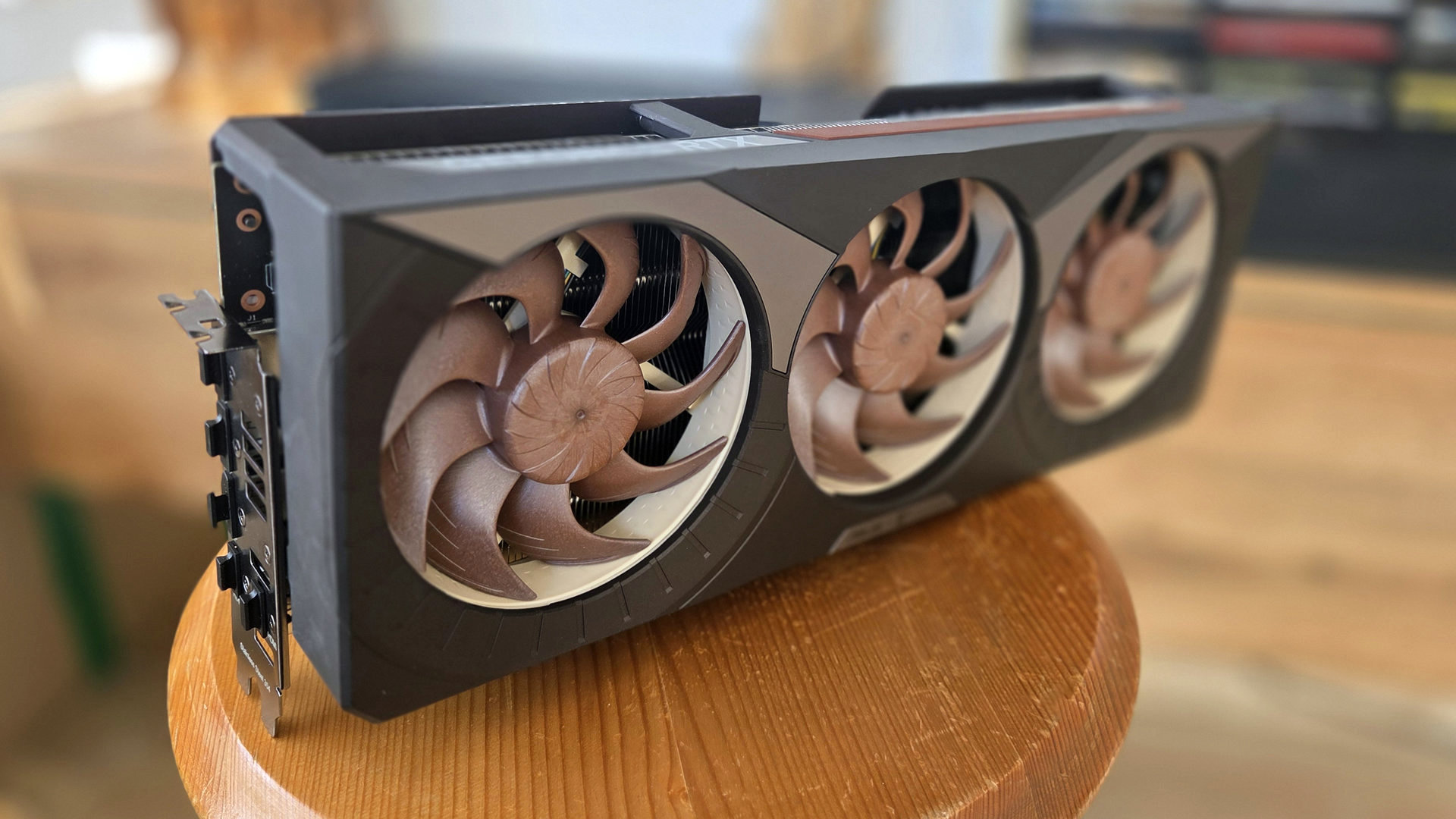
No new GPUs have appeared for months, so we’re taking the opportunity to test models that roam a little off the beaten path. After the PNY GeForce RTX 5080 Slim, today we’re going all out by testing the largest RTX 5080, the ASUS GeForce RTX 5080 Noctua Edition. A beast almost 40 cm long and weighing 2.7 kg!
9 / 10
Best prices
amazon.fr
Infomax
Finally, the latest RTX 5080 designed by ASUS was crafted in collaboration with the Austrian brand Noctua. It seeks to broaden its reach by partnering with others, like Antec on a Flux case we tested in our pages. The graphics card born from this collaboration is the ASUS GeForce RTX 5080 Noctua Edition, and its entire appeal rests, as you might guess, on integrating an extraordinary cooling system.
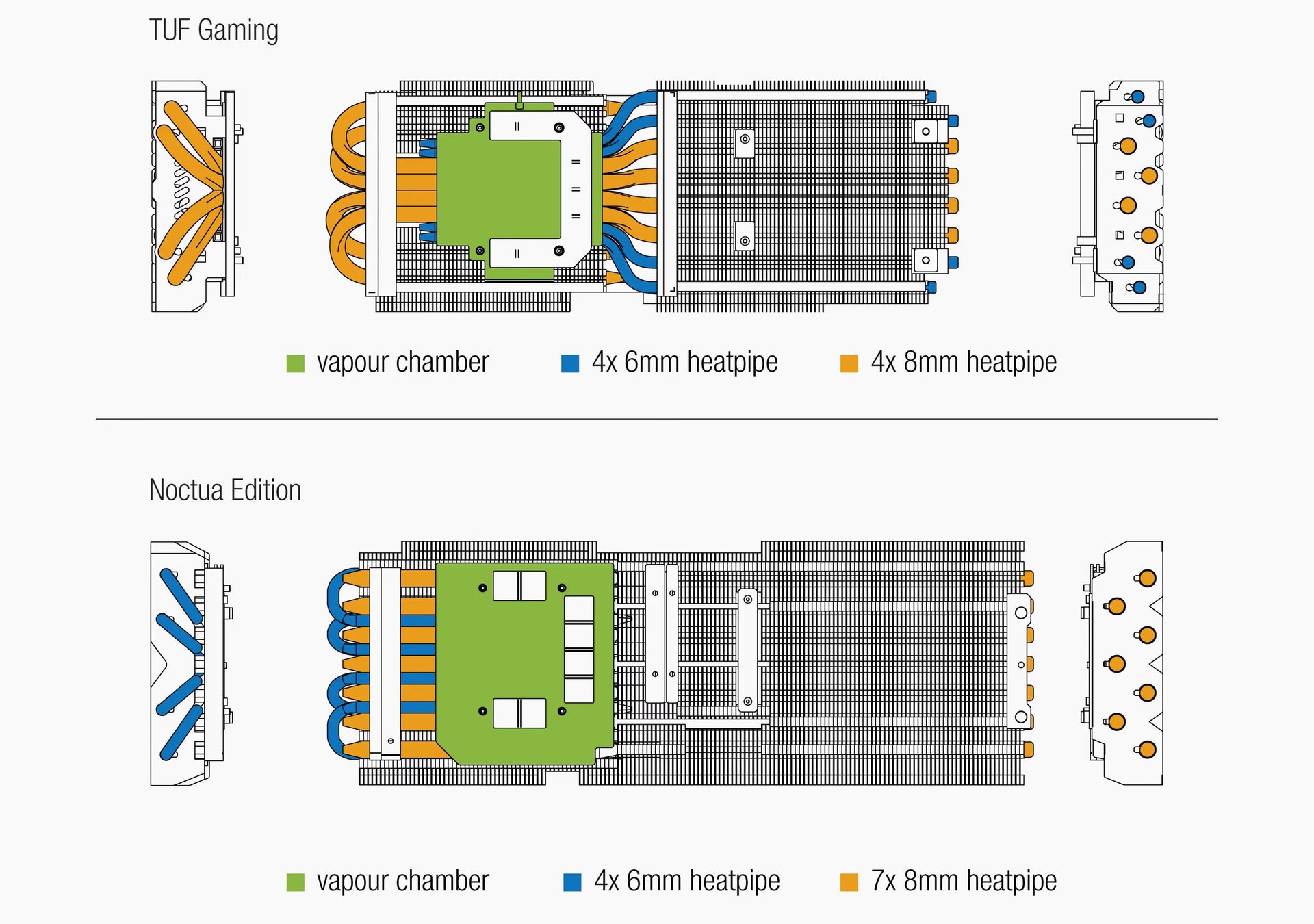
Après tout, Noctua s’est fait connaître grâce à ses ventilateurs et, plus généralement, ses solutions de refroidissement. Cela passe ici par une large chambre à vapeur qui recouvre aussi bien le GPU, que la VRAM et même les VRM. Que tout le monde en profite ! Noctua souligne l’utilisation d’un pad thermique à changement de phase pour assurer le contact entre le dissipateur contenant la chambre à vapeur et les composants.
The heatsink also features no fewer than 11 heat pipes, each with a 6 mm diameter. Four of them are directed toward the front of the card while seven others head toward the rear. A monolithic aluminum heatsink houses everything and, as Noctua would insist, is topped by three NF-A12x25 G2 PWM fans. Yes, massive 12 cm fans, 25 mm thick, each with 9 blades.
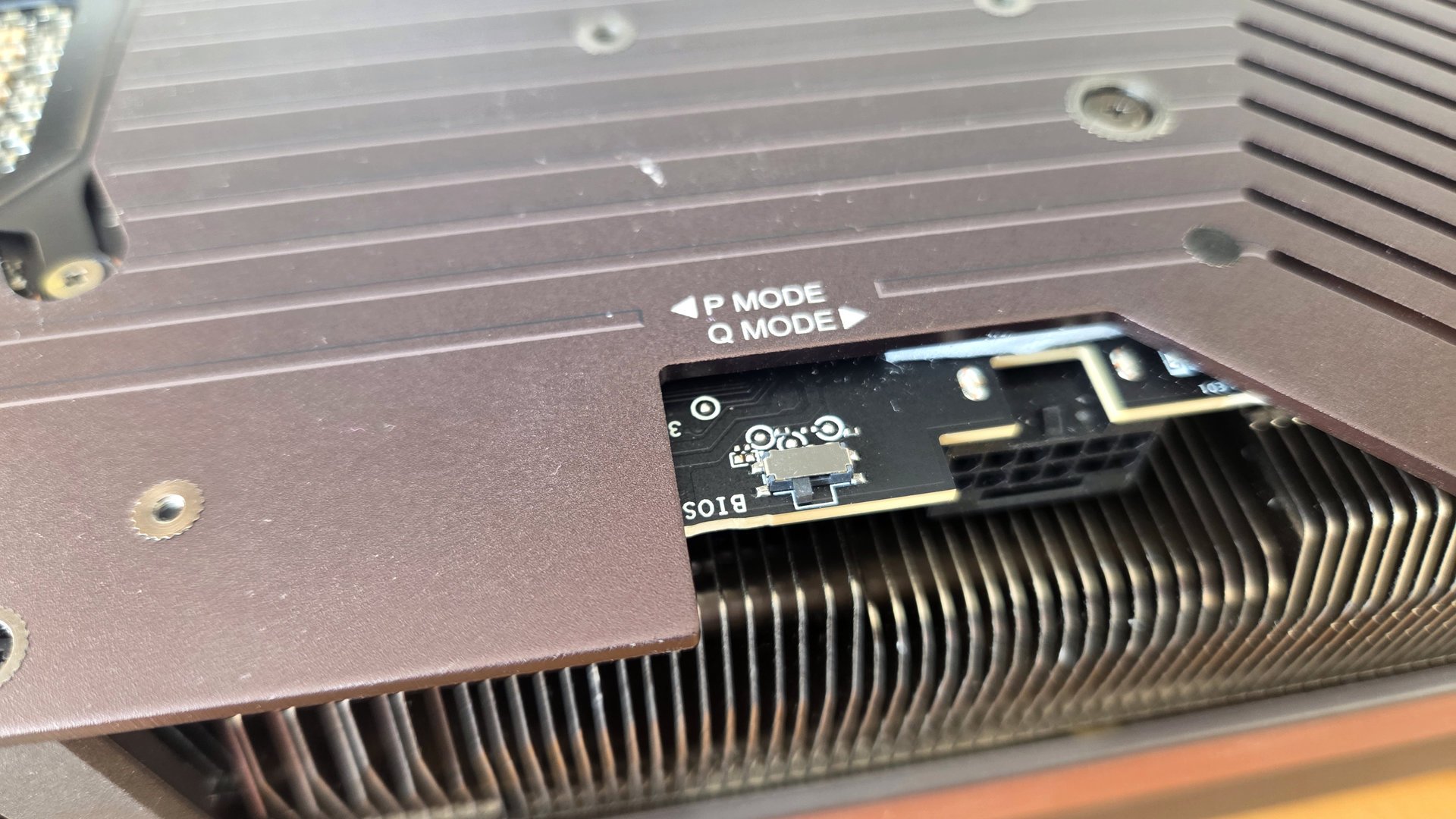
As you’ll notice, we emphasize the cooling system of the ASUS card because, honestly, that’s basically its defining feature. Note, this significantly influences the product’s footprint. As soon as you hold the box, you feel ASUS and Noctua mean business, and upon opening, you’re struck by the monster’s dimensions—it’s even bigger than the GeForce RTX 4090 FE.
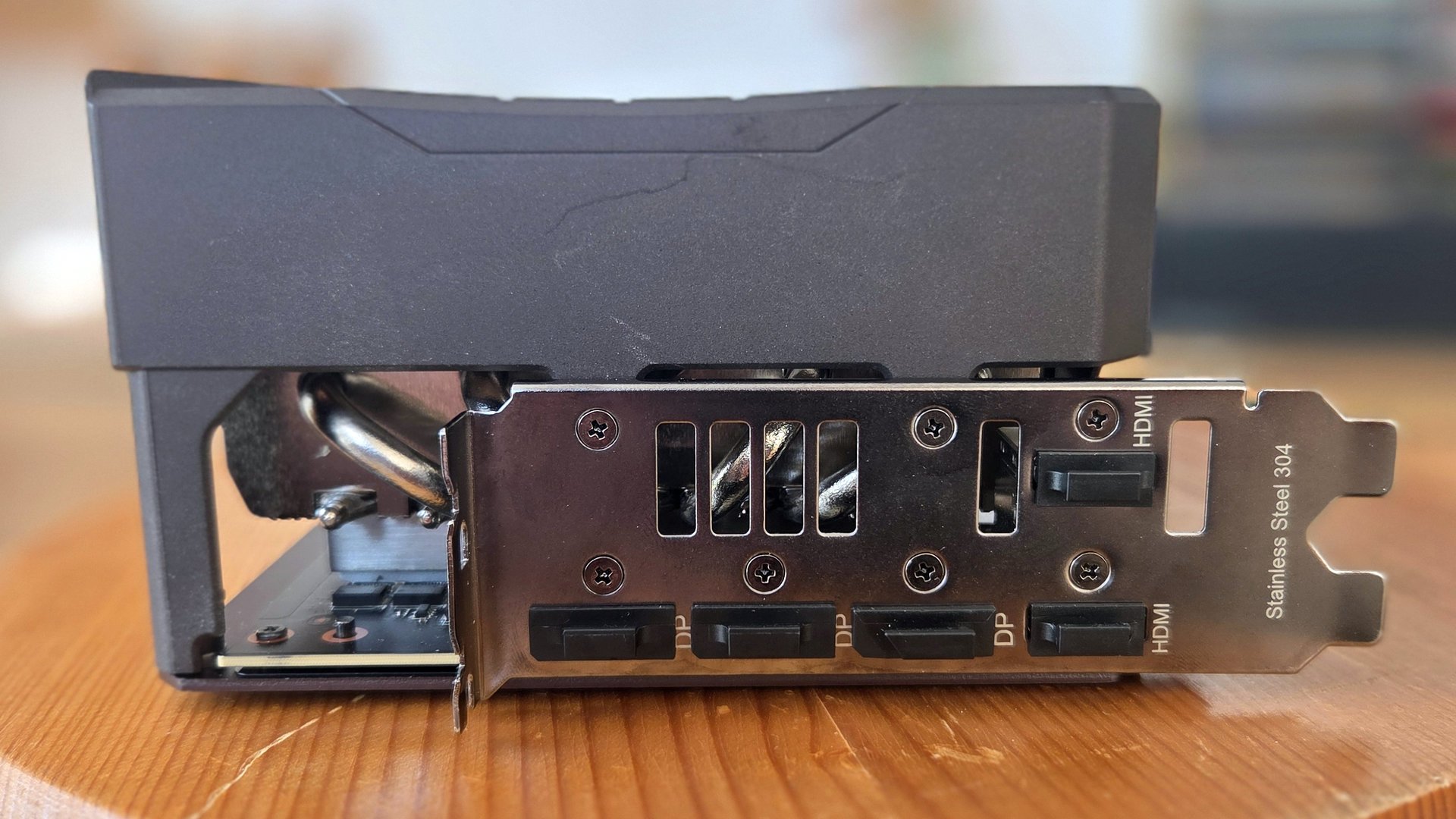
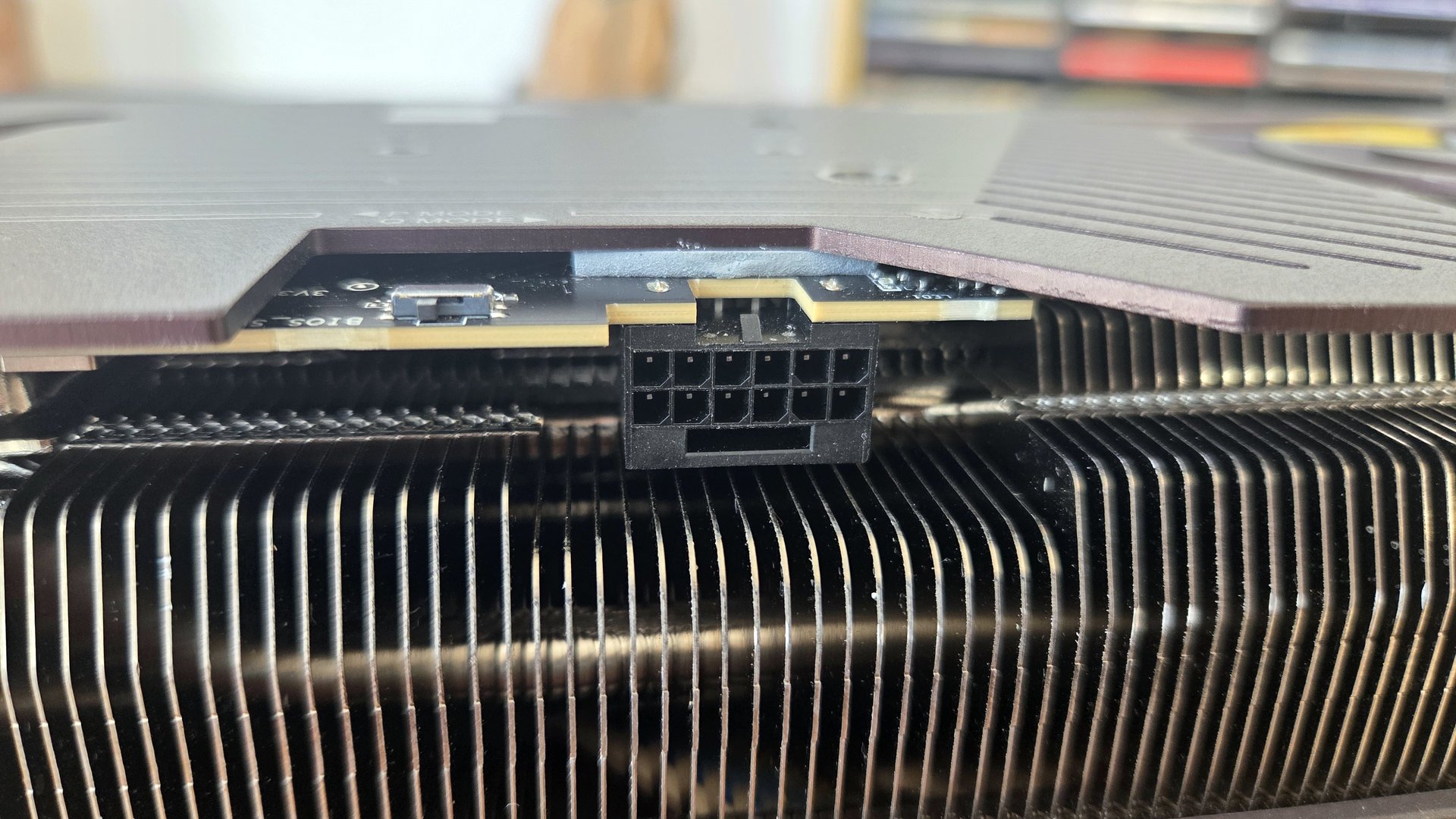
Logically, ASUS provides a “stand” accessory with the graphics card: feel free to use another one if you wish, but you will need one. ASUS also includes a 16-pin / 3x 8-pin adapter, since its card, like most RTX 50-series, uses NVIDIA’s famed 16-pin connector. Now, it’s time to move on to the actual test.
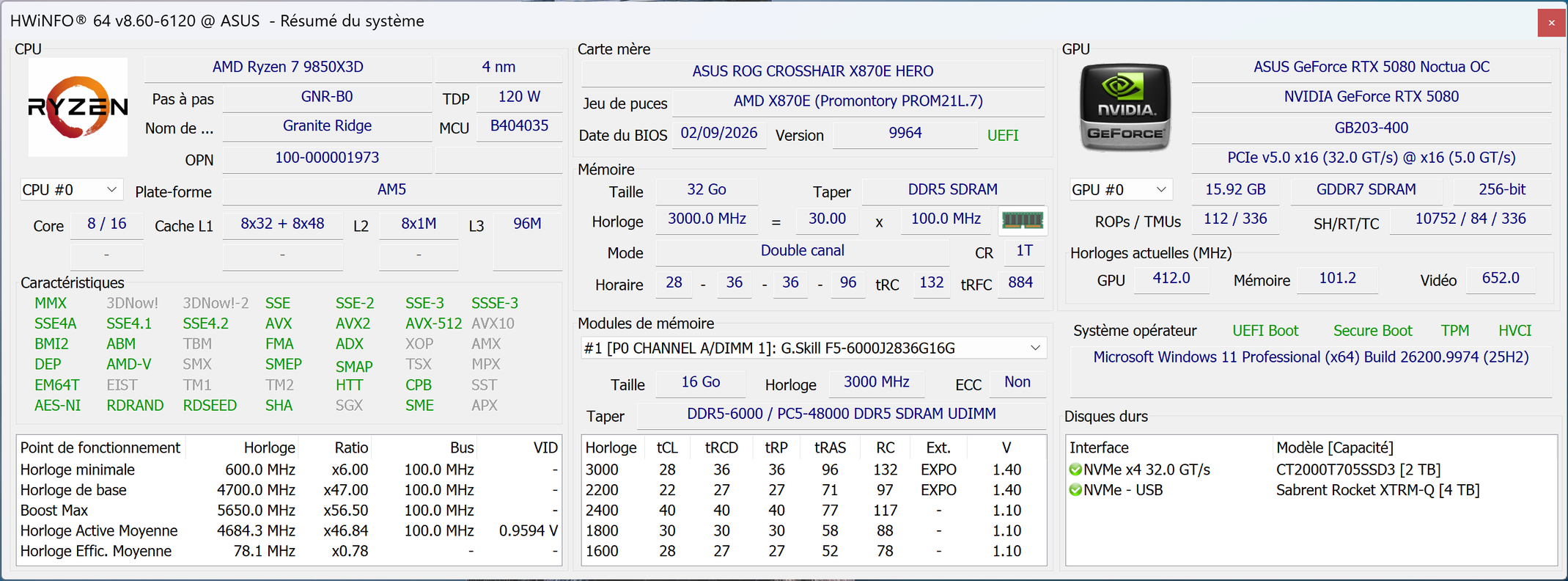
A card that won’t fit into every PC
It has been nearly two years since NVIDIA released the GeForce RTX 5080 through its Founders Edition, and of course through numerous partner models as well. ASUS was a natural partner and rolled out RTX 5080 in several variants, released at different paces. Astral, TUF Gaming or PRIME formed the core of ASUS’ lineup before being joined by ProArt and more specialized editions (White, Hatsune Miku, etc.).
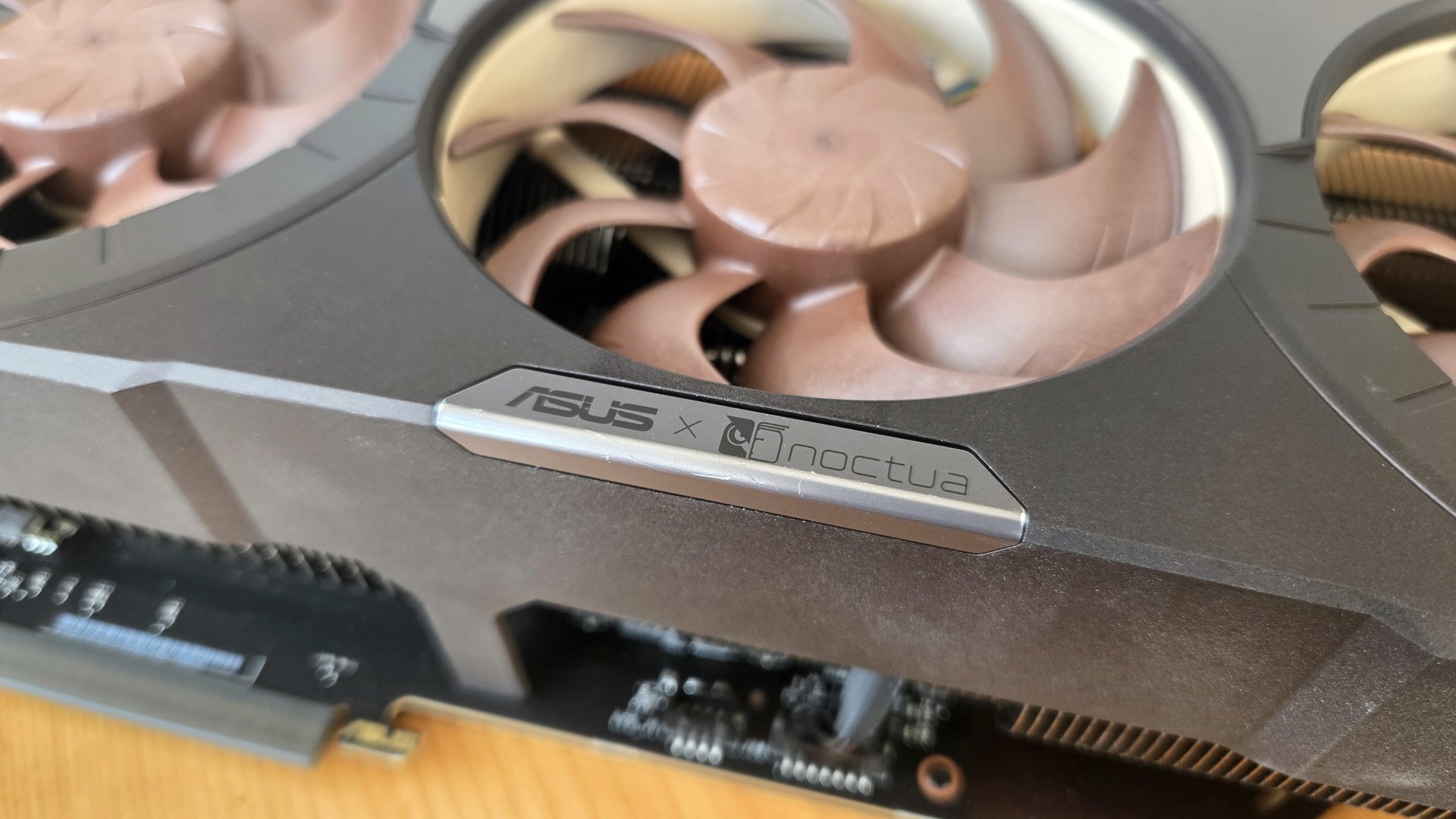
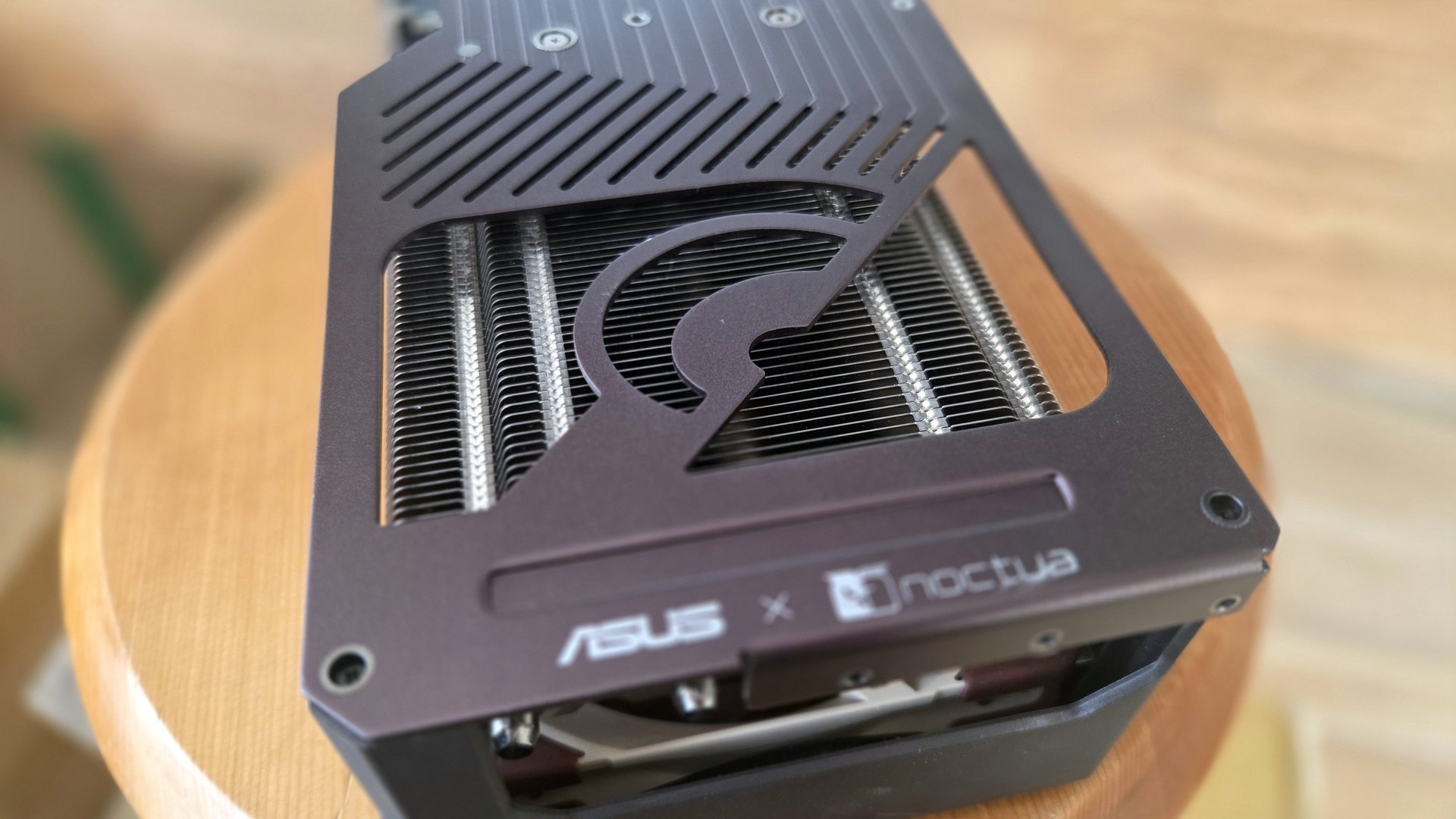
You will have noticed we emphasize the cooling system of the ASUS card because, frankly, that is almost its entire defining feature. Note, this clearly impacts the card’s footprint. When you hold the box in your hands, you can tell ASUS and Noctua mean business, and opening it, you’re struck by the beast’s size—it’s even bigger than the GeForce RTX 4090 FE.
Logically, ASUS provides a “stand” accessory with the graphics card: use another if you wish, but you will need one. ASUS also includes a 16-pin to 3x 8-pin adapter, because this card—like nearly all RTX 50-series—uses NVIDIA’s famous 16-pin connector. Now, let’s proceed to the actual test.
Test Protocol
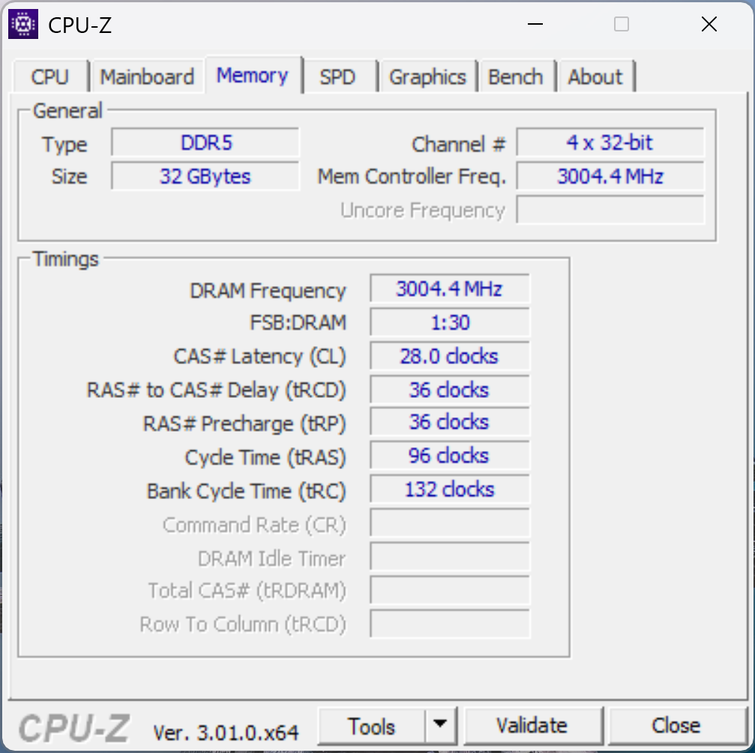
We don’t change a team that wins, and our test protocol hasn’t budged a bit since testing the first Blackwell card, the GeForce RTX 5090 Founders Edition. We return to our setup featuring an Intel 12th-gen processor and DDR5 memory from G.Skill. Of course, Resizable BAR is enabled in the BIOS.
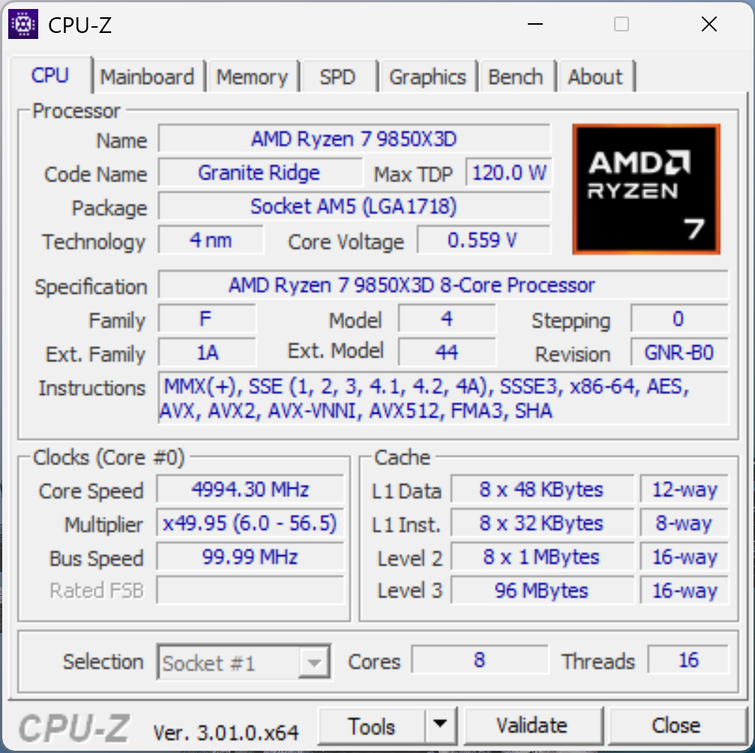
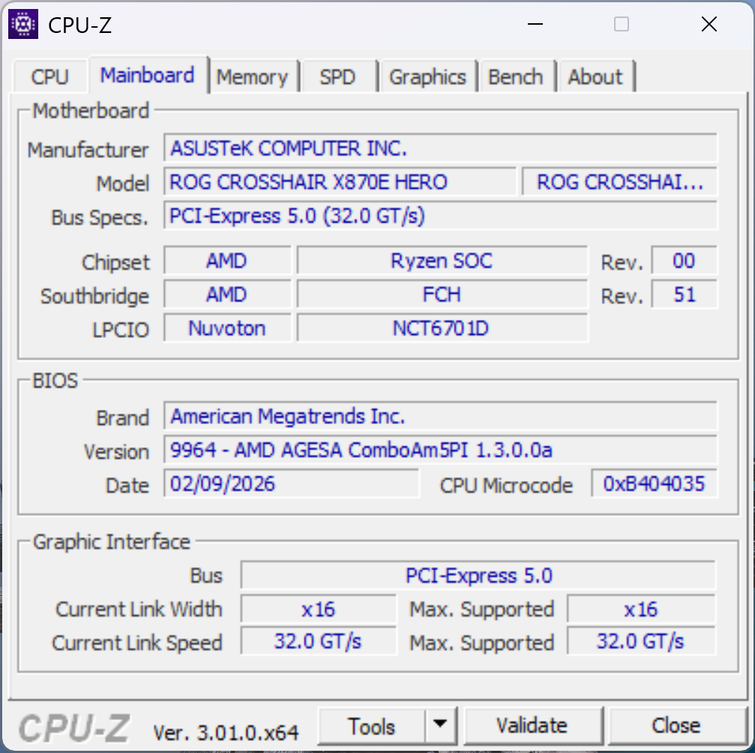
Test configuration
- Motherboard: ASUS ROG Strix Z790-E Gaming Wi-Fi II (BIOS 2107)
- CPU: Intel Core i9-12900K
- Memory: G.Skill Ripjaws S5 DDR5-6000 CL28 (2x 16 GB)
- System drive: Kingston KC3000 2 To
- Cooling: ASUS ROG Ryujin III 360 ARGB
- PSU: be quiet! Power Zone 2 (1200 W)
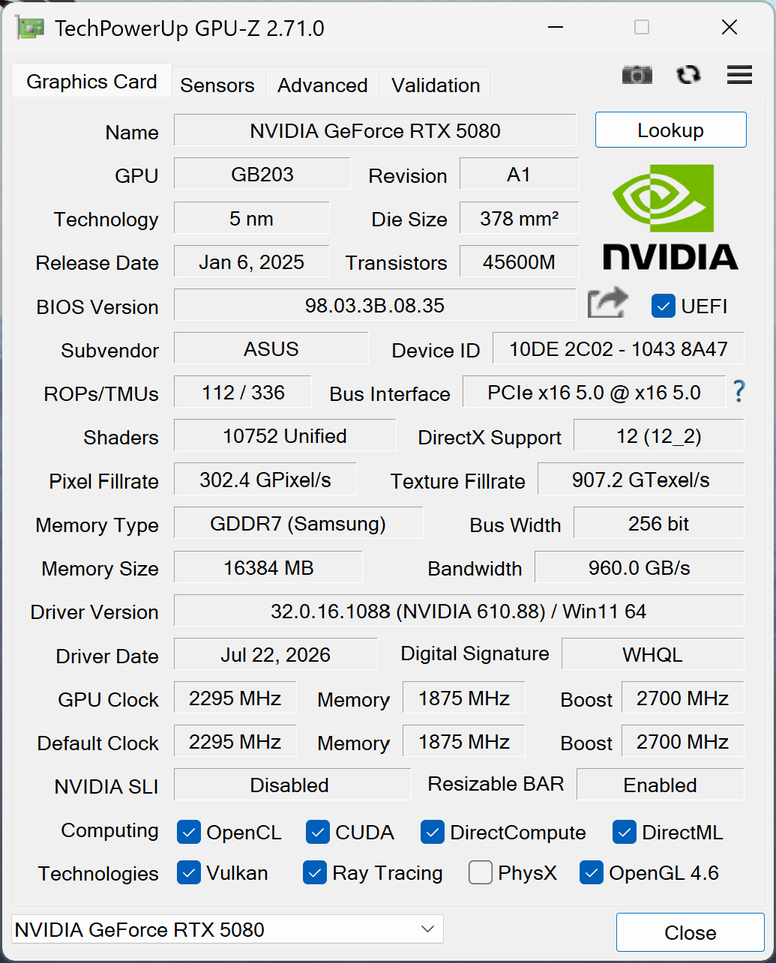
As far as possible, we remove in-memory programs and ensure configurations are as close as possible, both hardware-wise and software-wise.
- Windows 11 Pro 64-bit 25H2 v26200.9974
- Intel chipset drivers v10.1.20266.8668
- AMD graphics drivers v26.9.2
- NVIDIA graphics drivers v591.74
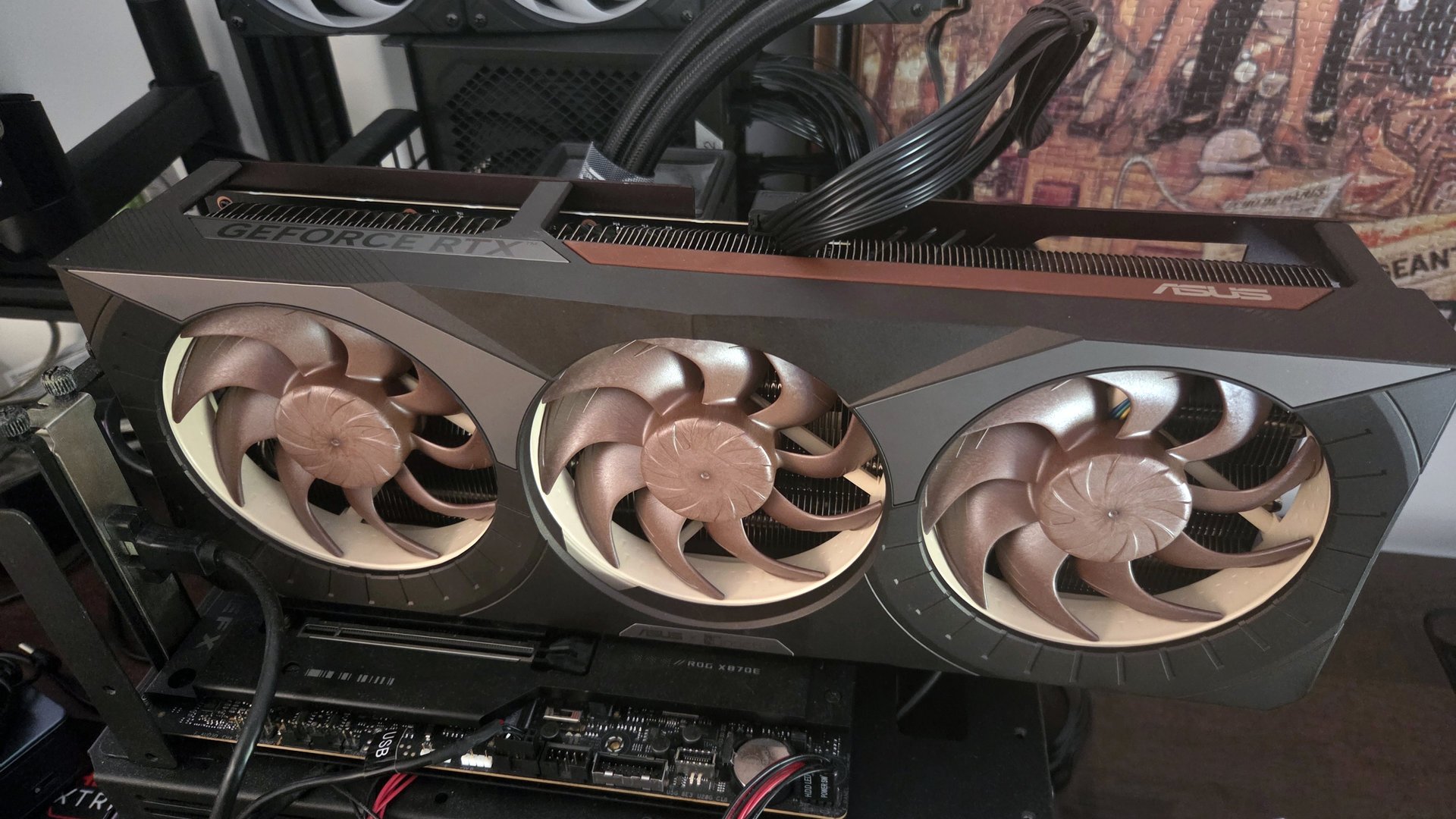
You’ve probably noticed we place a heavy emphasis on the cooling system for the ASUS card because, let’s be honest, that’s essentially its defining feature. It also has a notable impact on the product’s overall size. Once you get the box in hand, you realize ASUS and Noctua weren’t joking, and when you open it, you’re impressed by the beast’s dimensions; it’s even larger than the GeForce RTX 4090 FE.
Logically, ASUS provides a stand accessory with the video card: you can use another if you prefer, but you do need one. ASUS also ships a 16-pin to 3x 8-pin adapter, because as with nearly all RTX 50-series cards, it uses NVIDIA’s famous 16-pin connector. Now, it’s time to proceed to the test itself.
Performance testing
By partnering with Noctua, ASUS aimed at a dual objective: a high-performance cooling system to keep temperatures down without being noisy, and a way to push the GPU’s performance a bit further. Did they succeed?
3DMark
Same protocol, same test order, so we start measurements with the inevitable 3DMark. Time Spy Extreme represents the reference scene, Port Royal covers ray tracing, and SpeedWay is the heaviest sequence.
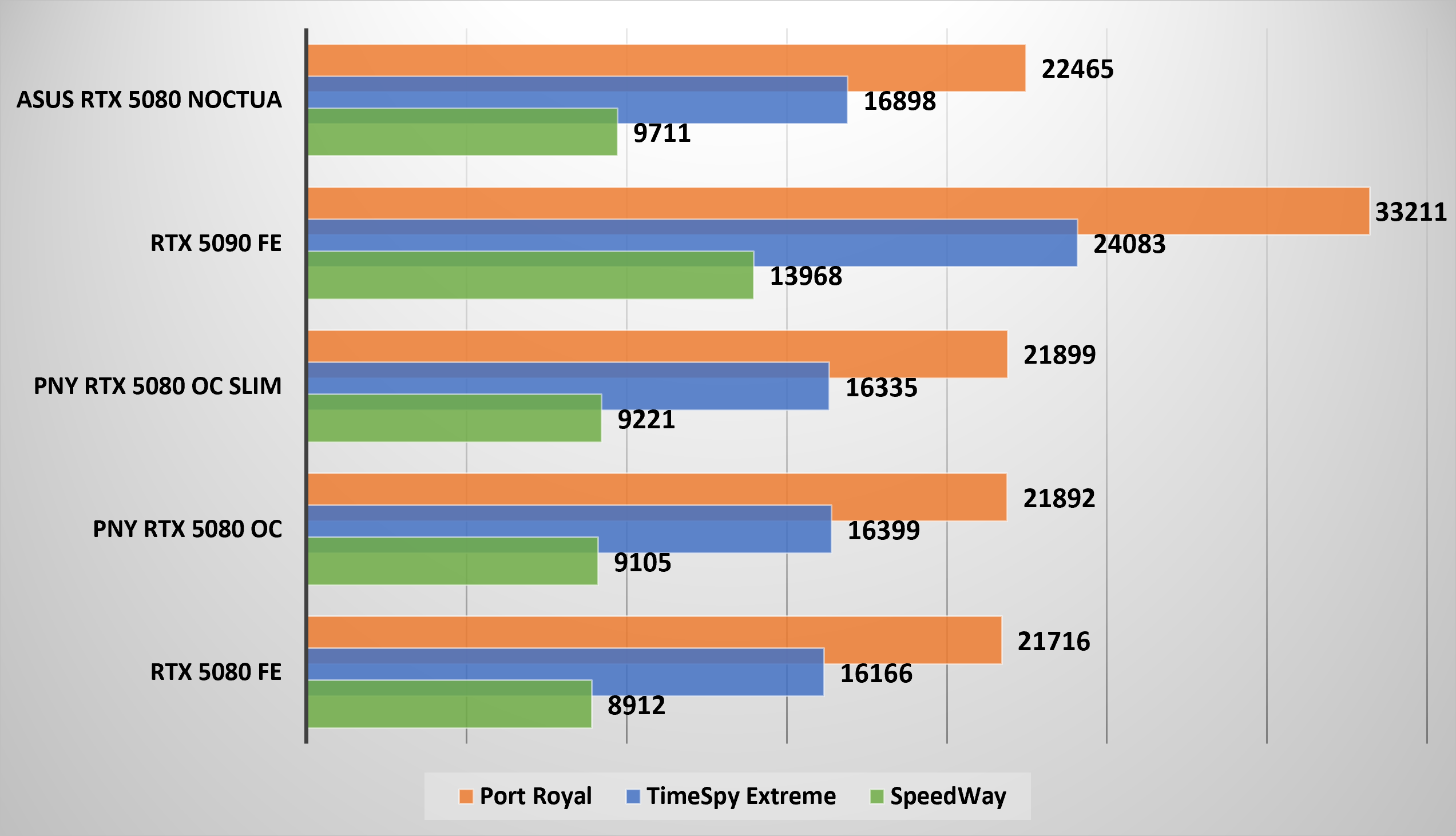
Three scenes with different orientations, yet the conclusions remain unchanged. Not surprisingly, the ASUS GeForce RTX 5080 Noctua Edition is close to other RTX 5080 cards, but it consistently edges ahead by varying margins.
Blender benchmark
V-Ray benchmark
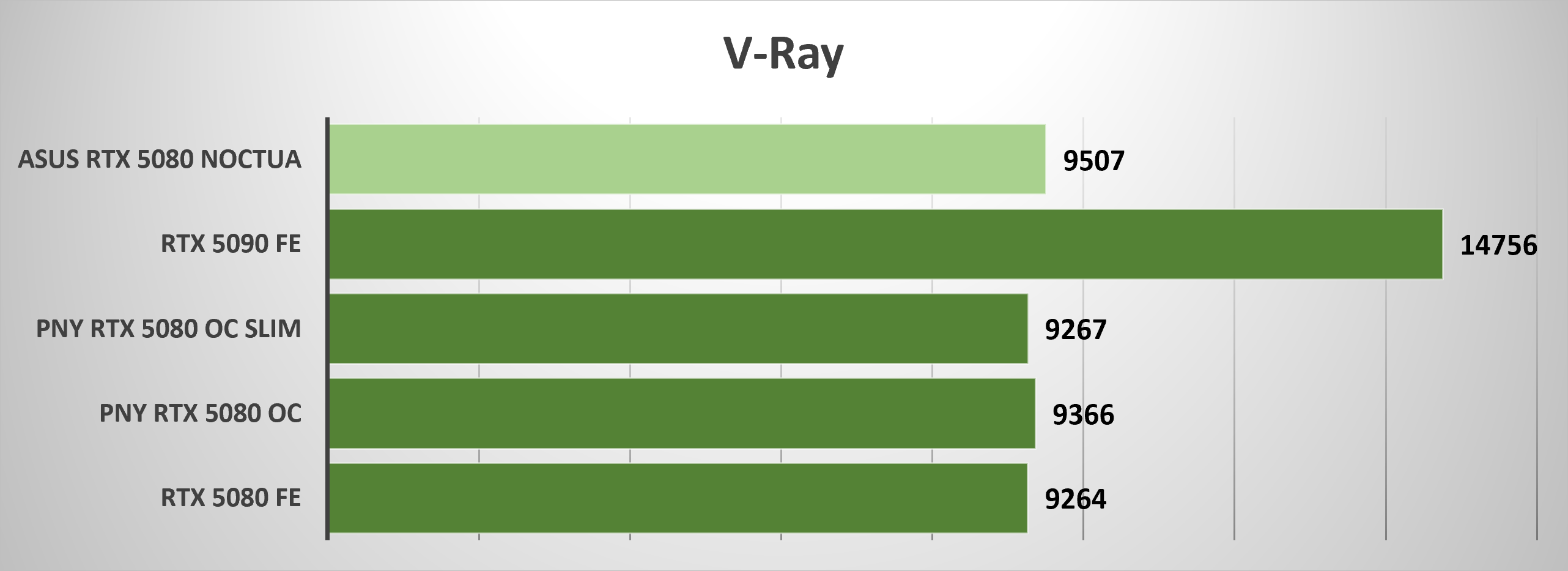
V-Ray is a tool designed for ray tracing, and it confirms the favorable impression of this ASUS/Noctua collaboration. Their RTX 5080 is simply the best tested to date.
Procyon image generation benchmark
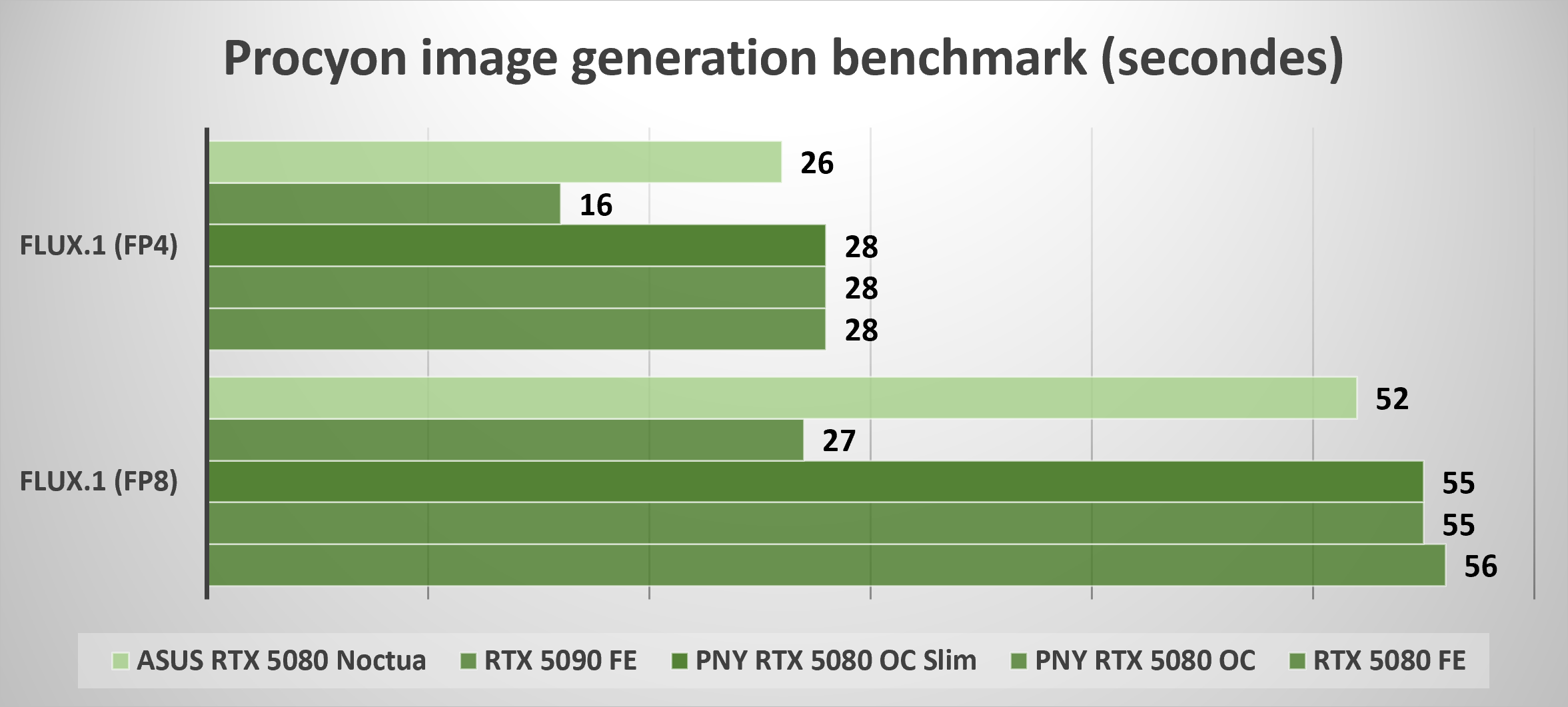
To keep the file manageable, we limit Procyon to its image-generation tool. Measured in seconds (lower is better), the values show only modest differences among RTX 5080 models, but once again the ASUS GeForce RTX 5080 Noctua Edition comes out on top.
Gaming performance
As with the highest-performing GPUs, we set aside Full HD gaming results and focus on UHD (4K) and QHD measurements. Our tests are still conducted in fullscreen, with V-Sync and G-Sync disabled. Here are the precise settings for each title selected.
- Cyberpunk 2077: RT Overdrive preset, path tracing ON, ray reconstruction ON, Quality DLSS with the Transformer model, frame generation MAX (OFF on RTX 3090, 2X on RTX 4090, and 4X on RTX 5090).
- Avatar: Frontiers of Pandora: Ultra preset, Balanced FSR, FSR frame generation ON (fixed)
- Black Myth: Wukong: Cinematic preset, Balanced DLSS (60%), frame generation ON
- Forza Motorsport: Ultra preset, Balanced DLSS
- Red Dead Redemption 2: Ultra preset, DLSS OFF
- Total War Warhammer III: Ultra preset
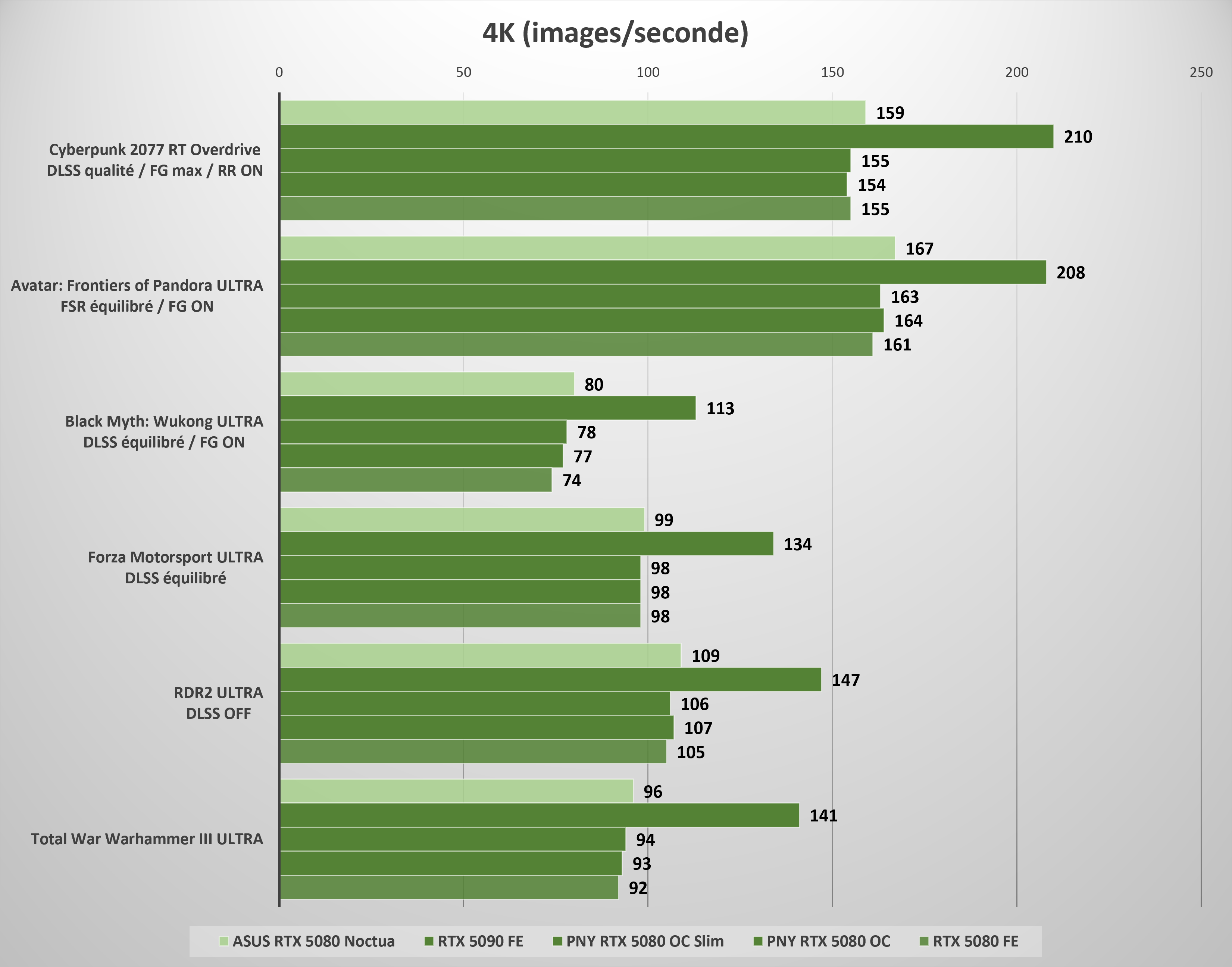
We won’t pretend to be surprised: the ASUS GeForce RTX 5080 Noctua Edition leads all gaming tests, dominating the other RTX 5080 models, whether the PNY versions or the Founders Edition. The margins are small, but the ASUS/Noctua card’s dominance is real and lasting.
Blender benchmark
V-Ray benchmark
V-Ray is a tool designed specifically for ray tracing, and it confirms again how favorable this ASUS/Noctua collaboration is. Their RTX 5080 is simply the best we’ve tested to date.
Procyon image generation benchmark
To avoid bloating the dossier, we limit Procyon to its image-generation tool. Expressed in seconds (the lower score, the better), the values show only minor differences among RTX 5080 models, yet once again the ASUS GeForce RTX 5080 Noctua Edition wins.
Gaming performance: the verdict
As with prior flagship GPUs, we set aside the gaming results at 1080p to focus on UHD (4K) and QHD measurements. We run tests in fullscreen with V-Sync disabled. Here are the exact settings for the games chosen.
- Cyberpunk 2077: RT Overdrive preset, path tracing ON, ray reconstruction ON, Transformer DLSS quality, frame generation MAX (OFF on the RTX 3090, 2X on the RTX 4090, and 4X on the RTX 5090).
- Avatar: Frontiers of Pandora: Ultra preset, FSR Balanced, FSR frame generation ON (fixed)
- Black Myth: Wukong: Cinematic preset, DLSS Balanced (60%), frame generation ON
- Forza Motorsport: Ultra preset, DLSS Balanced
- Red Dead Redemption 2: Ultra preset, DLSS OFF
- Total War: Warhammer III: Ultra preset
We’re not surprised: the ASUS GeForce RTX 5080 Noctua Edition dominates all gaming tests, head and shoulders above the other RTX 5080 models, whether the two PNY variants or the Founders Edition. The gaps are modest, but the ASUS/Noctua card’s dominance is real and enduring.
Blender benchmark
Procyon image generation benchmark
To keep things lean, we limit Procyon to its image-generation tool. Measured in seconds (lower is better), the results show little difference among RTX 5080 models, though the ASUS GeForce RTX 5080 Noctua Edition still comes out on top.
We must reiterate what we said during the RTX 5080 Founders Edition test: “despite a modest generational jump in raw performance, the RTX 5080 offers the best energy efficiency in our lineup.” That advantage doesn’t change much from one RTX 5080 model to another, with only a tiny edge for the ASUS GeForce RTX 5080 Noctua Edition, but very small indeed.
Unfortunately, ASUS and Noctua priced their card significantly higher than other RTX 5080s: 1,599 euros when NVIDIA launched its Founders Edition at 1,179 euros. Naturally, the price-performances metric suffers. Yet, as you well know, public MSRPs no longer tell the full story: this ASUS/Noctua card now trades around 2,400 euros to 2,500 euros. We’re really living in a remarkable era.
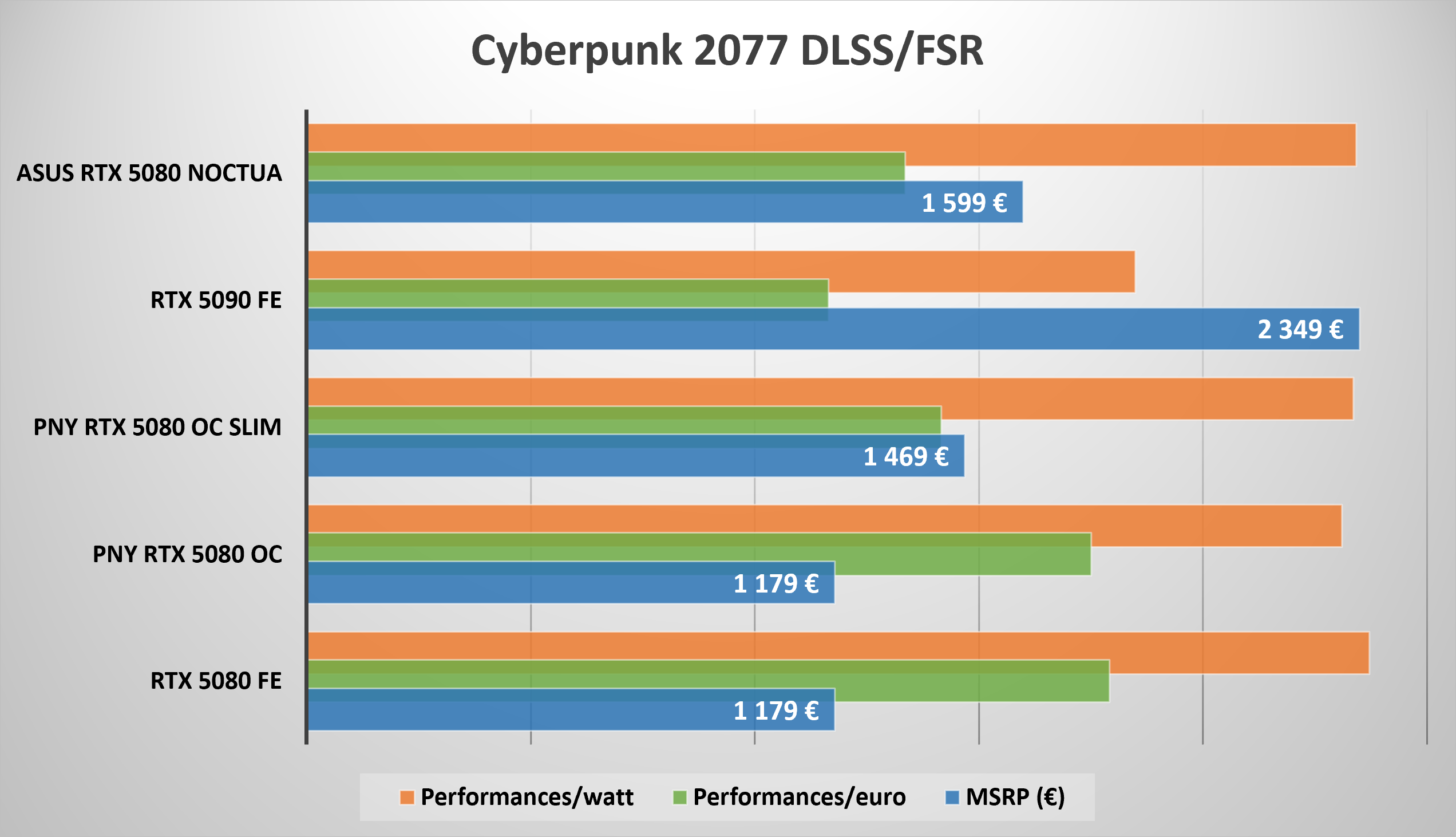
Remember that the ASUS GeForce RTX 5080 Noctua Edition, like other Blackwell models, relies heavily on multi-frame generation. Let’s examine the impact this technology may have on our two indicators.
In terms of performance per watt, we’re somewhat surprised to see a slight decline for the ASUS/Noctua card; it still leads the PNY models but yields to the Founders Edition with a very small margin. More critically, the price-perf metric is even more affected: this shows that the ASUS GeForce RTX 5080 Noctua Edition is a singular model that commands a substantial premium.
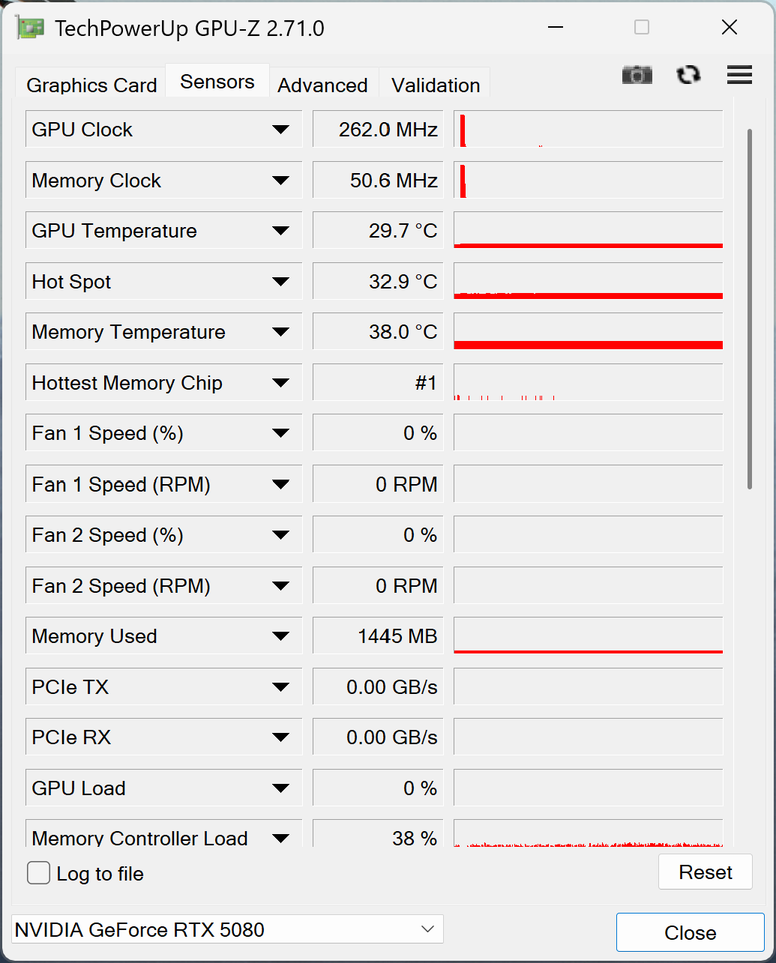

Before concluding, we must revisit why this price premium exists. We’ve already explained it: the cooling system chosen by ASUS and Noctua is unmatched. It naturally affects the card’s price, but also—and that’s a good thing—reduces component heating and lowers noise.
Plainly put, it dominates the competition: even under heavy load, we never reached 58°C for the GPU or 65°C for the hotspot, offering around 10°C to 15°C better cooling than other cards. And with fans typically under 1000 rpm, it remains exceptionally quiet (under 33 dB). In short, the card is a marvel.
ASUS GeForce RTX 5080 Noctua Edition: Clubic’s verdict
In terms of concept and results, there is absolutely nothing wrong with this card arising from ASUS and Noctua. The cooling system implemented may seem excessive for many users, but it genuinely guarantees remarkable thermal dissipation while greatly reducing noise.
Of course, every medal has its downside, and you must deal with a monstrously large graphics card that simply won’t fit in all chassis. Also, make sure you mount it correctly, because with nearly 3 kg on the scale, it will press on the PCI Express slot. Finally, and this won’t surprise anyone, its price is equally extravagantly high. Launched around 1,600 euros, it’s now closer to 2,400/2,500 euros. We’re really living in a remarkable era.
The plus points
- Impeccable finishes
- High-end performance
- Extremely discreet cooling
- Low component heat
- The DLSS 4/4.5 impact
- L’Ecosystem NVIDIA in general
How Clubic tests graphics cards?
What about the performance?
By partnering with Noctua, ASUS aimed at a twofold goal: an efficient cooling system to keep temperatures under control while remaining quiet, and a way to push NVIDIA’s GPU a bit further. Was the bet successful?
3DMark
Same protocol, same test order, so we kick off with the inevitable 3DMark. Time Spy Extreme is the reference scene, Port Royal handles ray tracing, and SpeedWay is the heaviest sequence.
Three scenes with different directions, but the conclusions remain unchanged. Unsurprisingly, the ASUS GeForce RTX 5080 Noctua Edition is close to other RTX 5080 cards, yet it consistently edges out the competition with sometimes noticeable margins.
Blender benchmark
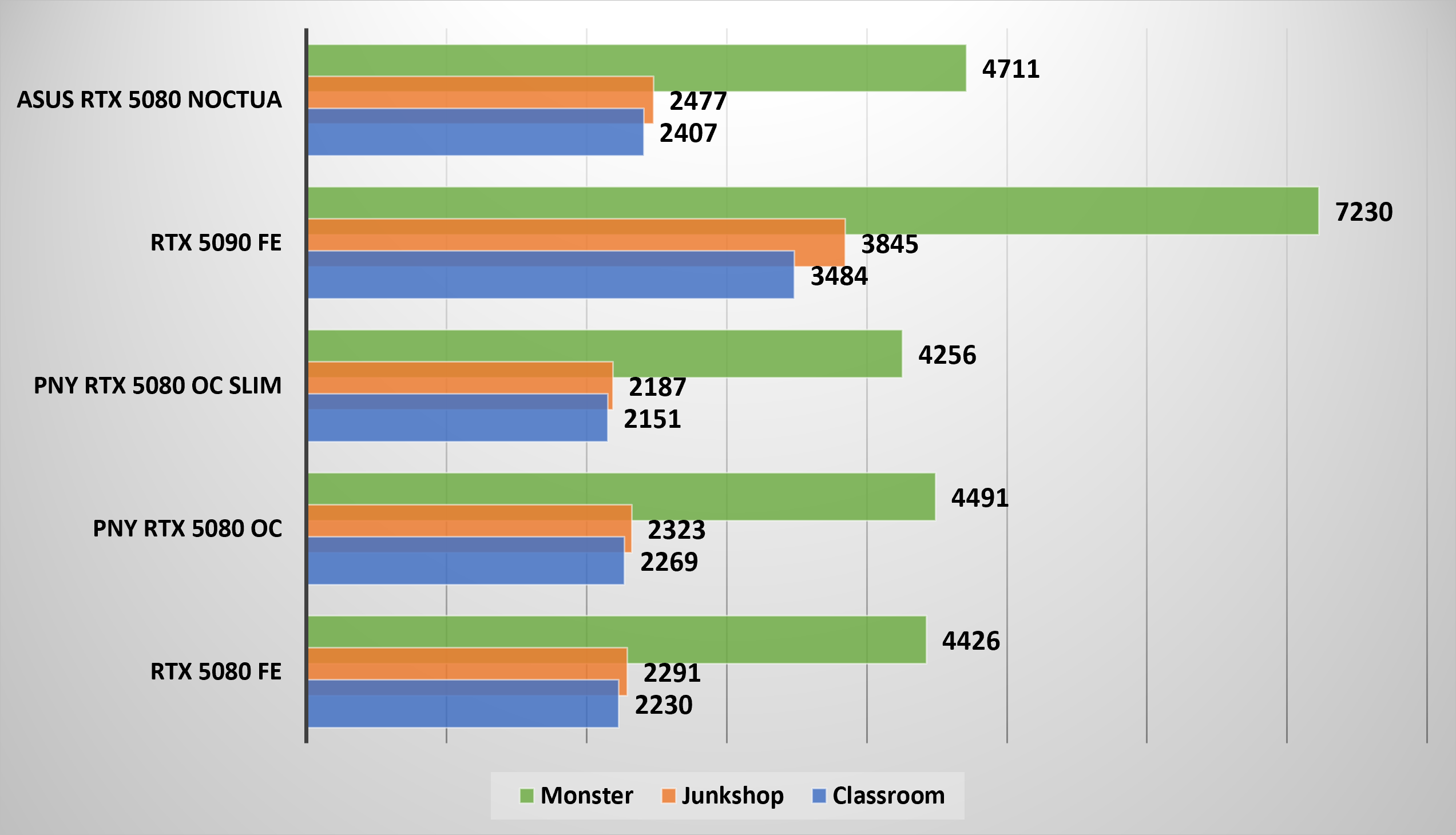
Blender is a ray-tracing-focused tool and it confirms again how strong this ASUS/Noctua collaboration is. Their RTX 5080 is simply the best we’ve tested so far.
Procyon image generation benchmark
We won’t go much further than 2,160p for gaming tests; the conclusions and the gaps between cards remain substantially the same. The ASUS GeForce RTX 5080 Noctua Edition proves to be the best player right now… Except, of course, for the RTX 5090 cards.
Efficiency /watt and /euro
Before Blackwell, NVIDIA had promised improvements in energy efficiency through more precise power management. The RTX 5090 Founders Edition testing did not reveal clear gains, at least not with DLSS 4 disabled.
Power consumption
Integrating Noctua’s cooling solution does not change the hardware recommendations: like all previous models and NVIDIA’s Founders Edition, this RTX 5080 requires a power supply of at least 850 W to be comfortable.
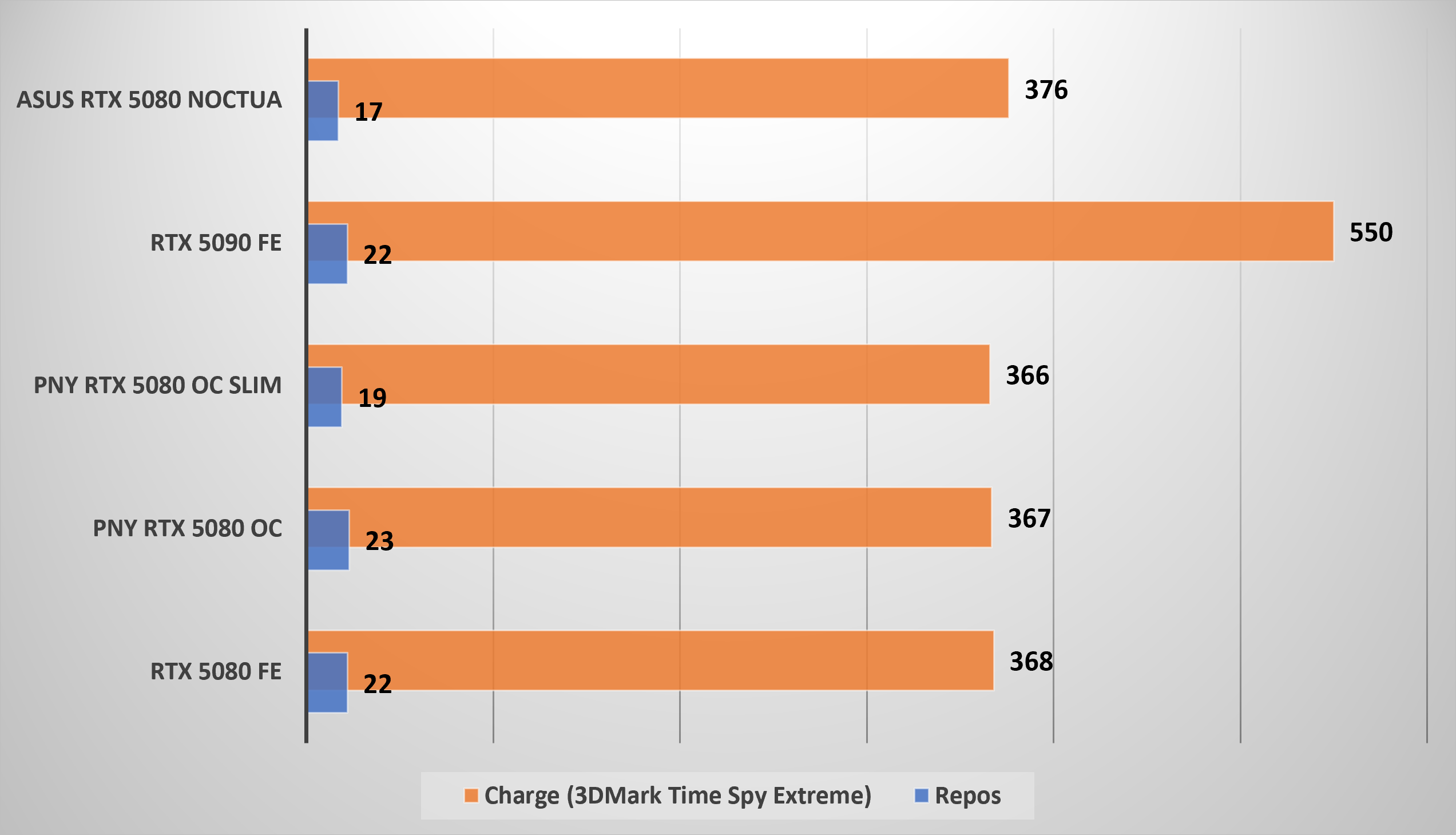
There may have been a small optimization here, because at idle the ASUS GeForce RTX 5080 Noctua Edition uses less power than our other picks. Under load, however, it sits a notch above the other RTX 5080 cards: with the cooling system in place, the GPU can probably let loose a bit more, which could explain its slightly higher performance.
Efficiency and “value”
To better account for GPU-specific characteristics, we decided to use two scenarios to evaluate energy efficiency: one for ray tracing, and another for a DLSS-enabled game with multi-frame generation.
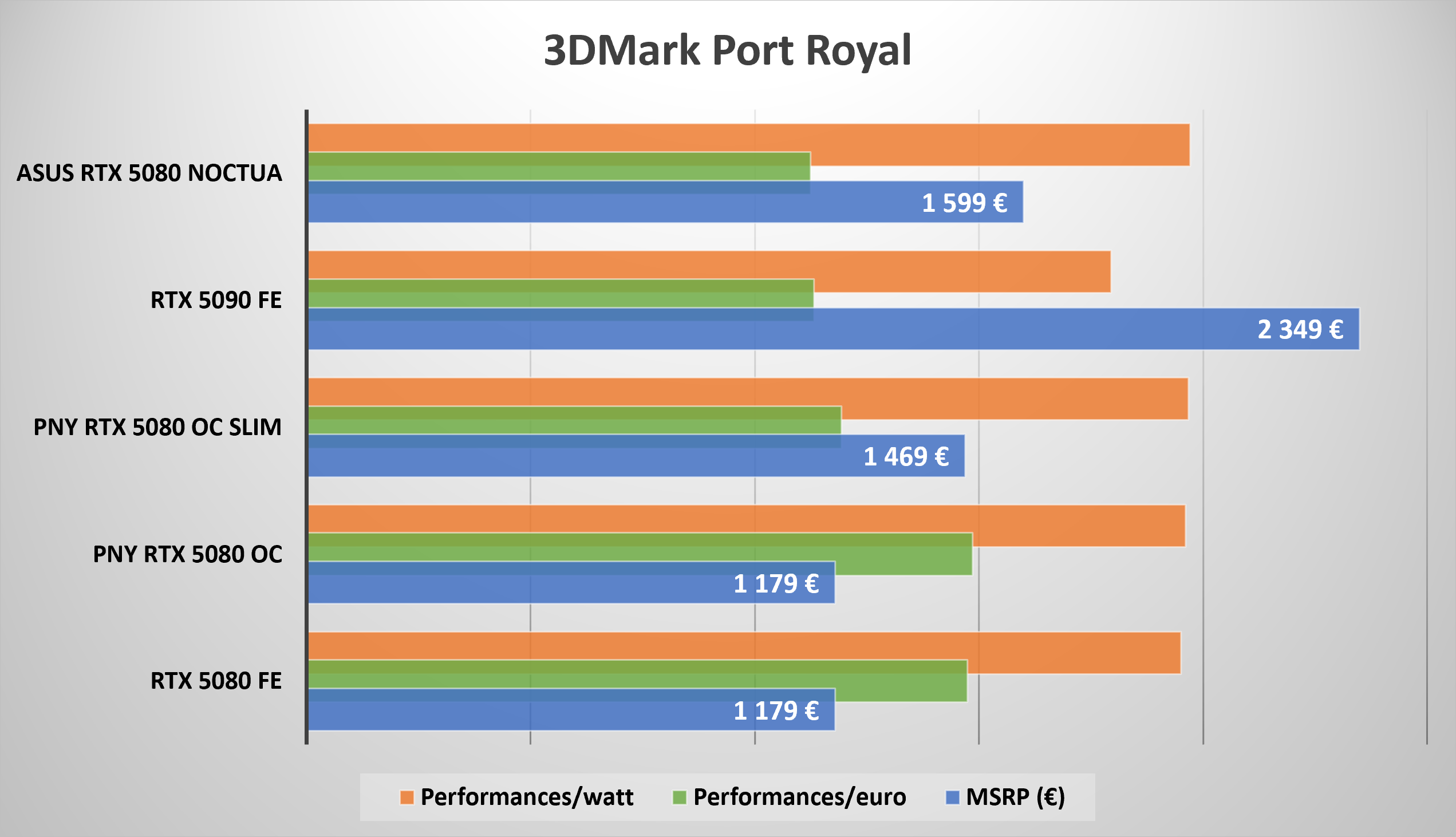
As we noted during the RTX 5080 Founders Edition test, this remains valid today: “despite only a modest generational leap in raw performance, the RTX 5080 offers the best energy efficiency in our selection.” An advantage that doesn’t change much from one RTX 5080 model to another, simply with a tiny lift for the ASUS GeForce RTX 5080 Noctua Edition, but only marginally.
Sadly, ASUS and Noctua priced their card at a public MSRP significantly higher than other RTX 5080 cards: 1,599 euros when NVIDIA launched its Founders Edition at 1,179 euros. Naturally, the price-per-performance indicator suffers. That said, you know as well as we do that these recommended MSRPs no longer tell the full story: the ASUS/Noctua card now trades around 2,400 to 2,500 euros today. We’re really living in a remarkable era.
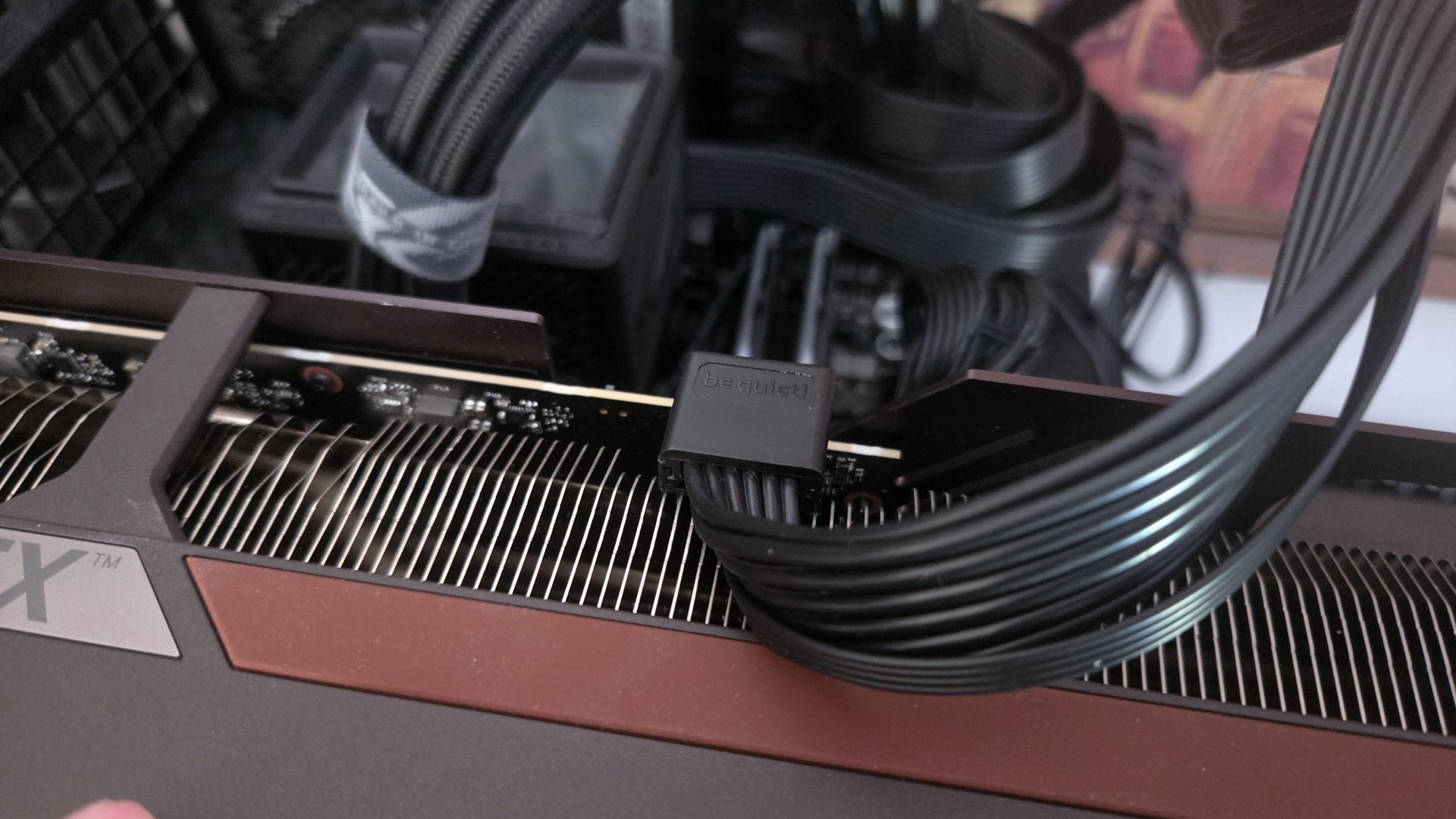
As you’ll notice, we place a heavy emphasis on the cooling system of the ASUS card because, frankly, that’s almost its entire defining feature. Note, this has a notable impact on the card’s size. When you hold the box, you can tell ASUS and Noctua aren’t joking, and upon opening, you’re impressed by the beast’s dimensions; it’s even larger than the GeForce RTX 4090 FE.
Before concluding, we must revisit why this premium is justified. We’ve already presented it: ASUS and Noctua’s cooling system is one of a kind. It obviously influences the card’s price, but it also — and that’s fortunate — reduces component heating as well as audible nuisance.
Put plainly, it dominates the competition: even under peak workloads, we never hit 58°C for the GPU or 65°C for the hotspot, offering 10°C to 15°C better cooling than other cards. All this while keeping fan speeds generally under 1000 rpm, making it especially quiet (under 33 dB). Nothing to fault here—the card is a marvel.
ASUS GeForce RTX 5080 Noctua Edition: Clubic’s verdict
In principle and in results, there is nothing to fault regarding this card from the ASUS/Noctua collaboration. The cooling system it employs may seem excessive to many, but it truly guarantees remarkable heat dissipation while greatly reducing noise.
Yet, with every medal come drawbacks: you must fit a monstrously large graphics card into your case. Also, ensure it’s properly mounted because with nearly 3 kg on the balance, it will exert pressure on the PCIe slot. And, unsurprisingly, its price tag is equally inflated. Launched around 1,600 euros, it’s now hovering around 2,400/2,500 euros. We really are living in a remarkable era.
Pros
- Impeccable finishes
- Very high performance
- Extremely quiet cooling
- Low component heating
- L’Impact of DLSS 4/4.5
- The NVIDIA ecosystem in general
- High public MSRP
- Massive footprint
- The 16-pin connector placement
- Card much larger than FE
What are the best graphics cards in 2026?

Daniel Brooks
I cover everyday products with a practical eye, from kitchen tools and home essentials to smart gadgets and consumer trends. My goal is to help readers understand what is genuinely useful, what is worth the price, and what deserves a second look before buying.