
A French trailblazer in music streaming, Deezer offers a substantial catalog of more than 120 million tracks. The service also features a number of innovative capabilities, such as customizable Flow recommendations or Remix Lab, which allows users to craft their own remixes. But is this enough to measure up to the giant Spotify? We subjected Deezer to a thorough examination to answer this question.

- FLAC 16 bits/44.1 kHz available with Premium
- Personalized recommendations with Flow
- AI-generated titles identified and excluded from recommendations
- More than 120 million tracks
- Full mobile app
- Deezer Premium, at €11.99 per month, removes ads, enables on-demand listening, offline downloads, and lossless HiFi quality in FLAC 16-bit/44.1 kHz at no extra cost. A student discount is also available.
- Deezer Duo, at €15.99 per month, extends Premium features to two accounts with individual recommendations, playlists, and favorites.
- Deezer Family, at €19.99 per month, supports up to six individual accounts, including the option to create child-friendly profiles.
- Deezer Étudiant, offered at €5.99 per month, provides the same core Premium features at a reduced price, subject to eligibility requirements.
Over a full year, the annual subscription offers savings. The Premium plan costs €107.99 per year, i.e., about 25% less than paying twelve monthly installments (€143.88), and yielding roughly €36 in savings. The annual Duo and Family plans offer around 9% savings.
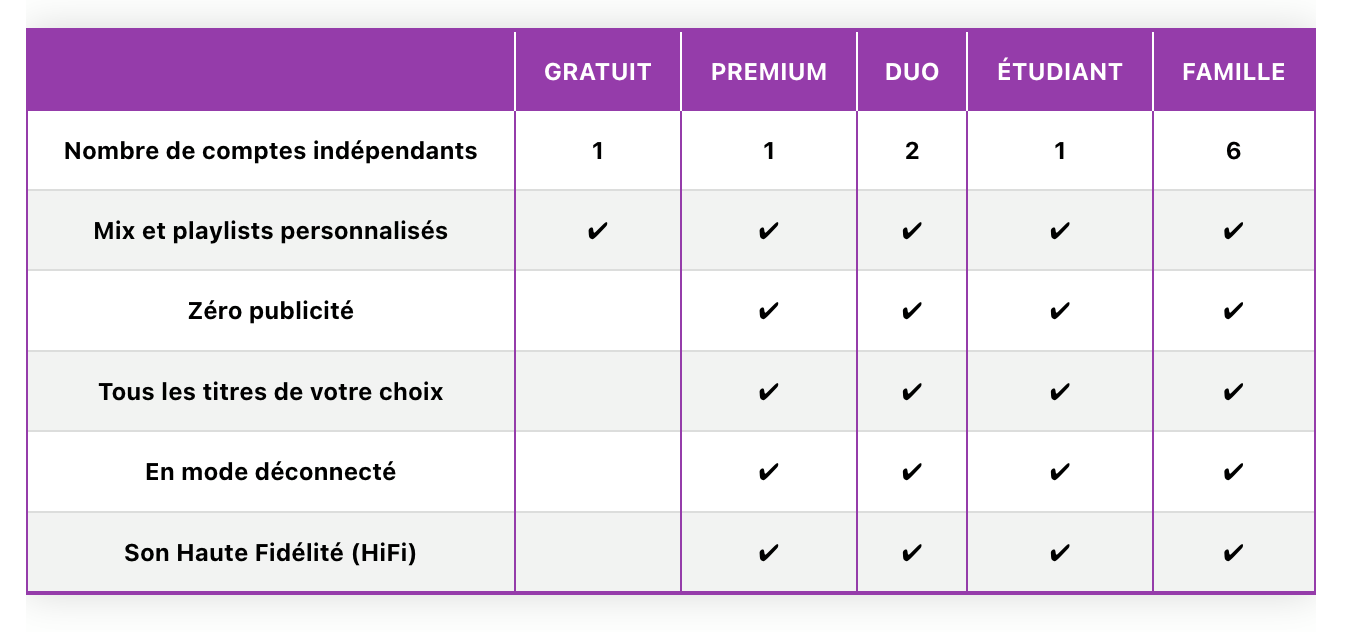
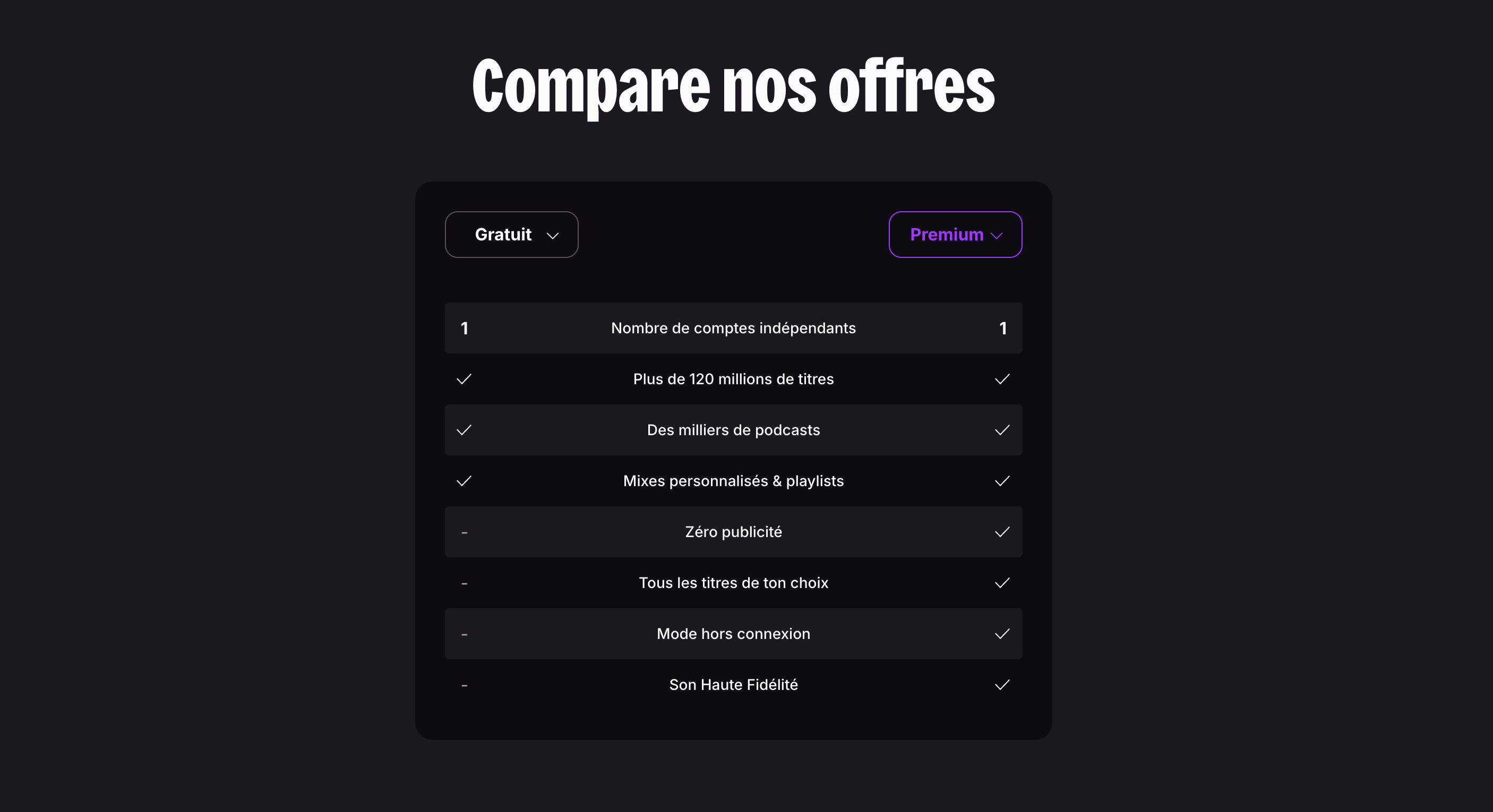
When comparing Deezer to its main rivals, its pricing remains competitive. The Premium plan at €11.99 per month includes HiFi lossless quality, whereas Spotify charges €12.14 per month for its Premium offer, with Lossless up to 24-bit/44.1 kHz. Apple Music and Amazon Music Unlimited are similarly priced at €11.99 and €12.14 per month, respectively, with lossless audio.
So, Deezer distinguishes itself less by a price advantage tied to HiFi than by offering that audio quality across its various paid plans.
For those who are unsure, it is possible to try the premium subscription for 1 or 2 months, depending on current offers. Trial periods and promotions vary according to time and eligibility conditions, so it’s best to check the offer at the time of subscribing.
Deezer or Spotify: which to choose in 2026?
On paper, Deezer and Spotify look a lot alike: offline mode, ad-free listening, and now lossless audio. The two platforms diverge, however, on price and content.
| Criteria | Deezer | Spotify |
| Premium, 1 account | €11.99/month | €12.14/month |
| Duo, 2 accounts | €15.99/month | €17.20/month |
| Family, up to 6 accounts | €19.99/month | €21.24/month |
| Student | €5.99/month | €7.07/month |
| Free trial (official pages) | 1 or 2 months | 1 month |
| Lossless audio | FLAC CD-quality | Lossless included in all Premium plans |
In terms of price, Deezer therefore has a small lead. Yet both services today offer a very complete experience. Deezer will suit those seeking a slightly lower price, HiFi quality, and Flow recommendations, while Spotify offers a broader array of audio content, notably with audiobooks.
Deezer’s catalog
When it comes to its catalog of songs, Deezer today sits among the top tier with more than 120 million tracks available. Spotify and Apple Music report over 100 million titles in their libraries in comparison.
Numerous French artists are present on Deezer and exclusively on Deezer, which will appeal to Francophone music lovers. However, the app isn’t always as precise when searching for obscure international artists from niche genres. It thus depends on personal tastes: the trial offer lets users verify whether their preferred genres are adequately represented.
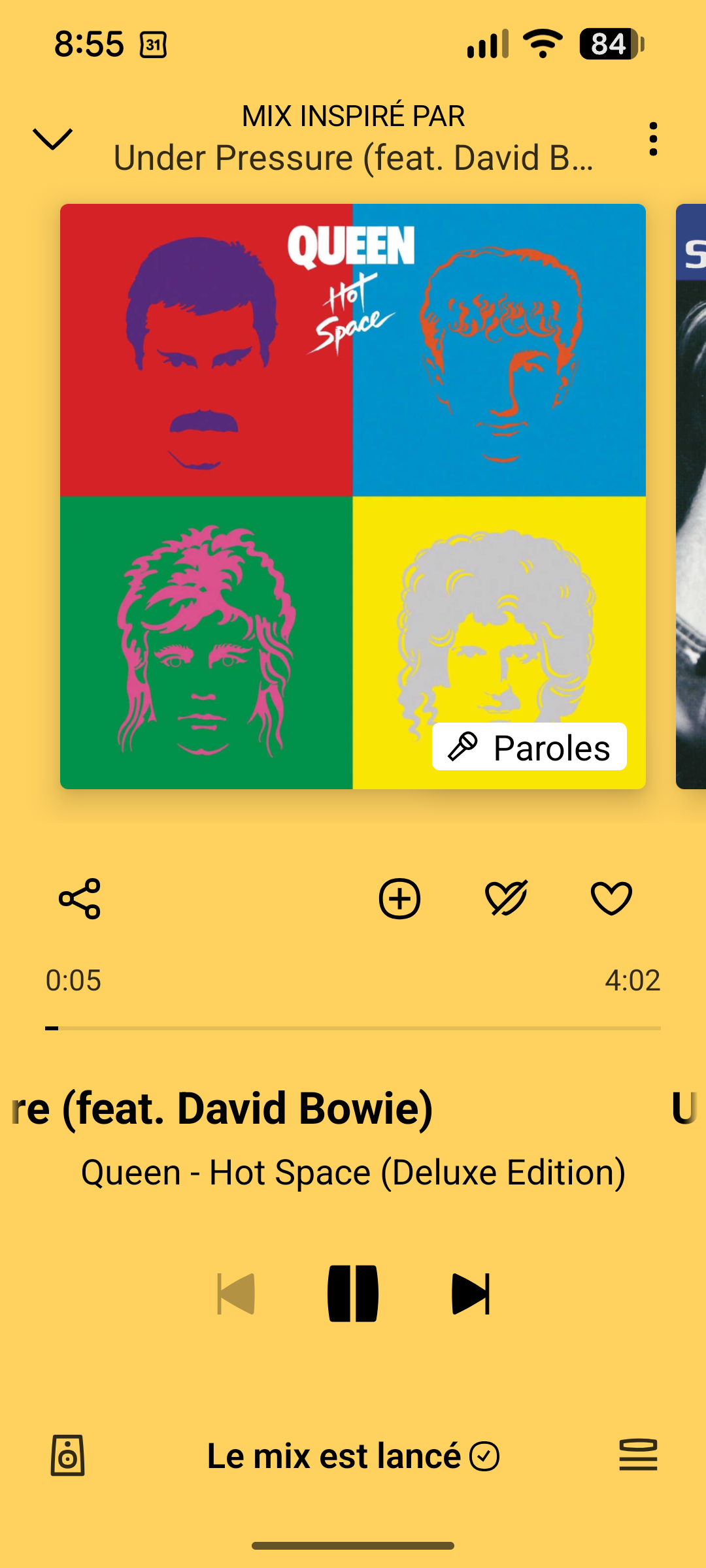
In terms of sound quality, Deezer offers HiFi lossless quality directly within paid subscribers, in FLAC 16-bit/44.1 kHz, equivalent to CD quality. A transition to 24-bit/192 kHz is in progress.
However, this quality depends on the hardware used to fully appreciate it. And Deezer is no longer alone in this field: since 2025, Spotify also offers Lossless to Premium subscribers, up to FLAC 24-bit/44.1 kHz. Both services thus offer lossless listening today, with different technical specifications.
Deezer availability
Deezer is accessible on a wide range of devices. The service is available on iOS and Android smartphones, computers, connected TVs, and consoles like Xbox, as well as in cars via Android Auto, Apple CarPlay or certain built-in automotive platforms. It is also compatible with numerous connected devices and audio systems.
In 2026, the Android TV app received a complete redesign, with a modernized interface and access to Flow, synchronized lyrics, and HiFi quality.
This broad compatibility ensures the catalog and features can be found on most devices used daily, from portable listening to home or car audio systems.
Pricing for the Deezer streaming platform
Deezer can be accessed in several ways. Its free offering, Deezer Free, grants access to the catalog with ads and certain playback limitations. Audio quality is lower than that offered to paying subscribers, and offline listening is not available. This plan is mainly for those who want to try the service without subscribing.
To enjoy the full experience, several paid plans are available:
| Offer | Accounts | Monthly price | Annual price |
| Free | 1 | €0 (ads, limited features) | — |
| Premium | 1 | €11.99 | €107.99 |
| Student | 1 | €5.99 (proof required) | — |
| Duo | 2 | €15.99 | €174.99 |
| Family | 6 | €19.99 | €218.99 |
- Deezer Premium, at €11.99 per month, removes ads and enables on-demand listening, offline downloads, and lossless HiFi quality in FLAC 16-bit/44.1 kHz, with no extra charge. A student discount is also offered.
- Deezer Duo, at €15.99 per month, retains Premium features for two individual accounts, each with its own recommendations, playlists, and favorites.
- Deezer Family, at €19.99 per month, supports up to six individual accounts, including child-friendly profiles.
- Deezer Étudiant, priced at €5.99 per month, provides the same core features as Premium at a reduced rate, subject to eligibility.
Over a full year, the annual subscription yields savings. The Premium plan costs €107.99 per year, which is about 25% less than paying twelve monthly installments (€143.88), resulting in roughly €36 saved. The annual Duo and Family versions offer approximately 9% savings.
If we compare Deezer with its main competitors, its prices remain competitive. The Premium subscription at 11.99€ per month includes HiFi lossless quality, while Spotify charges 12.14€ per month for its Premium offer, with Lossless up to 24 bits/44.1 kHz. Apple Music and Amazon Music Unlimited are also offered at 11.99€ and 12.14€ per month, respectively, with lossless audio.
Deezer thus differentiates itself less by a price advantage tied to HiFi than by the inclusion of this audio quality across its various paid plans.
Those who are undecided can also try a premium subscription for 1 or 2 months, depending on current offers. trial periods and promotions vary, so it’s best to verify the offer at the time of signing up.
The Deezer catalog
When it comes to its catalog of songs, Deezer today sits among the top tier with more than 120 million titles available. Spotify and Apple Music report over 100 million titles in their libraries by way of comparison.
Many French artists are present on Deezer and exclusively on Deezer, which will be a key selling point for Francophone music fans. On the downside, the app is somewhat less precise in finding obscure international artists from niche genres. It thus depends on user preferences: the trial offer lets users verify whether their preferred genres are well represented.
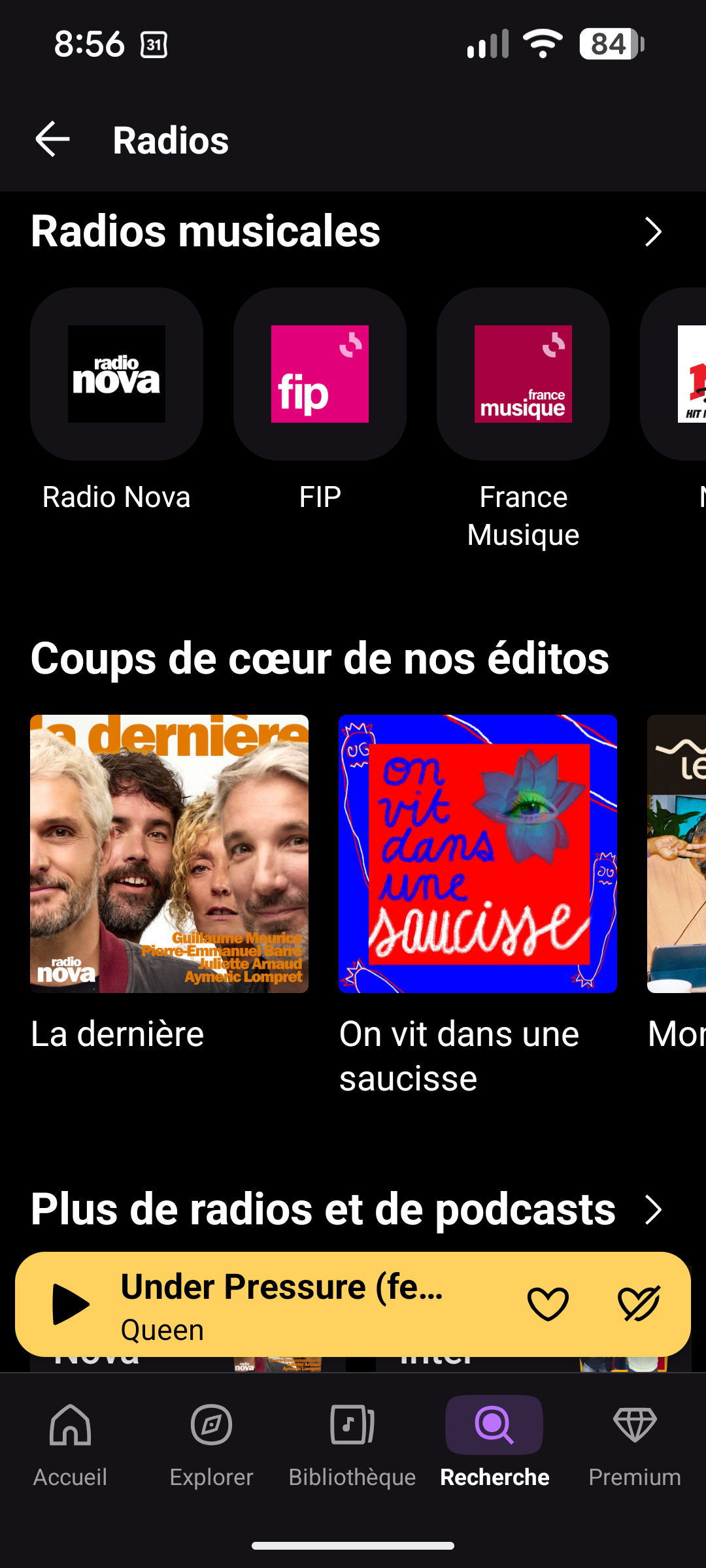
Elsewhere, Deezer offers the vast majority of radio broadcasts on broadcast waves (RTL, Europe 1, Virgin, NRJ, France Info, etc.), along with podcasts, though the catalog in this area is not as extensive as Spotify’s. Like many other services of this kind, Deezer allows quick access to the most popular titles of the moment via various Top 100 lists, usually categorized by genre or country.
Deezer also features editorialized content tailored to users’ tastes and musical affiliations. Similar to Spotify, Apple Music, or YouTube Music, Deezer offers curated playlists designed to introduce users to new music based on what they have listened to previously.
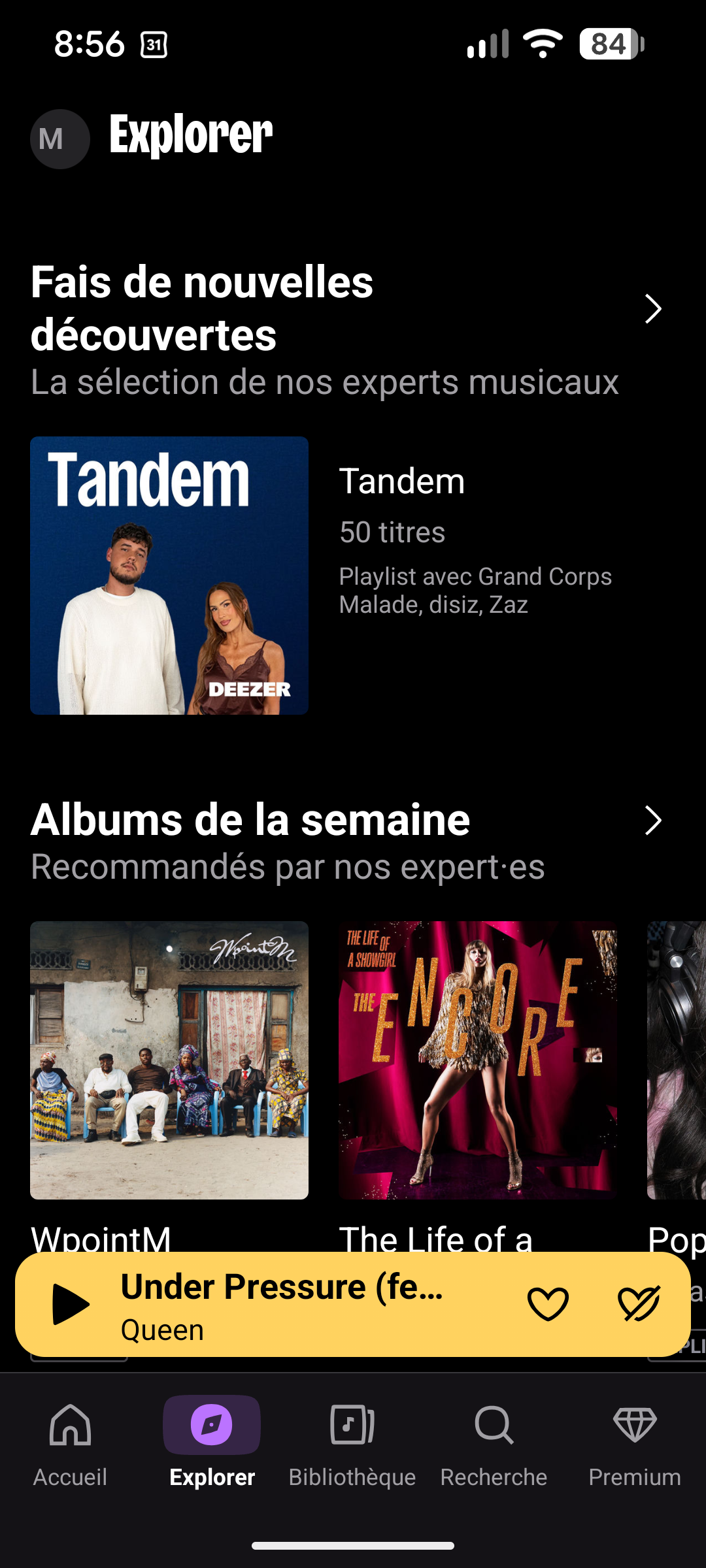
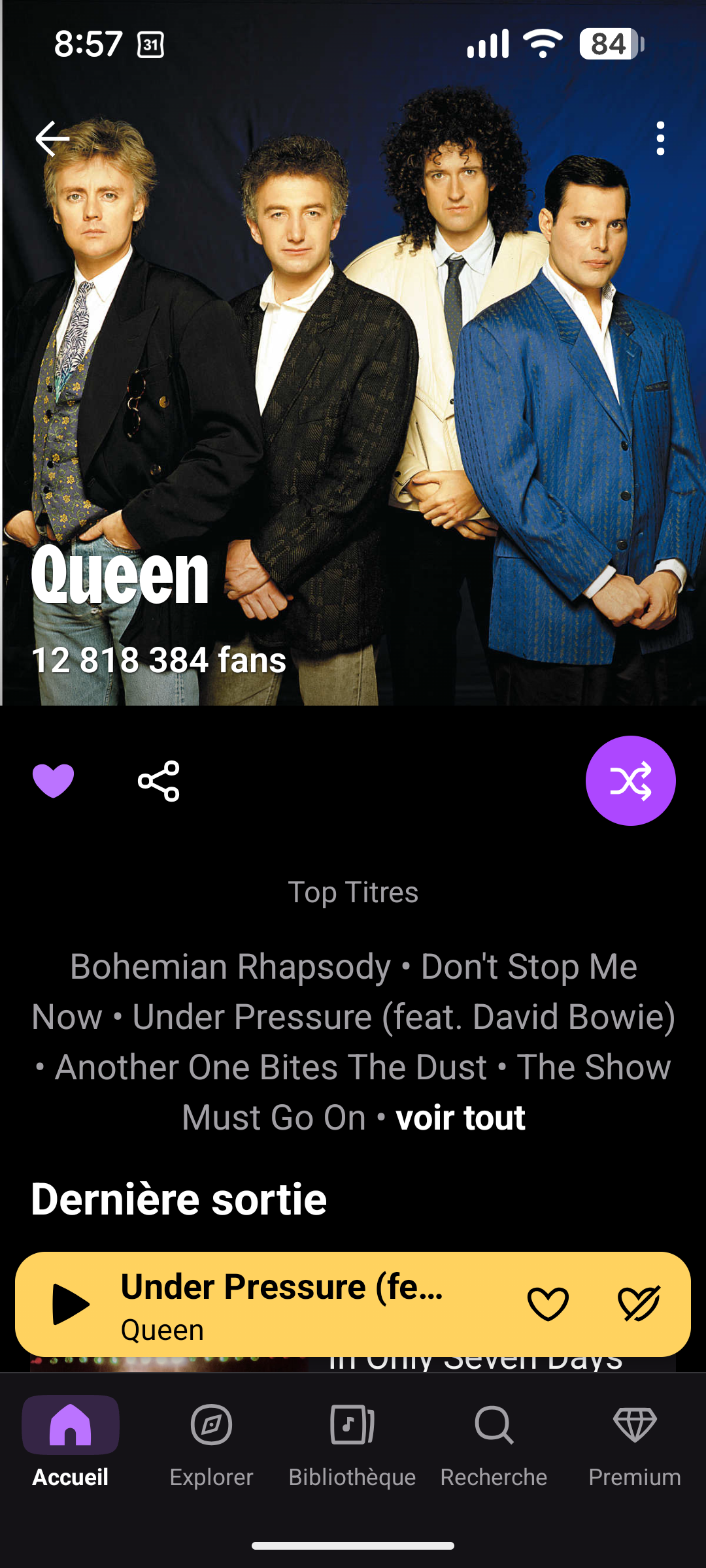
Some features add a small playful touch to Deezer’s overall experience. Like Spotify, it’s possible to share your activity and listening habits with contacts, so they can discover your favorite album, artists, or styles. However, the feature is a bit less prominent than on Spotify, since it requires navigating through several tabs to access. Deezer also offers SongCatcher, which, like Shazam, identifies the name and artist of a track.
There is also a highly sought social aspect among music streaming app users: collaborative playlists. With these, you can create playlists with multiple people, so you don’t have to juggle accounts. Deezer has offered this feature for years and goes further with Shaker, which enables multi-user playlists, including with users of other platforms. A convenient feature to blend everyone’s tastes without using the same streaming service.
Finally, Deezer directly drew inspiration from Spotify with Flow, a personalized recommendation tool based on the user’s tastes. The release dates for various “discover” and “new” playlists are even the same. Concert enthusiasts can also learn about the date of upcoming concerts by their favorite artists near their residence, directly in the interface.
AI-generated music and artist remuneration: Deezer’s stance
Deezer has taken a clear stance on two hot topics in streaming: generative AI music and revenue sharing.
First issue, AI-generated music. According to Deezer, more than 13.4 million AI-generated tracks were identified in 2025. In June 2026, tracks entirely generated by AI reached peaks of nearly 90,000 uploads per day, i.e., more than half of new releases. These tracks are flagged and excluded from algorithmic recommendations and editorial playlists. Deezer also states that up to 85% of plays of these titles were fraudulent in 2025 and are therefore monetized.
Second issue, remuneration. Deezer applies an artist-centric system (ACPS): artists who accumulate at least 1,000 monthly plays from 500 unique listeners can have their streams valued up to twice as much. A separate bonus rewards “active” listens, potentially boosting earnings up to four times that of a standard stream. In France, SACEM adopted this model with Deezer in 2025.
The aim is to better value artists with an engaged audience while curbing fraud effects.
Accessibility and Deezer’s interface
The web app
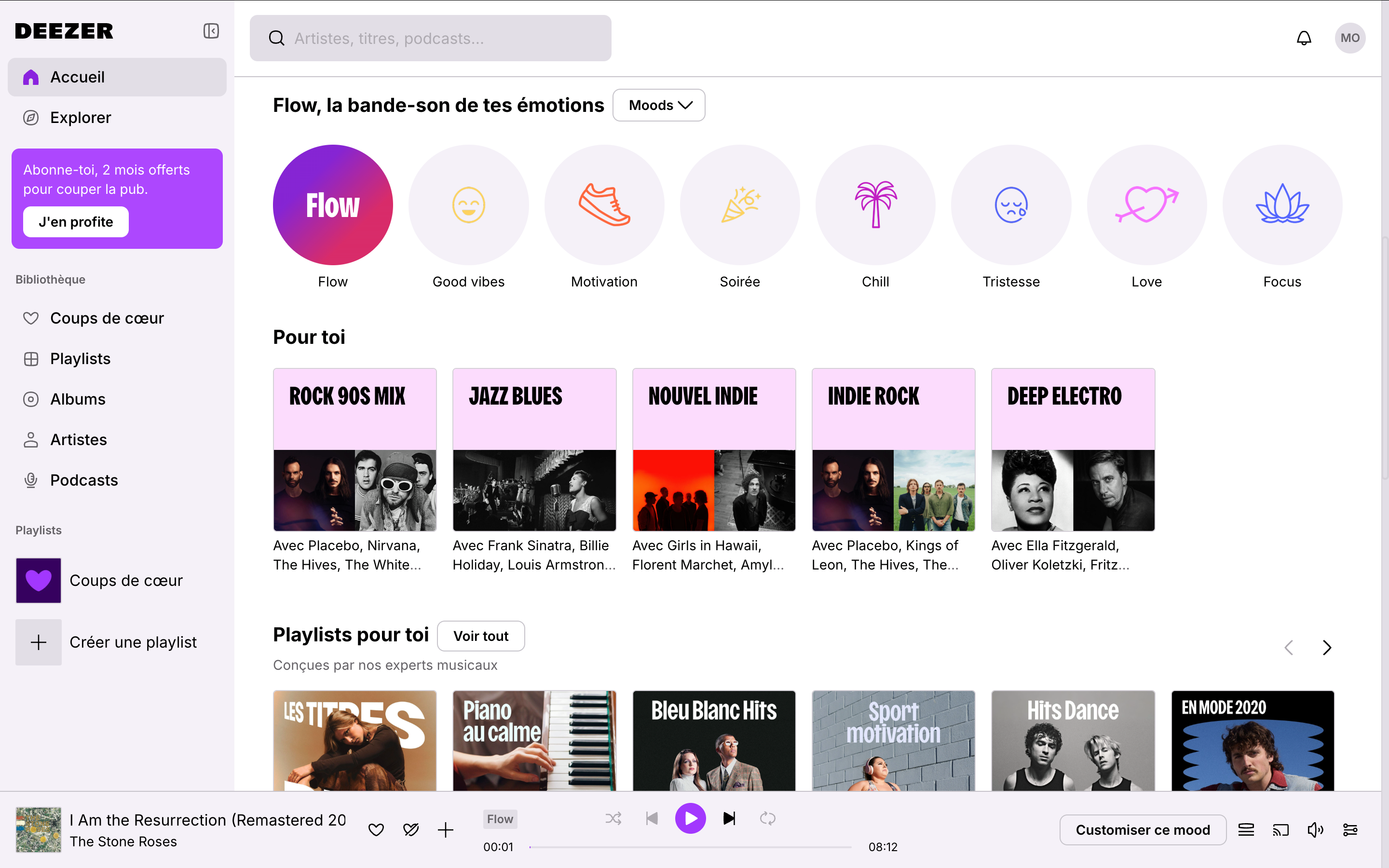
Deezer’s web app (usable in Chrome, Firefox, Opera, etc.) offers a classic and intuitive experience that won’t surprise regular users of music streaming services. It features the Home, Explore, Favorites tabs, and its playlists in a left-hand column. The bottom of the screen shows a bar to track currently playing titles, radios, or podcasts (with Chromecast, Queue, Audio Quality controls…), while the rest of the screen is dedicated to discovery or pre-selection of upcoming titles to listen to.
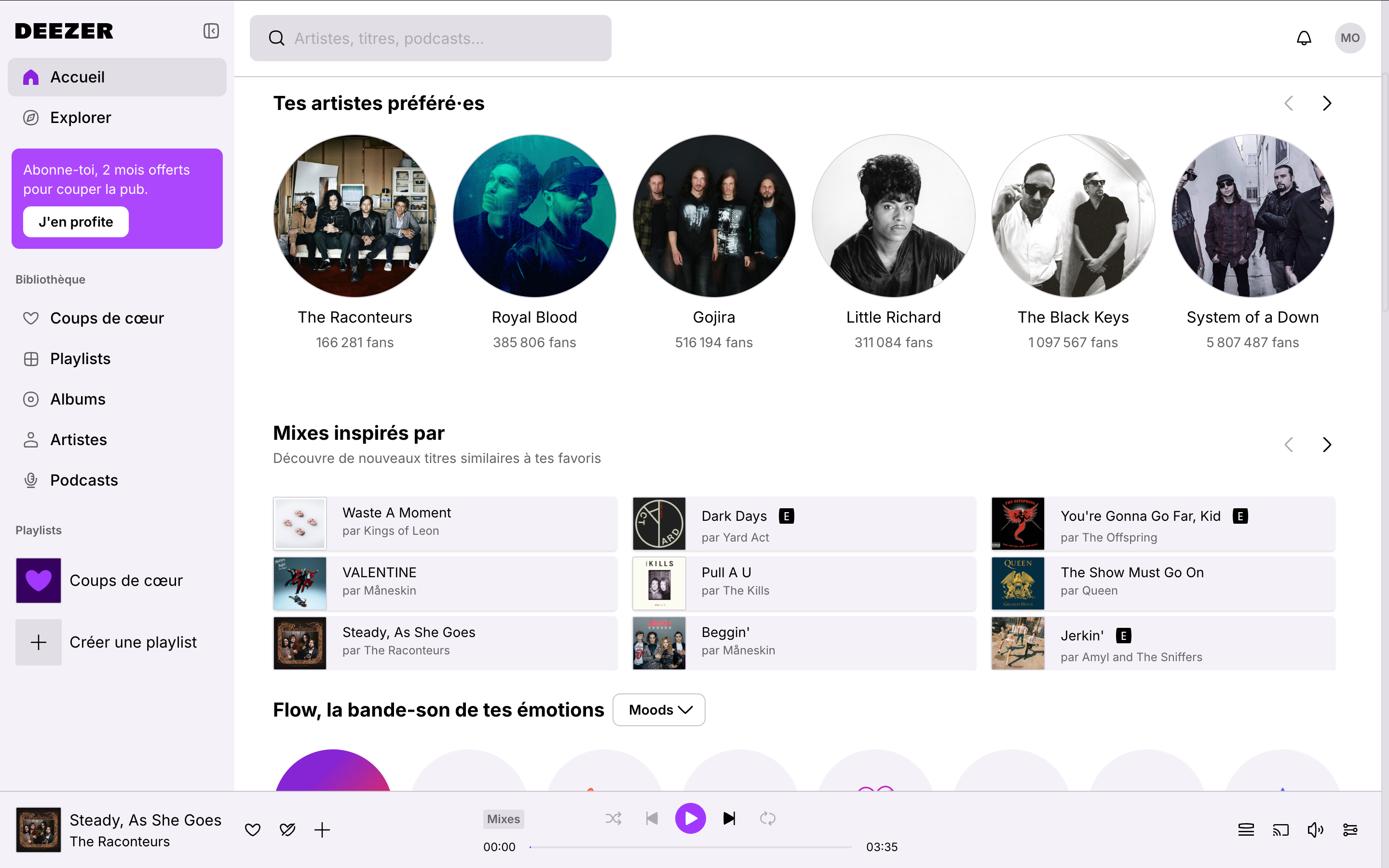
The overall look resembles what Spotify, YouTube Music, or Amazon Music offer on their platforms. A dark mode is available, though not activated by default.
The desktop app
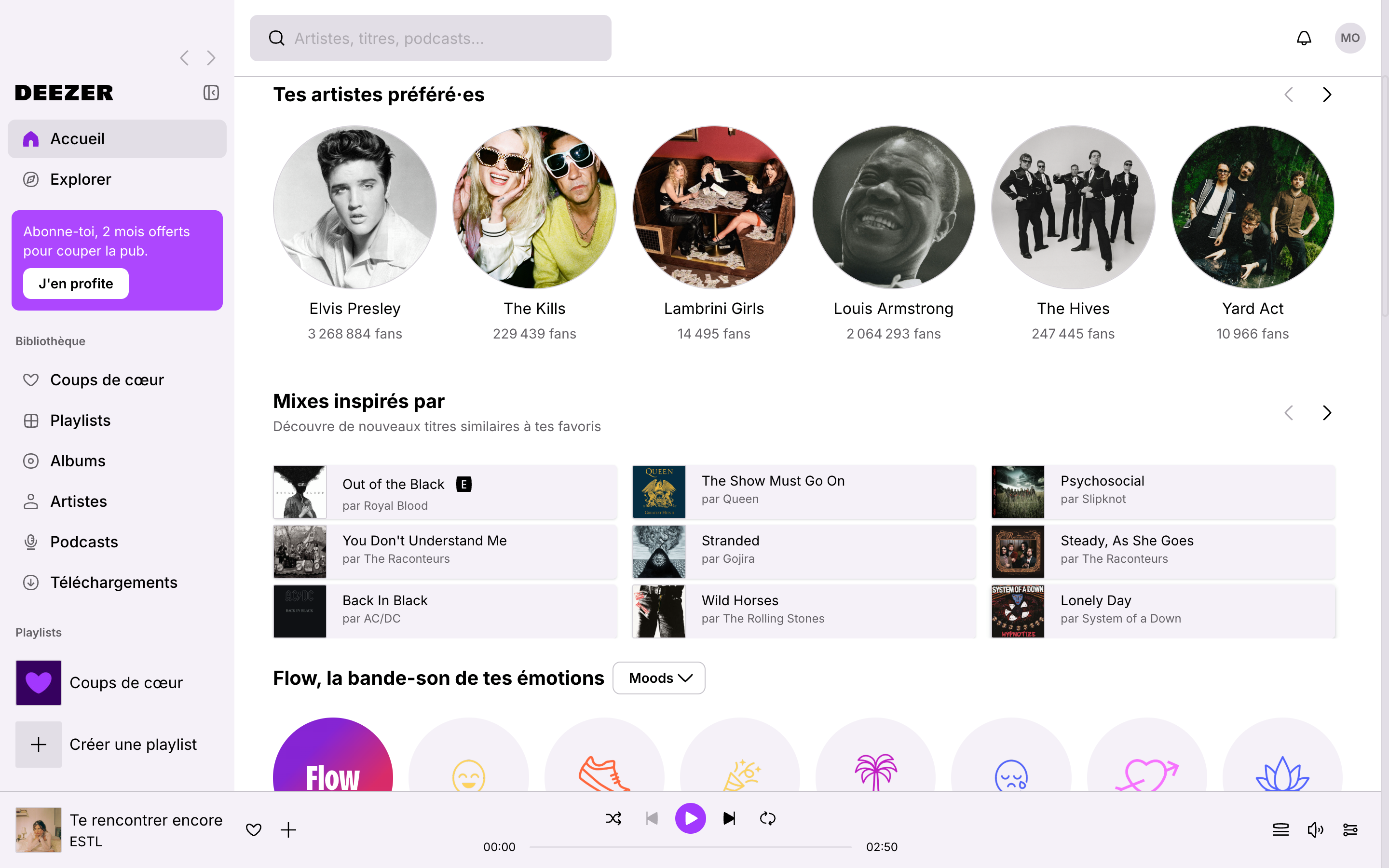
The Deezer desktop app closely resembles the web version. Its main advantage over the browser version is the ability to download tracks for offline listening. Otherwise, the desktop app is just as clear and easy to use as the web version.
Deezer mobile apps
The mobile version of Deezer is arguably the most complete today (a common trait among music streaming services, which are primarily used on the move). It combines the features of the web and desktop versions while adding several extras that boost everyday usability.
On iOS and Android, Deezer provides special widgets (shortcuts) for Flow, Favorites, For You, Latest Plays, and SongCatcher, allowing quick access to some of the app’s favorite sections directly from the home screen.
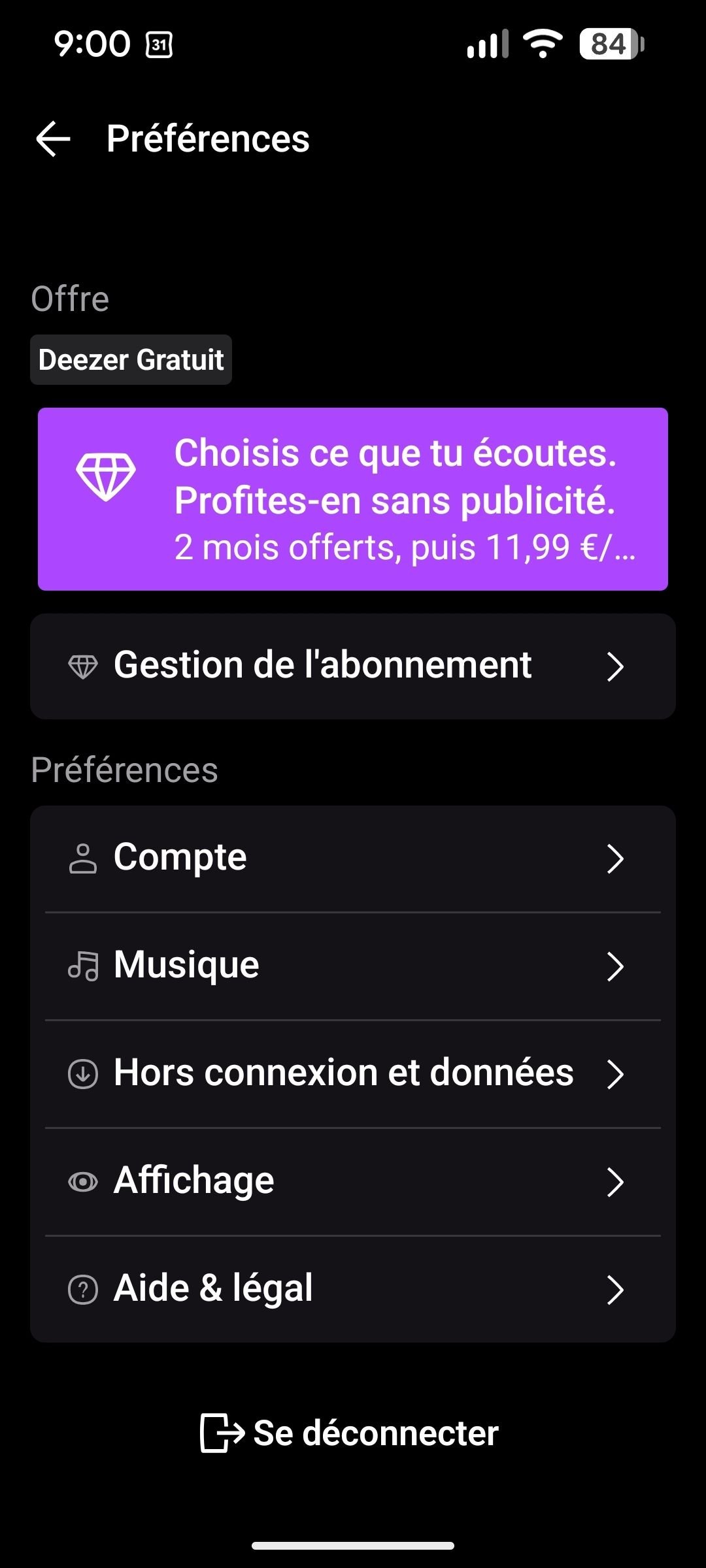
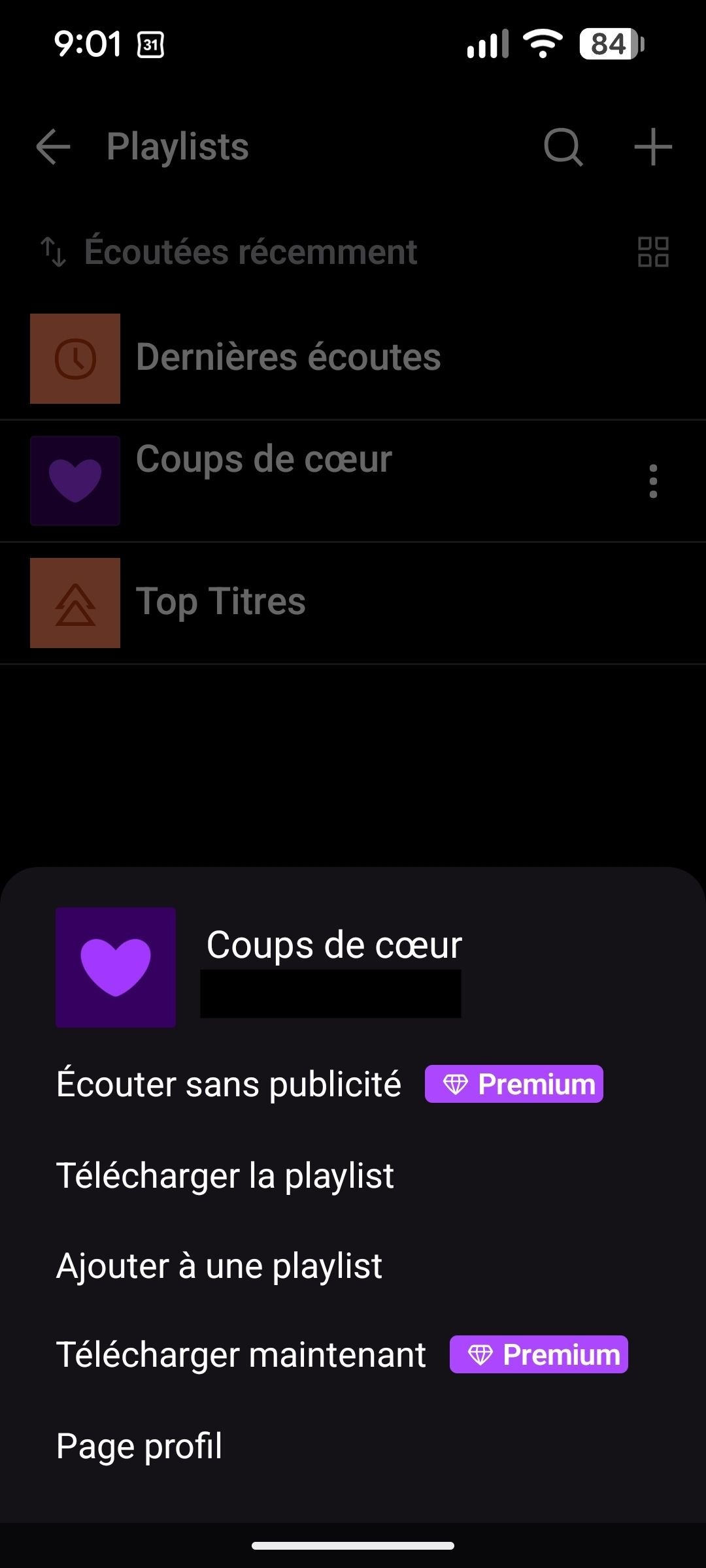
Par ailleurs, Deezer permet le téléchargement et l’écoute hors connexion de ses chansons favorites sur mobile, idéal pour les trajets incertains en réseau 4G (train, avion, etc.) et pour ne jamais être à court de musique ou de contenu.
Deezer sur la télévision connectée
Since 2026, Deezer has a fully redesigned Android TV application. It is available on compatible devices through the Google Play Store and now offers a modern interface, smoother navigation, and several features such as Flow, mixes, 100% artist playlists, synchronized lyrics, and HiFi quality.
Deezer remains compatible with Chromecast, enabling you to use your smartphone or tablet to control music playback on a TV or compatible system.
As expected, the TV version remains different from the mobile and desktop apps. It primarily focuses on listening and discovering music on the big screen, with certain features specific to these other versions that aren’t available in the same way.
Streaming on connected devices and personal assistants
Deezer is compatible with many connected devices and personal assistants, starting with the car. The service works with Android Auto, CarPlay, UConnect Live, BMW, RockScout by MirrorLink, and Waze.
The French streaming service is also available on certain smartwatches, such as the Apple Watch, Fitbit watches, or Garmin. These versions are limited but still allow access to a number of features, like playing downloaded music or listening to certain playlists.
Moreover, Deezer is compatible with several assistants and smart-home devices, such as Google Home, HomeKit, Amazon Alexa, or even Siri, making it one of the most versatile music streaming apps on the market.
What do Deezer subscribers think?
As of September 2026, Deezer’s ratings are as follows:
- 4.1/5 on Trustpilot with over 3,000 reviews;
- 4.6/5 on the Google Play Store with 3.63 million reviews;
- 4.7/5 on the App Store with more than 529,000 reviews.
Trustpilot reviews for Deezer are largely positive, with users praising the breadth of the catalog, ease of navigation, and Flow’s discovery features that help find new tracks and artists.
Some criticisms exist, particularly around subscription management and trial periods, with users noting a lack of reminders before expiry. Others mention that recommendations can occasionally lack variety.
Conclusion: value for money
Deezer remains one of the most feature-rich music streaming services on the market: a catalog of over 120 million tracks, Flow for recommendations, broad device compatibility, and plans tailored to different uses. Its historical strength, HiFi included at no extra cost, is no longer unique since Lossless arrived on Spotify.
Additionally, Deezer remains a market leader in France, thanks in large part to a vast selection of Francophone artists and a variety of subscriptions that meet diverse user needs. With a clean, pleasant interface and broad compatibility with connected devices, Deezer remains a serious competitor to the market leaders, provided it can continue to internationalize.
If you want lower costs without sacrificing sound quality, Deezer is an excellent option to try with a free trial to ensure your hardware is compatible.
Deezer remains a comprehensive music streaming app for listening to music and podcasts on a range of devices. Its extensive catalog, personalized recommendations, and download system meet daily usage. The free tier lets you discover the service, while the premium offer significantly enhances listening quality and ease of use. With its audio options, clear interface, and optimized online streaming management, Deezer is a reliable solution to enjoy songs and musical content at any time.
- FLAC 16 bits/44.1 kHz available with Premium
- Personalized recommendations with Flow
- AI-generated titles identified and excluded from recommendations
- More than 120 million tracks
- Mobile app complete
Deezer: answers to all your questions
Is Deezer free?
Yes, there is a Deezer Free plan, funded by advertising. It provides access to the catalog, podcasts, and personalized mixes, but without the advantages of paid plans (no ads-free mode, offline listening, or HiFi).

Daniel Brooks
I cover everyday products with a practical eye, from kitchen tools and home essentials to smart gadgets and consumer trends. My goal is to help readers understand what is genuinely useful, what is worth the price, and what deserves a second look before buying.