
RTX Spark laptops were unveiled with great fanfare at Computex 2026, and after years of speculation they are finally a reality. Propelled by the renowned NVIDIA N1X chips, these machines now step onto the market brandishing the banner of local, high-performance, secure AI, while also promising energy efficiency capable of rivaling the best Apple Silicon solutions.
Yet the wager is a risky one for these chips, whose development has been littered with obstacles. They must operate within a Windows ARM environment, albeit one that has clearly matured since the commercial rollout of Qualcomm Snapdragon X SoCs a couple of years ago. Nevertheless, their reputation and performance remain topics of debate.
After delivering a comprehensive review of the ASUS ProArt P16 in the 64 GB configuration, we now turn to another NVIDIA N1X-powered machine: the MSI Prestige N16 Flip AI+, the only convertible model in the RTX Spark line currently available. Beyond this particular trait, the unit MSI France kindly lent us is intriguing because it ships with 128 GB of unified memory. It thus benefits from the highest configuration NVIDIA presently offers in this new family of devices, capable of handling the largest language models (120 billion parameters and more) and venturing into the territory of agentic AI.
We will assess this model’s capabilities, but first, here is the full technical spec sheet for the PC we received on loan:
Fiche technique
MSI Prestige N16 Flip AI+
Summary
– Processor: NVIDIA N1X
– Memory: 128 GB
– Graphics: Blackwell
– Screen size: 16 inches
– Refresh rate: 120 Hz
OS
– Operating System: Windows 11
Processor
– Processor: NVIDIA N1X
– CPU type: 20 cores
– Processor frequency: 4.1 GHz
– Process node: 3 nm
– NVIDIA RTX Spark: Yes
RAM
– Memory size: 128 GB
– Memory type: DDR5
– Number of memory slots free: 0
Graphics
– Graphics card: Blackwell
– Max-Q: Yes
– VR Ready: Yes
Display
– Screen size: 16 inches
– Refresh rate: 120 Hz
– Panel type: OLED
– Screen type: OLED
– Screen resolution: UHD+
– Aspect ratio: 16:10
– Matte / anti-reflective: No
– NVIDIA G-SYNC: Yes
– Touchscreen: Yes
Storage
– Drive configuration: NVMe SSD
– Main drive: 2 TB
– Optical drive: None
– mSATA/M.2 slot: M.2 (occupied)
– Memory card reader: SD card
Connectivity
– Available connectors: USB 3.2, USB 4.0 Type-C, HDMI 2.1, SD Card reader (3.5 mm jack)
Wireless network
– Wi‑Fi: Yes
– Wi‑Fi version: 7
– Bluetooth: Yes
– Bluetooth version: 5.4
Equipment
– Webcam: Yes
– Speakers: Integrated
– Keyboard: Azerty
– Backlit keyboard: Yes, RGB
– Numeric keypad: No
– Fingerprint reader: Yes
Physical characteristics
– Length: 357.7 mm
– Width: 254.3 mm
– Thickness: 13.9 mm
– Weight: 1.9 kg
Design: MSI can (and should) do better…
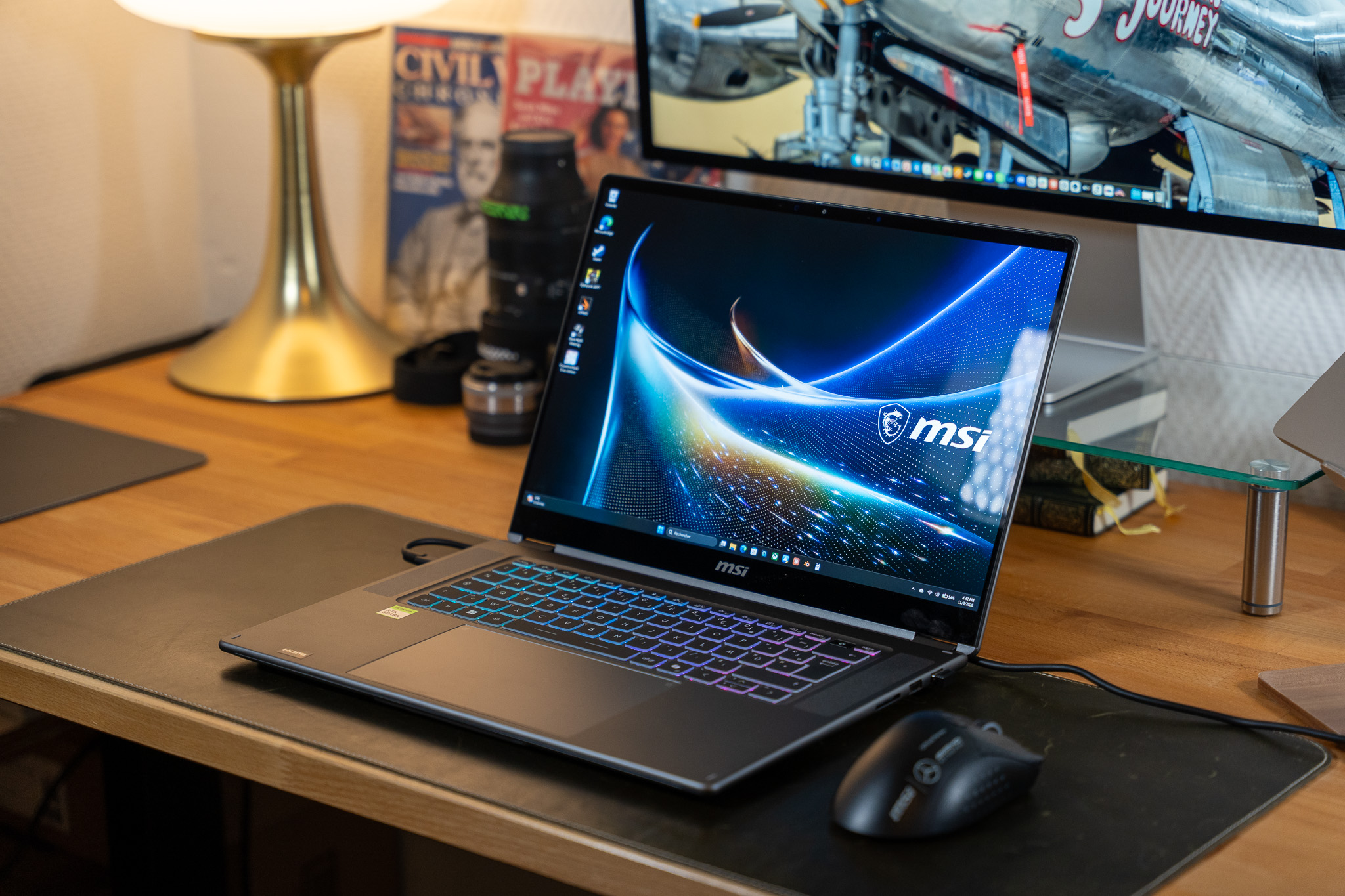
In the face of the clinical sobriety of the ASUS ProArt P16 and others, or the unmistakable “MacBook Pro” vibe of a Surface Laptop Ultra, we must admit that our Prestige N16 Flip AI+ was a bit less blessed by nature — or at least by MSI’s designers.
With a chassis that’s fairly compact for a 16-inch laptop (357.7 x 254.3 x 13.9–16.9 mm, about 1.9 kg), the device isn’t overly heavy or thick, but it feels more like a slightly refined, sturdier, and better-assembled variant of the MSI Stealth 16 AI+ than a brand-new model designed specifically for the new N1X chips and the RTX Spark lineup — as Microsoft has done.
It is, however, a solid, portable form factor for a 16-inch device, and it does not overstate its hand.
The Best Prices
Infomax: 7,959.00 €
GrosBill: 7,999.90 €
Cybertek: 7,999.90 €
Materiel.net: 7,999.95 €
Voir plus de prix
Pros
– Promise kept on locally managing large LLMs
– The SoC N1X, one of the most versatile on the market to date
– A 16-inch convertible, slim and not too heavy
– The OLED UHD+ touchscreen, very bright at 120 Hz
– The included MSI Nano Pen with clever storage
Cons
– Less endurance than hoped (10–12 hours)
– Runs hot and breathes a bit at all times
– The non-haptic, calamitous touchpad
– Keyboard a bit soft, webcam and speakers somewhat neglected
– A prohibitive price (7,999.90 €)
Read the conclusion
Conclusion
The bet is risky for these chips, whose development has been far from straightforward, requiring them to operate within a Windows ARM environment that has finally matured but still carries questions about reputation and performance. After delivering a full test of the ASUS ProArt P16, in the 64 GB version, MSI sends another NVIDIA N1X-powered machine into the ring: the Prestige N16 Flip AI+. Beyond being the sole convertible in the RTX Spark range, this model is notable for packing 128 GB of unified memory. It leverages NVIDIA’s top configuration available for this new device family, enabling the handling of very large language models (120B params and beyond) and pushing into the realm of autonomous AI.
We’ll explore the chip’s capabilities, but first, here is the full technical sheet for the loaned unit. The MSI Prestige N16 Flip AI+ proposition is strong on paper: a high-end SoC, a 16-inch OLED UHD+ display with 120 Hz, a generous amount of unified memory, and a Windows platform tuned for AI workloads. However, the real question remains whether MSI has managed to balance performance with sub-system acoustics, heat, and input comfort in a way that meets the price tag.
Measurements across the board reveal a device that can sustainably perform heavy tasks locally, a crucial requirement for private AI workflows. The RTX Spark’s local AI capabilities are indeed compelling, thanks to the 128 GB of unified memory, which allows the N1X to pool CPU and GPU memory for high-demand workloads. The result is a system that can run largest language models locally and operate with a level of privacy and security that is hard to match with cloud-based solutions.
What remains most notable is that, even with top-tier specs, the Prestige N16 Flip AI+ faces a few rough edges. The keyboard, while precise and well-spaced with a robust tactile feel, can be a touch loud, and the trackpad — non-haptic and frankly difficult to live with — undermines the otherwise strong typing experience. The webcam and speakers also underperform relative to the rest of the package, and the overall endurance on battery, while respectable, is not spectacular given the machine’s power envelope and the battery’s substantial 99 Wh capacity. In short, the MSI Prestige N16 Flip AI+ delivers impressive local-AI potential, but it isn’t perfect, and its price places it in a very demanding market segment where Apple’s existing solutions still enjoy a notable energy-efficiency advantage.
Performance: how does the best RTX Spark configuration fare?
As with the rest of the RTX Spark family, the Prestige N16 Flip AI+ represents the top tier of MSI’s portable AI ambitions. It pairs NVIDIA’s N1X with a substantial 128 GB of unified memory, split between CPU and GPU usage so that the system can leverage any available resource pool to sustain large models and agent-based tasks. The combination makes it possible to operate large language models locally while maintaining a level of energy efficiency that’s competitive with the best Apple Silicon machines in some scenarios. The GPU side of the package, RTX Blackwell, is a strong performer in integrated graphics terms, particularly for workloads that benefit from NVIDIA’s DLSS and related acceleration features.
However, the X-power of the N1X is also constrained by a 3 nm process and a core architecture that sits roughly in between the latest Snapdragon-class CPU designs and Apple’s M-series offerings. In practical terms, this translates into solid, but not catastrophic, single-core performance, and a GPU that can compete with many mid-to-high-end integrated solutions, but may lag behind top-tier gaming GPUs in sustained, high-load scenarios. The “local AI” angle shines brightest when the system leverages its 128 GB pool to host large models — in practice, MoE (mixture-of-experts) configurations that don’t require all parameters active at once often run most efficiently here. For dense models where all parameters work at every token, the N1X shows its limits, with relatively modest throughputs in some larger configurations (12 tokens/s on some heavy models, and as low as 6 tokens/s on particularly dense setups).
On the CPU side, the N1X can deliver competitive performance, but it lags behind the latest Snapdragon X2 Elite and X2 Elite Extreme when measured on single-core speed. This gap helps explain why Apple’s M5 Pro remains a strong leader in both single- and multi-core performance, and why the fastest Snapdragon options outpace the N1X on most single-core tasks. The GPU side, though, remains a different story: the RTX Spark’s 6144 CUDA cores, combined with the Blackwell architecture, outperform many integrated GPUs and deliver strong, if not class-leading, results for gaming and creative workloads, especially when DLSS and frame-generation techniques are employed effectively.
In gaming, MSI’s RTX Spark solution stands out as the most capable integrated option currently available for gaming and content creation. While it can’t match the raw power of a dedicated RTX 5070 or 5080 in all scenarios, the combination of a capable GPU, intelligent memory pooling, and DLSS-like technology allows it to deliver excellent frame rates in a portable, no-graphics-card-needed package. For creative workloads and real-time 3D rendering, the N1X proves itself as a capable flagship for a portable AI workstation, thanks to the large shared memory pool and its robust on-die acceleration tools.
Beyond synthetic benchmarks, the local AI story is where the Prestige N16 Flip AI+ truly stands out. With the ability to run 10 LLMs locally (30–120B parameter models) and a promising workflow for offline AI that preserves privacy, the MSI unit demonstrates that local, real-time AI processing on a single notebook is no longer a fantasy. We tested a wide range of models, from lighter MoE-based configurations to more demanding dense models, and the results were consistently informative: MOE-type models scale well on the unified memory pool, whereas fully dense models push the limits of the N1X in this configuration.
Local image generation is also feasible, using Flux and ComfyUI. A 1536×1024 image can be produced in about 160 seconds in normal mode with 28 steps, or 48 seconds in a fast 8-step mode, all via a single prompt. The potential is clear: a compact device capable of running sophisticated AI apps offline and privately, which has obvious appeal for professionals who need to protect sensitive data.
Battery life: 4 to 6 hours in AI, thankfully longer elsewhere
Local LLM workloads are energy-hungry, and the GPU is heavily taxed. In terms of consumption, the AI workload and creative or gaming use share similar energy footprints. In AI mode, expect about 4 to 6 hours of battery life, but not a lot more if you use the “Performance boost” profile.
In more general, mixed-use scenarios (office tasks, web browsing, occasional local AI tasks) and with a more economical energy profile, such as the balanced mode, the Prestige N16 Flip AI+ can reach roughly 10 to 12 hours of endurance. This is respectable for a high-powered portable with a 99 Wh battery, though it remains below the efficiency demonstrated by Apple’s most optimized laptops in equivalent use.
The device ships with a 140 W USB-C charger, and a full recharge from empty takes roughly two hours — a reasonable window given the power reserve.
MSI Prestige N16 Flip AI+ (RTX Spark): Clubic’s verdict
What should you take away from the MSI Prestige N16 Flip AI+? It largely reflects the strengths and weaknesses of the RTX Spark platform, with a few notable flaws of its own.
On local AI, NVIDIA keeps its promise. With the 128 GB of unified memory guarding the N1X, the chip runs large LLMs smoothly, never leaking data off the device. The new SoC also offers the most capable on-device solution for casual gaming and creative workloads without a dedicated GPU, delivering an attractive balance of performance and power.
Unfortunately, when AI workloads are not the focal point, the NVIDIA N1X is somewhat underwhelming. CPU performance on a single core is behind the best of its rivals, and its energy efficiency could be improved. The experience is dampened by a noticeable throttling when on battery in certain scenarios, plus frequent fan activity even under lighter workloads. As for endurance, even with a large 99 Wh battery, it falls short of expectation for such a device, leaving Apple’s ecosystem advantages evident in certain use cases.
If NVIDIA were a smaller company, one might call this an interesting, even successful first draft. But given the scale NVIDIA has achieved in recent years, there was room to expect more. This first RTX Spark generation opens a window onto a promising future, but the second iteration deserves careful watching.
MSI, for its part, does not do the platform any favors. A gorgeous OLED display, a slim and convertible form factor, and a cleverly stowed stylus do not automatically make a device memorable at a price that lands between 4,000 and 8,000 euros. At this price point, a handful of flaws — a keyboard that’s a touch soft, a calamitous touchpad, and speakers that could benefit from better tuning — should not exist. Everything should be nearly flawless, akin to a fully configured MacBook Pro 16 with a PROLED XDR display. It’s not the case here.
Overall, the Prestige N16 Flip AI+ manages to keep its promises in a very challenging space. It offers a credible, private, on-device AI experience that continues to impress, and for the right professional who needs on-device AI capabilities, it’s compelling. But in a market where even Apple holds the energy advantage, the MSI unit asks for a premium that should come with a near-flawless all-round experience.
Pros
– Local-Large-Language-Model handling is truly feasible and private
– The SoC N1X is one of the most versatile on the market today
– A 16-inch convertible that’s slim and not too heavy
– Bright OLED UHD+ touchscreen with excellent color and a 120 Hz refresh rate
– The included MSI Nano Pen and its smart storage
Cons
– Battery life under AI load is not outstanding
– The machine gets hot, with fans frequently audible
– The trackpad is non-haptic and unwieldy
– The keyboard is good but not exceptionally quiet; webcam and speakers underperform
– The price is very high (roughly 8,000 euros)
In summary, the MSI Prestige N16 Flip AI+ delivers a strong value proposition for a niche that wants on-device AI and a premium convertible in a portable form factor. However, its drawbacks — particularly the keyboard feel, the trackpad, and the audio quality — mean it won’t be the obvious choice for all users. It remains, nonetheless, a solid milestone for RTX Spark, signaling what MSI and NVIDIA are capable of achieving together in a future that should bring even tighter integration and better overall polish.
Notes
Design
– A strong concept with some rough edges
Display
– A gorgeous OLED panel with superb brightness and color coverage
Performance
– Solid overall, with the advantage of on-device AI acceleration, but not a true flagship for pure power
Autonomy
– A respectable balance, though shorter on AI tasks than on daily productivity
Rating
– 9 out of 10
Competition: which alternatives to the MSI Prestige N16 Flip AI+?
Apple MacBook Pro M5 Pro
– Price: around 2,604.00 €
– Strengths: superb efficiency, excellent battery life, outstanding build quality
– Weaknesses: not an AI-on-device powerhouse in the same sense; different OS ecosystem
ASUS ProArt P16 RTX Spark
– Price: around 3,299.99 €
– Strengths: strong all-around performance, refined display, better balance for creators
– Weaknesses: slightly lower on-device AI flexibility, energy usage varies
Conclusion
– The MSI Prestige N16 Flip AI+ embodies the RTX Spark ambition but comes with some notable caveats. It demonstrates that on-device AI with large language models is possible and private, but the overall experience could be finer in terms of input devices, sound quality, and energy efficiency for a premium price. The next generation will likely improve these aspects and push RTX Spark further toward delivering a more complete, on-device AI workstation. In the meantime, it remains a compelling option for professionals who prioritize privacy and on-device AI capabilities, and who are willing to pay for it.
Performance: Cinebench and beyond
– Our tests show that the N1X-based system performs well in CPU and GPU tasks, often outrunning many integrated solutions, while still trailing the very top discrete GPUs in pure gaming performance. The unified memory approach helps with heavy AI models, but dense models still push the architecture to its limits.
Local AI and image generation with Flux/ComfyUI
– Local image generation is feasible and efficient enough to be practical for production work, with prompts delivering detailed results within a few minutes depending on complexity and steps.
Battery life and power management
– The unit’s energy demands are notable when running large language models locally. In optimized, mixed-use scenarios, endurance improves significantly, but it remains below what the most energy-efficient Apple devices deliver.
In short, MSI’s Prestige N16 Flip AI+ is a notable step forward for RTX Spark—and a reminder that the line could mature into a highly compelling, all-in-one creator laptop that blends private AI with robust performance. It’s not perfect, but it points to an exciting, ambitious direction for the next generation of portable AI-ready machines.