
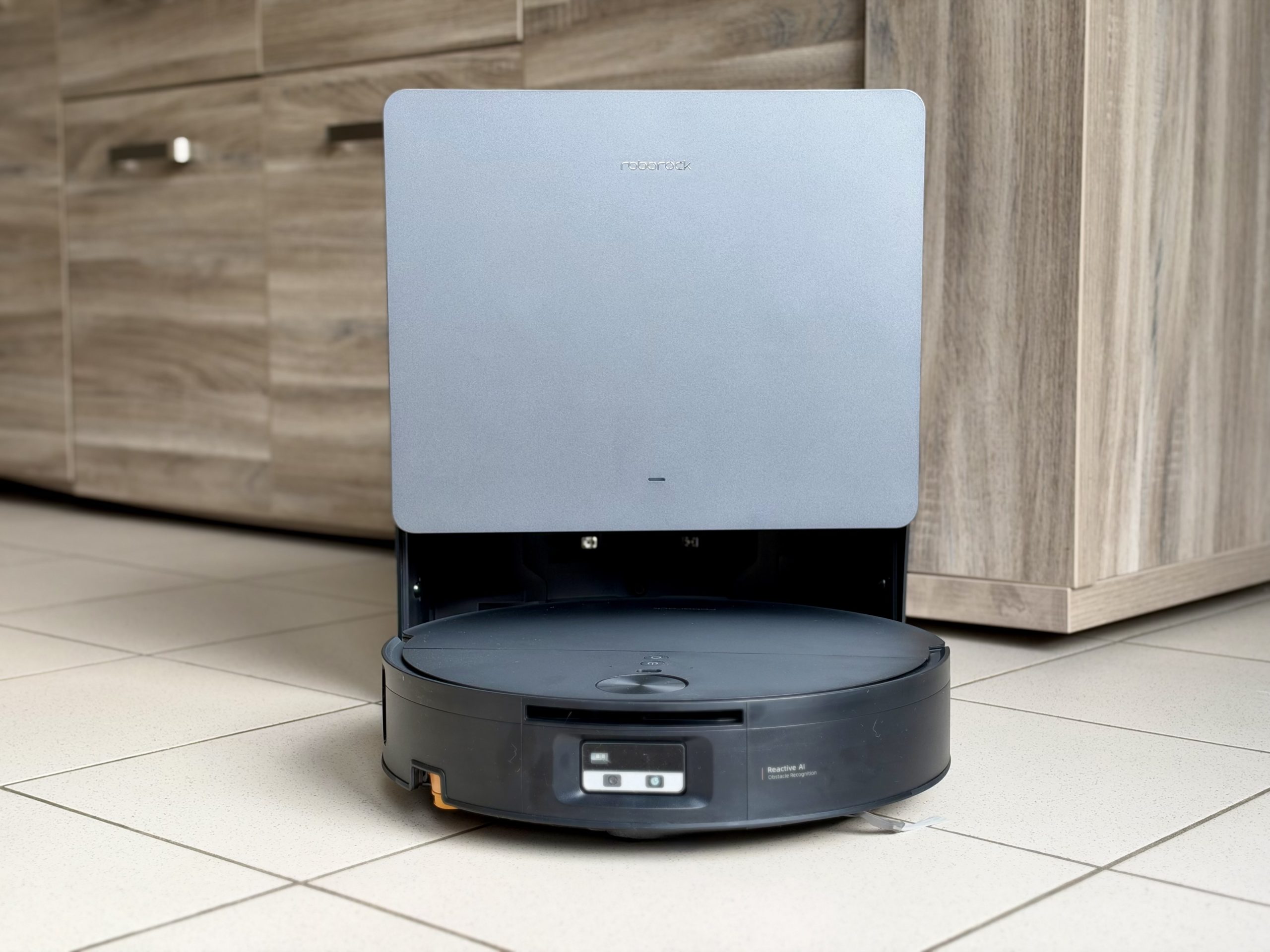
The mop roller is in vogue, and Roborock is riding this trend with the Saros 20 Flow Complete, its new robot vacuum released in recent weeks. We had the opportunity to test it for a week in a 90 m² apartment to see if this novelty lives up to all its promises.
9 / 10
Best Prices
Boulanger
- Lavage au rouleau très efficace, sur tous les types de taches
- Rinse roller, cleaned in hot water
- Aspiration impeccable, sans emmêlement
- Crossing double thresholds
- Full-featured app and Matter compatibility
- Carpet cleaning a bit below expectations
- Some bugs during mapping
- Obstacle detection could be improved
- Roller drying time around 3 h 30
- High price
The point of this device lies in replacing rotating mops with a brush roller. Roborock isn’t new to this approach, having already experimented with it on the Qrevo Curv 2 Flow. The graft seems to have taken enough root to now reach the high end. If, in practice, this new model closely resembles the Saros 20 released earlier this year, there are enough differences to analyze it from every angle and share our opinion with you.
Test conducted on a unit loaned by the manufacturer.
Design and Build: a slightly thicker robot, and a step back
We particularly appreciate Roborock’s vacuum-cleaner designs from an aesthetic standpoint. The Saros 20 Flow Complete follows the rule. The docking station, dressed in a matte black finish, looks great and is cleverly designed. To reduce overall footprint somewhat, Roborock placed the detergent solution reservoir and the dust bag beneath the water tanks, rather than in a dedicated compartment. This saves only about two centimeters in depth and 3 cm in height, and the unit still requires a fair amount of space in the home, but it’s a step in the right direction.
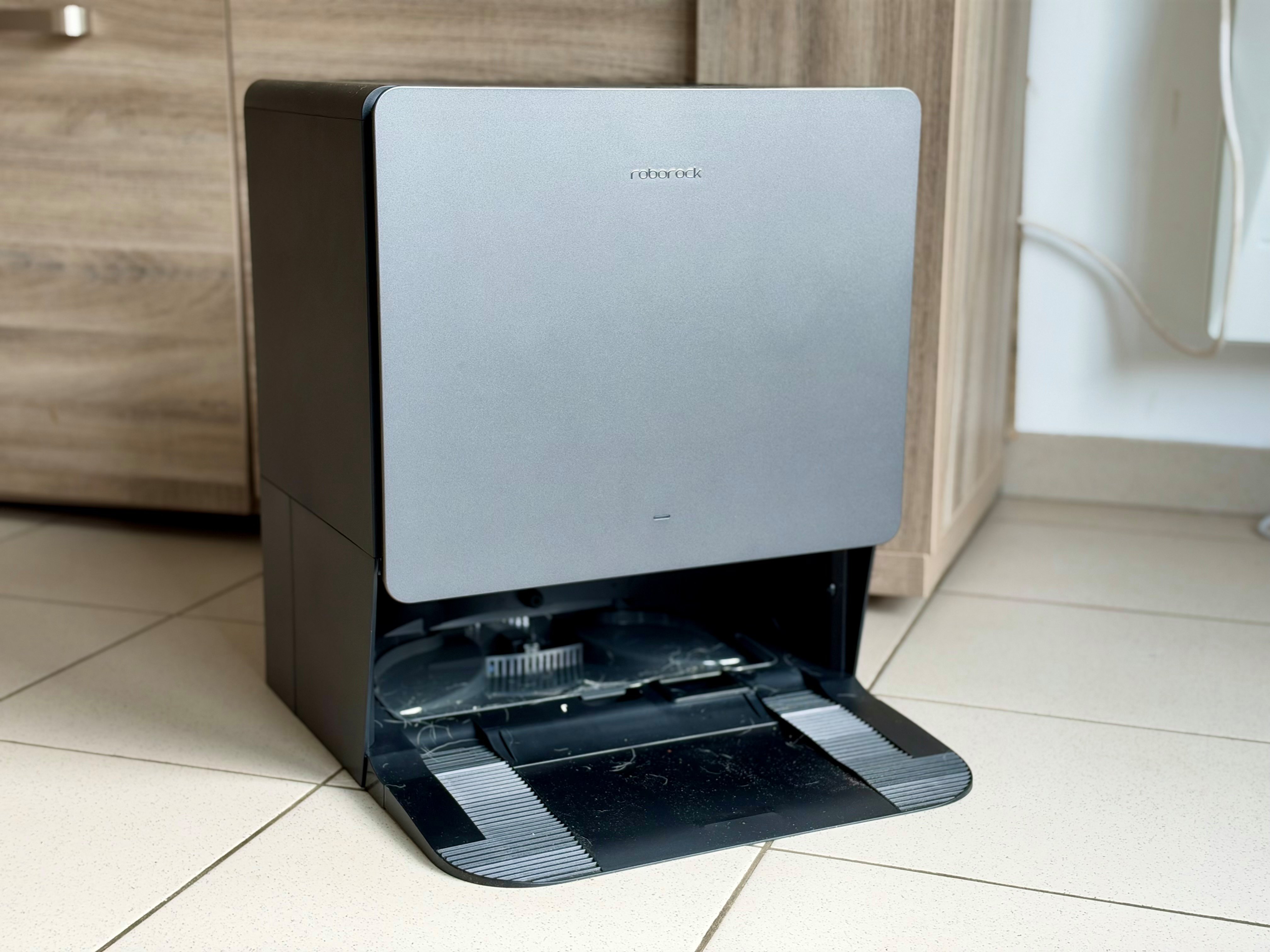
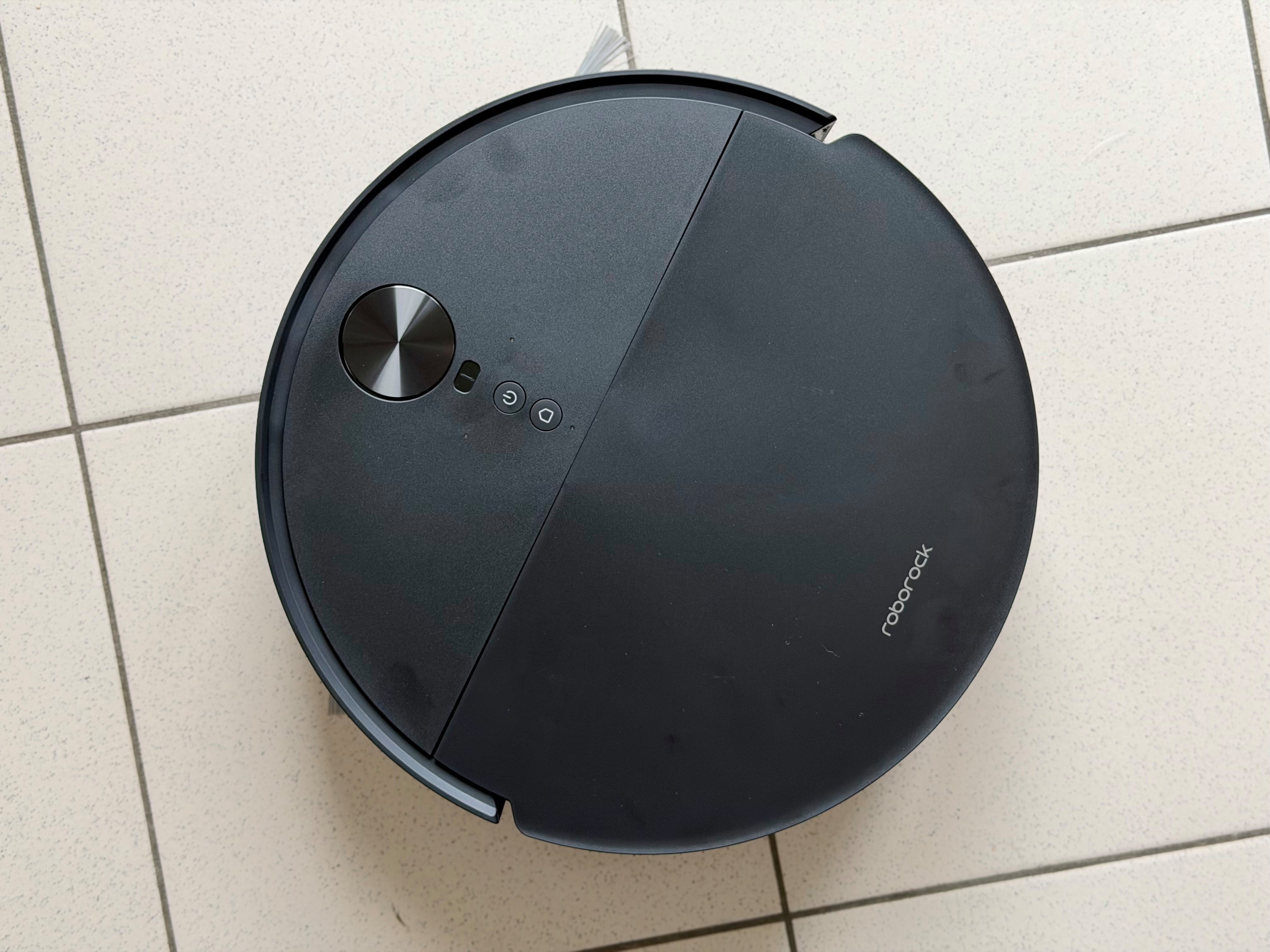
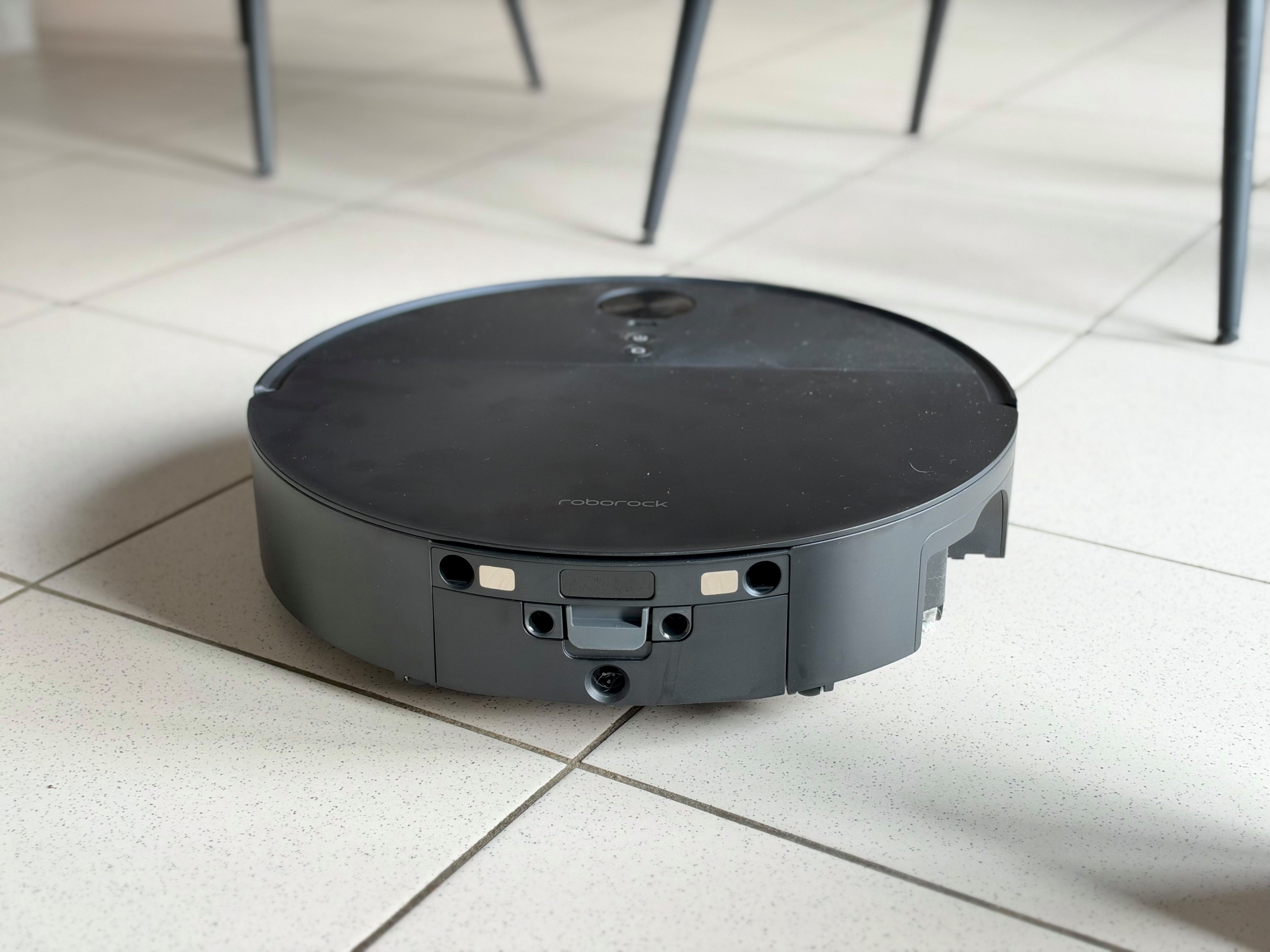
The robot vacuum resembles the Saros 20 in design, but is a touch thicker, by about 1 cm compared to the standard model (8.98 cm vs 7.98 cm). The extra height is likely due to the cleaning roller underneath the unit. With a height of barely 9 cm, the vacuum can still slide under a sofa or low furniture. Another surprise: the retractable LiDAR returns to the device, after having been replaced earlier in the year by a LiDAR integrated inside the body. It retracts automatically as it approaches a low piece of furniture.
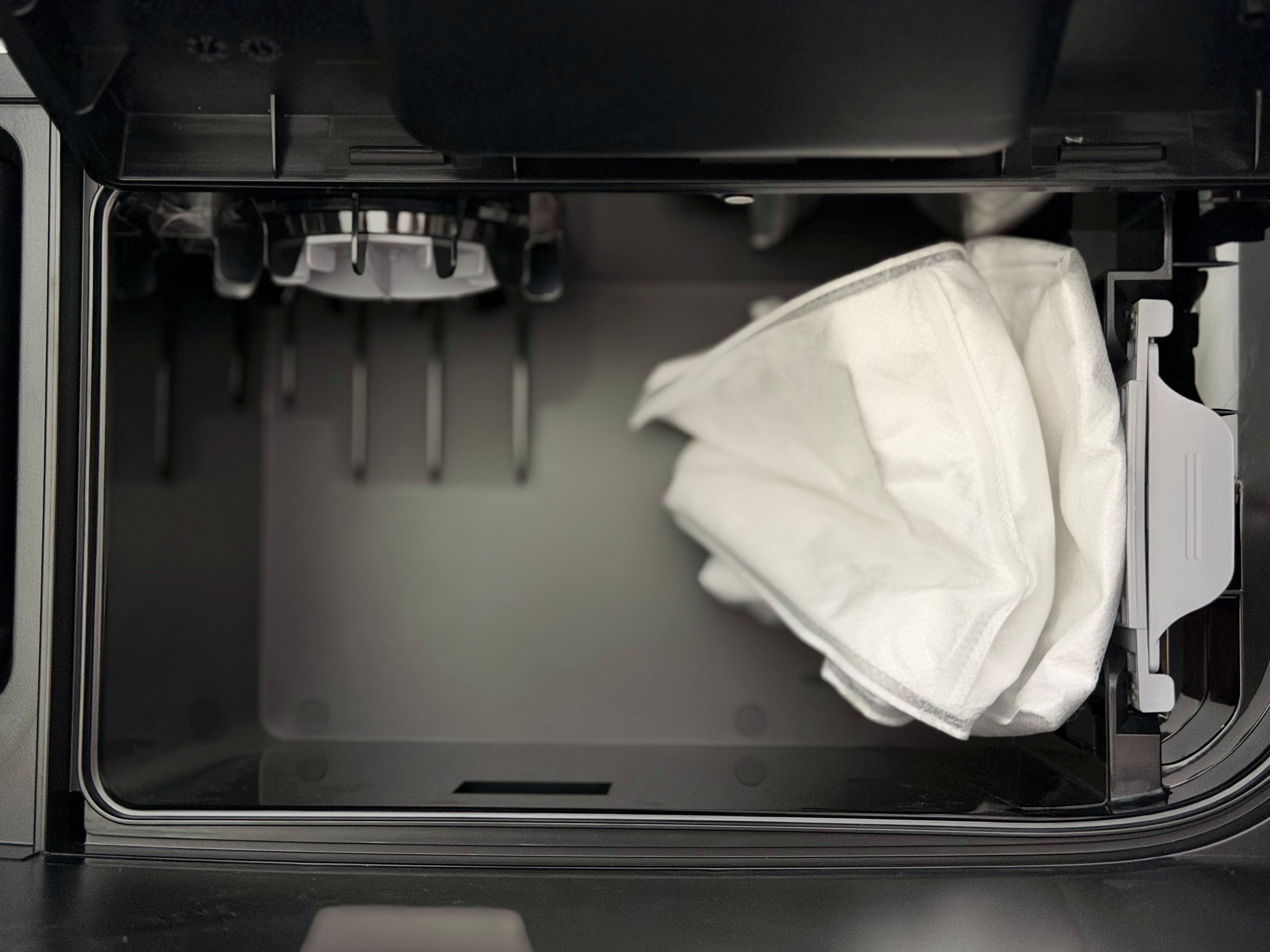
Finally, let’s talk about the kit contents. I found the Saros 20 particularly sparse, with few accessories included. Roborock changes tack here and shows much more generosity with seven dust bags in total, a sample of floor-cleaning solution, two filters, and an extra roller.
Suction: flawless, nearly perfect
The Saros 20 Flow Complete offers the same level of power as the Saros 20 at the start of the year, namely 36,000 Pa. In other words, we are not surprised by the vacuuming performance, which remains excellent.
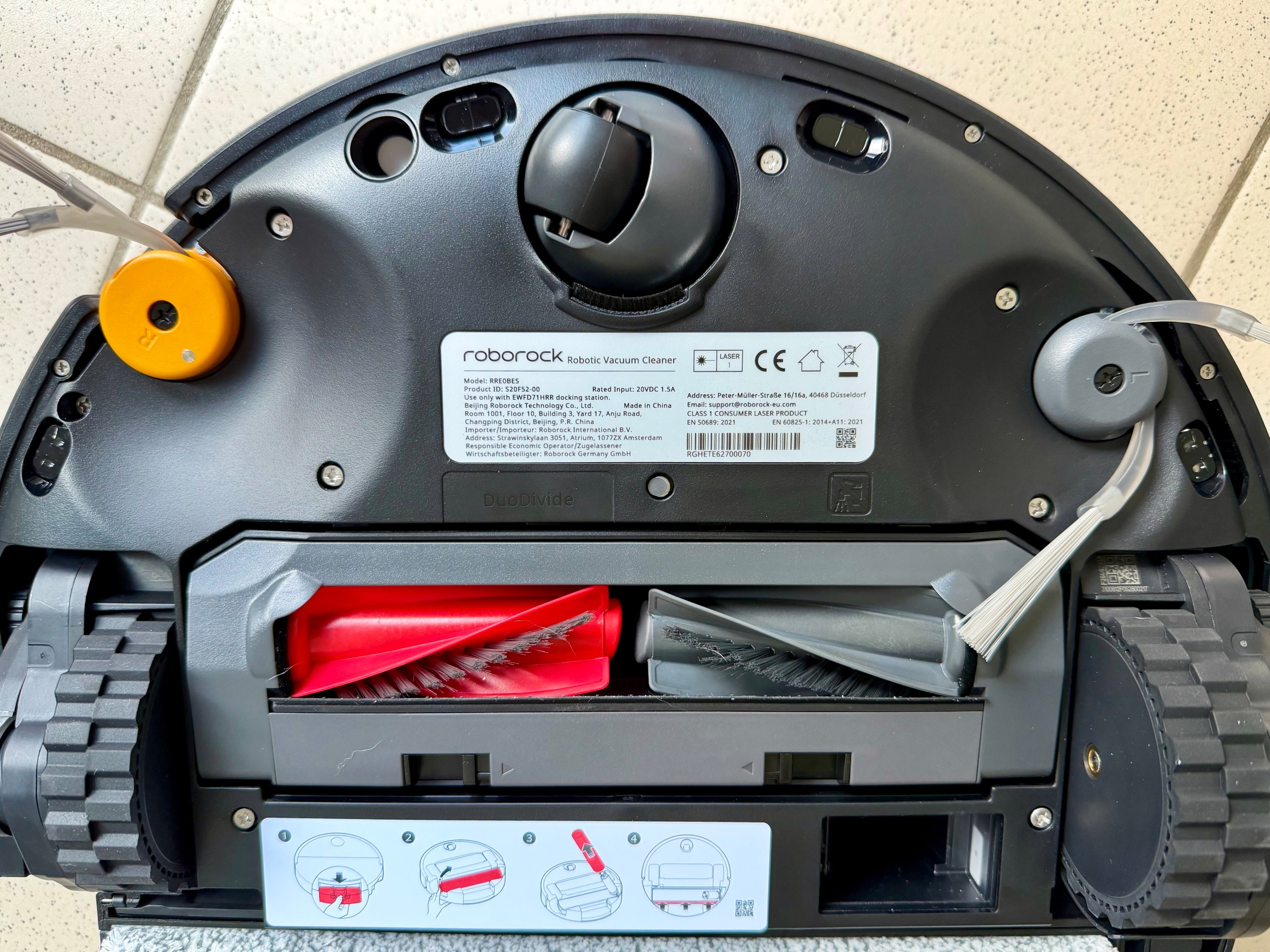
Initial cleanings were performed with SmartPlan, the program using the manufacturer’s AI models to automatically detect dirty zones based on rooms. I have little to add to my previous test. The vacuum delivers impeccable debris recovery. Dust and crumbs are swallowed in a single pass by the DuoDivide dual brush and the two side brushes. With Labrador shedding this autumn, the Saros 20 Flow Complete also captured tufts of hair with ease, without tangling in the brush or the suction duct. After more than a decade of existence, Roborock has this subject down to a science. The Saros 20 Flow Complete is suitable for all user types.
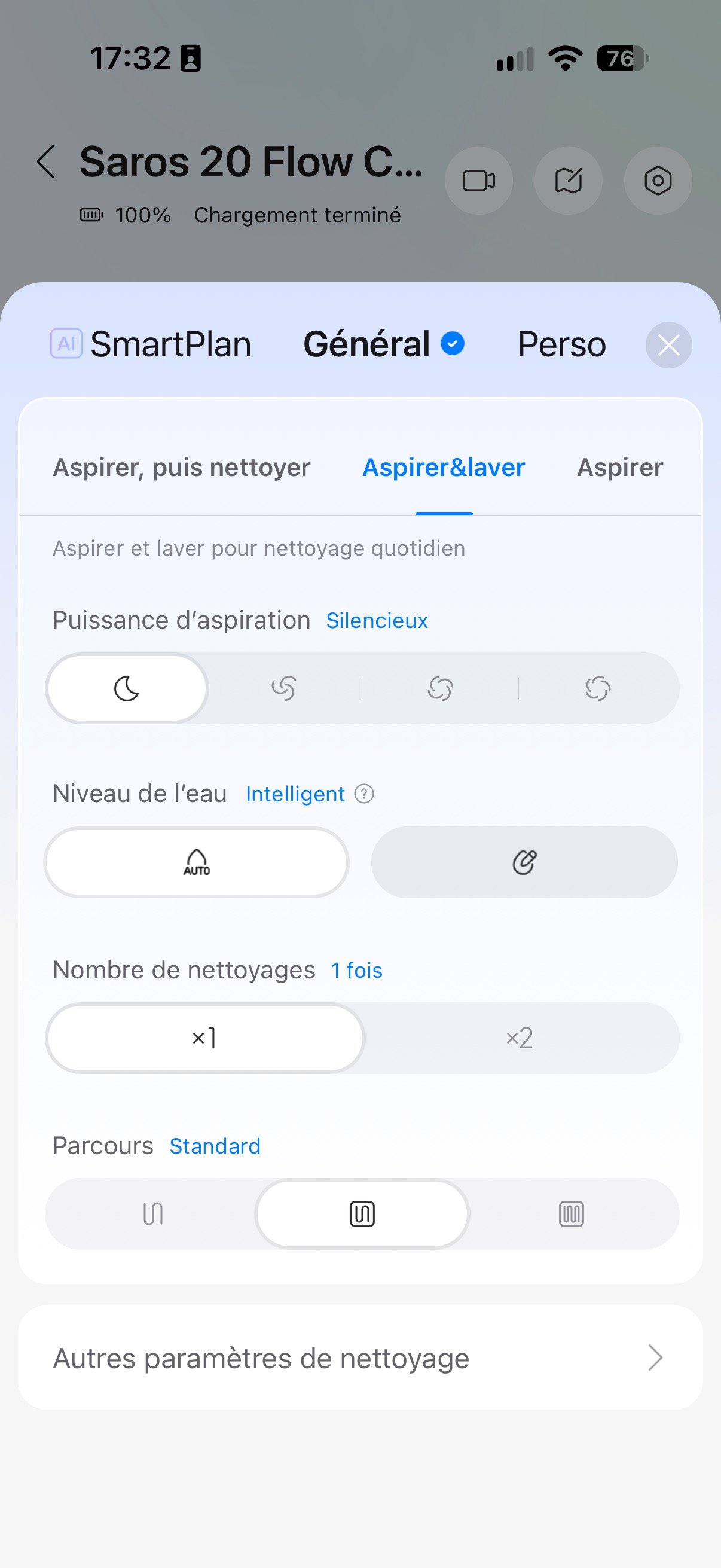
We also tested the different cleaning modes by switching to manual control, offering four suction levels. In Silent mode for daily cleaning, the robot does a solid job with noise not exceeding 52 dB. Conversely, the strongest mode (Max) roars at nearly 65 dB but proves perfect for quickly cleaning a very cluttered area.
Another comparison point: carpet cleaning. As usual, I tested the Saros 20 Flow Complete on a high-pile rug, and again the device performed well. Once the zone is automatically labeled as carpet on the floor map, the vacuum expends real effort, occupying the space for several minutes to intensify cleaning. Most crumbs and debris are picked up in the run; only embedded hair in the carpet fibers remains upon closer inspection. This remains entirely acceptable, especially if you vacuum with a robotic cleaner daily in your home.
Washing floors: finally up to the Saros lineup
Thus, the Saros 20 Flow Complete completes the manufacturer’s range with the introduction of its SpiraFlow 2.0 system—a brush roller placed under the vacuum. This is supposed to offer better stain recovery, similar to dedicated scrubbing vacuums, and it self-cleans during washing through continuous rinsing. Roborock adds that the station fills the robot’s reservoir with warm water after every wash, helping to dissolve dirt more effectively. The Saros 20, which uses a duo of motorized mops, left me puzzled with an cleaning efficiency slightly below what Roborock typically offers. The Saros 20 Flow Complete performs markedly better on everyday stains.
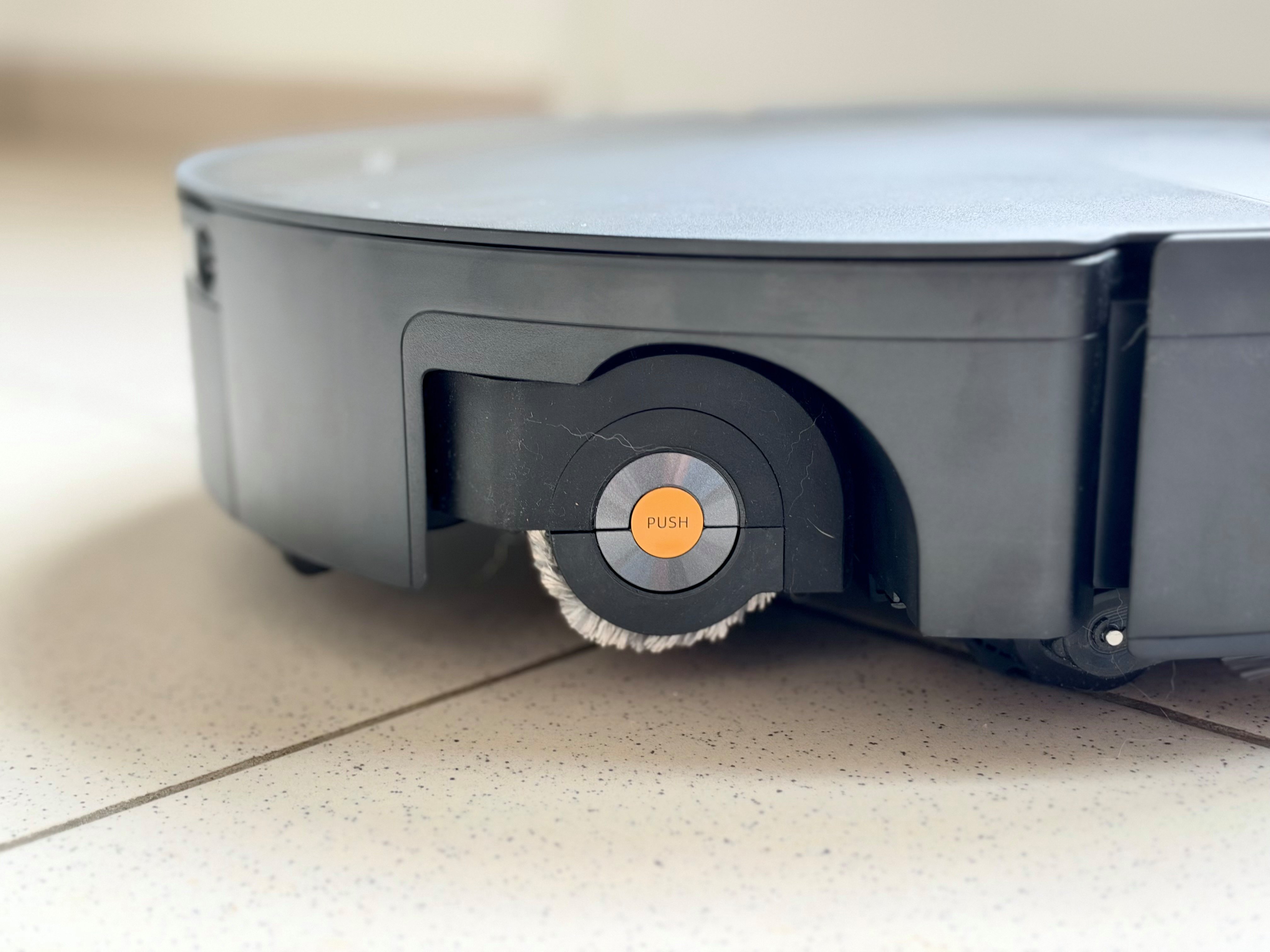
Again, I started my test with SmartPlan and let the vacuum assess the level of dirt in each room to see what it could do. The first pass was highly effective at removing light stains (dirt, footprints). The roller brush leaves few marks on the floor and automatically extends along baseboards to reach as many areas as possible.
Even with soda or sauce traces, generally hard for this type of device to recover, the Saros 20 Flow Complete handles it, earning praise from the jury. The robot identified the trace and passed over it twice to remove most of it. I would be lying if I claimed the job is perfect, but it is enough to recover the bulk of the stain and excellent for daily use. The roller lifts when it passes over a rug. On a long-pile model, the roller may lightly touch, but it does not contaminate further.
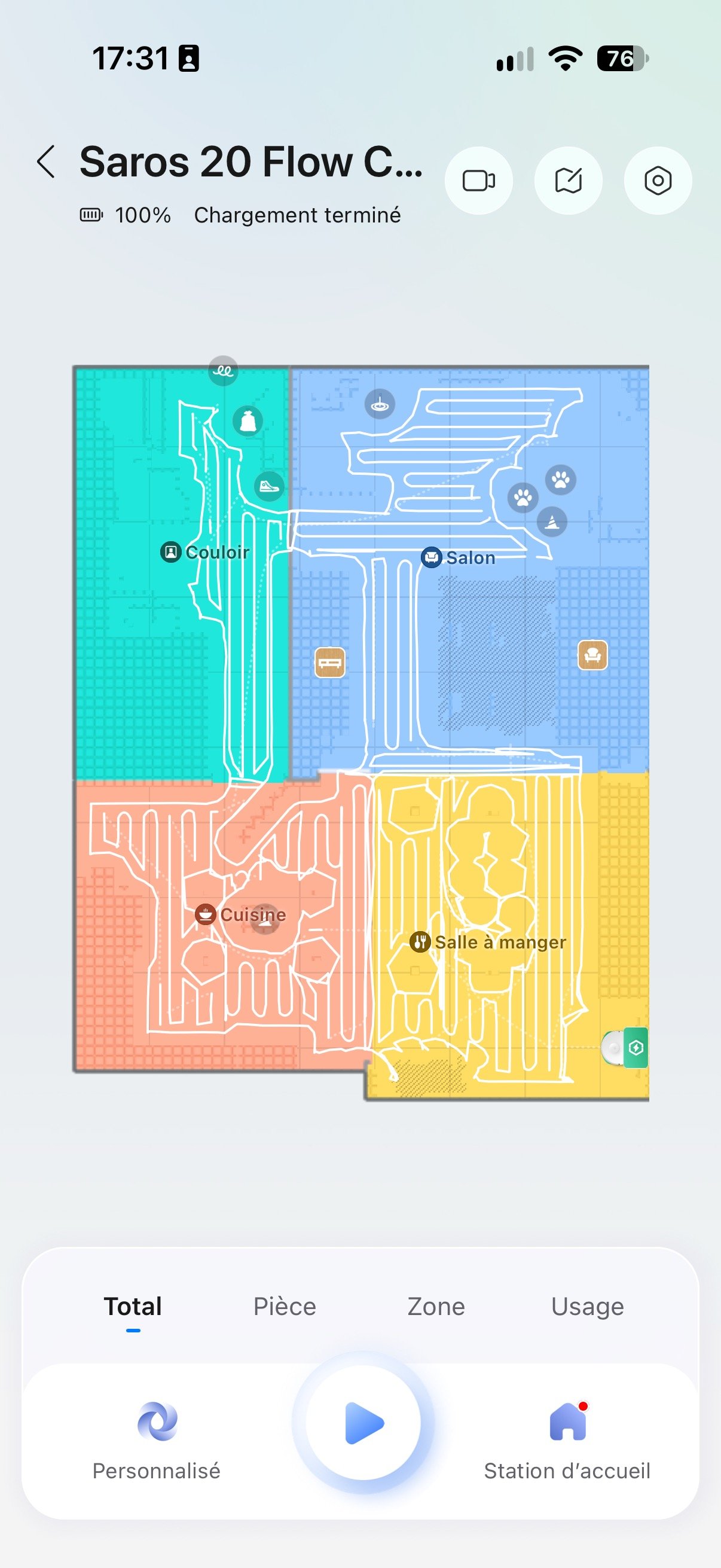
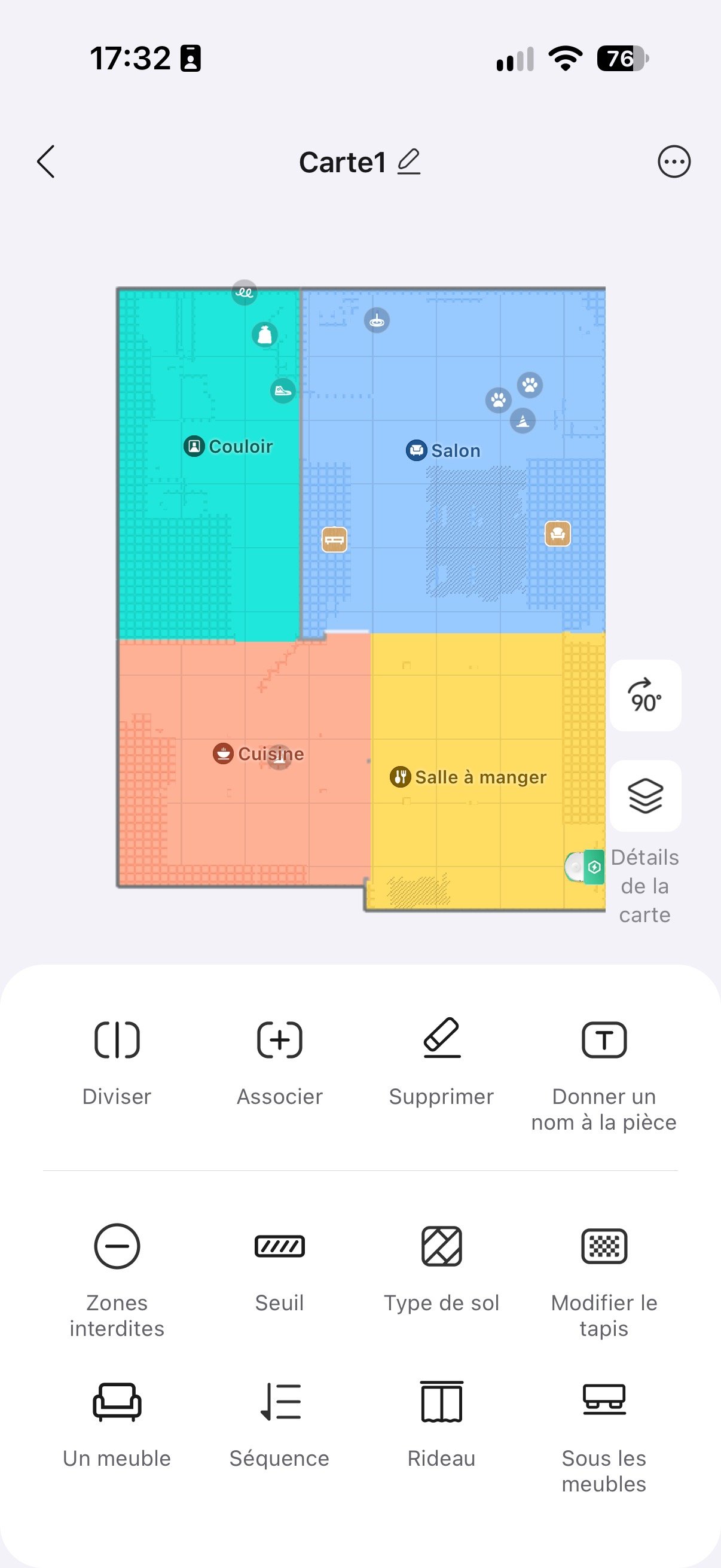
Meanwhile, Roborock’s companion software evolves only modestly, still offering a wealth of options and settings in a well-designed, easy-to-use interface. The software experience remains one of the industry benchmarks. Roborock also offers Matter compatibility, the standard that connects the robot to Apple Home, Google Home, or Amazon Alexa for easy integration into a smart-home ecosystem. Most of the brand’s recent models now support it, which is a positive step.
The chassis, called AdaptiLift Traverse 3.0, is another strong point of the robot. A lifting arm lets it clear double thresholds, up to a total of 8.8 cm according to Roborock: a first step up to 4.5 cm, then a second under 4.3 cm. In my home, crossing a threshold happens without hesitation for the robot.
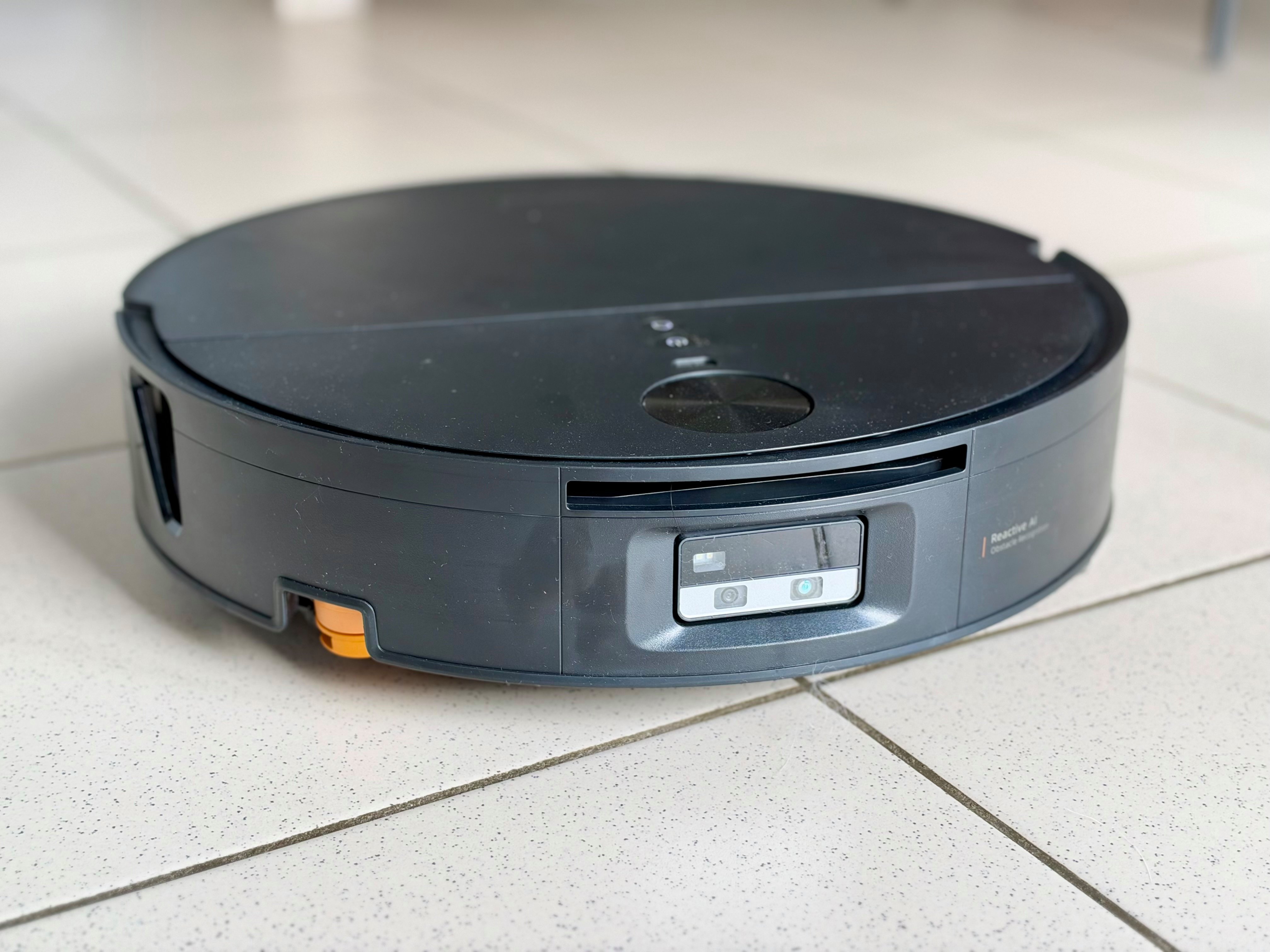
As for navigation in the home, the Saros 20 Flow Complete combines three sources: a retractable LiDAR (a laser sensor that scans the room), a color RGB camera, and the VertiBeam structured light, which widens the lateral field of view to detect walls, thresholds, and low obstacles. It recognizes around 300 object types according to the manufacturer. Most of the time, the robot carefully avoids pairs of slippers or other items left on the floor, as well as cables. It can still misread and miss a small foam cluster or a large tuft of hair, regarded as objects rather than debris.
Autonomy and Maintenance: 3 h 30 with a dry roller
The Roborock Saros 20 Flow is powered by a 6,400 mAh battery, a fairly standard capacity in the world of robot vacuums. During my test, the model took about 1 hour 30 minutes to complete a ground-floor wash, with a return to the dock after each room cleaning to refill water and wash the mop roller. It is possible to save a few minutes by prioritizing a clean after a certain number of square meters covered.
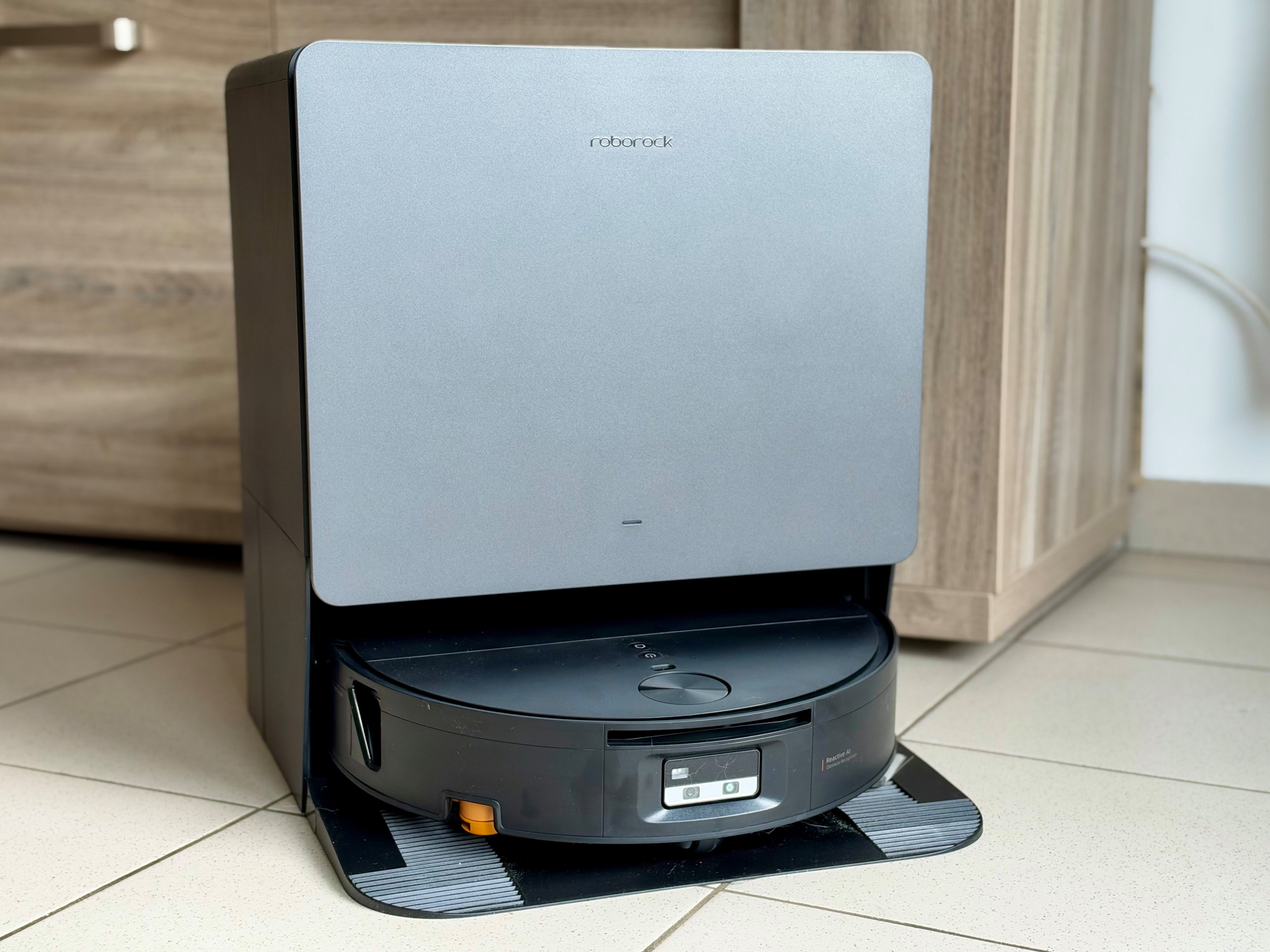
The unit also features rapid charging, enabling a 0–100% charge in roughly three hours; Roborock states a full recharge time of 150 minutes. The smart charging goes a step further: you can defer full charging or schedule it during off-peak electricity hours, saving a few euros in the process.
In terms of maintenance, the station does most of the work, and quite well. Emptying the dust bin into the base’s bag leaves no notable residue after cycles. The system has proven reliable, with no hiccups. The robot’s top plate detaches easily to give access to parts that need manual cleaning.
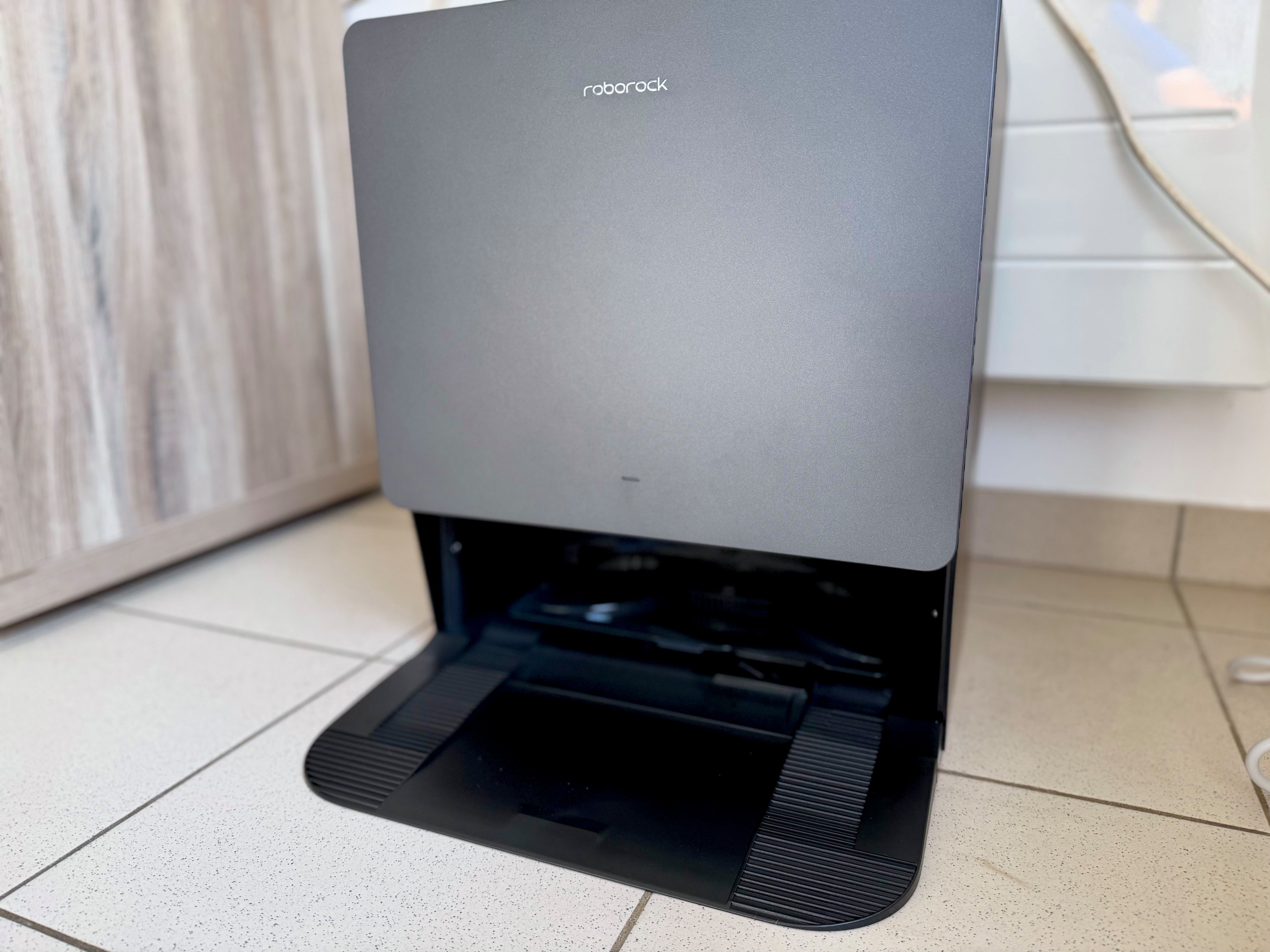
The roller, for its part, is treated to special care. During washing, it is continuously rinsed. Once back on the station, it undergoes hot-water washing, up to 100 °C according to Roborock, with automatic detergent dosing. This temperature has already been seen with the Saros 20, but now applied to a roller. The manufacturer notes that the station monitors dirt levels during operation and adjusts the washing duration accordingly. The result is clear: the self-cleaning performance is excellent, and even after several washing sessions, very few residues remain on the roller.
The drying stage, however, is the longest chapter. Roborock claims warm air reaching up to 63 °C, compared to 55 °C on the Saros 20. A hotter air, therefore, but a program that lasts about 3 h 30 in my test, more than double the robot’s operating time. That’s the price of a roller denser and more saturated with water than a mere pair of mops. Yet it comes out perfectly dry at the end of the cycle.
Roborock Saros 20 Flow Complete: Clubic’s Verdict
Roller holds its promise. While the Saros 20 was puzzling with its mops, the Saros 20 Flow Complete wipes away dirt, footprints, and other ingrained stains, then cleans its roller automatically with hot water. The washing, once a weak link of the Saros 20, becomes the robot’s strength here.
The rest, as we already knew, remains excellent. Suction is flawless, even when dealing with a Labrador’s shed, with a long-pile rug as the only caveat. The power has not budged from Roborock’s 36,000 Pa on the Saros 20; progress is now happening elsewhere, beneath the robot.
Elsewhere, there is still work to do, and it is no longer in the dust. The mapping invents rooms, some obstacles still escape the camera, and the app requires a few tweaks before we can leave the robot on its own. Floor coverage is gained, but the battleground of intelligence has only just begun. The Saros 20 Flow Complete is an excellent vacuum that cleans flawlessly but still requires some watching. That’s the flip side: when the floor is pristine, the small missteps become a bit more noticeable.
- Lavage au rouleau très efficace, sur tous les types de taches
- Rinse roller, continuously cleaned in hot water
- Aspiration impeccable, sans emmêlement
- Franchissement des doubles seuils
- Application très complète et compatibilité Matter
- Carpet cleaning a little below expectations
- Some bugs during mapping
- Obstacle detection could be improved
- Roller drying time of about 3 h 30
- Tariff élevé
The advantage of this device is the replacement of rotating mops with a brush roller. Roborock isn’t new to this approach, having already experimented with it on the Qrevo Curv 2 Flow. The graft seems to have taken hold enough to now reach the high end. If in practice this new model resembles the Saros 20 released earlier this year, there are enough differences to examine it from every angle and share our verdict with you.
Test performed on a unit loaned by the manufacturer.
Design and Build: A slightly thicker robot, and a step back
We particularly love Roborock vacuum cleaners from an aesthetic standpoint. The Saros 20 Flow Complete does not break from this rule. The docking station, clad in a matte black finish, looks striking and is cleverly designed. To reduce footprint somewhat, Roborock placed the detergent reservoir and the dust bag beneath the water tanks, rather than in a dedicated compartment. This only saves about two centimeters in depth and 3 cm in height, and the device still requires a fair amount of space in the home, but it’s a step in the right direction.
The robot vacuum closely resembles the Saros 20, but it is a touch thicker by about 1 cm (8.98 cm vs 7.98 cm). The extra height is likely due to the cleaning roller beneath the unit. With a height just under 9 cm, the vacuum can still slide under a sofa or low furniture. Another surprise: the retractable LiDAR has returned to the device, after having been removed earlier in the year in favor of a LiDAR integrated into the body. It retracts automatically as it approaches a low piece of furniture.
Talking finally about the kit contents. I found the Saros 20 particularly sparse, with few accessories included. Roborock changes strategy here and shows much greater generosity with seven dust bags in total, a sample of floor-cleaning solution, two filters, and an extra roller.
Suction: flawless, almost perfect
The Saros 20 Flow Complete delivers the same power level as the Saros 20 at launch, namely 36,000 Pa. In other words, we aren’t surprised by the vacuuming performance, which remains equally excellent.
The initial cleanings were performed using SmartPlan, the program that uses the manufacturer’s AI models to automatically identify dirty areas based on rooms. I don’t have much to add to my previous test. The vacuum offers impeccable debris recovery. Dust and crumbs are swallowed in a single pass by the DuoDivide double brush and the two side brushes. With the autumn shed, the Saros 20 Flow Complete also faced the Labrador moulting, and tufts of hair were just as easily retrieved, without tangling in the brush and suction duct. After more than a decade of existence, Roborock has mastered its craft. The Saros 20 Flow Complete is suitable for all types of users.
We also tested the various cleaning modes by switching to manual control, offering four suction levels. In Silent mode for daily cleaning, the robot does the job properly with noise not exceeding 52 dB. Conversely, the strongest mode (Max) makes the motor roar at nearly 65 dB but proves perfect for quickly cleaning a very cluttered area.
Another comparison point: carpet cleaning. As usual, I tested the Saros 20 Flow Complete on a long-pile rug, and again the device satisfied me. Once the area is automatically marked as carpet on the floor map, the robot puts in real effort, occupying the space for several minutes for a more intensive clean. Most crumbs and debris are picked up in the run; only embedded hairs remain upon closer inspection. This remains entirely acceptable, especially if you vacuum with a robot on a daily basis in your home.
Washing Floors: Finally on par with the Saros lineup
The Saros 20 Flow Complete thus broadens the manufacturer’s range with the introduction of its SpiraFlow 2.0 system, a brush roller placed beneath the vacuum. This is intended to offer better stain recovery similar to washing vacuums, and it self-cleans during the washing process thanks to continuous rinsing. Roborock adds that the station fills the robot’s water tank with warm water after each wash, helping to dissolve grime more effectively. The Saros 20, which uses a pair of motorized mops, had left me puzzled with its cleaning efficiency slightly lower than Roborock’s usual standard. The Saros 20 Flow Complete performs markedly better on everyday stains.
Once again, I started my test with SmartPlan and let the vacuum assess the dirt level in each room to see what it could do. The first pass was highly effective at removing light stains (dirt, footprints). The roller brush leaves very few marks and automatically extends along baseboards to reach the maximum number of areas.
Even on soda or sauce traces, typically difficult for this type of device to recover, the Saros 20 Flow Complete handles them well, earning the jury’s praise. The robot identified the trace and passed over it twice to remove the majority. I would not claim perfection, but it is sufficient to remove the bulk, and excellent for daily floor maintenance. The roller lifts when passing over a carpet. On a high-pile model, the roller may lightly touch but without causing further soiling.
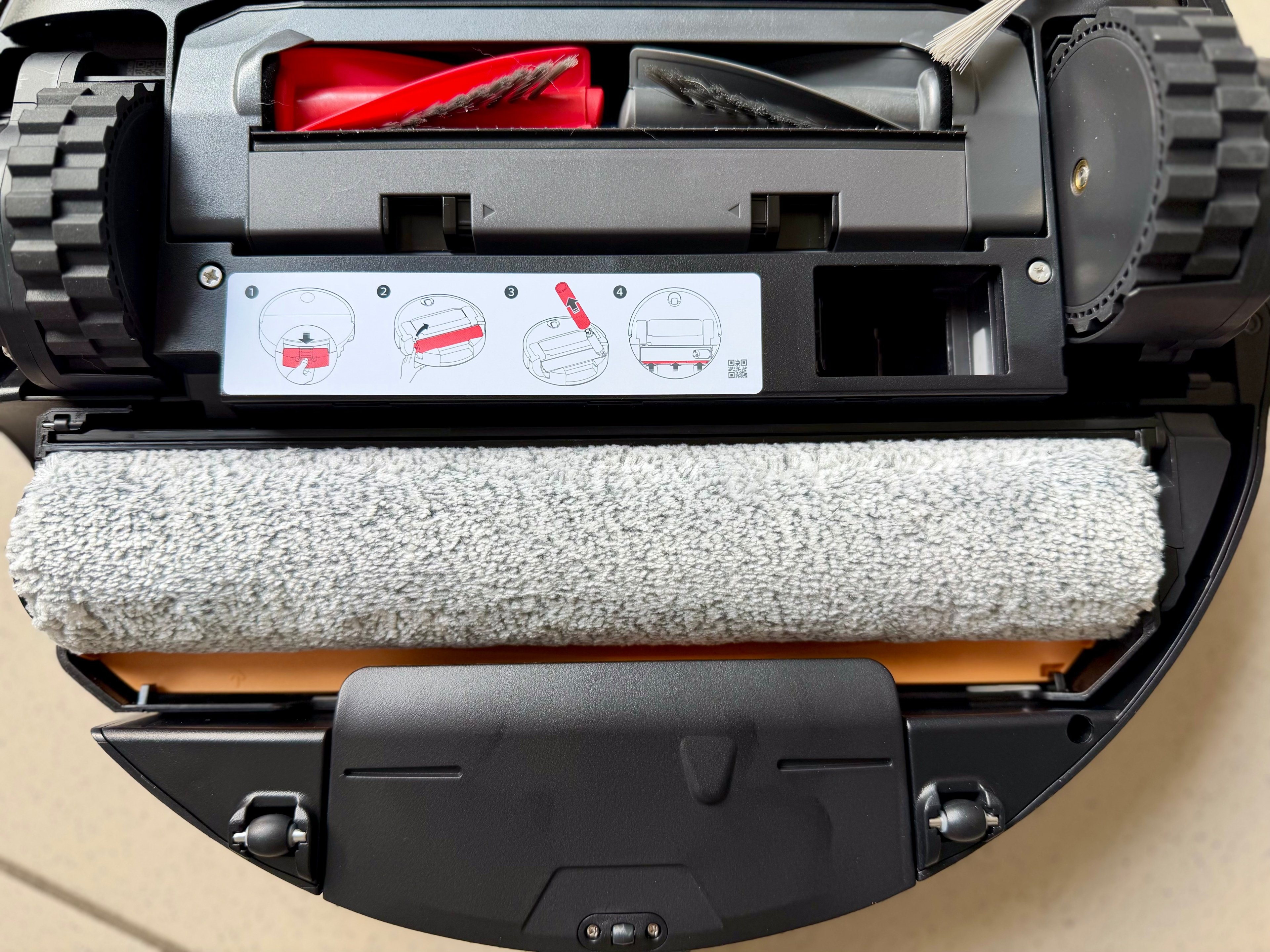
As with suction, you can disable the automatic mode to adjust the water flow to the brush; automatic adjustment should be enabled manually in the app. You can also change the navigation mode to a more precise, longer passage, since the vacuum will pass over the same area multiple times to lift stains and debris from the floor. Reserve this for very dirty floors; in most cases, SmartPlan should be sufficient.
Navigation and Software: a Benchmark, With a Few Rare Lapses
The Saros 20 posed no mapping issues, and the Saros 20 Flow builds on the same basis. The initial mapping is fast (about 10 minutes), but the automatic arrangement of rooms isn’t ideal. Without doors or actual boundaries, the vacuum works with what it has, and added zones in a somewhat random manner required some adjustments in the mobile app. The map editing tool offers all the expected options to merge, split, or rename rooms, and to add furniture, which I strongly recommend.
During this, Roborock’s accompanying software remains only marginally evolved, still offering a wealth of options and settings within a well-thought-out and easy-to-use interface. The software experience remains one of the industry benchmarks. Roborock also provides Matter compatibility, the standard linking the robot to Apple HomeKit, Google Home, or Amazon Alexa for easy integration into a smart-home ecosystem. Most of the brand’s recent models now support it, which is a step in the right direction.
The frame, the AdaptiLift Traverse 3.0, is another asset of the robot. A lifting arm lets it clear double thresholds, up to a total of 8.8 cm according to Roborock: a first step up to 4.5 cm, then a second under 4.3 cm. In my place, crossing a threshold happens without hesitation for the robot.
As for navigation around the home, the Saros 20 Flow Complete combines three sources: a retractable LiDAR (a laser sensor that scans the room), an RGB color camera, and the VertiBeam structured light, which widens the side view to detect walls, thresholds, and low obstacles. It recognizes about 300 object types according to the manufacturer. Most of the time, the robot carefully avoids slippers or other items left on the floor, as well as cables. It can still misread and miss a small foam patch or a large tuft of hair, treated as objects rather than debris.
Autonomy and Maintenance: 3 h 30 for a dry roller
The Roborock Saros 20 Flow is equipped with a 6,400 mAh battery, a fairly standard capacity in the world of robotic vacuums. During my test, the model took about 1 hour 30 minutes to complete a ground-floor wash, returning to the dock after each room cleaning to refill water and rinse the mop. It’s possible to shave a few minutes by prioritizing cleaning after a certain number of square meters covered.
The roller, meanwhile, enjoys special handling. During washing, it is continuously rinsed. Once back on the station, it undergoes hot-water washing, up to 100 °C according to Roborock, with automatic detergent dosing. A temperature already seen on the Saros 20, but now applied to a roller. The manufacturer notes that the station monitors the dirt level during operation and adjusts washing time accordingly. The result is clear: the roller’s self-cleaning efficiency is excellent, and even after multiple wash cycles, very few residues remain visible on the roller.
Remaining is the drying phase, and it is the longest chapter. Roborock reports warm air up to 63 °C, versus 55 °C on the Saros 20. A hotter air, thus, but a program that runs about 3 h 30 in my test, more than double the robot’s working time. That’s the price of a roller denser and more saturated with water than a couple of mops. Yet it emerges perfectly dry at the end of the cycle.
Roborock Saros 20 Flow Complete: Clubic’s Verdict
9
9
9
8
9
9
8
Boulanger
Specification Roborock Saros 20 Flow Complete
Résumé
| Type of robot | Robot vacuum cleaner with mop |
| Dust bin capacity | 2.7 l |
| Water tank capacity | 4 l |
| Brush type | Nylon, Rubber, Hair |
| Docking base | Yes |
| Autonomy | 180 min |
| Navigation technology | Laser, Camera |
| Mapping | Yes |
| IA-assisted cleaning | Yes |
| Obstacle detection | Yes |
| Climbs thresholds | No |
| With articulated arm | No |
Naviagation
| Navigation technology | Laser, Camera |
| Mapping | Yes |
| IA-assisted cleaning | Yes |
| Obstacle detection | Yes |
| Void detector | Yes |
| Climbs thresholds | No |
| Virtual walls | Yes |
| Programmable | Yes |
| With articulated arm | No |
| Traversal modes | S-shaped, Random |
Connectivité
| Wi‑Fi | Yes |
| Bluetooth | Yes |
| Compatible environments | Apple HomeKit, Google Home, Amazon Alexa |
| Voice assistant | Google Assistant, Alexa, Siri |
Navigation
| Navigation technology | Laser, Camera |
| Mapping | Yes |
| IA-assisted cleaning | Yes |
| Obstacle detection | Yes |
| Void detector | Yes |
| Climbs thresholds | No |
| Virtual walls | Yes |
| Programmable | Yes |
| With articulated arm | No |
| Route modes | S-shaped, Random |
Connectivité
| Wi‑Fi | Yes |
| Bluetooth | Yes |
| Software environments supported | Apple HomeKit, Google Home, Amazon Alexa |
| Voice assistant | Google Assistant, Alexa, Siri |
What are the best robot vacuums in 2026? Tests and comparison

Daniel Brooks
I cover everyday products with a practical eye, from kitchen tools and home essentials to smart gadgets and consumer trends. My goal is to help readers understand what is genuinely useful, what is worth the price, and what deserves a second look before buying.