
Spotify Review 2026: The Leader in Music Streaming
Can Spotify still be considered the benchmark for music streaming in 2026? The Swedish platform remains at the top of the market, with more than 300 million Premium subscribers worldwide. It must, however, face competition that has substantially advanced in audio quality and features. Between personalization, catalog richness, ease of use, new features, and AI, here is our comprehensive take on the world’s most popular music streaming service.

Spotify
9 / 10
Try Spotify now!
The Pros
- Many subscription options to fit different needs
- A content personalization that saves the day
- A fast, efficient interface and UX
- An unmatched cross-device experience right now
The Cons
- Your sound quality lags behind the competition
- A restrictive free plan
- A slightly less extensive catalog than other players (Amazon Music, Apple Music, Deezer)
For several years now, most music streaming services have offered roughly the same pricing. The real differentiators are the catalog, features, interface, and audio quality.
Lately, Spotify has had to contend with increasingly aggressive competition in several areas. The platform has managed to close part of its gap, notably with the arrival of lossless sound, long requested by users.
It continues to evolve its interface and discovery tools, with new features rolled out regularly. Nevertheless, Spotify maintains a particularly coherent experience across devices and remains indispensable for many users.

Spotify: Key points to remember
- Spotify remains the leader in music streaming with 777 million monthly active users, including 300 million Premium subscribers (Q2 2026 figures).
- The free ad-supported tier is still available. For Premium, expect €12.14 per month for Individual, €17.20 for Duo, €21.24 for Family, and €7.07 for Students, with a one-month free trial for new subscribers.
- Lossless is finally here: Premium subscribers gain access to FLAC up to 24-bit/44.1 kHz. It’s a real advancement, even if Apple Music goes further with 24-bit/192 kHz.
- The emphasis is on personalization: Daily Mix, Discover Weekly, Release Radar and AI DJ are major strengths, available on computer, mobile, web, TV and many connected devices.
- An AI that’s increasingly present, but regulated: on-demand playlists, personalized podcasts and the new “AI Persona” badge for virtual artists are among the features, but several of these functions are not yet available in France.
Who is Spotify?
Spotify is one of the leading players in music streaming: launched nearly twenty years ago, this Swedish service helped popularize this mode of listening and still maintains a significant lead in subscriber numbers. It faces tough competition from Apple Music, YouTube Music, Deezer, and others.
Created in 2006 in Sweden by Daniel Ek and Martin Lorentzon, and publicly launched in October 2008 in several European countries, Spotify quickly grew and became a flagship of the new wave of streaming platforms. By September 2010, the service had surpassed 10 million users. Since then, its growth has accelerated with international expansion and the addition of new content, such as podcasts and audiobooks.
In Q2 2026, Spotify claims 777 million monthly active users worldwide, including 300 million Premium subscribers. The service operates in 184 markets and offers more than 100 million tracks, plus several million podcasts and over 600,000 audiobooks.
What are the latest updates for Spotify?
In recent weeks, Spotify has not altered its pricing or audio quality, but the service isn’t resting on its laurels.
The platform is tackling the issue of virtual artists. Announced in August, an “AI Persona” badge will appear from mid-September on profiles whose identity is based on generative AI. It will be visible on the artist’s page, in search results, and in playlists. These profiles will also be excluded from default recommendations. The badge concerns the artist’s identity, not how the music is produced.
On the features side, the end of September brought two novelties. Muse, Meta’s personal assistant, can command Spotify by voice once the account is linked. The Taste Profile screen, accessible from the profile photo, shows how Spotify interprets your tastes and allows you to correct them to steer the homepage. For now, it’s limited to Premium subscribers in the United States and New Zealand.
For bad news, the service experienced an outage on September 29. The app was unusable for several hours.
Offers
The leader in musical streaming
As a musical streaming service, Spotify lets you listen to tracks, but also podcasts and audiobooks depending on the market. The platform offers a free ad-supported tier and a Premium plan that includes ad-free listening, offline downloads, and access to Lossless audio.
Spotify claims a catalog of more than 100 million tracks, searchable by artist, album, or track, and across various genres and moods. Yet a key strength remains the personalization of the experience. Spotify relies on user listening habits to suggest recommendations and personalized playlists, helping users rediscover favorites and discover new music.
Spotify also now offers video access: some clips are visible on the platform. For podcasts, Spotify hosts a large selection in many languages and competes well with rivals in this domain.
Interfaces and accessibility
Desktop App
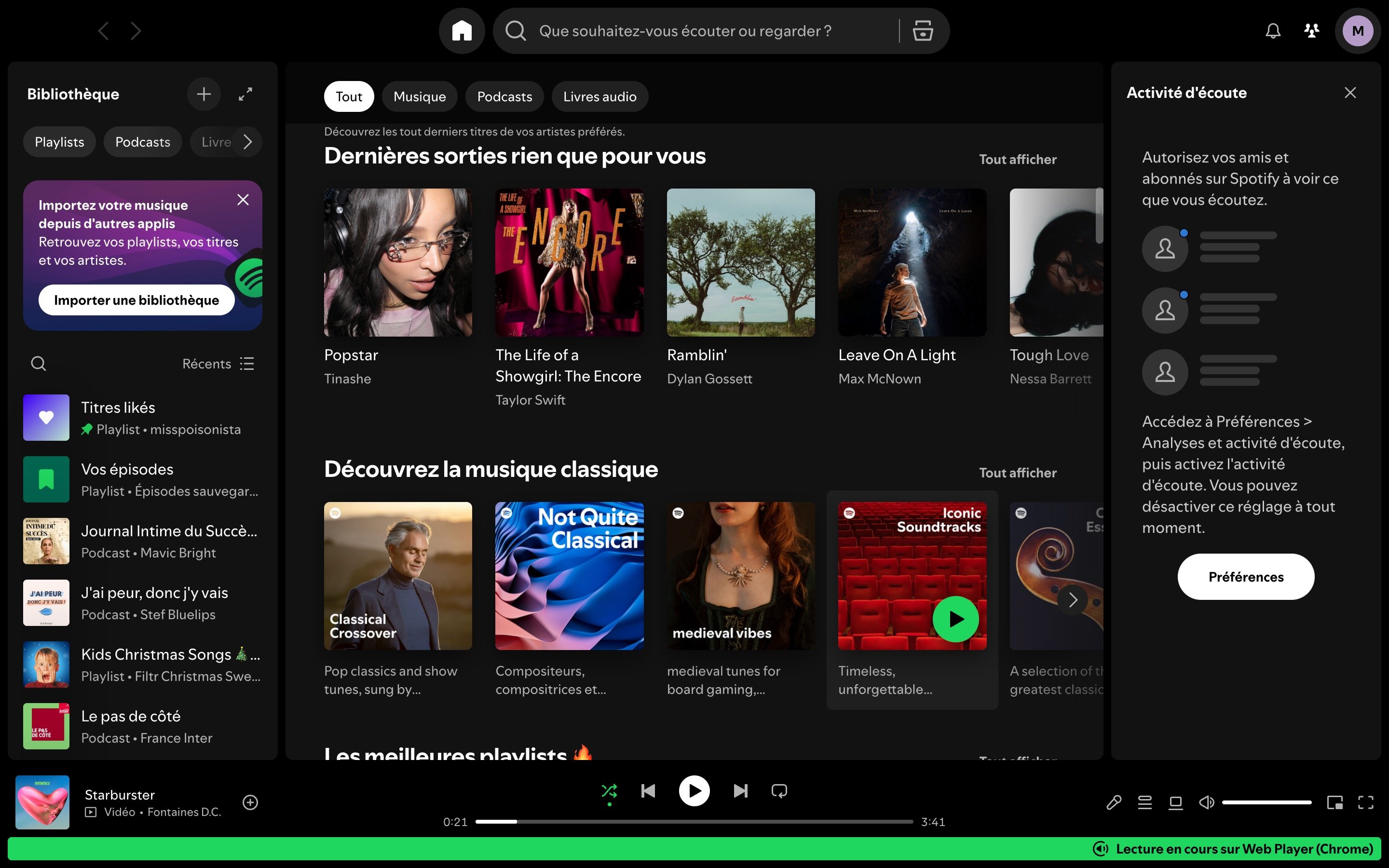
The Desktop app offers a very complete experience. In addition to direct access to all playlists, podcasts and favorite songs, the platform includes a social feature. On the right side of the screen, each user can see what friends are listening to in real time.
Interface-wise, the Desktop app mirrors the web layout. It can display social elements (what friends are listening to?) or a selection of information about the artist currently playing (concerts, merchandise, bio, and songs to follow).
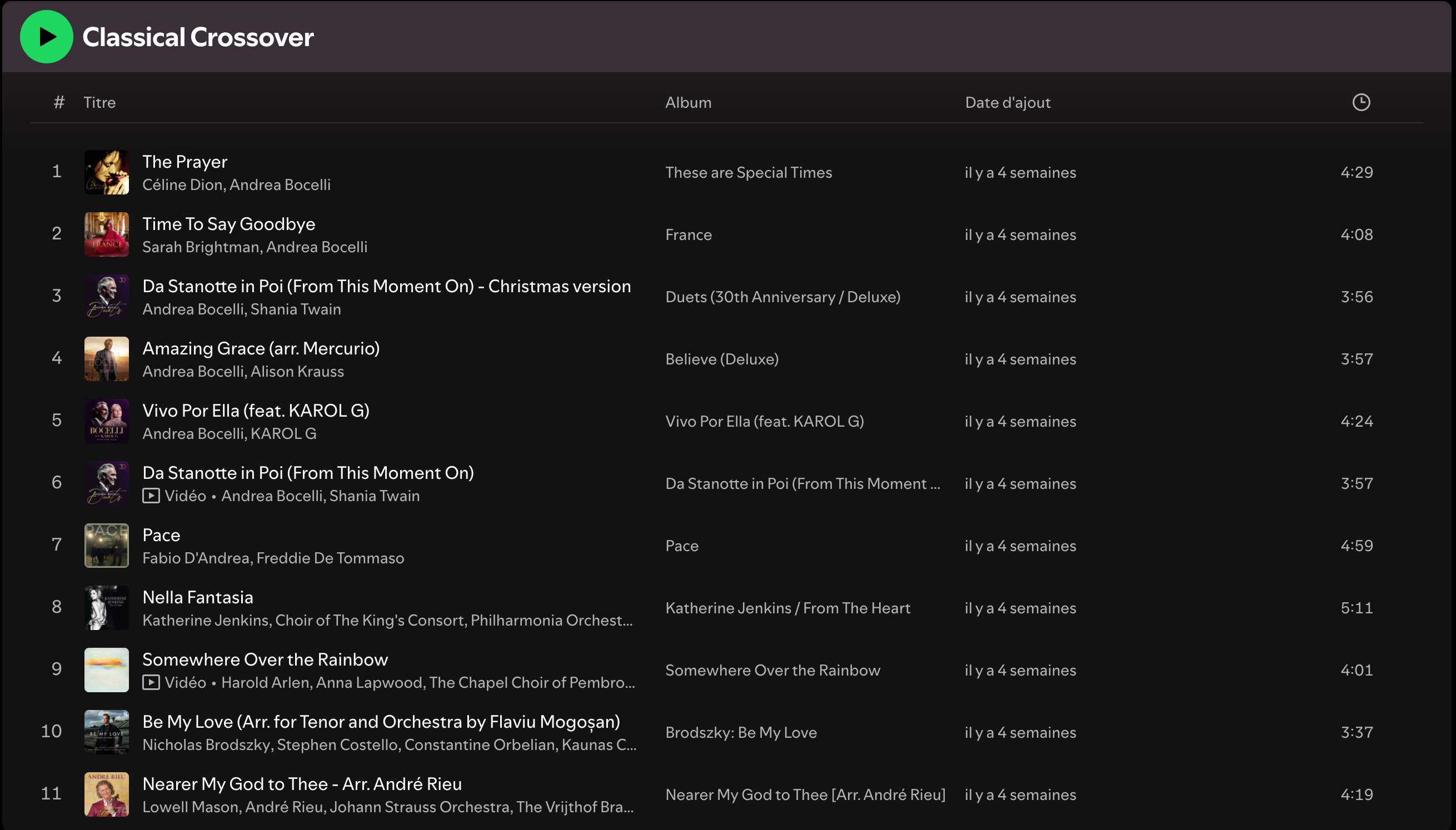
Beyond that, using the service is simple, practical and quick, with a smooth and intuitive user experience. For example, double-clicking a track will start playback immediately.
Moreover, Spotify is among the most enjoyable apps in the music streaming space, and the desktop version lets Premium users download tracks for offline listening, similar to mobile.
Web
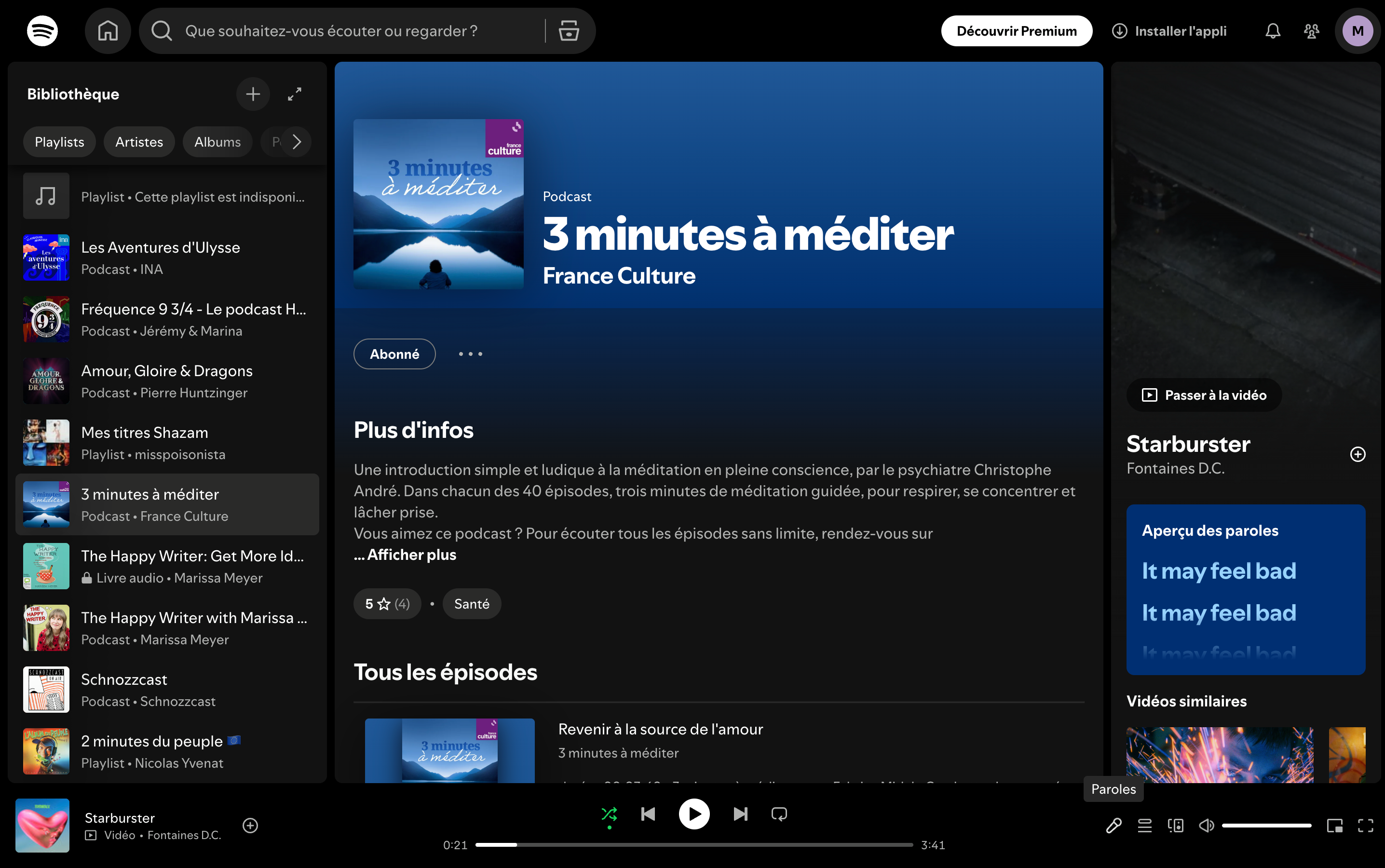
The web app is very convenient when you’re on the move or using someone else’s computer. It can be used anywhere via your browser of choice. In terms of ergonomics and interface, it’s very similar to what you’ll find on other devices.
Mobile apps
The mobile apps (iOS and Android) remain among the best experiences on the service today. They let you access the entire catalog plus a wide range of discovery features, with personalized recommendations and song lyrics while listening. Spotify also offers some video content, such as music videos and video podcasts, directly in the app. On mobile, the service remains particularly complete and pleasant to use daily.
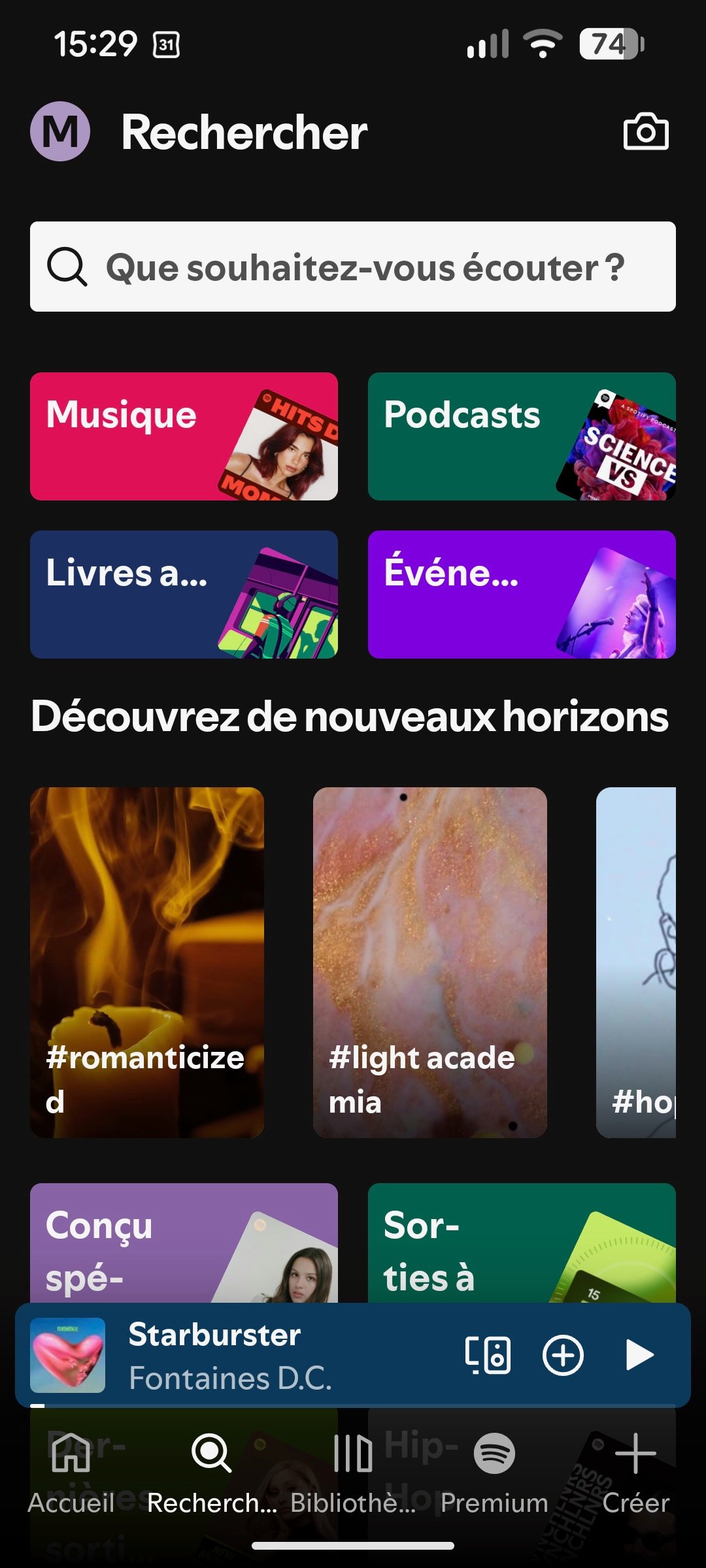
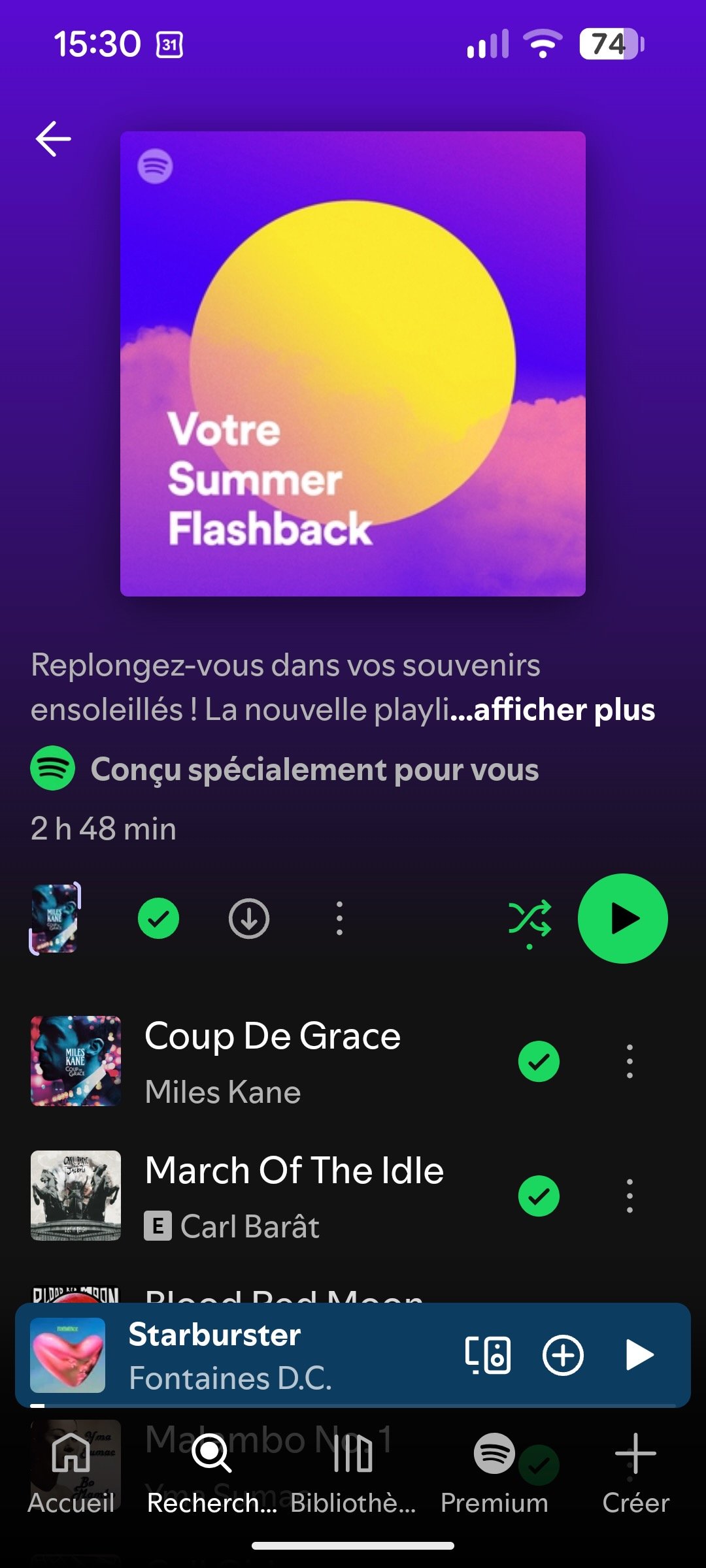
The mobile experience is more intuitive than on desktop, thanks to a touch-optimized interface. iOS and Android apps also let you download playlists, albums or podcasts for offline listening.
Smart TVs
Like most streaming apps, Spotify is available on smart TVs with an interface designed for a big screen. You’ll find your playlists, recommendations and queue, plus music videos and some video podcasts. You can also join in on Jams directly from a compatible TV.
The experience differs from mobile or desktop, but the TV version is now robust enough not to be seen as a mere fallback solution.
Personal assistants
If some setup is required, Spotify can be connected to various personal assistants available on the market today. Bixby, Google Assistant, and Alexa are all compatible with the streaming service. They let you control the app with voice commands, a very handy hands-free feature.
You can also connect the app to certain home devices, such as speakers, gaming consoles, or a connected screen. The same goes for smartwatches, like the Apple Watch, which are fully compatible with Spotify. This lets you control the music directly from your wrist.
In the car, you can listen to podcasts or a playlist without keeping your phone nearby. The app is compatible with CarPlay, Android Auto, and various car brands (BMW, Buick, Cadillac, Chevrolet, Mini, Tesla, Volvo, among others).
Spotify and artificial intelligence
Spotify is leaning more and more on AI. The AI DJ feature arrived in French in May 2026. This music assistant selects tracks based on your tastes, and Premium subscribers can request mood or style changes.
The service is also testing playlists generated from a simple description with the experimental Prompted Playlist. Studio by Spotify Labs can generate a personal podcast from a single request, but the tool is still in the USA testing phase.
Alex Norström, Spotify’s CEO, defends deploying AI “legally and in a controlled manner.” An agreement with Universal Music includes AI-generated remixes and covers with royalties for participating artists. This proposal has sparked some criticisms.
Primarily, Spotify emphasizes transparency. It relies on the DDEX standard, where artists and distributors declare AI usage themselves. Optional AI credits, tested in beta on mobile, indicate if the technology was used to generate lyrics, singing, or instrumentals. For profiles of virtual artists, Spotify recently introduced an “AI Persona” badge, excluding them from default recommendations.
Finally, Spotify is stricter about imitation. Podcasts that imitate a creator’s voice or image without consent will be removed, and voice imitation in music is only allowed with the artist’s permission. Artists can also approve tracks before they appear on their profile using the experimental Artist Profile Protection tool.
Conclusion
Spotify isn’t one of the most popular music streaming apps for nothing: it’s intuitive, simple to use, and practical for beginners and veterans alike. It’s a safe bet in the field, even if it has a few drawbacks. Its historical weakness, audio quality, has been largely addressed with Lossless, enabling Premium subscribers to enjoy up to 24-bit/44.1 kHz FLAC quality.
The main draws for a wide audience rest on two positives:
- A wide range of subscription options tailored to each user, plus a free ad-supported version;
- The exceptionally high level of personalization, letting users keep up with new releases and discover playlists aligned with their tastes.
Thanks to these strengths, Spotify now offers a particularly complete experience, in terms of catalog and music discovery alike.
Conclusion
General note
9 / 10
Despite minor flaws (including audio quality that’s about to be raised to better meet new market standards), Spotify remains a reference in music streaming. With more than 200 million regular worldwide users, it is simply the most popular service today. Thanks to total service customization, numerous subscription options (or the option to use it for free), a simple and effective interface, Spotify is unlikely to disappear soon and will likely stay a leader for years to come.
The Pros
- Many subscription options to fit different needs
- A content personalization that saves the day
- A sleek, effective interface
- An unparalleled cross-platform experience
The Cons
- A sound quality below the competition
- A restrictive free plan
- A catalog somewhat less extensive than other market players (Amazon Music, Apple Music, Deezer)
For several years now, most music streaming services have offered roughly the same pricing. The differentiators lie in the catalog, features, interface, and audio quality.
Lately, Spotify has faced increasingly aggressive competition in several areas. The platform has managed to close part of its gap, notably with the arrival of lossless sound, long requested by users.
It continues to evolve its interface and discovery tools, with new features rolled out regularly. Still, Spotify maintains a particularly coherent experience across devices and remains essential for many users.
Quality: Lossless is finally here
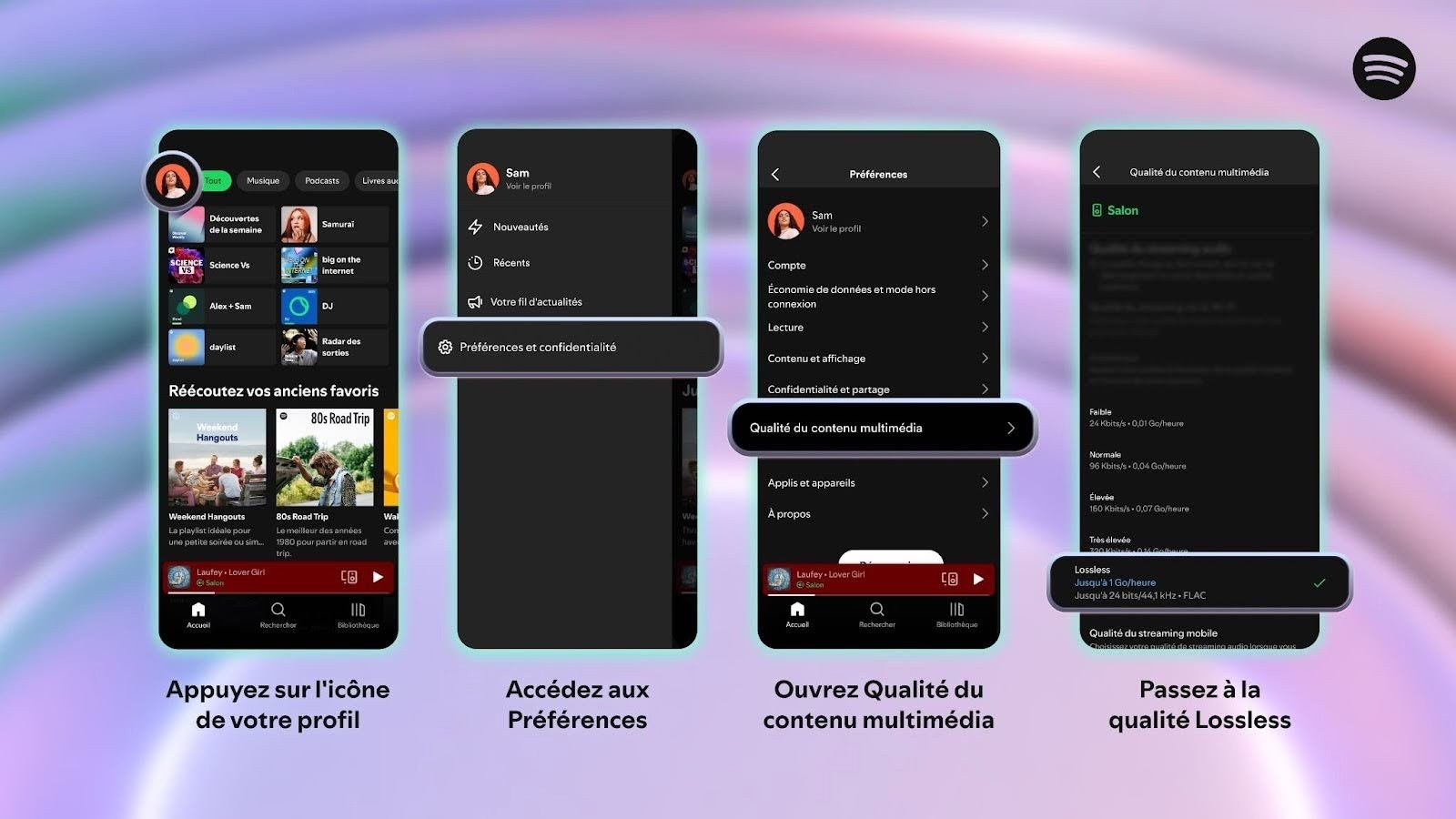
Spotify offers several audio quality levels. Premium users can select between 24 kbit/s (Low), 96 kbit/s (Normal), 160 kbit/s (High), and 320 kbit/s (Very High).
Since 2025, the platform also offers Lossless audio: users can now listen to certain tracks in up to 24-bit/44.1 kHz FLAC without loss of quality. This option is available on desktop, mobile and tablet, as well as on devices compatible with Spotify Connect. It can also be used for offline downloads.
However, Lossless requires a compatible device and connection. Spotify notes that the actual quality achievable may depend on several factors, including the type of connection used. Data usage and the storage needed for downloads are also higher.
Spotify’s Lossless tops out at 44.1 kHz. Apple Music reaches up to 24-bit/192 kHz (high-quality Lossless requires an external DAC) and offers Dolby Atmos. Deezer also includes HiFi audio in its Premium plans. Spotify thus closes much of its audio-gap but doesn’t lead the audio tier.
Compatibility
Spotify is available on the main platforms: iOS 16.1 and later, Android 7.0 and later, macOS 13 and later, as well as Windows 10 64-bit and Windows 11. The service can also be used directly from a browser with Chrome, Firefox, Edge, Opera or Safari.
The app is also offered on certain TVs, game consoles, cars and smartwatches. Spotify can be cast to many other devices via Spotify Connect, AirPlay, Alexa, Bluetooth or Chromecast.
Thus, Spotify can be used on all connected devices available today, making it one of the most comprehensive multiplatform apps on the market.
Pricing
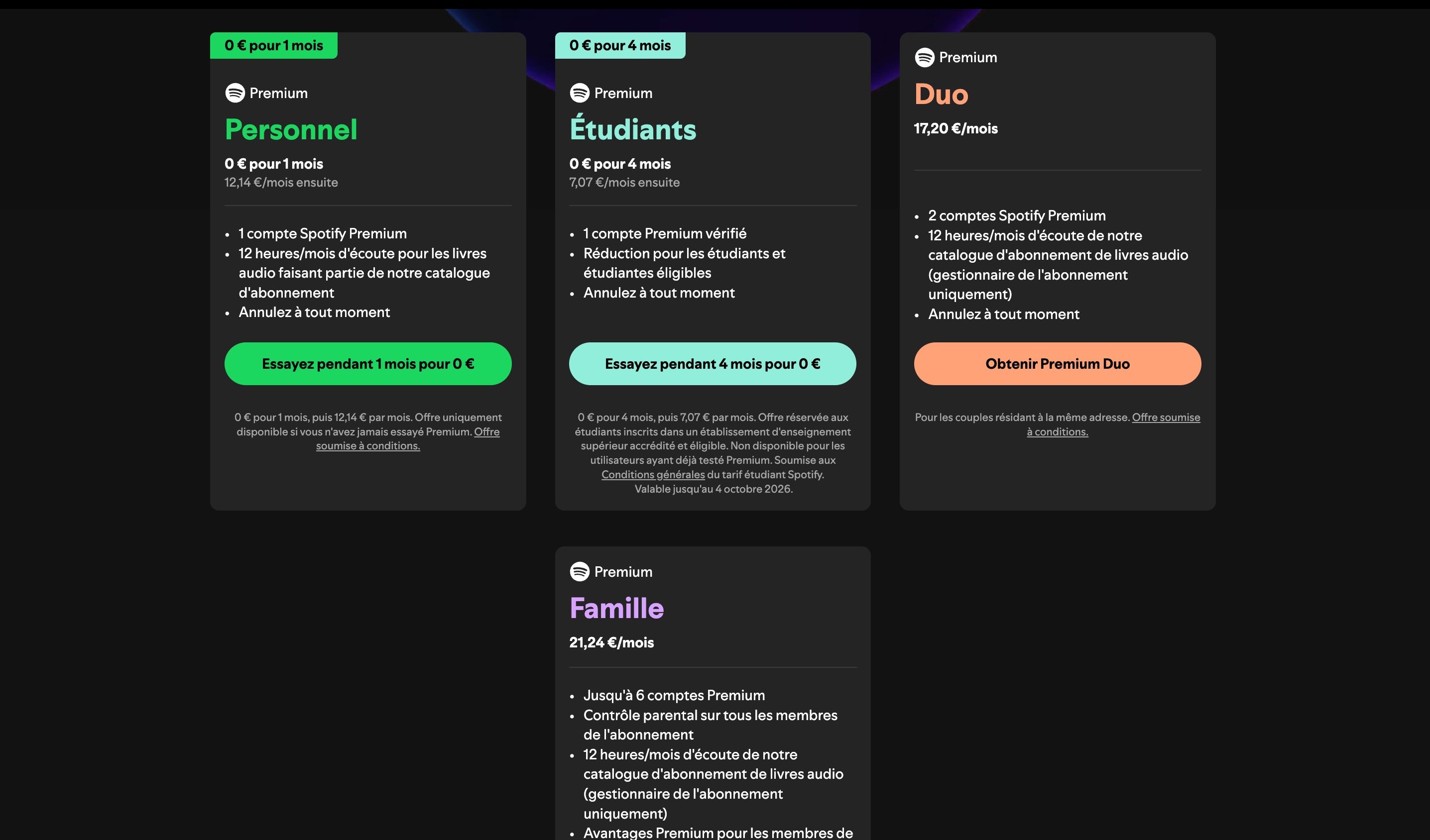
Spotify offers a free tier with limited features (for example, you cannot play tracks in a chosen order). To fully enjoy the service, you’ll need one of the Premium plans:
- Premium Individual: €12.14 per month for a single account.
- Premium Duo: €17.20 per month for two accounts, for two people living at the same address.
- Premium Family: €21.24 per month for up to six accounts, with parental controls.
- Premium Students: €7.07 per month for eligible students, after status verification.
Premium subscriptions also include Lossless audio. Spotify occasionally runs promotional offers letting curious users test Premium. By comparison, Spotify is more expensive than Deezer for the individual plan in France when looking at current rates.
Catalog
The catalog of songs available on Spotify is one of its greatest strengths. There are more than 100 million tracks freely accessible on the platform. To compare with competitors, Spotify sits around the middle in terms of content volume. But where the Swedish service stands out is in its presentation and its use of content to offer a completely personalized user experience.
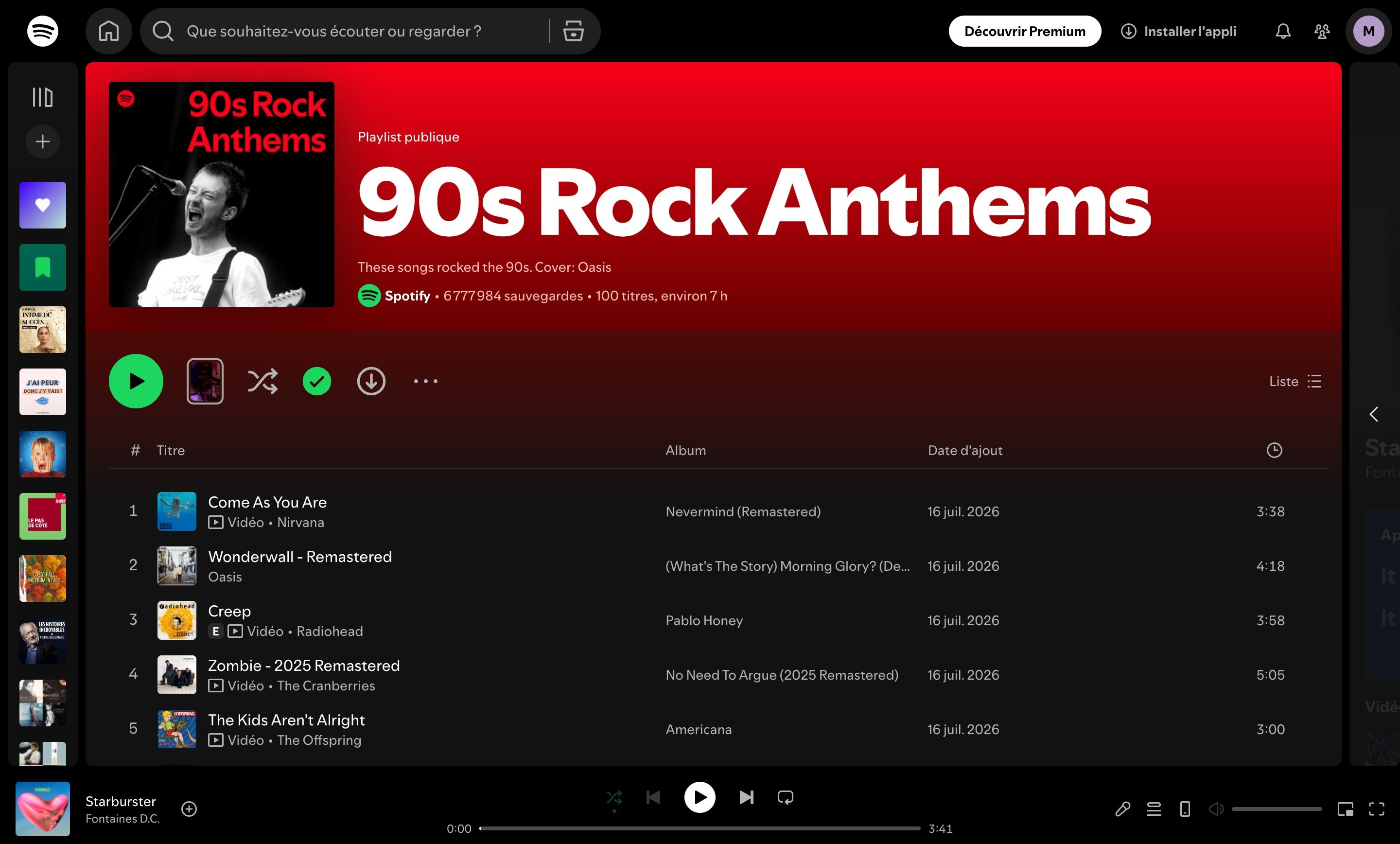
Spotify offers a range of automatically generated daily playlists linked to user tastes, including Daily Mix, regularly updated by genre or affinity. Discover Weekly refreshes weekly to help you discover new tracks based on listening habits, and Release Radar highlights new releases from artists you enjoy. This combination makes it easy to discover new music without actively seeking it.
Additionally, Spotify regularly curates event- or season-themed selections. Every year, Spotify Wrapped revisits artists, tracks, and listening habits that marked the past twelve months.
Beyond personalized playlists, there are many general editorial playlists covering various genres, moods and trends. And of course, you can always create your own playlists according to your taste.
Spotify now also provides video access: some clips are now viewable on the platform. Regarding podcasts, Spotify offers a vast selection across many languages and holds its own against competitors in this category.
Interfaces and accessibility
Desktop App
The Desktop app offers a very complete experience. Beyond giving direct access to all playlists, podcasts and favorite songs, the platform includes a social feature. On the right side of the screen, you can see what your friends are listening to in real time.
In terms of UI, the Desktop app follows the ergonomics of the web version. It can display social elements (what are friends listening to?) or an artist information panel (concerts, merchandise, bio, and track to follow).
Additionally, using the service is simple, practical and quick, with a streamlined and intuitive user experience. For example, double-clicking a track will start playback automatically.
Moreover, Spotify is undoubtedly one of the most enjoyable apps in the music streaming realm, and this desktop version allows Premium users to download tracks for offline listening, similar to mobile.
Web
The Spotify web app is very convenient if you’re on the move or not using your own computer. It can be used anywhere via the web browser of your choice. In terms of ergonomics and interface, it remains very similar to other platforms.
Mobile apps
The mobile apps (iOS and Android) remain among the best experiences on the service today. They give access to the entire catalog and many discovery features, including personalized recommendations and on-screen lyrics while listening. Spotify also lets you watch some video content, such as clips and video podcasts, directly in the app. In short, on mobile, the service remains particularly comprehensive and enjoyable to use daily.
The mobile experience is more intuitive, thanks to a touchscreen-optimized interface. The iOS and Android apps also enable downloading playlists, albums or podcasts for offline listening.
Connected TVs
As with most music streaming apps, Spotify is available on smart TVs with an interface adapted to the large screen. You’ll find your playlists, recommendations and queue, but also music videos and some video podcasts. You can also join in on Jams directly from a compatible TV.
The experience remains different from mobile or desktop, but the TV version is now robust enough not to be considered a mere fallback solution.
Voice assistants
If a bit of setup is needed, Spotify can be connected to the various voice assistants available today. Bixby, Google Assistant and Alexa are all compatible with the streaming service. They allow you to control the app with voice commands, a particularly handy hands-free feature.
It is also possible to connect the app to certain smart devices at home, such as speakers, a gaming console or a connected display. The same goes for smartwatches, like the Apple Watch, which are fully compatible with Spotify. This enables controlling the music directly from your wrist.
In the car, you can listen to podcasts or a playlist without needing to hold your phone. The app is compatible with CarPlay, Android Auto, and various car brands (BMW, Buick, Cadillac, Chevrolet, Mini, Tesla, Volvo, among others).
Spotify and artificial intelligence
Spotify is increasingly leaning on AI. The AI DJ feature arrived in French in May 2026. This musical assistant selects songs based on the user’s tastes, and Premium subscribers can request mood or style changes.
The service is also testing playlists generated from a simple description with the experimental Prompted Playlist. Studio by Spotify Labs can generate a personal podcast from a single request, but the tool is still in the USA testing phase.
Alex Norström, Spotify’s CEO, defends deploying AI “legally and in a controlled manner.” An agreement with Universal Music notably includes AI-generated remixes and covers with royalties for participating artists. This path has drawn criticisms.
Primarily, Spotify focuses on transparency. It relies on the DDEX standard, where artists and distributors declare AI usage themselves. Optional AI credits, tested in beta on mobile, indicate whether the technology was used to generate lyrics, singing, instrumentals, etc. For profiles of virtual artists, Spotify recently introduced an “AI Persona” badge, with such profiles excluded from default recommendations.
Finally, Spotify is stricter about imitation. Podcasts that imitate a creator’s voice or image without consent will be removed from the platform, and voice imitation in music is only allowed with the artist’s permission. Artists can also pre-approve tracks before they appear on their profile via the experimental Artist Profile Protection tool.
Conclusion
Spotify isn’t one of the most popular music streaming apps for nothing: it’s intuitive, easy to use, and practical for both newcomers and veterans. It’s a safe bet in the field, even if it has a few drawbacks. Its historic weakness, audio quality, has been largely addressed with Lossless, enabling Premium subscribers to enjoy up to 24-bit/44.1 kHz in FLAC.
The service’s big draws for a broad audience are primarily twofold:
- A wide range of subscription options tailored to each user, plus a free ad-supported version;
- The exceptionally high level of personalization, enabling users to keep up with new music releases and discover playlists aligned with their personal tastes.
Thanks to these strengths, Spotify offers a particularly complete experience today, in terms of both catalog and music discovery.
Conclusion
Note
9 / 10
Despite minor flaws (including audio quality close to the latest market standards), Spotify remains a reference in music streaming. With over 200 million regular users worldwide, it is simply the most popular service today. Thanks to complete personalization, many subscription options (or the option to enjoy it for free), a simple and effective interface, Spotify is set to endure and continue to lead for many years to come.
The Pros
- Many subscription options to fit different needs
- A content personalization that saves the day
- A smooth, efficient interface
- A truly cross-platform experience
The Cons
- A sound quality below competitors
- A restrictive free plan
- A catalog somewhat less extensive than other market players (Amazon Music, Apple Music, Deezer)
Sub-notes
Interface – Ergonomics
9
Accessibility
10
Audio quality
7
Content/pricing value
9
Try Spotify now!
Spotify: answers to your questions
Is Spotify Premium worth it in 2026?
Yes, if you listen to music or podcasts regularly. With ad-free listening, offline downloads, Lossless included, and features like Jam or DJ, Premium Personal (€12.14/month) remains a safe bet. The more exacting listeners on sound may still look towards Apple Music, which goes up to 24-bit/192 kHz and offers Dolby Atmos.
How much does Spotify cost in 2026?
In France, Spotify offers a free plan with ads and four Premium subscriptions: Personal at €12.14 per month, Duo at €17.20, Family at €21.24 and Students at €7.07. New Premium Personal subscribers get their first month for €0. These prices reflect the official rate card as of October 1, 2026.
What do you lose with Spotify Free?
Spotify Free remains accessible without a credit card, but comes with ads. Only Premium unlocks ad-free listening, offline downloads, the ability to choose track order, Lossless quality, remote group listening, and queue management. Audio quality on the free tier tops out at High, roughly 160 kbps.
What do you lose with Spotify Free?
Spotify Free remains accessible without a card, but with advertising breaks. Only Premium unlocks ad-free listening, offline downloads, the ability to play tracks in any order, Lossless audio, remote group listening, and queue management. On the sound quality front, the Free plan maxes out at High quality, roughly 160 kbps.
Can you cancel Spotify Premium?
You can cancel your subscription at any time from your account page, under Manage your Subscription > Cancel Subscription.
Your Premium access remains active until your next billing date, after which your account reverts to Spotify Free. Your saved playlists and songs remain intact.
All our other reviews of music streaming services:
- Deezer review: is French streaming worth it?
- YouTube Music review: when Google challenges Spotify
- Amazon Music Unlimited review: catalog, pricing, service
- Apple Music review: price, catalog, service, everything you need

Daniel Brooks
I cover everyday products with a practical eye, from kitchen tools and home essentials to smart gadgets and consumer trends. My goal is to help readers understand what is genuinely useful, what is worth the price, and what deserves a second look before buying.