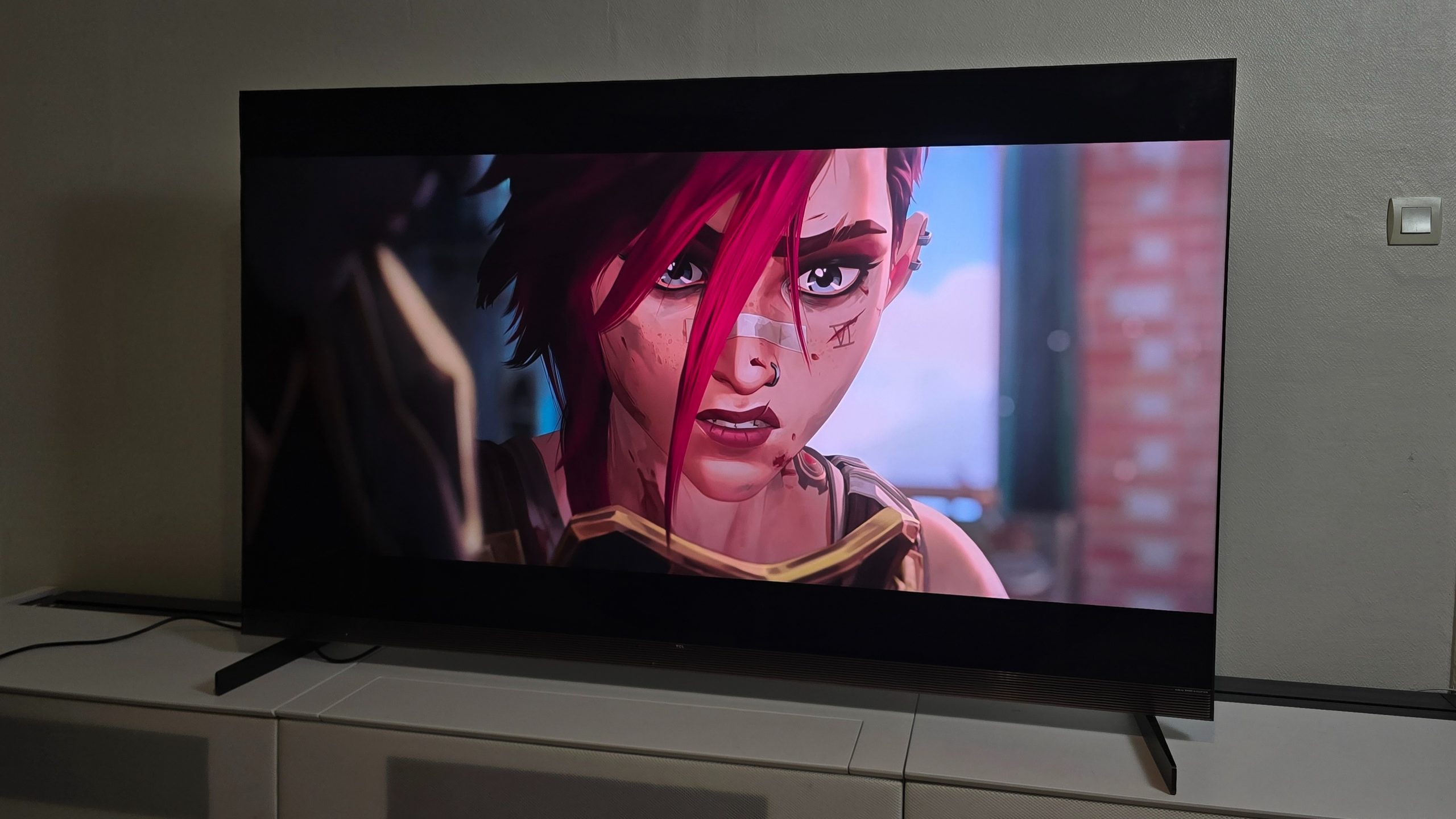
With the X11L, TCL is no longer merely aiming to offer a brilliantly bright MiniLED TV. The brand wants to demonstrate everything its SQD-MiniLED technology can bring to the very top tier: an impressive number of local dimming zones, a very wide color coverage, spectacular HDR imagery, and a more ambitious audio section. The question remains whether this flagship truly justifies its price compared with the C8L… and the best OLEDs.
At TCL, MiniLED is no longer just a transition technology. For several years now, the manufacturer has made it the core of its premium strategy, with a clear approach: push LCD to the limit to offer a credible alternative to OLED, especially on large diagonals and in bright living rooms.
The TCL X11L today serves as the showcase for this strategy. It sits above the C8L/C89L, already very convincing, but also significantly more affordable. The main challenge of this test is therefore to understand what the X11L actually brings as an extra. At this price level, it isn’t enough to add a few hundred nits or a few lines in a spec sheet. The television must offer a more controlled, more precise, higher-end experience.
9 / 10
Best prices
amazon.fr
Son-Vidéo
Fnac
Boulanger
See more prices
- Excellent contrast with very deep blacks
- Spectacular HDR with strong brightness headroom
- Excellent HDR fidelity / color coverage
- Convincing video processing and scaling
- Excellent Bang & Olufsen-branded audio performance
- Full Google TV, with Gemini coming
- Well-controlled energy consumption
- Blooms clearly more visible off-axis
- Limited viewing angles for a top-tier model
- SDR calibration not perfect in Filmmaker mode
- Blackout calibration limited
- SDR calibration not perfect in Filmmaker mode
- Blooming on HDR is not fully mastered at this price level
- SDR calibration not perfect in Filmmaker mode
- Limited surround immersion despite built-in audio
- Pricey, especially next to TCL C8L
This ambition is backed by the SQD-MiniLED technology, which TCL presents as its most advanced architecture. In the 75-inch model we test here, the X11L features 11,520 local dimming zones, versus 20,736 zones on the 98-inch model. TCL also claims color coverage up to 100% of BT.2020, a CSOT Ultra WHVA 2.0 panel, and a particularly advanced local dimming processing.
This positioning must also be viewed in the industrial context of the manufacturer. TCL doesn’t merely sell TVs: its subsidiary TCL CSOT is among the major LCD panel suppliers on the market, including for other brands. TCL CSOT has already talked about supplying 98-inch panels to Samsung, and noted that its 98-inch 4K panels were adopted by Samsung, Sony, TCL, Xiaomi, Changhong, and Haier. The X11L thus serves as a showcase for what TCL can integrate in its own range when it controls the panel, backlighting, color filters, and control algorithms.
Interestingly, TCL is also developing its own RGB MiniLED technology with the RM9L series, but positions it below the X11L in its hierarchy. Unlike several competitors, the manufacturer thus does not make RGB MiniLED its flagship technology, at least for 2026.
TCL X11L: performance and picture quality
Our measurements
The X11L arrives with an even more ambitious promise than the C8L: push MiniLED brightness far enough to compete with the best premium TVs, including OLED. The question is subtler than a simple brightness race. The C8L was already very bright; the X11L must therefore demonstrate a better controlled backlight, truer colorimetry, cleaner HDR, and more refined handling of complex scenes.
This matters even more given the price tag of the X11L. Up against a much cheaper C8L, it must justify flagship status. Our measurements aim to verify whether this upscale translates into a real gain, or if TCL is betting primarily on an impressive spec sheet.
Click here to view our SDR measurements
To obtain the most faithful image, we performed our measurements in Filmmaker mode, with processing that could alter the rendering disabled.
In SDR, the TCL X11L presents a fairly mixed balance. We recorded an average Delta E of 5.3 on the grayscale, a value well above the 3 threshold beyond which deviations commonly become noticeable. The RGB balance shows a slight green tilt, while red recedes progressively in the brighter levels.
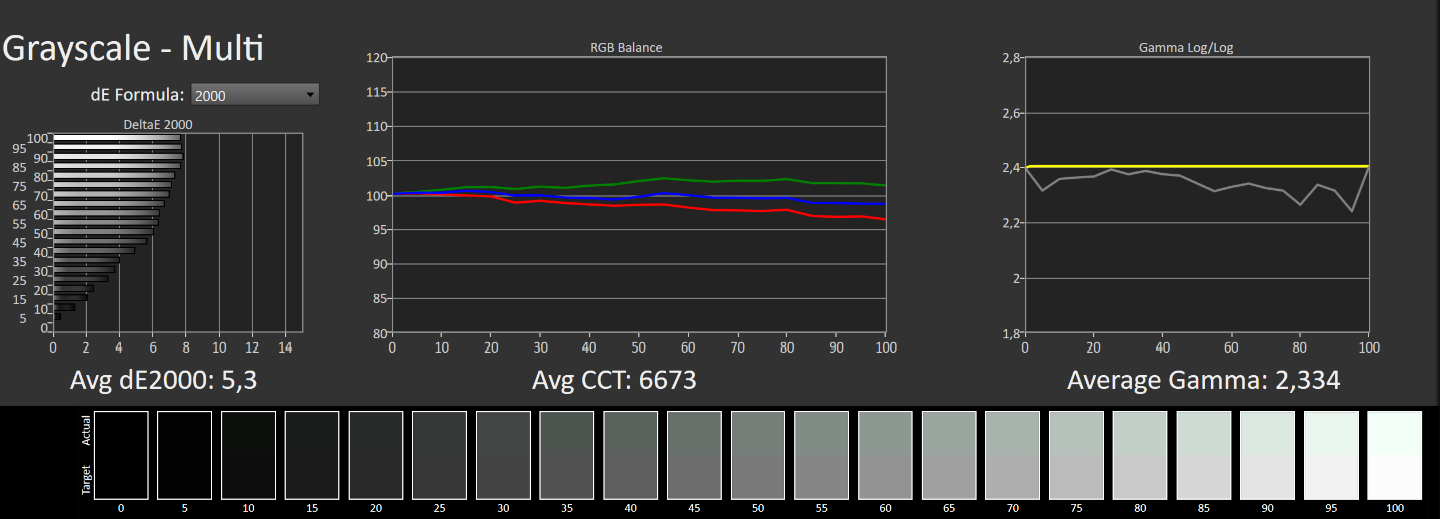
The gamma averages 2.334, close to our target of 2.4. The curve shows some variation with brightness levels but remains generally coherent with a viewing-for-cinema-in-a-dark-room intent. The color temperature averages around 6,673 K, quite close to the 6,500 K aim.
The X11L does better on this point than the C8L, whose image was noticeably cooler. This fairly accurate average alone does not guarantee a perfectly neutral grayscale, as seen in the differences between RGB components.
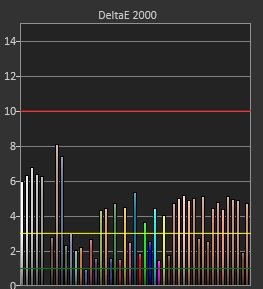
In color fidelity, the result is also not perfect. We measure an average Delta E 2000 of 4.01, with a maximum of 8.13. Several tones deviate noticeably from their reference. Despite a well-adjusted color temperature, the X11L’s Filmmaker mode does not deliver SDR calibration as rigorous as the best premium TVs.
HDR measurements follow-up
The TCL X11L supports the main HDR formats, including HDR10, HDR10+, HLG and Dolby Vision IQ. It covers both static and dynamic metadata formats, with broad compatibility for streaming content and UHD Blu-ray.
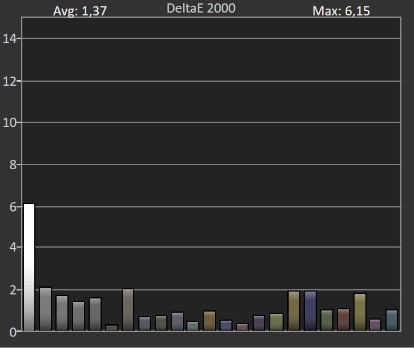
In HDR, the Filmmaker mode proves significantly more convincing on colorimetric terms. We record an average Delta E 2000 of only 1.37, with a maximum of 6.15 on white. Overall, it remains very well controlled.
That’s an excellent result for a MiniLED TV in this class, and a progression compared to the C8L, for which we measured an average HDR Delta E of 2.17.
The EOTF curve tracks the reference fairly well in the darks, but diverges gradually in the mid and high luminance ranges. The X11L tends to display a slightly less bright image than expected, before the tone-mapping intervenes in the highlights. The tracking thus lacks perfect neutrality, without any major rupture.
On color accuracy, the result is also improvable. Delta E 2000 averages 4.01, with a maximum of 8.13. Several tones deviate meaningfully from their reference. Despite a reasonably well-tuned color temperature, the X11L’s Filmmaker mode does not deliver SDR calibration as rigorous as the best premium TVs.
The HDR measurements suite
The TCL X11L supports the main HDR formats, including HDR10, HDR10+, HLG and Dolby Vision IQ. It covers both static and dynamic metadata, with broad compatibility for streaming contents and UHD Blu-ray.
In HDR, the Filmmaker mode is notably more convincing in colorimetric terms. We note an average Delta E 2000 of only 1.37, with a maximum of 6.15 on white. The overall result remains particularly well controlled.
This is an excellent result for a MiniLED TV in this class, and a clear progression compared to the C8L, for which we measured an average HDR Delta E of 2.17.
The EOTF curve tracks the reference fairly well in the darks, but gradually diverges in the mid and high-luminance ranges. The X11L tends to display a slightly less bright image than expected, before tone-mapping intervenes in the highlights. The tracking thus lacks perfect neutrality, without a major rupture.

The brightness peak reached 2,905 cd/m² in Filmmaker mode, with our reference settings. A high value, but it does not exceed the C8L’s 2,985 cd/m² under the same conditions. It should be noted that the X11L can exceed with the “Boost” brightness option, surpassing 4,000 cd/m² over a 10% window. This is an excellent result for a MiniLED TV of this category, and a progression relative to the C8L, for which we measured an average HDR Delta E of 2.17.
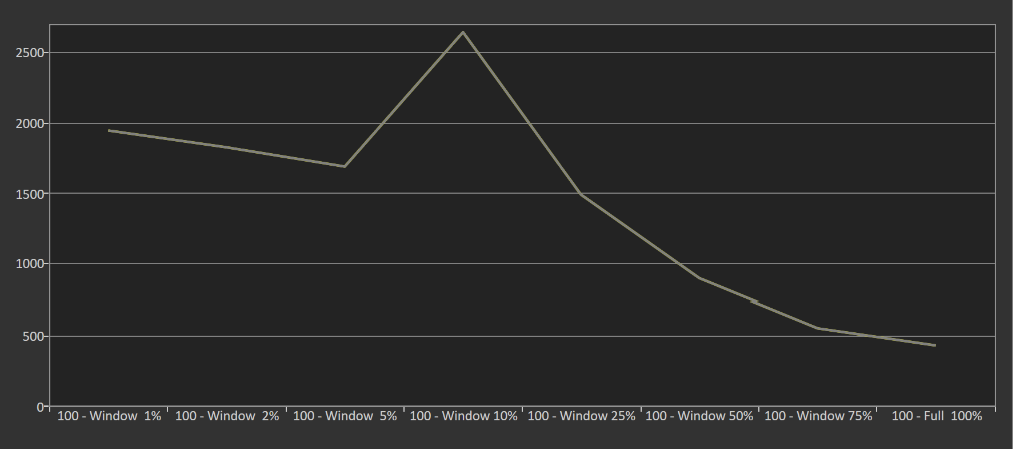
The measurement across window size helps understand this behavior. The X11L outputs roughly 1,950 cd/m² on a 1% window, about 1,700 cd/m² at 5%, and around 2,650 cd/m² at 10%. Brightness then declines as the lit area increases, with nearly 1,500 cd/m² at 25%, 900 cd/m² at 50%, and around 430 cd/m² in full-screen. This curve reveals a somewhat peculiar behavior: the TV does not reach its maximum brightness on the smallest windows, despite the density of its backlight. It also shows that the C8L maintains better luminance stability across multiple window sizes in our protocol. The number of zones alone does not predict a MiniLED’s brightness performance.
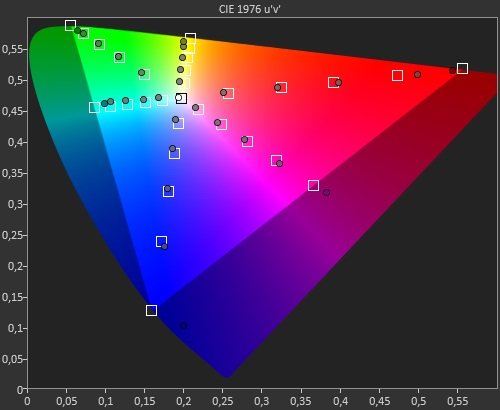
Color coverage is one of the most interesting aspects of the X11L. We measured 98.54% of the DCI-P3 and 90.29% of BT.2020. TCL does not reach the full BT.2020 coverage claimed for its SQD-MiniLED technology, but the result remains remarkable.
To put this performance in perspective, our TCL C8L reached 89.65% of BT.2020, versus 86.33% for the Samsung S99H QD-OLED. The Hisense UR9S RGB MiniLED, however, keeps the lead with 92.94%. The X11L thus confirms that SQD-MiniLED can deliver a particularly wide color palette without resorting to RGB backlighting, though it does not necessarily dominate competitors on this criterion.
TCL X11L: performance and image quality
Our measurements
The TCL X11L arrives with a more ambitious promise than the C8L: push MiniLED brightness far enough to rival the best premium TVs, including OLED. The question, however, is subtler than a pure brightness race. The C8L was already bright; the X11L must therefore demonstrate better backlight control, truer colorimetry, cleaner HDR, and finer handling of complex scenes.
This matters even more given the X11L’s price tag. When faced with a much cheaper C8L, it must justify flagship status. Our measurements are precisely to verify whether this upscale translates into a real gain, or if TCL is betting primarily on an impressive spec sheet.
See our HDR measurements
In HDR, the X11L implements the main formats, including HDR10, HDR10+, HLG and Dolby Vision IQ. It covers both static and dynamic metadata, with broad compatibility for streaming contents and UHD Blu-ray.
In HDR, the Filmmaker mode proves significantly more convincing on colorimetric terms. We note an average Delta E 2000 of only 1.37, with a maximum of 6.15 on white. The overall result remains particularly well controlled.
It’s an excellent result for a MiniLED television of this class, and a progression compared with the C8L, for which we measured an average HDR Delta E of 2.17.
The EOTF curve tracks the reference fairly well in the shadows, but gradually deviates in mid and high luminance levels. The X11L tends to display a slightly less bright image than expected, before tone-mapping engages in the highlights. The tracking thus lacks perfect neutrality, but without any major discontinuity.
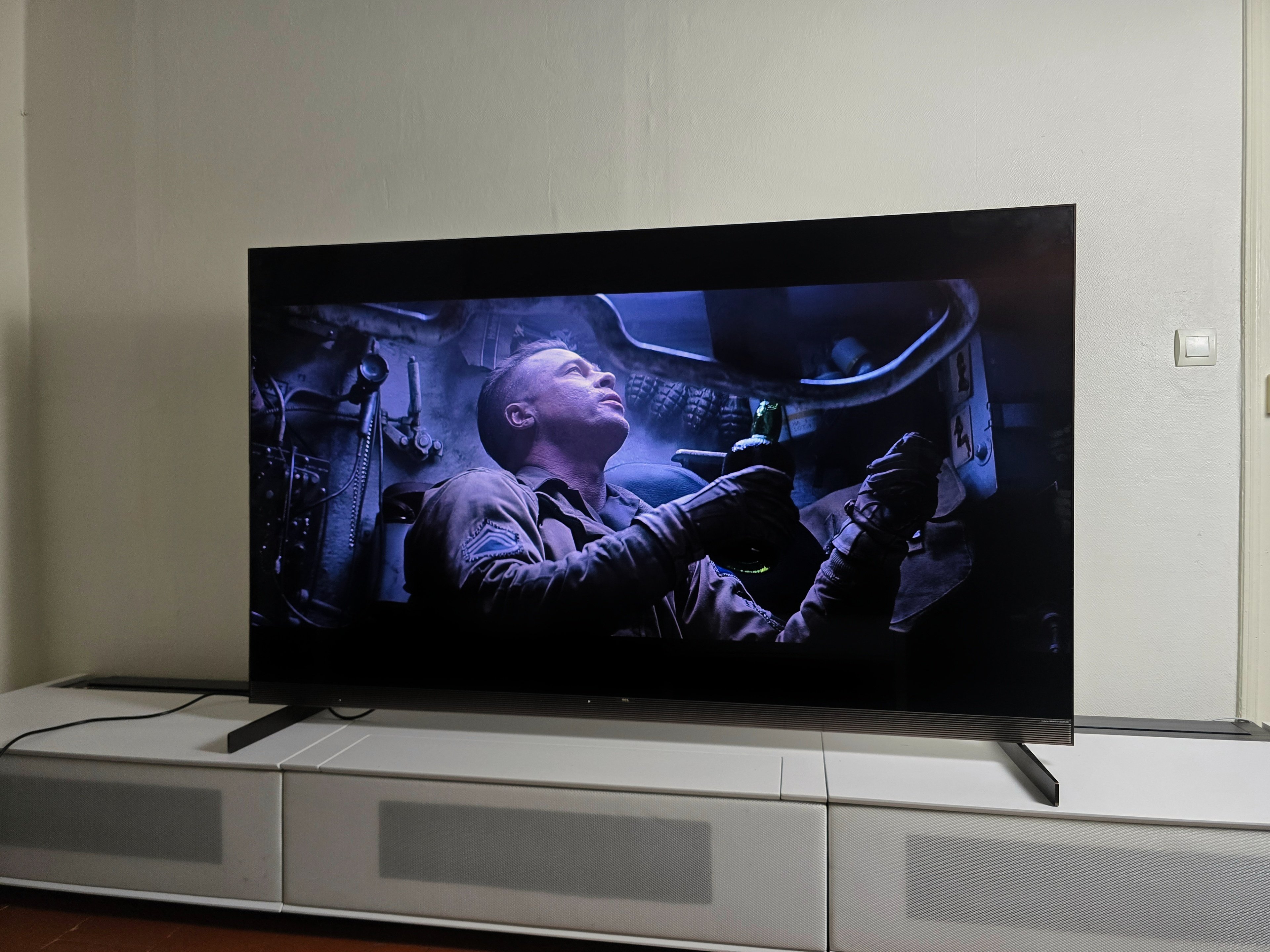
Brightness-wise, we recorded a HDR peak of 2,905 cd/m² in Filmmaker mode, with our reference settings. A high value, but it does not outrun the C8L’s 2,985 cd/m² under the same conditions. Note that the X11L does have a higher luminance headroom: enabling the maximum brightness “Boost” can push the TV beyond 4,000 cd/m² within a 10% window. This remains an excellent result for a MiniLED TV of this category, and an improvement over the C8L, for which we measured an average HDR Delta E of 2.17.
The window-size measurement reveals the TV’s behavior. The X11L delivers around 1,950 cd/m² on a 1% window, then 1,700 cd/m² at 5%, and about 2,650 cd/m² at 10%. Brightness drops as the lit area increases, with nearly 1,500 cd/m² at 25%, 900 cd/m² at 50%, and around 430 cd/m² in full-screen. This curve reveals a fairly peculiar behavior: the TV doesn’t reach its maximum brightness on the smallest windows, despite its densely packed backlight. It also shows that the C8L maintains better brightness stability across several window sizes in our protocol. The number of zones alone does not predict a MiniLED’s luminous performance.
The window-size measurement reveals a distinctive behavior: the X11L delivers about 1,950 cd/m² on a 1% window, around 1,700 cd/m² at 5%, and approximately 2,650 cd/m² at 10%. Brightness then declines as the lit area increases, with nearly 1,500 cd/m² at 25%, 900 cd/m² at 50%, and about 430 cd/m² in full-screen. This curve shows that the TV doesn’t hit its maximum brightness on the smallest windows, despite a dense backlight. It also shows that the C8L maintains stronger brightness across multiple window sizes in our tests. The zone count alone cannot predict the luminous performance of a MiniLED.
The Dynamic mode can push brightness up to 9,000 cd/m² on the 75-inch model, and the larger diagonal models are advertised up to 10,000 cd/m². HDTVTest’s Vincent Teoh even managed to reach 10,093 cd/m² on an 85-inch model—a record, simply put!
Colorimetric coverage is, finally, one of the X11L’s more compelling points. We measured 98.54% of the DCI-P3 and 90.29% of BT.2020. TCL does not reach the full BT.2020 coverage claimed for its SQD-MiniLED technology, but the result remains remarkable.
To place this performance in context, our TCL C8L reached 89.65% BT.2020, versus 86.33% for the Samsung S99H QD-OLED. The Hisense UR9S RGB MiniLED retains the lead with 92.94%. The X11L thus confirms that SQD-MiniLED can achieve an exceptionally wide color palette without RGB backlighting, but it does not necessarily outperform competing technologies on this criterion.
TCL X11L: daily video performance
SDR measurements
The X11L’s promise is to deliver a highly faithful image, measured in Filmmaker mode with processing adjustments disabled. In SDR, the X11L presents a relatively mixed balance. We register an average Delta E of 5.3 on the grayscale, a value above the threshold of 3 where drifts typically become noticeable. The RGB balance shows a slight green bias, while red recedes in the brighter levels.
The average gamma sits at 2.334, fairly close to our target of 2.4. Its curve shows some variation with luminance levels but remains broadly coherent with a cinema viewing intent in a dark room. The color temperature averages around 6,673 K, fairly close to the target 6,500 K.
The X11L performs better on this point than the C8L, whose image was noticeably cooler. This fairly accurate average alone does not guarantee a perfectly neutral grayscale, as shown by differences between RGB components.

On the brightness side, we measured a HDR peak of 2,905 cd/m² in Filmmaker mode, using our reference settings. A high value, but it doesn’t beat the C8L’s 2,985 cd/m² under the same conditions. It should be noted that the X11L has a higher luminance reserve: when the “Boost” brightness option is active, the TV can exceed 4,000 cd/m² on a 10% window. This remains an excellent result for a MiniLED TV of this class, and a step up from the C8L, for which we measured an average HDR Delta E of 2.17.
The measurement across window size shows how the X11L handles brightness: about 2,000 cd/m² on a 1% window, roughly 1,700 cd/m² at 5%, and around 2,650 cd/m² at 10%. The brightness then declines as the lit area grows, with about 1,500 cd/m² at 25%, 900 cd/m² at 50%, and around 430 cd/m² on full screen. This curve reveals a somewhat special behavior: the TV does not hit its maximum brightness on the smallest windows, despite its bright backlight. It also shows that the C8L retains better luminance consistency across several window sizes in our protocol. The zone count alone cannot predict a MiniLED’s luminance performance.
With Dynamic mode, our 75-inch model can push brightness up to 9,000 cd/m². The larger diagonals are advertised up to 10,000 cd/m². Vincent Teoh of HDTVTest even flashed an 85-inch model at no less than 10,093 cd/m²—a record!
The color coverage is another standout feature of the X11L. We measured 98.54% of the DCI-P3 and 90.29% of BT.2020. TCL does not reach the full BT.2020 coverage claimed for its SQD-MiniLED technology, but the result remains impressive. In comparison, our TCL C8L reached 89.65% BT.2020, while the Samsung S99H QD-OLED stood at 86.33%. The Hisense UR9S RGB MiniLED maintains an advantage with 92.94%. The X11L thus confirms that SQD-MiniLED can achieve a very wide color palette without RGB backlighting, but it does not necessarily outperform rivals on this criterion.
Daily experience
Beyond its image performance, the TCL X11L presents itself as a very complete TV. It does not merely aim to be a MiniLED showcase: it wants to establish itself as a premium large-screen for cinema, TV series, sports, video games, and daily use.
Audio
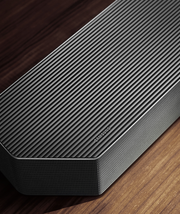
The audio section is one of the elements that clearly sets the X11L apart from a more conventional TV. TCL partners with Bang & Olufsen to deliver a soundbar system, reinforced by woofers placed at the back. The result is notably more ambitious than what most flat TVs offer.
What are the best soundbars in 2026?
The sound reproduction is ample, clear, and sufficiently powerful to accompany the image. Voices are well projected, the lower end gains weight thanks to the woofers, and the TV provides less of an impression that an external soundbar is immediately required. For movies, series, or sports, the result is already very convincing.
That said, don’t expect a true surround bubble. The sound stage gains width and presence, but side or rear effects remain limited. The X11L does not replace a high-end soundbar or a dedicated multichannel system. It nevertheless offers a solid built-in audio performance, coherent with its positioning, and more in line with the TV’s visual ambition than the C8L.
Interface and features
The TCL X11L runs on Google TV, a well-known interface now, rich in apps and easy to use. The main streaming services are present, voice search works well, and Google ecosystem integration makes content and connected devices easily accessible.
The interface is generally smooth in daily use. Switching between apps, navigating menus, and adjusting settings pose no particular difficulties. Google TV maintains its approach of heavy recommendations, which may bother users who prefer a simpler interface.
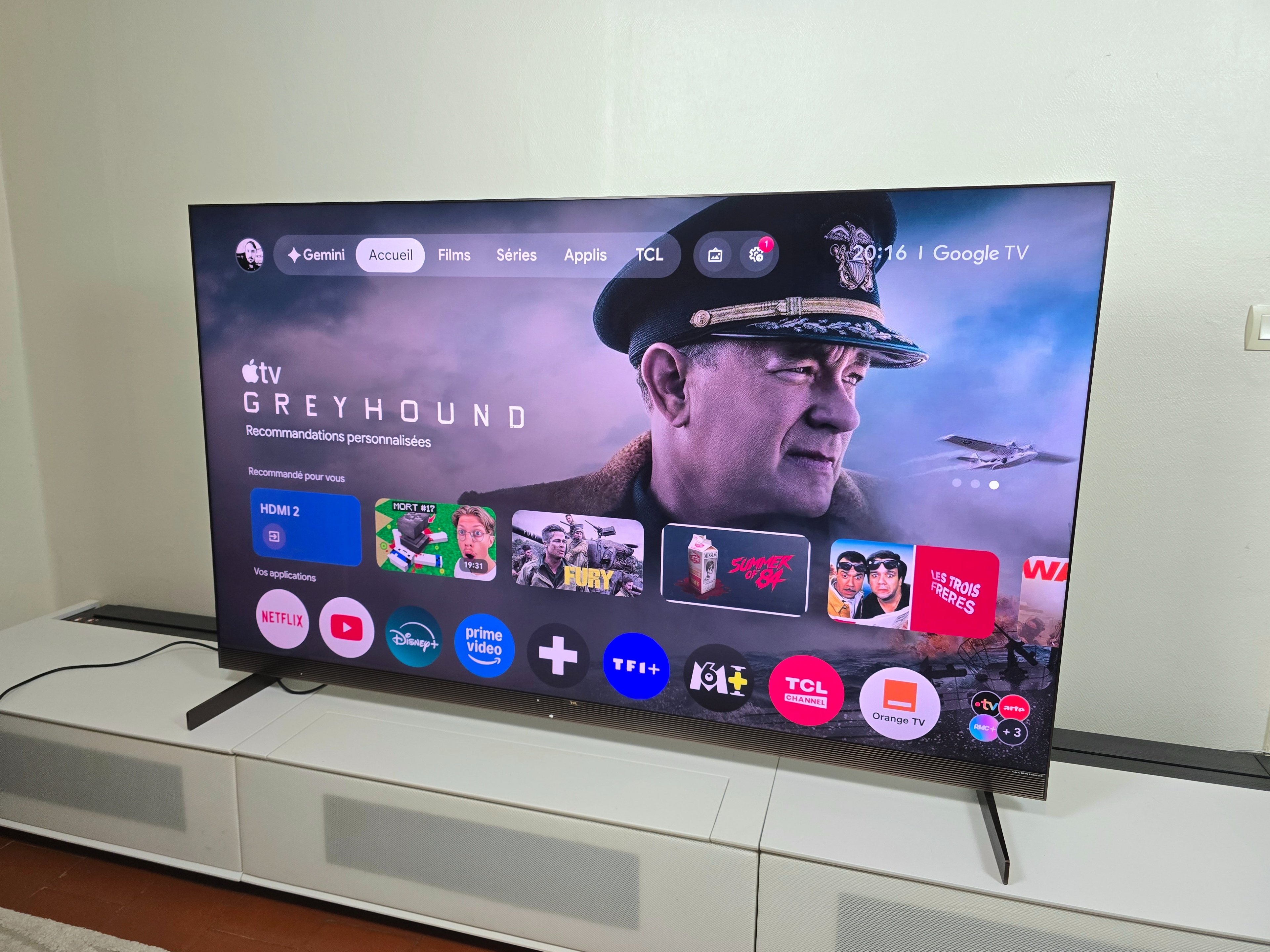
The TCL menus offer numerous image, processing, motion, sound, and gaming options. It’s comprehensive, even if not always crystal clear. As with many TCL devices, you’ll need to spend some time to understand which settings actually affect the image and which ones mainly make the picture more showy.
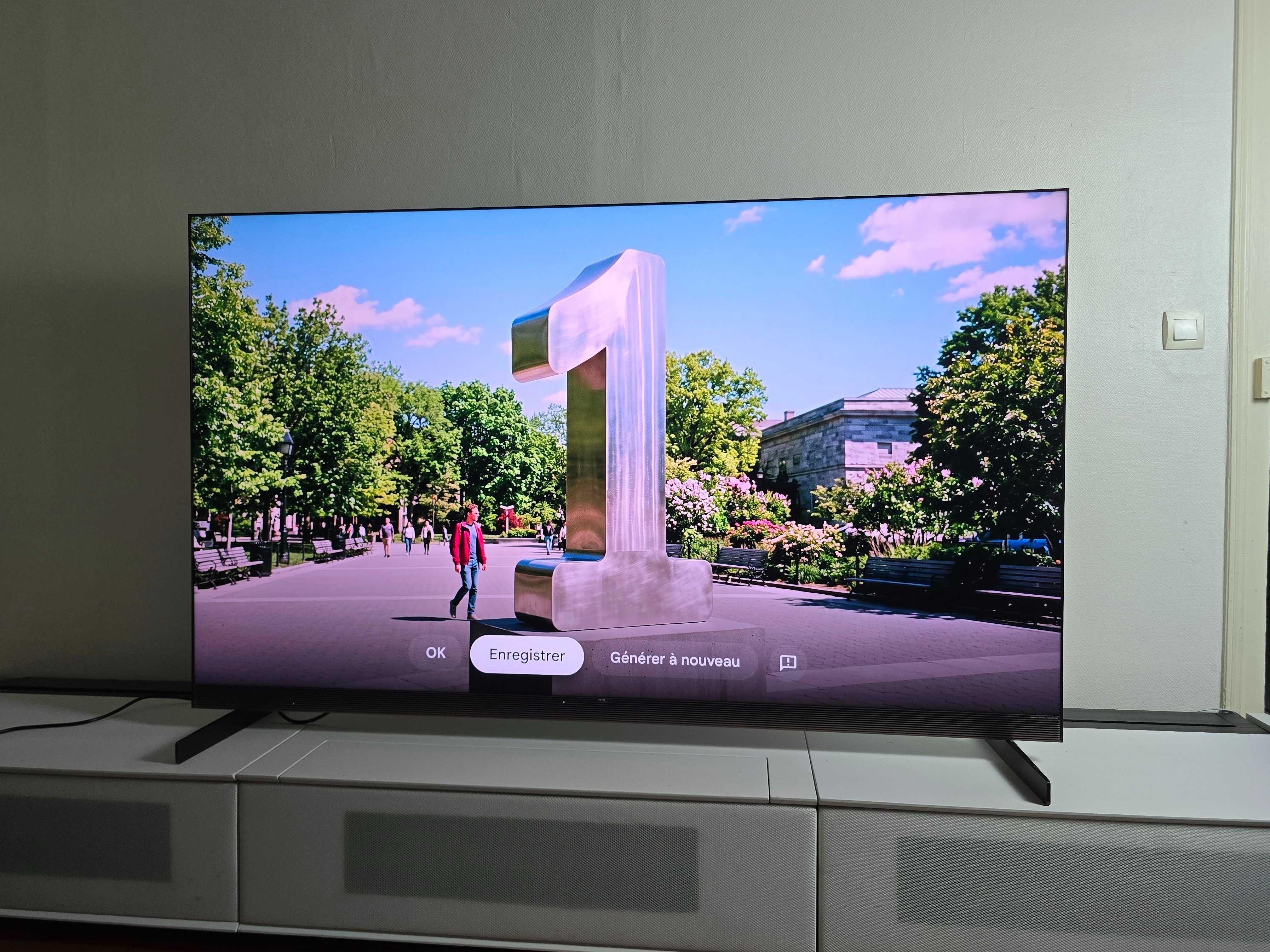
Gemini’s arrival, which TCL began deploying on its France-compatible TVs from September 2026, is the main novelty. The X11L is among the first models involved. Google Assistant should progressively be replaced by Gemini, with more natural vocal interactions: finding films from a description, refined recommendations as conversation evolves, general questions, or controlling certain connected devices.
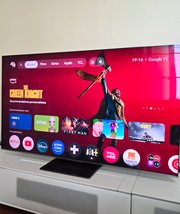
Gemini arrives on TCL TVs in France: which models are affected?
The integration goes beyond content search, as Gemini will also allow operating some TV settings via natural language commands. Deployment remains progressive and depends on the software version installed. All these features are therefore not necessarily accessible immediately on every unit.
Gemini arrives on TCL TVs in France: which models are affected?